Alhambra day

Tour booked for midday, I woke, showered successfully with the new sleeve and set off for breakfast. The hotel does provide a buffet but you have to book it the day before and I hadn’t.

I walk down the slope towards a small square and what do I see? Cafe Futbol – how could I not? In the well-heated exterior area were lots of people doing churros y chocolate but for me it was the more modest orange juice, cafe solo doble and a croissant. Great start to the day.

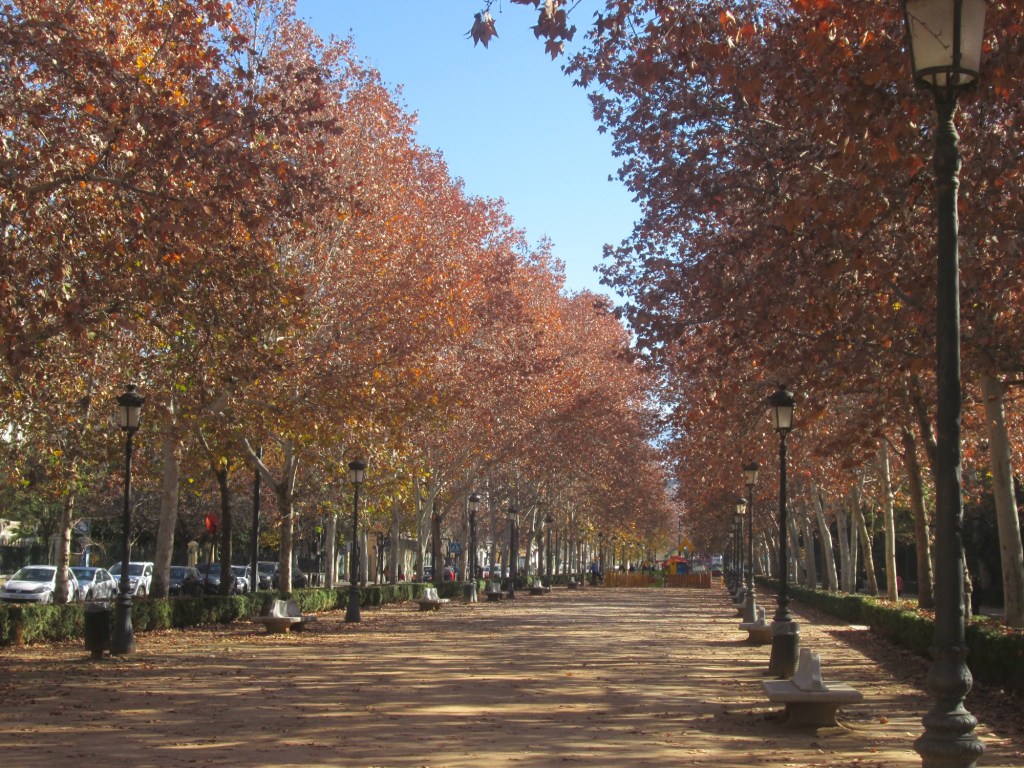
I then decided to stroll down the Street of the Virgin towards a tree- lined Paseo alongside the river Genil. This was a recce, but a stroll along here is probably on the cards for Christmas Day. As I returned up the nearby and strangely named Acero del Darro – the Darro river is on the other side of the Alhambra and this road leads to the Genil. Ah well. I am drawn, as so often, into El Corte Ingles the big department store chain as it has loos and the opportunity to replace a falling apart credit card wallet. Back to the hotel to pick up my ticket for the tour and set off up the street to catch the 30 bus to the Alhambra – I’m encouraged to be there 15 minutes early. Nearing the bus stop I realise I left my phone in the room so it’s a quick dash back to retrieve that I make the next bus and the ride up to the Alhambra is crowded but I get there in time to meet Laura, our guide for the next several hours.

We start just outside the entrance to the Parador which brings back a dash of nostalgia and some very happy memories. It was such a delight to walk from breakfast on the terrace straight into the Generalife Gardens.

The said Generalife is where the tour leads us first. Laura points out to the non-Spanish speakers, that it is not an insurance company (!) but the sultan’s summer palace. It gives us great views of the whole complex, a look down on the gardens which grow vegetables and fruit for the palace and we stroll through the summer palace itself noting the areas that are still essentially moorish and those which the conquering Christians decided to convert to more northerly tastes. This theme repeats throughout the tour since the Moors held Spain from 711 until 1492 when Philip and Isabella finally managed to drive them out. So there’s a lot of Arabic influence to overturn. And a lot of mis-translation of Arabic names into Spanish as in this one:

Bib-al-hambra was thought to be the original name which means red gate to the Alhambra but was confused by the incomers with Bib-al-jambra which would have been wine gate. Since Muslims don’t do alcohol it seems that red gate is the most likely but the name Puerta de Vino is on all the signboards.

As we leave the Generalife and move to the fortress and palaces of the Alhambra, Laura gives us some history and context of the astounding engineering capabilities of the Arabs and the ongoing archaeology that is uncovering more of the plebeian areas of the site. To support the sultans and their courts there would have had to be hundreds if not thousands of ordinary folk who baked, spun, made leather, did carpentry, built palaces and castles. They lived in the Medina which has been partially uncovered in recent years.

Medina excavations

The most impressive feat of the period of Mohammed I in the 13th century was to make water flow uphill and to capture the river Darro six kilometres away and through water wheels and aqueducts supply his new hilltop city with all the water it needed. There was an interesting BBC report a couple of years back that explains it all and here is part of the original aqueduct that gave the complex the water it needed for drinking, bathing, for fountains and for flushing loos.

The tour takes us next to the alcazaba, the military part of the city. It’s impressive in size and scale and that it is constructed from local compacted earth and not from quarried stone. It also affords great views over Granada and of the sow-topped Sierra Nevada some 40 km to the south east.

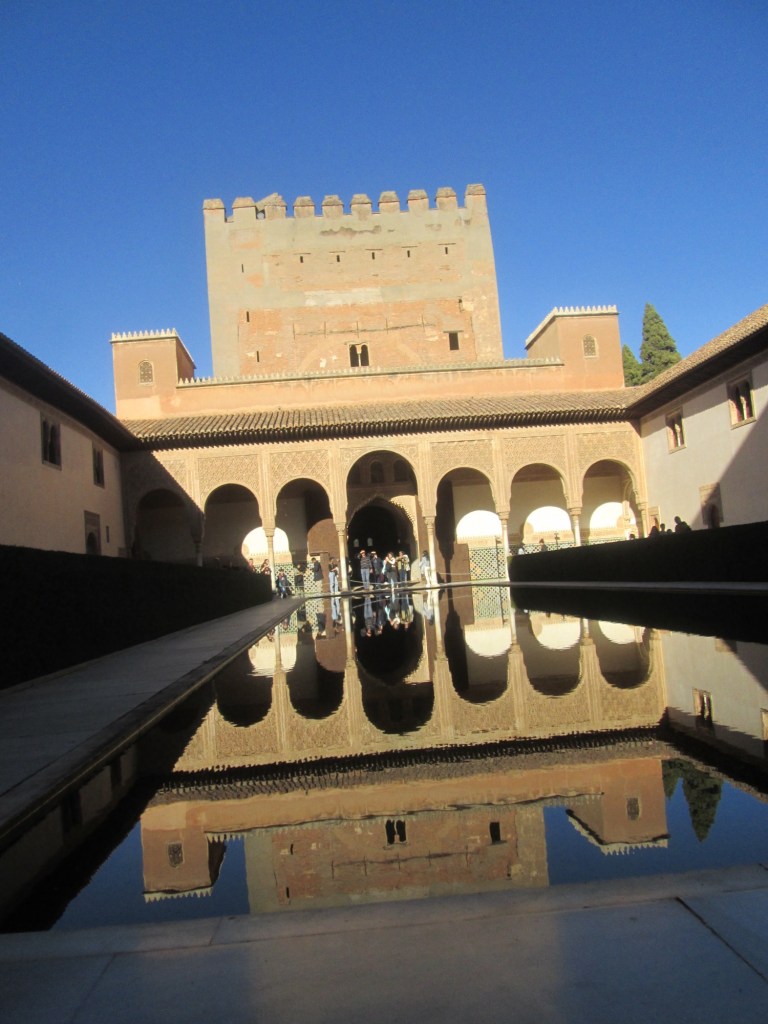
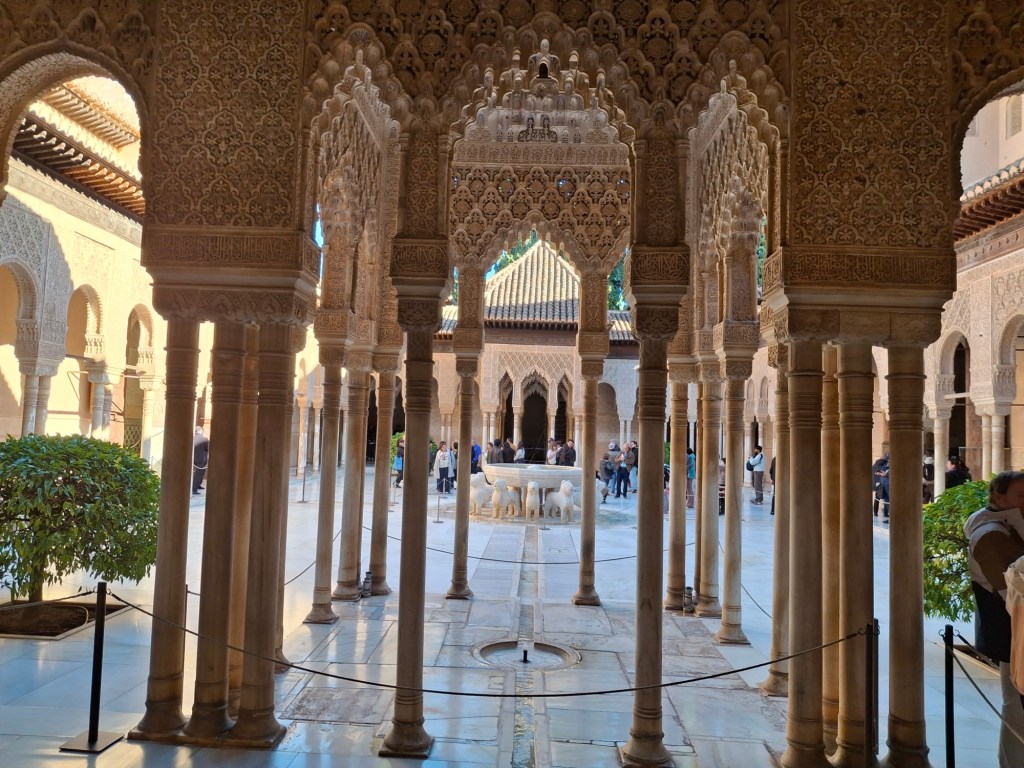
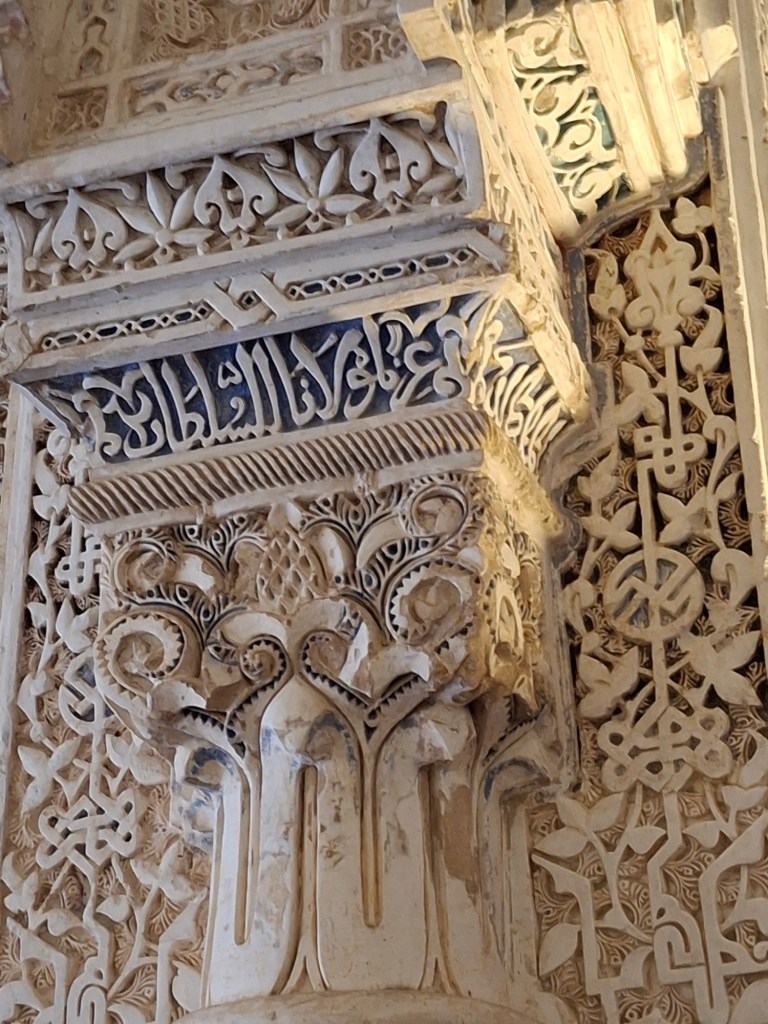
My recollection of the amazing decoration, elegant architecture and layout of the Nasrid Palaces was more the reinforced on a second viewing. When Dee and I had been here before we were able to wander at will but now with many vying tour groups – 9000 visitors on a busy day! – it was all a bit more regimented but still with time to admire the craftsmanship in wood, plaster, marble and tiles that make the palaces worth anyone’s time to visit. In my loft at home I have negs and contact sheets of the black and white shots I took on our previous visit – must dig them out when I’m back. Here’s a flavour of today’s visit – in colour.

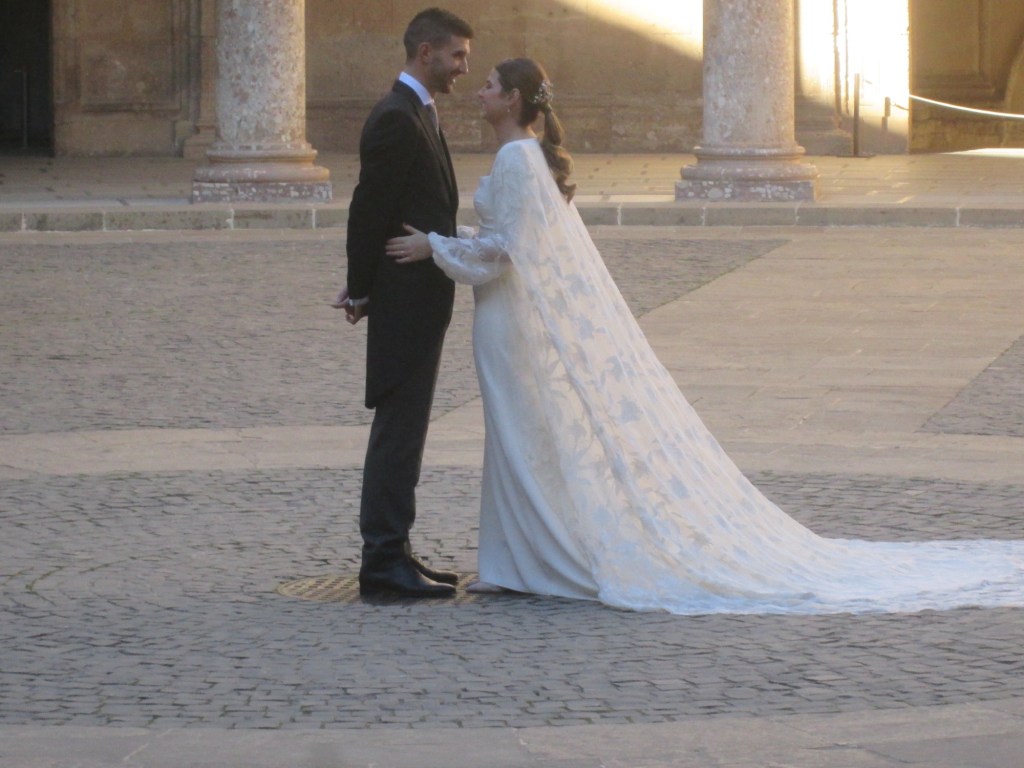
Laura had been a brilliant guide giving us a short break during which she could smoke a couple of cigarettes – her theory is that smoke numbs the throat and gives her the ability to talk in a foreign language non-stop for three and a half hours. We didn’t discuss the other side effects! On the way out there was either a wedding or a magazine photoshoot in the centre of the very ugly palace that the Hapsburg Holy Roman Emperor and Charles V of Spain plonked in the midst of all this elegance to make his mark. I had hoped after being on my feet for five hours to get the bus back into town but it was so crowded that I gave up and walked – blissfully down – back to the centre. It was a pleasant stroll through the Gomerez forest and passing the ruins of the Bibalrambla Gate which was one of the original entries to the Arabic city from the 11th century until 1492 and is commemorated in the name of the main square.

Much needed respite came in the way of beer and a plate of freshly sliced Iberian ham and the discovery that I was only about 10 minutes form the hotel, where I went to put my feet up for a bit and write up yesterday.

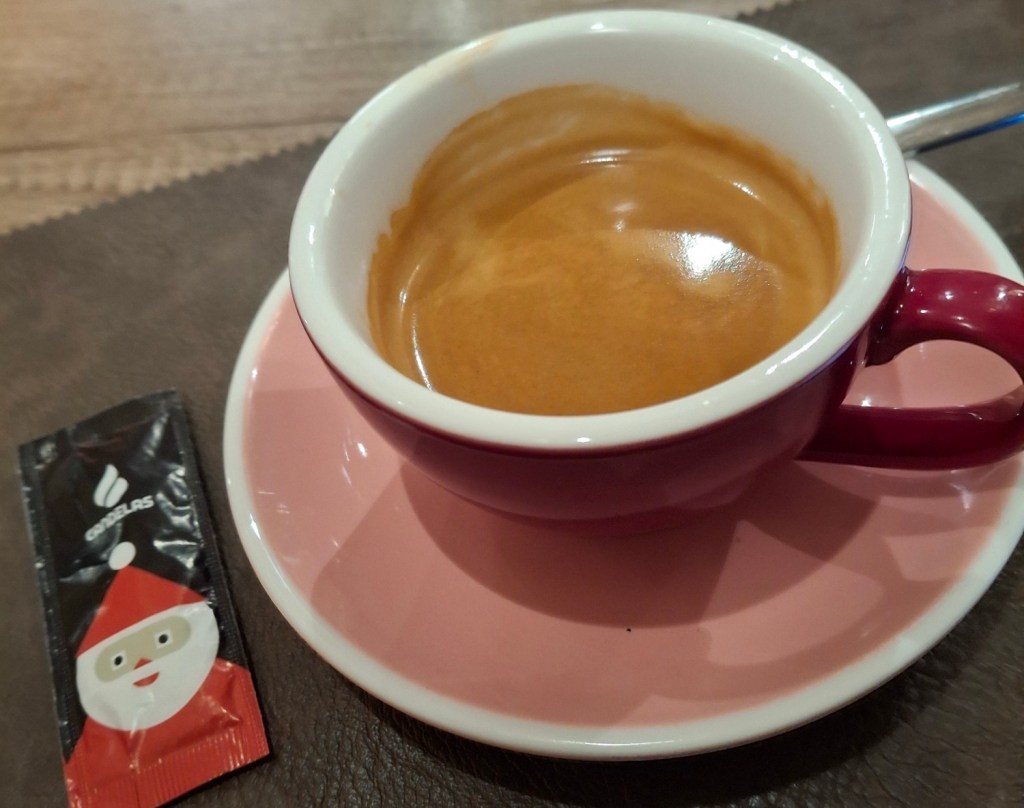
I then made an evening tapas crawl and finished up in a quite posh restaurant where I was able to have another favourite dish carilleras de cerdo (pigs cheeks) served with half a baked apple and caramelised onions – a new take on traditional pork with apple sauce. They just overdid the Christmas thing with my coffee.

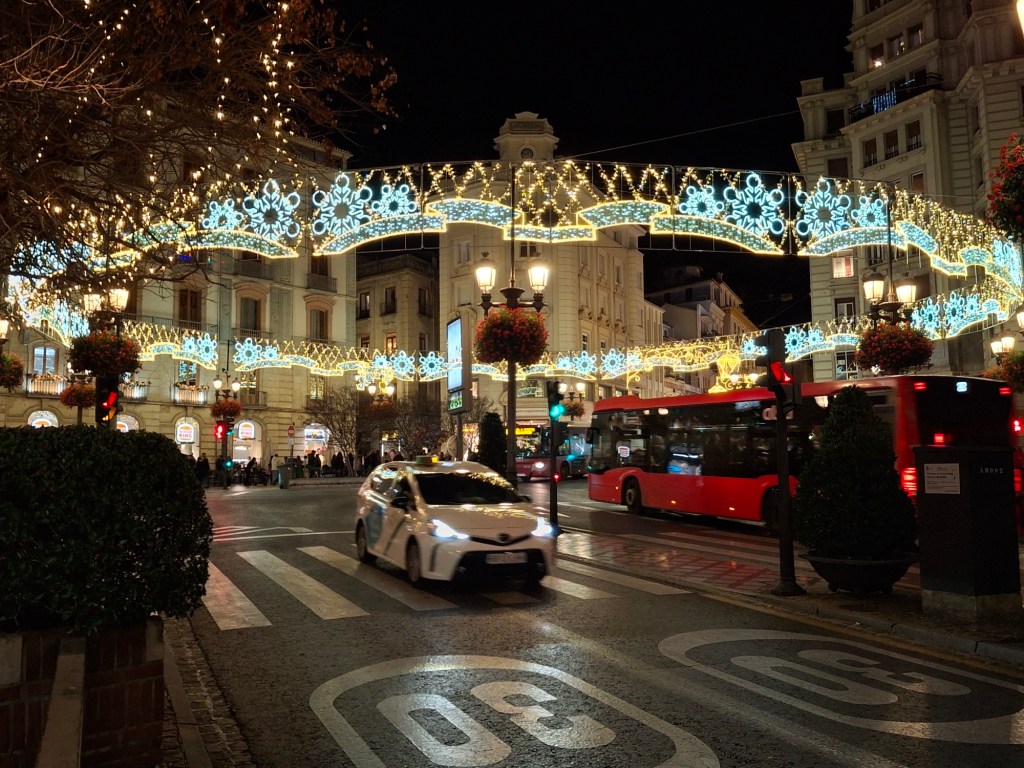
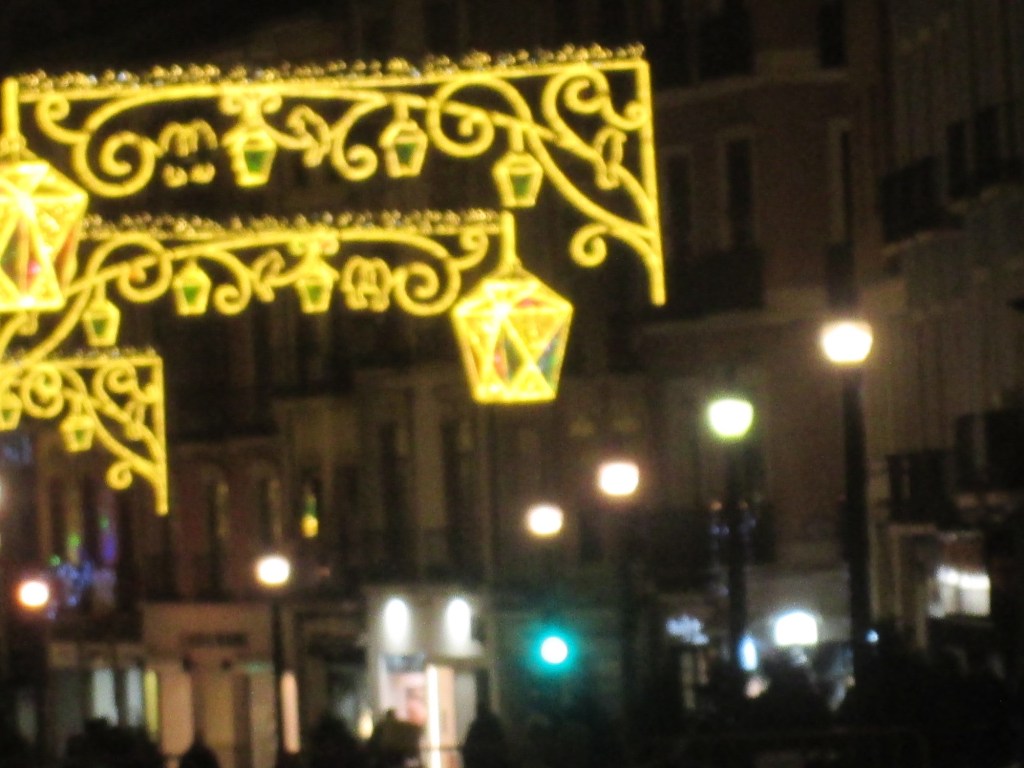
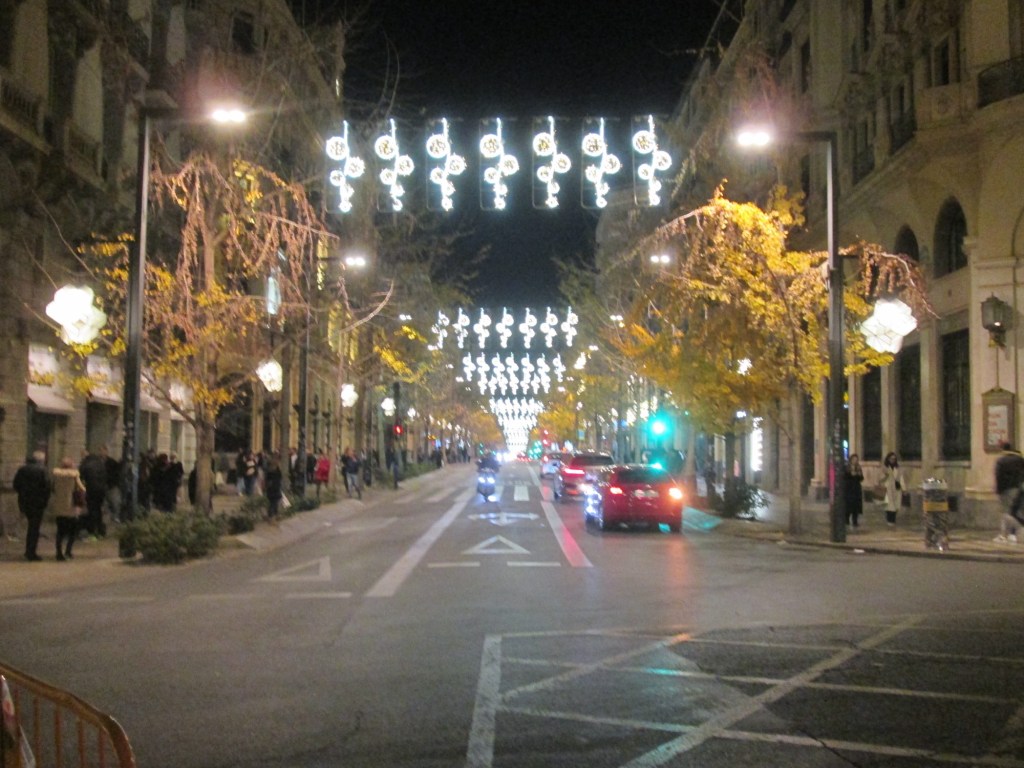
Then it was back via another spectacular lights display – a circle round the Puerta Real and when I got back even Navas Street was showing its Christmas spirit.

A circle of light at Puerta Real
Calle Navas at night

Westward Ho! Whoa!

So, I leave the hotel in what I thought was good time to catch the 07:35 to Granada. However given the construction work around Atocha Station it’s quite a trek to get there. Then once inside it’s up an escalator, through a huge airport style mall and then an airport style baggage security check which I hadn’t been expecting. However I find seat 7 in coach 2 which I’d been told by train operator Renfe was a special seat with extra space and fewer passengers to ensure a quiet journey. All good you’d think. But just opposite was a family of four with one fairly studious 7 year-old boy but a totally fractious 3 year-old daughter who screamed pretty well non-stop except when being stuffed with food. Bliss! I then freaked out as the announcer said the next stop would be Cordoba. Now I know enough about Spanish geography to position Granada due south of Madrid with Cordoba a long way to the south west. It dawned on me that the AVE (high speed) routes were limited and that it made sense to first build tracks to serve Cordoba, Sevilla and Malaga direct and then construct a new west-east line through Andalusia. As it happens we had seen much of the construction work for this route when visiting friends who used to live in Antequera or renting a cottage in the hamlet of La Parilla, near Iznajar some years ago. Some familiar scenery flashed by as we raced across Andalucia.

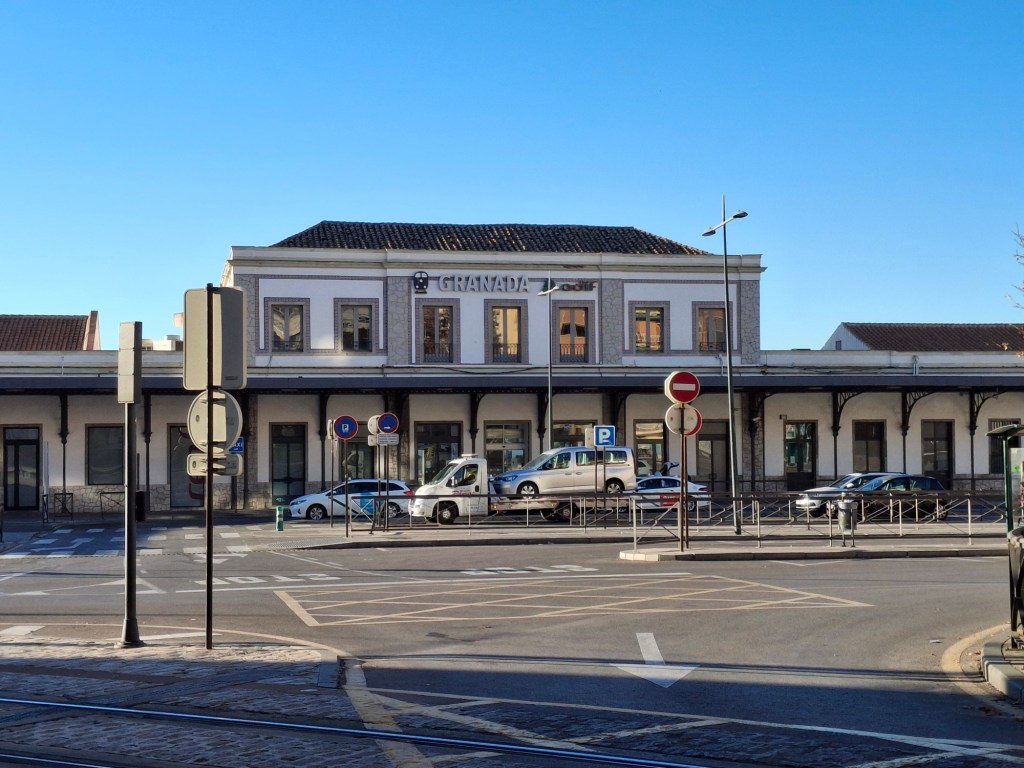
However the train did arrive at Granada Station at the time predicted and apart from my neighbours it was a good trip – announcements in Spanish and English, a trolley coffee service (which I didn’t use as it was instant Nescafé – in Spain!) and was clean and comfortable.

My plan was to walk to a nearby bus stop and get a bus to within a five minutes walk of my hotel. Oops! Read the front of the bus more carefully, Michael – CENTRO CERRADO DESVIO POR CAMINO DE RONDA. It meant it wasn’t going anywhere near where I wanted to be but the excellent CityMapper told me where to get off and take another bus. It worked and I arrived much too early to check in but they kindly relieved me of my bags, took my passport and sent me off to explore.

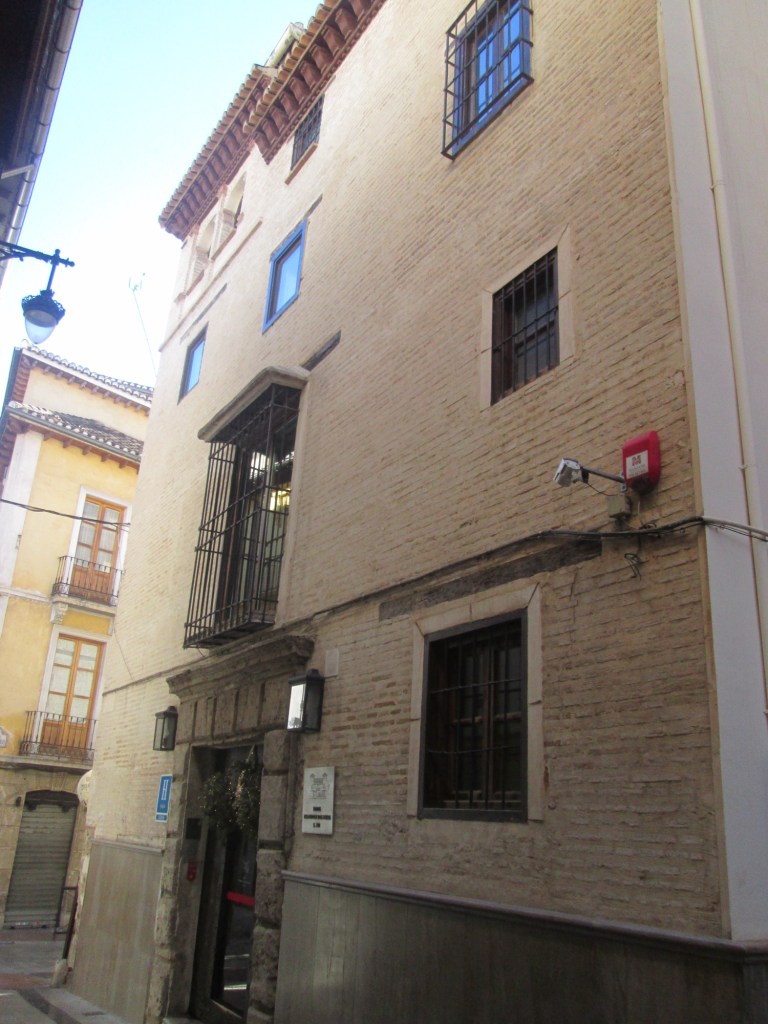
It’s a very fine hotel converted from a sixteenth century palace but fortunately with a lift and modern plumbing and facilities. I selected it because my only prior knowledge of hotels in Granada was the magnificent Parador inside the Alhambra where Dee and I stayed many years ago. This one looked OK and was five minutes walk from lots of things I wanted to do. Arriving before check-in rather forces you to go and explore which I did with glee as Calle Navas where the hotel is located is in a pedestrianised street full of bars and restaurants.

Calle Navas

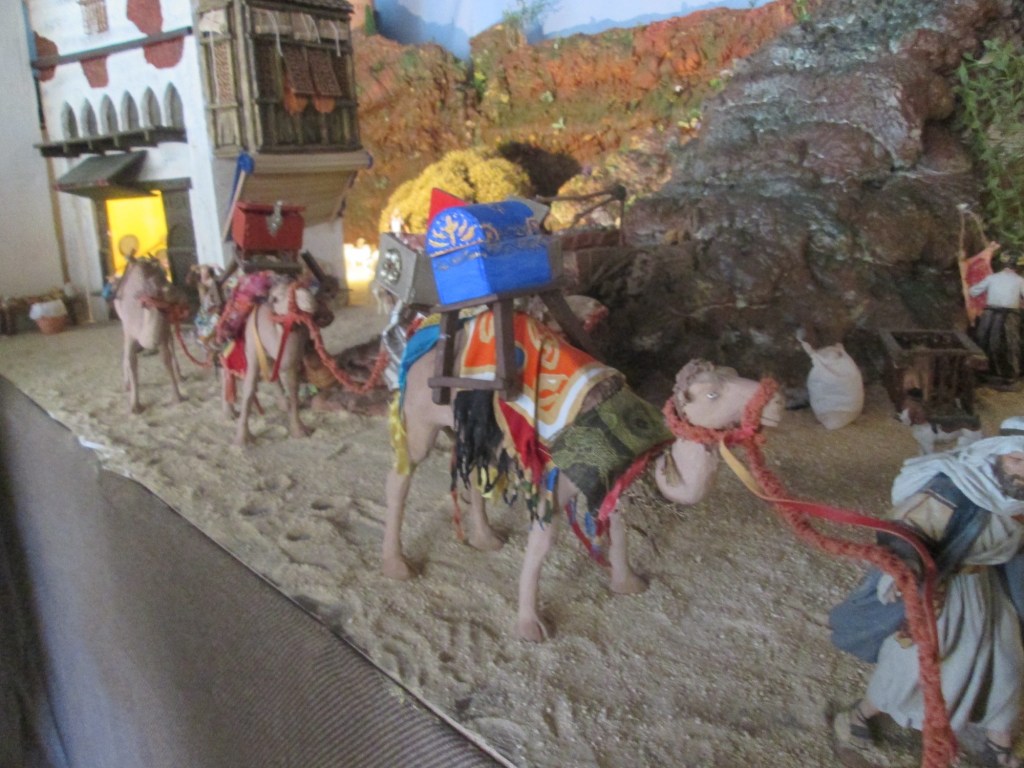
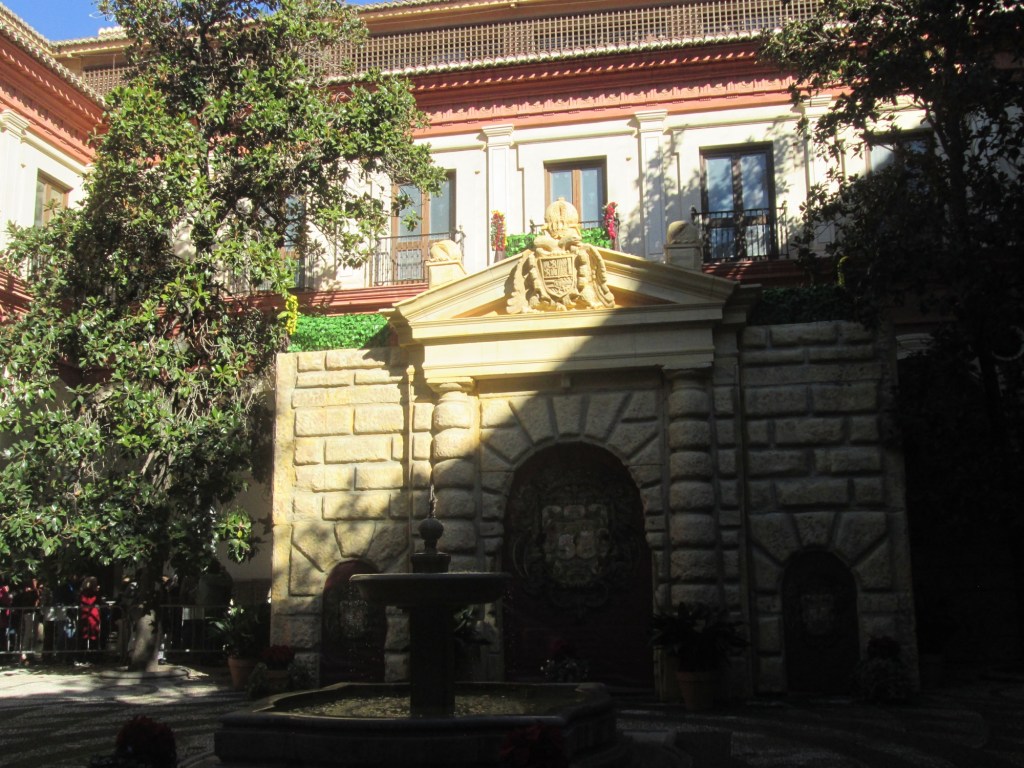
I was waylaid by the aroma of a decent coffee and then discovered that by walking straight up the road I was soon in the famous Plaza Bib Rambla said to be the heart of the city. And boy do they do Christmas here. A Christmas tree circus flying chair device, a cycle-powered traditional carousel and signs to Belens everywhere. These are the scenes of Bethlehem that are a tradition all over Spain. This one was in the splendid Town Hall building.

I found myself outside the market – Mercado de San Agustin which was still pretty lively on a Sunday afternoon and will be visited again. I did sit at a bar outside in bright sun where my phone said it was 17 degrees- oh that’s why I’m here. Looking at the competing menus displayed all around I chose a restaurant that served one of my favourite dishes aubergines with honey which I make myself quite often but this had the added benefit of being topped with miel de caňa which I can’t get in the UK. It’s black, not too sweet and made from sugar cane. My travels took me past the Cathedral, the Lorca centre I intend to visit on Tuesday – in common with most of the world it seems museums don’t open on Mondays – and onto the high-end shopping street Reyes Catolicos, which I skipped along not being much of a window shopper.

My one piece of shopping involved getting a protective sleeve to cover the dressing on my left leg so I could shower properly – in Madrid it had been an early morning struggle to keep it dry. Fortunately protect is protegir and bandage sounds pretty much like vendaje , so I emerge from the farmacia with just what I needed – and it worked well this morning by the way.

I went back to the hotel about five thirty where my luggage had already been taken to my very pleasant room and I spent a while unpacking, organising myself and taking a breather after a fairly hectic day. Post first day blog, read a bit of the Booker prizewinning Orbital and then it’s time to head out for dinner. There are lots of tourists so you can eat at any time you like really but the local families in the place I chose came in around nine to nine-thirty so a bit earlier than Madrid. It proclaimed to be famous for its croquetas so I ordered three filled with morcilla (black pudding) and caramelised onions. They were delicious and very filling so I had a small bowl of chips topped with freshly sliced ham and a spicy tomato sauce. I needed to walk off this repast so I headed off to the central area again to be blinded by the amount of sparkling lights strung across every main thoroughfare. They do do Christmas in Granada!

Back home for a little nightcap, a bit more book and a look forward to tomorrow’s trip to the Alhambra which I had pre booked with an English guide whereas our previous visit from the Parador allowed us to wander at leisure among those amazing palaces and gardens. Apparently you can still get day tickets but the queues are enormous. I’ll find out tomorrow.

On the road (rails, wheels and wings) again

A new adventure starts and I decide it’s going to be a pauper’s trip. So Saturday finds me walking to Lee station as the drizzle turns serious. I board a train to London Bridge, a bus to Liverpool Street and then the Stansted Express to the airport.

None of the luxury of drive up and get an overnight with parking hotel deal. No priority lounge either but a rather good bacon sarnie in Perch. For once there is a shorter Priority queue at Ryanair and we board the plane a mere 30 minutes late. However they make up time with a tail wind and we arrive in Madrid at the scheduled time. On message, it’s take the 5 euro bus into town – no car rental or taxis this trip. Having spent the flight finishing Haruki Murakami’s latest book The City and its Uncertain Walls in which fictional and (f)actual worlds intersect, unicorns die in droves through the cold and people are separated from their shadows, I was relieved to observe people with shadows as I exited the terminal – not least because it meant the sun was shining brightly from a clear blue sky – a real joy after my damp and dismal start to the day.

Sadly the Express bus to Atocha Station called at all the other terminals first and was rammed by the time it got to International Arrivals. So I had some near-intimate encounters with a couple of lady passengers as the bus swerved lanes and managed roundabouts on its way into the city. But we got there and my hotel for one night only was close., I’m glad I’d seen the glories of Atocha before because the elegant structure is now clad in construction work hoardings. I check in to the Hotel Mediodia and quickly set off in quest of a beer and a snack. The cafe Argemosa proves an ideal spot and I’m even given a free tapa – an orange segment topped by some cod and balsamic vinegar and an apple slice with chorizo and migas – both very tasty and a good sign that outside tourist traps, tapas with a drink are still a thing.

This was a very local neighbourhood bar with a massive collection of bottle openers and a reminder that life in Madrid is a bit different.

The blackboard reads:

IN MADRID WE DINE FROM 10 OK.

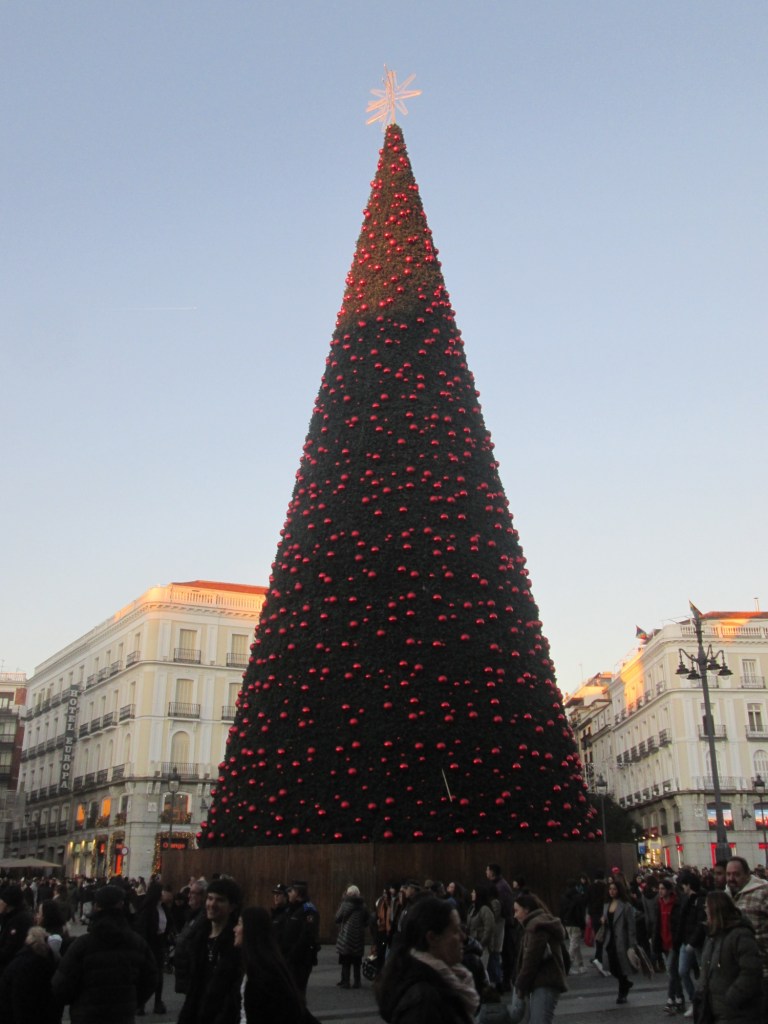
Refreshed, I wander through trendy Lavapies and make my way slowly up to the centre thinking that Madrid was not as Christmassy as Barcelona had been a couple of years ago. But then I got to Puerto de Sol and saw this enormous tree and a green Santa, a Grinch and a Gruffalo all receiving tips from the passers by – cash not performance notes

Then I walked up to another square and came across – of course – a Christmas market. Then as it grew dark, I started noticing the stars suspended across several streets. I had an evening beer in Plaza Santa Ana – one of our favourite spots on a previous trip – no free tapas here. I had another in a bar earmarked for a longer return visit, La Descubierta, where my Estrella Galicia was served with a slice of bread topped with chorizo and manchego,

I then ventured into a well-stocked bookshop and was amazed to see these titles on display next to each other. Very woke acceptance of past history!

Then it was on to the main event of my overnight in Madrid – a session at the Jazz Cafe Bar Central. I wimped out and booked for the 20:00 gig rather than the 22:00 as my train for Granada leaves at 07:35 in the morning. I had booked the gig and dinner option from their website and as a lone diner was shoved away into a corner – not unreasonable really and the tapas style board was good and went down well with a Rioja I’d had before, Ontanon. The band was the Joshua Edelman Sextet – Edelman on piano with bass, drums and congas and a front line of trombone and flute. They played a lively set of originals and standards with a heavily Cuban feel. Which suited my neighbours well as the couple were born in Havana but had lived in Spain for 40 years. As also was a much younger couple at the next table. So immigrants get everywhere don’t they?

A 15 minute stroll down Calle de Atocha signposted me nicely back to the hotel just as Madrid was getting started for the night. Like my daughter kindly remarked a while back – I’m old. Night, night

Carry on culture back home

SUNDAY 9 JUNE

Back in UK on Friday evening, Saturday shopping and multiple laundry sessions and Sunday it’s off to the Tate Modern with neighbours Sean and Maria and my friend Rosa who last saw me on crutches for Pina Bausch’s Nelken at Sadler’s Wells at the end of january. We four went to see the exhibition Yoko Ono: Music of the Mind. It was back in the sixties when I first heard about her when her film Bottoms caused a great media storm. I’d then obviously been aware of the John Lennon connection but had not really thought about her as a serious artist. But my goodness she is – yes there are some stunts that may be a bit gratuitous, but taken as a body of work this exhibition shows her to be a serious, thought-provoking artist – and very Japanese in her mental processes.

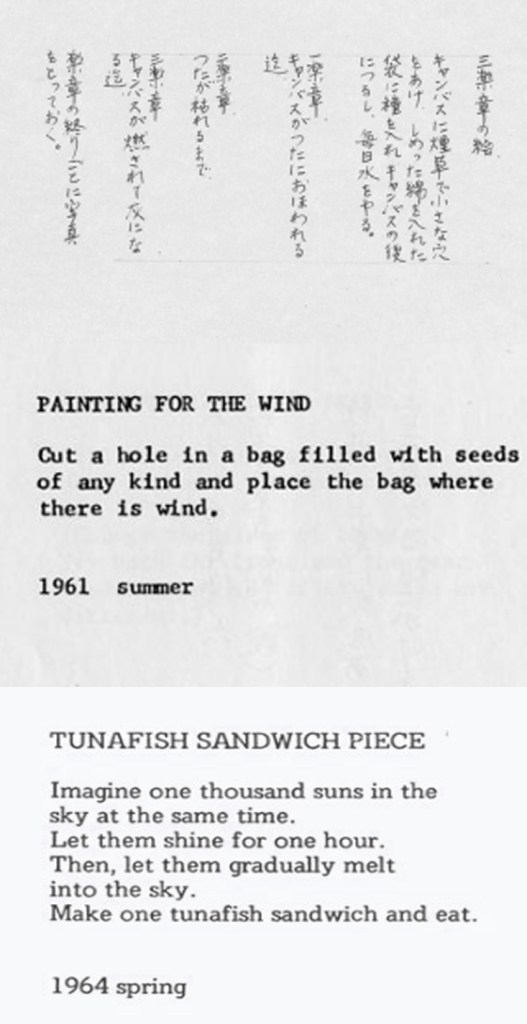
Her earliest works were immaculately typed and calligraphed utterly surrealist notions in her Action Poems with a wide variety of ideas that make you think about dreams, reality and which you’d prefer to be in. So many of these contain messages like the Painting for the Wind where you think how wonderful it would be if new seeds were spread by the wind allowing new life to grow, This idea recurred many years later when she and John sent acorns to world leaders to plant trees for peace. Some of the responses they received are displayed too. It is quite shocking to realise that Yoko was doing things 60 years ago that are considered edgy today. There are far too many to comment on all of them and to read all the works in the show you’d need to be there for days not hours. I might go gain.

Then there’s the mesmeric striking and burning of a match filmed at 2000 frames a second and replayed in ultra slow motion. You can’t take your eyes off it. Throughout the exhibition there is a constant exhortation to get involved to become art yourself – one of us did..

The joint projects with Lennon like the Bed In for Peace were shown in films you could watch from benches or bean bags and for many younger visitors these were probably news – I’m old enough to remember them vividly from media coverage at the time. Another of their films Film number 11: Fly was truly disturbing as a number of flies crawled over the naked body of the wonderfully named Virginia Lust accompanied by a very experimental audio track with Yoko’s vocals, John’s guitar and various tape recorder reverse effects. As a producer I hope they paid Ms Lust a substantial fee for her ordeal – she hardly flinched under all those tickly flies’ feet.

I had vaguely heard of the Half a Room project that Yoko first showed at MoMA in 1967. It does make you think about completeness, wholeness and things you are missing in life and trains the eye to see things differently.

As indeed does the bullet hole in a pane of glass where she encourages us to go and look from the other side. When first shown in Germany it was punningly entitled Das Gift with its pleasant English comnnotation but in German gift means poison. It reminds us that John Lennon was tragically shot by a bullet and there are far too many still being fired in conflicts all over the world. She and John were always very politically engaged. Their famous poster WAR IS OVER if you want it can be seen in the background and in many other areas of the exhibition

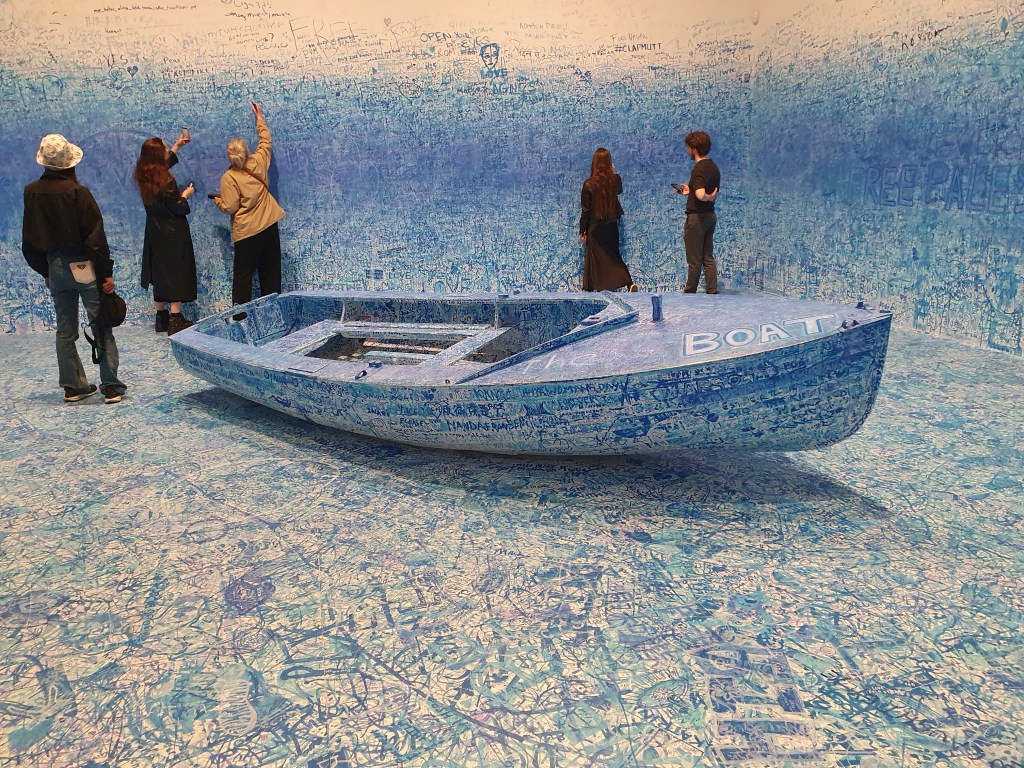
Getting involved is always on offer – playing chess on all-white boards, climing a step ladder to look at the sky, watching the sky above the Tate on an old B&W TV in real time – they are all asking us to think about art and artificality, imagination and reality and it certainly gave me a great deal of food for thought and arguments to counter those who dismniss this as gimmicks not art. Politics and collaboration are featured in the last two major exhibits. One started as a completely white painted room with a refugee boat as its centerpiece. During the course of the exhibition people have been invited to write messages in varying colours of blue felt pen so that the boat itself and the walls are covered in messages – some highly legible and frequent like FREE PALESTINE, others more intimate expressions of love. And the final room asks visitors to write messages of love for their mothers and pin them to a wall that is growing ever thicker as post-it notes are superimposed on one another.

Add Colour: Refugee Boat at the tate modern makes us all think about the worldwide refugee crisis.

MONDAY 10 JUNE

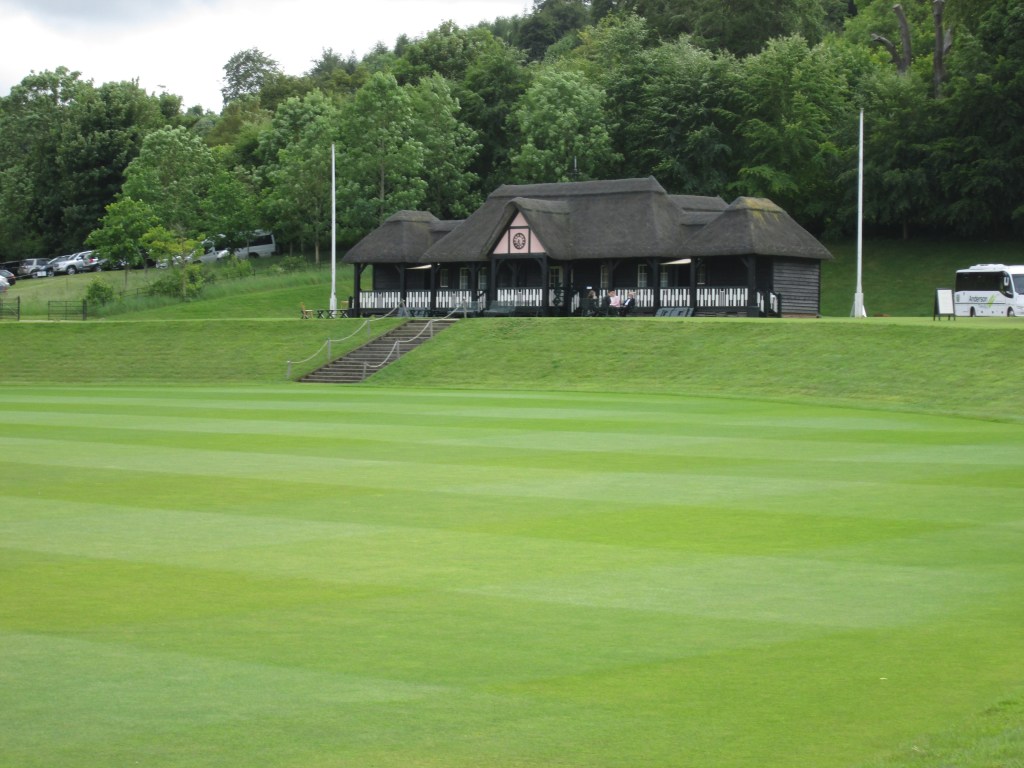
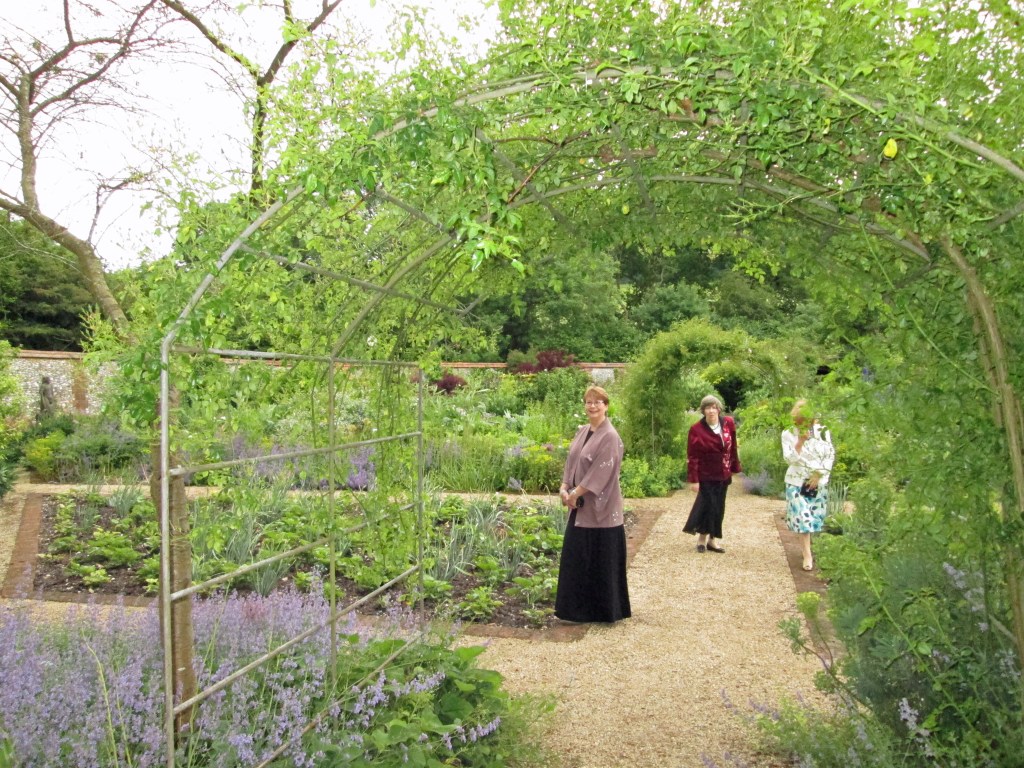
Then on Monday it’s off to Garsington Opera for a performance of Platée, an opera by Jean-Philippe Rameau I’d never seen and only ever heard extracts from. I’m quite a fan of the Baroque and even managed once to use a piece from his opera-ballet Les Indes Galantes as the soundtrack for a infant formula corporate video I made back in the 80s. I’ve been a friend of Garsington for many years now since beinhg introduced to it by my friend Susie Stranders (now at the Royal Opera House) who was music director for several years. I love the brilliantly maintained cricket pitch and the vintage coach ride to the walled garden and especially the glass box opera pavilion all among the lush Chiltern Hills. It helps that they mount outstanding productions with world-class musicians, singers and directors.

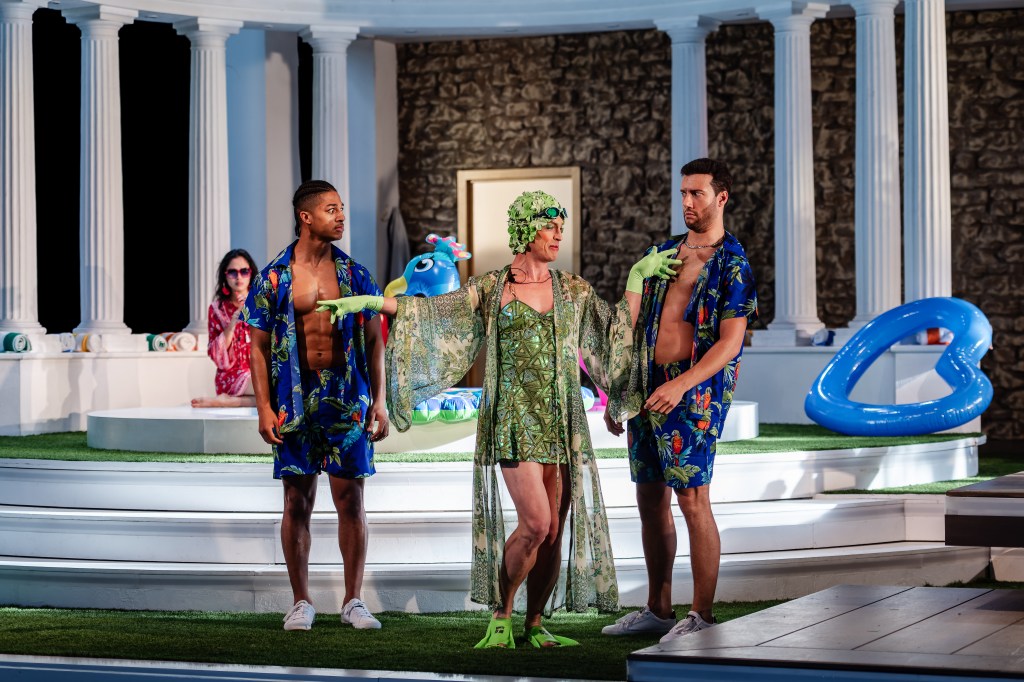
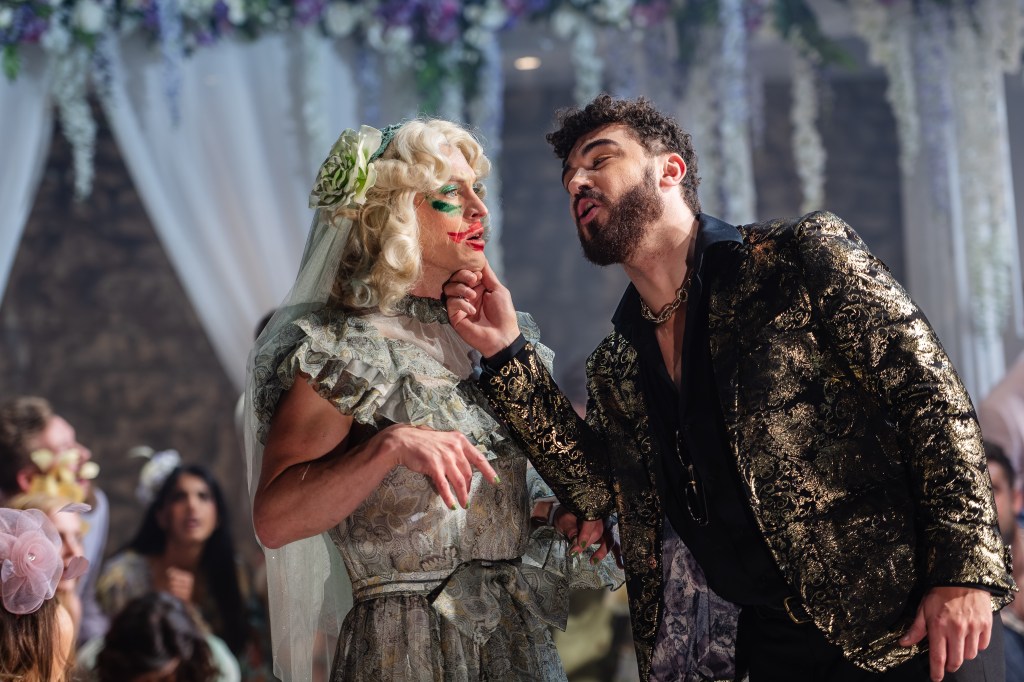
So now to Platée with my friend Jadwiga and I keen to explore new adventures knowing little of the story except that it was the familiar theme of the Gods interfering with mortals for their own nefarious purposes. On entering the pavilion we are surprised and delighted by the set which takes the form of Studio 3 at Olympus TV – a particular delight for me having spent a lot of my professional life in such places. During the lengthy and very lovely overture a script conference is taking place where execs demand creatives find ways to boost the falling ratings of the hit show Jupiter and Juno – or should that be Juno and Jupiter as egos are involved here. There are tacky (deliberately) animations on the big screen, the occasional countdown clock that we used to hope the public would never see. There is some brilliant choreography with the meeting room tables swinging around while the creatives search for a solution and for Thespis, Momus and Thalie (Holly Brown a very convincing stomping about the set frustrated producer) as they sort out the new scenario. Now there’s, rightly, no photography allowed during the production and I’m extremely grateful to Garsington for sending me some images to illustrate this blog. Sadly none of them show the entire set in all its glory – plunge pool, colonnade, cocktail bar, fire pit and so on – so hurry and bag a ticket if you can and go and see it for yourself.

The opening production meeting in the ‘studio’ Photo: Julian Guidera

The plot is convoluted but what matters is the music. First heard in 1745 at the wedding of  the son of Louis XV of France to Maria Teresa Rafaela of Spain, the main character is a none too attractive nymph with whom the team persuade Jupiter to fall in love. Given that Maria Teresa was said to be no beauty, I wonder if there were a few sniggers among the wedding guests. The tradition at the time as we know from Handel was to combine dance with the singing bits to keep the audience happy and there are long passages where you just revel in the melodies, the unusual inventions Rameau introduced in both time and instrumental effects – a timekeeping tambourine was a lovely surprise. I was also struck by his brilliant writing for voices – the trio for the three seen above was ravishing and the choral pieces were beautifully sung by the Garsington Chorus. In the pit was the English Concert under the baton of Paul Agnew who knows this piece really well having sung the role of Platée several times. They were lively and committed throughout. It is a comic opera and the music included some funny elements that were presented skilfully. So yes, Platée is a role for a high tenor making the ingongruity of Jupiter falling for ‘them’ (in modern day wokery I guess) all the more absurd.

Jupiter enters in a glitzy gold golf buggy and after a beauty parade in Love Island style chooses the dowdy nymph rather than the very pissed off supermodels who were gracing the stage with their colour coordinated wheelie luggage.

Photo: Clive Barda

Platée’s competitors parade each with accompanying on-screen graphics. Photo: Clive Barda

Special mention has to be made of the dancers who produced some spectacular displays. My eyeballs will never lose the image of them lying in rubber swim rings performing synchronised swimming moves. Nor will I forget the whole casts’ falling repeatedly asleep while waiting for Jupiter to come to the wedding and equally the brilliant staccato movement of their chairs across the set in another scene. As Platée becomes more excited about the impending wedding we have an interlude from a sparkling La Folie whose sheen and style are a contrast to poor Platée’s OTT wedding outfit.

As we drove home Jadwiga exclaimed that she’d never seen anything like it. I have to agree that Luisa Muller’s production – so different in tone from the last of her productions we’d seen here Britten’s Turn of the Screw – but so admirably suited to the harum scarum, off the wall plot and the musical twists and turns. The TV execs got what they wanted – Juno stormed in full of jealously but then saw Platée and realised that she’s been gulled and all ended happily ever after for Juno and Jupiter.

Juno reclaims Jupiter Photo: Julian Guidera

As I said in another post last week when gods and mortals mingle it always ends in tears for the earthlings. It was a cruel end for Platée ridiculed for her pretension and slinking off back to her swamp. But then life ain’t fair is it? What is fair is that, despite everything, Garsington Opera can still put on evenings like this despite the draconian cut backs to the arts. In fact they’ve just opened a wonderful facility on the site Garsington Studios so that rehearsals can take place simultaneously for different productions and sets can be contructed, wardrobe and props made, making the whole production process so much smoother for all concerned. And when not used for the company, the studios can be hired out to produce income. Thank you Garsington for another superb evening at the opera, I can’t wait to come back for Benjamin Britten’s A Midsummer Night’s Dream on 19 July.

Last day dilemma

Last days of holidays are often a bit of a problem. You have to check in for a flight by a certain time but what do you do with the time in between? In my case it’s a three hour drive direct to the airport at Palermo and I need to drop off the car around two o’clock to make the two hour check-in slot. Breakfasted and out before nine, what’s to do? I have a nerdy rush of completism. I’ve been in/by the Mediterranean Sea at Agrigento and Modica Marina and the Ionian Sea at Siracusa and Taormina but Sicily is a triangle and the long top side has the Tyrrhenian Sea. There’s a town called Cefalu that sounds interesting and that’s an hour from Palermo so I’d have the advantage of puting most of the drive in first thus reducing the get-to-the-airport-on-time panic factor. On the triangle thing, I’d been ignorant of why I keep seeing three-legged figures everywhere like the one below on airport floor tiles. So I looked it up and it’s the Trinacria the symbol of Sicily first adopted in 1282 which became an official part of the Sicilian flag in 1943. The woman is Medusa with her snakey hair, wheat ears for fertility and the three legs represent Sicily’s three capes at the points of the triangle – isn’t the internet useful sometimes.

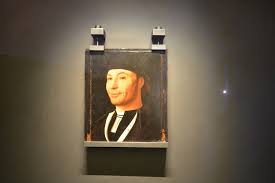
So I leave my pleasant home for four days and set off for Cefalu. The first part of the journey is a repeat of yesterday as far at Catania but then veers off through the centre of the island on the A19. The A suggests autostrada or motorway and bits of it are but I reckon 30% of my journey was in slow single file traffic through mostly invisible roadworks – the odd digger made you think some work might be going on now and then. The landscape is generally brown and pretty dull until I get to Enna where on entering the Madonie mountain chain where the massive Pizzo Carbonara (o not a duly noted) is the second highest peak after Etna. I was surprised to see a ski lift sign by the roadside but there’s a resort here, Piano Battaglia, and a further two on Etna. Then it’s a long descent towards Palermo before a side road heads off to Cefalu. I’m glad I made the detour. It’s a very pretty town in a splendid bay and therefore totally touristy – but that’s no bad thing. It reminded me a bit of the Concha beach in San Sebastian (Donostia for any Basque readers). A long promenade, colourful beach umbrellas, the fight for a stretch of the strand, warm sea and bright sun – all the ingrdients for a fun holiday. So I headed to the ‘second most important cathedral after Monreale’. It’s, of course, up a flight of steps and built in Norman style between 1131 and 1240. Like Monreale it has a lot of gold and the altar piece is a massive and incredibly detailed mosaic of Christo Pancreator. And the museum nearby has a portrait by Antonello da Messina (of Annunciata fame) of a smiling boy. He was good.

A quick coffee and then off to the car hire return place, confirm no damage to report and take the shuttle bus into the airport. As this was my first journey since the operation, I’d been a bit worried about my hip through scanners but in both instances I just pointed to it and said either “metal hip replacement” at Stansted or point at hip and “metallico” at Palermo. In both instances I had a further wand wafted over me before being allowed to proceed. I did have a photo on my phone and my hospital discharge papers just in case but they weren’t required. The flight was delayed by 30 minutes but was happily uneventful. It was clearly not a busy time but still took 30 minutes to slalom our way through passport control. My suitcase had at least arrived by then so I retrieved it, I got the Stansted shuttle bus to the long stay car park, took a few moments to realise I didn’t have to change gear any more and arrived home having had a thoroughly enjoyable holiday in Sicily.

Sicily of the stars

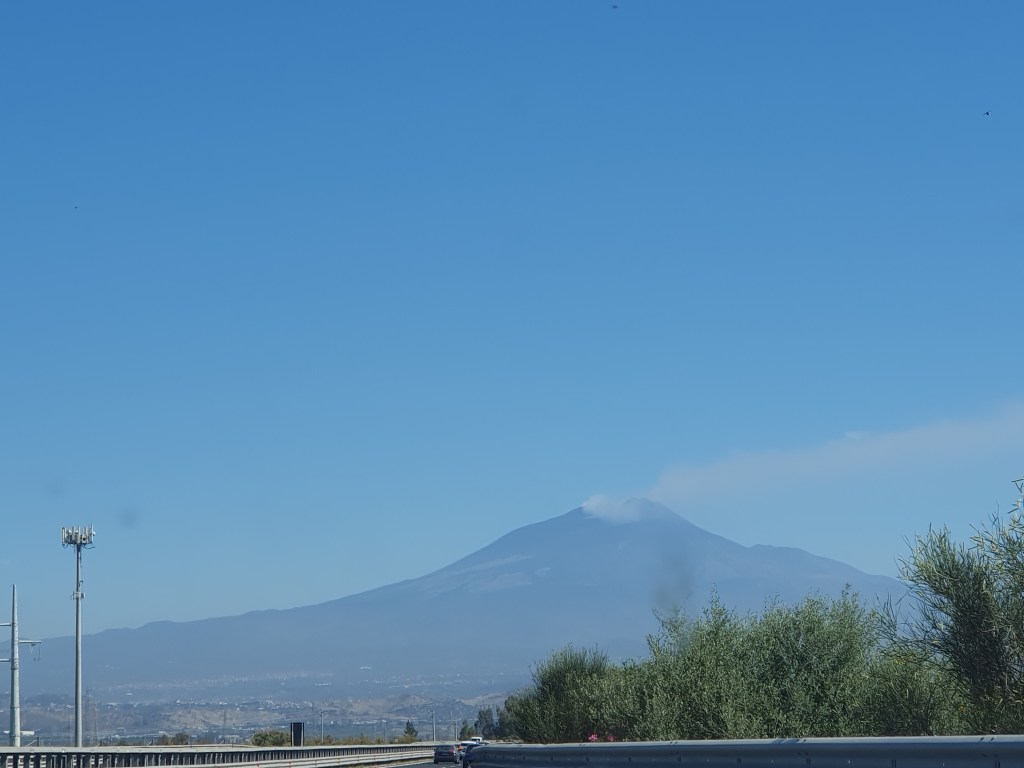
So Thursday dawns bright after a another horrendous Sahara storm in the night which has left the car looking like a Damien Hirst dot painting with sand blobs or a negative Dalmatian dog. The washers work, I can see out safely and set off. I decided to head for Taormina up to the northern part of the Ionian Sea nestling under Mount Etna, Sicily’s pride and joy. A bit like Fuji in Japan, Etna imagery is everywhere and it happens to be a very good wine DOC. I’m not going to do the many tours on offer. But she looks great from the road, (it should be said there are frequent stop areas so no driving danger involved).

Movie stars, models, la belle monde have made Taormina the playground of the rich and famous since the days of the Grand Tour. I was intrigued by a Monty Don BBC series about a garden made by the Brit socialite Florence Trevelyan. The best way there is up the motorway past Catania – a place I’ve decided to omit from my trip as it looks like a sprawling industrial city – actually Sicily’s second biggest. What the road does do is give great views of Mount Etna.I bypass Catania, the second largest city as I think it will be too much for the last of my days here. From the road it looks like an enormous sprawl as the Catania plain floats into the sea. Taormina looks much more attractive, after all Wagner visited in 1881 and said “We should have fled there in 1858 and spared ourselves many torments. The children could have lived on prickly pears!” It proved a haven for Oscar Wilde when he was too gay for Capri. The composer Ethel Smythe spent time here as did D H Lawrence. I don’t have Sky Atlantic but I believe series two of White Lotus was filmed here so it must be worth a look. Giulia does a great job getting me to the gardens I was seeking but of course there is nowhere to park and I descend back to the seafront some two hundred metres below. Following my Ragusa experience I look for a hop on hop off bus to take me back up. From a sign on the exterior, there’s supposed to be an Tourist Information point in the elegant station but there isn’t, not even a closed window. I wonder for a moment if I should have come by train. I enquire of a taxi driver who says he’ll take me up for 50 euros which I politely decline, have a wander along the seafront and have a coffee to think about things.

The station at Taormina and a cove and beach.

Eventually I decide to drive back up and hope a parking space opens up. I’m amused by Giulia’s instructions to take ‘via Luigi Pirandello’. I think whoever was responsible for street names had a great sense of humour. This street from lower to upper Taormina is a hair-raising, gear-changing succession of hairpin bends – with as many twists as Pirandello plot.

The centre looks very crowded and touristy and I let her take me straight to the gardens again. They were created by Florence Trevelyan who came to Taormina after – rumour has it – Queen Victoria exiled her after an illicit affair with Prince Edward. Whatever she built a house near Taormina’s Greek Theatre, She married Salvatore Cacciola a doctor and sometime mayor of the town. She also bought the small island Isola Bella and a large expanse of land up in the centre where she laid out a private leisure garden with views of Etna and a whole host of follies (a feast for my folly guru Gwyn) which she called her ‘beehives’. They are in many different shapes and sizes and made from a variety of stone, cloth, brick, pipes, wood and other architectural salvage. There’s also a war memorial formed by an Italian wartime two man submarine, her own henge and lots of bougainvillea (one on the move?), sunflowers and fragrant plants.

Time for lunch and where better than Ristorante al Giardino? I happen to be wearing my Murakami T-shirt today (a story from another day here). It elicits an admiring comment from a couple also dining there. I tell them the story and we have an intersting conversation during which Lilian – who I think said she was from Chicago – and her companion express an interest in travelling to Japan so we chat even more. They move on and my sea bream in lemon sauce arrives with a glass of Etna Catarratto – perfect. I explore the town a bit and then head back to find my car. From up here have a great view of the station from above – glad I didn’t come by train and try to walk up! – posh dolce vita hotel and the beaches I was walking along earlier. It is a truly spectacular coastline and I can see while it appealed to so many in the belle epoque and to producers of glitzy TV.

As I set off back down the A18 I think of making a slight detour to a town the sign for which I’ve seen a few times as I pass. Augusta is the very pleasant capital of Maine. I think there’s another where people play golf. So when I see a sign claiming it as the city of two ports I visualize myself sipping an evening beer watching activity in a quaint harbour. Fat chance! After a rigorous exploration of the terrain I discover that the two harbours are #1 Military and #2 oil terminal complex. Tail between legs – back home!

Augusta – Intersting town gate, military harbour and oil refinery sprawl.

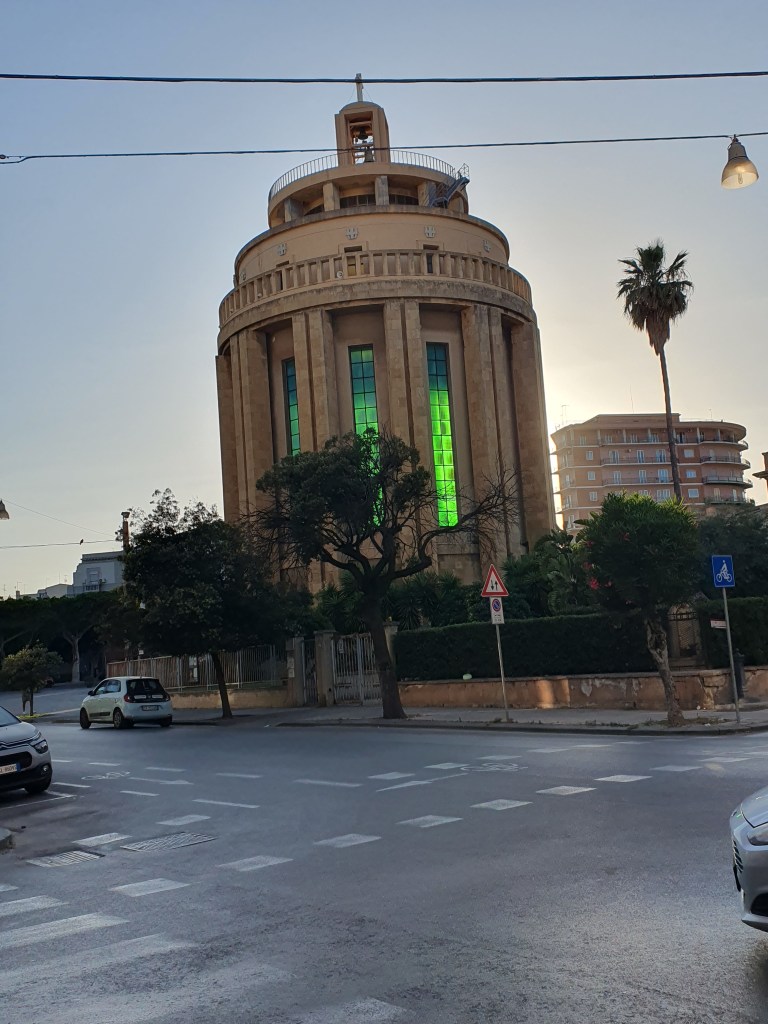
My evening beer is in the brilliantly named Civico Maltato (the malted city) near the amazing cylindrical church of St Thomas of the Pantheon where the setting sun catches the stained glass dramatically. I had food left over from last night’s culinary efforts so it’s back home to eat and pack.

Noto bene, Ragusa rifusa e Medic-toeranneo

So after a local day yesterday and still glowing from last night’s theatre trip – I know family and friends have seen opera in Verona but this was a first for me and was just astounding – I planned to venture south to Noto and Ragusa both highly recommended both by the book and Gwyn and Von. Giulia Googlemappa took me on an interesting route when I’d clicked no motorways. It wended its way through flat areas near Siracusa with citrus fruit and olives, gradually segueing to slightly more upland areas near Avola of wine DOC fame where slopes were covered in poly tunnels and black and red vine protection nets. Necessary eyesores I suppose but not pleasant companions among rural roads fragrant with rosemary (I nicked some for later) and other odours.

I could see that Noto was a seriously hilly town so I made my way quite a way up, found a parking spot, shot the street name so I could find my way back and set off up to the centre. My first encounter in a pleasant, not quite yet awake square, was the Chiesa di Santissimo Crocifisso. I mounted its steps and entered a really splendid space. Apart from the church itself there was a pair of Roman era lion sculptures which used to be outside but were moved into the nave in 1984 to prevent further environmental damage – early onset climate change awareness, perhaps.

Walking around in 32 degrees brings on a thirst but as I’m driving and it’s only 10:30, I settle for a granita. I’d had it explained somewhere that the granita started in Sicily because they brought down great blocks of ice from the mountains to preface the refrigerator and a bright spark said we can make money out of this. Siracusa lemons are also highly regarded so I was honoured to receive this refreshing dish – served with a spoon rather than in a glass with a straw as in Spain. Off to find the cathedral and town hall both must-see buildings in a town where at every corner you are stunned by the architecture and the expense of constructing these palazzos.

A random palazzo of which there are so many.
Noto Cathedral.

So of course there are more steps up to the cathedral and from the top I look back at the town hall which was built in 1746 in a style ‘inspired by French palaces’. Well just wow. Twenty arches on thin columns defying gravity. I prefer the baroque cathedral of Saint Nicholas myself from1776.

Inside the cathedral I was able to have a moment of levity with my grandson Jake by WhatsApping him a pic of his namesake suggesting he was praying for good A level results – pre-university entrance qualifying exams for those not familiar. Poor Jake some of the worst exams of your life. But you’ll be fine, I’m sure.

I think I could have happily spent more time in Noto, but Ragusa called. The drive there was exhilarating through undulating foothills and then into switchback roads through Modica and then into some real valleys, nay gorges Agrigento, as we approach Ragusa. It’s perched across a hillside and gave me a first problem. Note to self number whatever by now: be precise with Giulia delle mappe. There are two Ragusas and she takes me quite logically to the one where you can drive, park your car and enjoy a bland modern city. However I need to be in Ragusa Ibla further across the hill. Two towns joined by a staircase threatens the guide book. I follow brown Ibla signs and being turned back by a cop at a another road sign that said ‘city centre permit holders only’, I do a U-turn and find a convenient parking place and start to walk up into the real Ragusa. At first sight it reminded me of Deja in Mallorca clinging to its hillside. However this was a really big hillside and after 170-odd steps with a few bits of level in between I seem nowhere near reaching the centre. I also missed my footing a couple of times as the steps are uneven and recalling a broken elbow in Mallorca and my daughter’s admonition “You are old” I regretfully abandon Ragusa, retrace my steps, carefully, back down to the car and head off back to Modica for lunch. This may be a major regret of my life as Ragusa sounds amazing. Tant pis! I am old!

Sitting with a beer and a ham and mozzarella cannoli in Modica, feeling a little crestfallen let’s admit it, two thoughts occur to me: Italian pastry is very stodgy and I’ll avoid it in future – understand it’s role is to be filling while hiding the fact that fillings are the expensive bit while flour and water are plentiful, Second I’m on holiday on an island and while I’ve seen the sea I’ve not really been that close or indeed to the seaside. So Giulia is tasked with taking me to Modica Marina which sounds like it should be on the coast. It is and it’s lovely. Free parking until the season kicks in on June 25, a sandy beach and a promenade which I guess would be filled with eateries when the season starts, and aloo. I sit on an bench for an hour and read Colm Toibin’s fabulous sequel to Brooklyn, Long Island. I’m biting my nails with the jeopardy at every turn. What a writer! This is what holidays are meant to be. Eilis takes a dip in freezing Irish Sea in the chapter I just finished.

Encouraged by this I took myself to the strand, removed my shoes and exposed the wounded Birkenstock toe to the healing influence of the warm and salty Med. Seems to have worked as it’s not leaking stuff anymore. Now I’d said to lots of people I was booking a BnB in Siracusa so I could market shop and cook one night or so, because I love markets and regret not being able to shop because I’m in a hotel. Well Monday I’d just arrived, Tuesday was the theatre trip and a huge lunch so now looked like the tine. A local supplier allowed me to purchase one potato (cubed and fried in olive oil with the rosemary I’d knicked), an aubergine, a pepper and he had a piece of pork fillet (unusual in Sicily) an attractive option after an almost entirely, and happily fish diet, it seemed a good idea. I cubed the pork and made a mini-ratatouille with the veg and enjoyed it with the only possible wine since I’d driven through Avola in the morning.

The paper gods

So it’s Tuesday and Syracuse. I’m booked for Fedra at the Greek theatre at 19.30 so decide Ito spend the day doing a tour of Siracusa’s famous island Ortygia. There are two bridges onto the island and the main street close to my apartment, Corso Umbero I, leads directly to one of them.

Confronted almost immediately by a cat on a hot car roof, I have to head off the way it’s pointing. So I go there and admire the ruins of the Temple of Apollo – grey not the golden stone of yesterday’s ‘Valley’, but impressive in scale. And it dates back to the sixth century BCE.

I walk on through the Jewish quarter, cursing Netanyahu for giving them an undeserved bad name, and find myself enchanted by a tiny church (San Paolo I think) with a magical Catalan style multi-column arch – just so elegant. As I pass through the narrow streets I am often lured by planting displays into dead ends – hey, that’s discovery! I emerged at a seaside street and opposite was a building that made me think I’d chosen the right BnB.

Shortly after this, as a self-styled writer, I was intrigued by the Museum of Papyrus. Yes I known it’s importance and Egypt and all that but why in Sicily? So I have to go in and find out. It transpires that in times past papyrus plants came to Sicily as part of conventional trade deals and found a home on the river Caine, where it has flourished. It’s not just a museum it’s a whole research centre into papyrus ancient and modern with rooms stacked with files and specimens that we could not enter. But where we could go was fascinating with a video tracing Carrado Basile’s fascination with all things papyrus, the production process and examples of works on papyrus from many different centuries. And of course they had papyrus boats which I had heard of before. I was particularly struck by an ancient Egyptian palette and pens.

After an unexpectedly interesting hour and a half (always keep an open mind!) I walked on around to the easternmost point of Ortygia but I couldn’t see the mainland., but the sea was good and the prospect appealing.

It proved even better in that a bar with a beer was close by and restored me to walk into the main square in quest of Caravaggio. One of his paintings The Burial of Santa Lucia is in a church here. It isn’t, but there’s a technologically brilliant facsimile involving hi-res scanning and 3-D printing. It’s in a room with a modern take on the subject that I liked for it’s expressionism and a photographic tableau recreation that was quite scary.

This church dedicated to Lucia the patron saint of Sicily is at the edge of a very impressive main square with the cathedral and of course lots of restaurants, It’s a fine cathedral too.

It’s time for lunch and I take it back by the other bridge off Ortygia, A seafood mixed grill gives me two enormous prawns, octopus tentacles (sorry!) and a squid and a slice of swordfish, full stomach, oily fingers and a good local crisp wine to set it off,

Next step was to book a cab for the Teatro Greco and sadly do some laundry. I’d packed a few pairs of pants and a couple of tops too few. The dryer on the balcony was struck by a Saharan sand storm in the night so I had to do it all again next morning. Reassurance – I do have clean pants.

But the theatre visit was incredible. Loads of young people thronging their way in – set book at school? The amphitheatre is a stunning semicircle and despite the cushions (thanks) you can still see much of the original stone seats. It gradually filled up.

I had an interesting exchange with a group of young women who asked whether I’d understand a word. I told them I knew the story and loved theatre and wan’t going to pass up a probably once-in-a lifetime experiences. They sang Happy Birthday to me and we were friends for the duration – I did feel a little uneasy as an 80 year-old among teenagers but soon the play was the thing and we all became absorbed by a production directed by the Scottish Paul Curran. And what a production! A huge godhead formed the main set dressing, otherwise mostly scaffolding, A mix of wafty mauve-tinged shifts for the chorus, dramatic yellow for sad Oenone, black for Fedra and an amazing gold outfit for Aphrodite. The opening Chorus scene was a great dance routine The opposing armies were in rescue services hi-vis gear and helmets.. And as so often with Greek drama it all ends in tears and cheers. The audience stood as one at the end to salute the performers,

The Valley (!) of the Temples and sea to sea

After a pleasant breakfast on a sunny terrace at the BnB with views up to the top of the old town and out to sea, I set off for Selinunte, the amazing archeological site just ten minutes from the centre of Agrigento. I noted as I went to the car, that inverted umbrella displays were not the sole prerogative of Valdepeñas where I’d first seen streets full of them a few years back.

As you approach the main entrance this magnificent ruin dominates the hill – yes hill – in front of you.

The Temple of Juno Lacinia built between 460 and 430 BCE

I wanted to stop the car to shoot it from a distance but the stream of visitors’ vehicles would not permit that. Just believe me it’s a breathtaking moment, like first seeing downtown Boston from the I-93 or the City of London from the M11. There was chaos at Gate V so I carried on to a gate at the other end of the site where there was no access, for no specified reason. I was told to return to Gate V. There was less chaos by now and I was able to park under a shady olive tree, buy my ticket and trudge up the hill. It is steep and it’s definitely not a valley. There are lots of useful information boards in Italian, English and French and the site goes on for a long distance from this eastern end along a ridge towards the sea. It is quite stunning.

This first temple of Juno is obviously a ruin and as I walk along the hill/ridge I pass burial chambers and evidence of multi-cultural appropriation. The Romans desecrated the Greek buildings and remade them. The Arabs had a go too and finally the Christians took over and the original worship of Gods various and Nature were subsumed by the dominant faith. Original fortifications became burial sites since they thought they were safe from invasion. I was reminded of the triple-whammy of Empuries in Spain where the Carthaginian original settlement was successively taken over by Greeks and Romans all with their own ideas of what’s to do with the place.

Then as you walk musing about all this along you come upon this:

The almost complete Temple of Concord from 440-430 BCE.

I really needed hiking poles (not available) to scale the outcrop to get this shot – but I was very careful, I promise. (For new readers I have a recent history of falls resulting in stitches to the head.) It is a stunning piece of craftsmanship and design and crowns the site with its awesome presence. Even I’d be inclined to pray. There are lots of other ruins, sculptures and relics scattered over the hill but there’s also a garden and you know how i like a garden. It had oleanders, rosemary, lavender and herbs I wasn’t sure about but a lovely fragrant and cooling period on the hillside at 32 degrees.

Oleander, olives and prickly pear – very Mediterranean!

Around this point I decided I’d gone far enough and found this excellent shady arbour for my return. The only problem was that I was accosted by a lizard and history tells what trouble that can get you into. (Again for those who weren’t there, an inquisitive lizard in Ibiza led to a group of us entering a team of plastic lizards in a local 5-a-side football tournament. Full story is in YBR 39 available from https://thewatfordtreasury.com/ or I can send the text of the article as a pdf to anyone who cares.) Happy memories of absent friends.

On my way back I passed an enclosure celebrating the return of the mountain goat to the – signboard quote – mountainside. I guess the threat of sacrifice has passed and they can safely graze. There was a cafe nearby so a late morning coffee set me up for a cross-Sicily drive. I hadn’t covered the entire site but had spent a full two and a half hours of marvelling at the ‘Valley’ of the Temples.

My next four days were to be spent in Siracusa so I needed to traverse Sicily from the Mediterranean Sea on the west coat to the Ionian Sea on the east. With a co-navigator I might have drifted about the centre from town to town, but as a lone traveller, I decided to take the A19 motorway that cuts straight through the middle. It was a scenic journey nonetheless, with the lush citrus groves near the coast, giving way to olives and almonds and then to a rugged landscape of harvested cornfields, rock outcrops and an overall brown-ness. It was very hot today but we were clearly gaining height as warnings about winter tyres being obligatory were joined by snowflake signposts and skidding dangers when icy. Hard to imagine that today. But like roads everywhere there were many stretches with road woks reducing the dual carriageway to two-way operation. What I did note was that in every lay-by there was scattered litter – some loose, some in plastic bags. From my limited experience I would say that Sicily is a mess when it comes to both clearing up rubbish – and I regret to say dog shit – which is everywhere.

Another aspect of Sicily that’s rubbish from my sample of one is the food on offer in service areas – I stopped at one for a late lunch and fuel. Everything was in bread including a soft bread bun that contained breadcrumbed chicken fillets! No salads just ciabatta, panini, focaccia and buns. I finally settled for a lemon Fanta and a bag of crisps. And I have to say that the offer was familiar from a number of the numerous ‘street food’ outlets in Palermo and Agrigento.

For once I found the BnB very easily but had to wait for someone to come and let me in. He was pleasant, efficient and explained that the breakfast part was served in the Hotel Mediterraneo two minutes walk away. He also carried my suitcase up these and into my very pleasant apartment which has this open plan living kitchen, dining area and a bedroom and bathroom and a balcony with clothes drier. Good choice I think.

Parking is free in nearby streets – narrow and mostly one way – I had to move my car to let someone else pass while waiting for the guy to arrive. So I went and parked, returned to put the phone that’s done sterling SatNav duty and charging block on to charge, unpack and then set out to explore the immediate neighbourhood. Luckily just round the corner is a bar with a much-needed post-driving beer. I start walking towards the sea and passed a garden that made me stop and think because of its very explicit signage. I’m used to Jewish quarters in lots of Spanish cities and had read that the Giudecca is one of the areas to explore on Ortygia, the island that forms a large part of Siracusa.

I make it to the twin bridges across to Ortygia but had planned that for tomorrow so I do a restaurant recce, buy some basic supplies for ‘home’ drop them off and then go to eat Siracusa-style tuna, cooked with onions peppers and tomatoes, helped along with an Etna red, half with the meal, half carried through the streets to enjoy while unwinding with music and a book. Buonanotte.

Saturday and Sunday in Sicily

I had always planned to use my last full day in Palermo to visit the famous golden cathedral at Monreale. It’s on a steep hill outside Palermo but the guides advised the two-bus strategy for adventure and price. So I headed off for Central Station to catch the 109 to Piazza Indipendenza which Google maps showed as a 30 minute walk along a major thoroughfare. So I bought my ticket from the conveniently marked ‘Ticket Point’ for the princely sum of one euro 40 each way and waited for a 109. It came in about ten minutes and was immediately quite crowded – Sicilians have strong elbows – but I got a seat and observing the route through not the nicest area, I was glad I decided not to walk.

Then it was onto the 389 whIch just shuttles between the square and Monreale. It rattles along with occasional pickups so we end up with standing room only. It drops us off at a roundabout, leaving a steepish ascent up a road with great views over Palermo until finally one makes it to the premium attraction.

Palermo from the top of Monreale, the exterior of the apse and the west front.

I play my bus pass and driving licence to get a reduction and to my amazement they waved me through. I later discovered that the cathedral is free but other attractions cost. It is a truly amazing building with so much gold in the mosaics, frescos and service and ceremonial items. Built for William II , the Good, it’s a majestic church attached to a Dominican abbey. I loved the Arabic patterns in the mosaic wall panels, remembering Córdoba and Granada where Muslim and Christian faiths coalesced, the sublime vaulted ceiling and would, I’m sure have loved the huge depiction of Christ behind the main altar. Sadly I got a printed cloth showing what we might have seen were not in the midst of refurbishments.

I’ll update my pics eventually but you’ll prolly get better from here including what I couldn’t see.

The museum was absolutely packed with gold and silver chalices, crosses and wonderfully woven vestments but after a while I began to glaze so I headed for the elegant monastery cloister. No entry without a ticket and despite my entreaties the young attendant would not let me pass. I glimpsed it from a higher level and it did look like a bit of a miss.

Golded out, I wandered about the town centre which is 100% tourist dedicated. What would these businesses do if, as often requested, we all stayed home? Souvenir shops with ceramics, leather and paintings – maybe once upon a time – but these days I steer clear. But I found an unassuming bakery that would survive any tourist fall off given the number of badly parked cars and Vespas coming to collect their daily bread. The baker apologised for keeping me waiting while he took a batch of panini out of an oven. He then made me one with anchovies and tomatoes which was complemented by a Messina beer which I read from its label has salt crystals from Trapani added to give it extra bite. Salty anchovies with salty beer, what could be better. The 389 goes every half hour so I walked back down the hill, so much easier! and soon the bus arrived and took about 40 minutes to get to Indipendenza and then another fifteen back to the station. I decided to spend a little time sorting my self out and packing for my early morning Sunday departure. Well prepared I went for dinner back in La Kalsa and found a rare table on a busy Saturday night at Quattro Mani where I had more aubergine as a starter and then black sesame crusted seared albacore tuna which was superb and washed down nicely with and Etna Cotanera grape. A fine farewell to four days in Palermo.

On the road

On checking out of the hotel, I noticed for the first time that it had a small bar and a pretty garden which I would have been entitled to use as an apartment dweller. Were I ever to go back I’d happily stay there again as it’s in a great location and they were very helpful. So it’s to Central Station once more for my six euro trip to the airport to be picked up by a car rental shuttle. On arrival I made a series of notes to myself 1: If it looks good value (ie cheap) it’s probably for a reason; 2: don’t assume – no not all rental cars have SatNavs fitted; 3: not all cars start up just because you get and push a button, some need keys inserting and turning; 4: try to adjust to manual transmission – there’s a thing called a clutch – and instrument layout to avoid the windscreen wipers going when you want to turn. Having said all that the VW UP! Has got me from Palermo to Agrigento and now at the time of writing to Siracusa, it hasn’t been all bad thanks to Google maps and Bluetooth.

My destination for the day was Agrigento but on the way both guidebook and Gwyn and Yvonne said “Go to Gibellina”. So I did. It’s a very, very sad story. In 1968 the village was destroyed in an earthquake and rather than rebuild the villagers were relocated to Gibellina Nuova 18 km away.

Very sadly they left the cemetery behind so if families await to pay their respects they have to schlepp along a very deformed country road to do so. I appreciate the problems-for planners but this was a travesty. To mark the horror an artist Alberto Burri made one of the most powerful artworks I’ve ever seen.

Alberto’s installation, the Creti di Burri covered the village’s ruins in one metre high concrete blocks within which you can walk the meandering streets, climb the hill and feel a real sense of a lost community. As someone who loves the technical, in the close ups you can see the sinuous outlines of the bags that held the concrete in place. In others there’s a pink glow as if the terracotta tiles from the destroyed houses had leached their tears into the concrete. Beautiful, moving, a true work of art – and huge!

By contrast the new town, conceived by notable architects as a Utopian living place, turned out to be a soulless disaster. Despite claims as the art of living, there are many public works but no cafes, a closed supermarket and a public square that looks less than inviting. And there’s a grotesque abandoned multi-use space that dominates this sad spot. Oh progress, where art thou? Note to Labour – if you do build new towns, don’t make them like this!
Leaving the new Gibellina behind I headed for my BnB in Agrigento. The road was pleasant with frequent glimpses of the coast before the nightmare of finding the place I was to rest my head. The instructions were great if you knew the town but were confusing in that Via Atenea didn’t have a name plaque adjacent to the adjoining street where I’d been told to park. Locals were helpful and I discovered I’d have a lengthy trek with suitcase to get there. While deliberating going round the block to use the closer car park, I was waved down by someone older than me to give him a lift to the cathedral. He was carrying a silver plaque and a lanyard so I guessed he mattered. I didn’t say, but thought “I despise Christians and other religions for all the trouble they’ve caused” and meekly accepted his blessing when I dropped him off.

So I eventually parked, arranged minimal luggage into a backpack and set off. On arriving at the BnB this confronted me and gave me some further notes to self. 1: You are new at this game ask more questions; 2; Get very clear instructions and a map.

As it happened my poor weary body had to climb 97 further steps to get to my very pleasant room once I’d got up this so-called via Ficani. That’s not a road! And there were another fifteen to get breakfast on their lovely terrace. Next morning. Caveat emptor writ large.

However once installed and braving a trip back out to eat I found that via Atenea is the posh part of the old town. I was so pleased to see that proper bar service has resumed – a beer, crisps and peanuts all for three euros. Supper later was a scaloppine al limone with a carafe of unspecified but acceptable house white in a family run restaurant where the owners knew everybody but me. Then back up those 90+ steps. Night, night.