
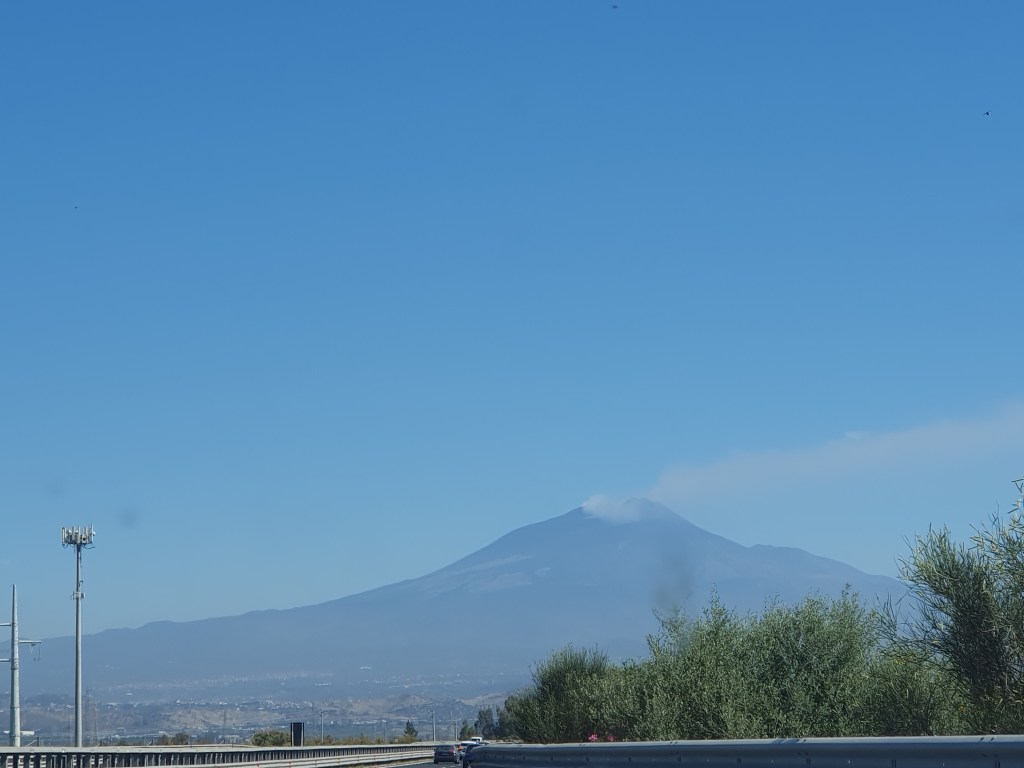
So Thursday dawns bright after a another horrendous Sahara storm in the night which has left the car looking like a Damien Hirst dot painting with sand blobs or a negative Dalmatian dog. The washers work, I can see out safely and set off. I decided to head for Taormina up to the northern part of the Ionian Sea nestling under Mount Etna, Sicily’s pride and joy. A bit like Fuji in Japan, Etna imagery is everywhere and it happens to be a very good wine DOC. I’m not going to do the many tours on offer. But she looks great from the road, (it should be said there are frequent stop areas so no driving danger involved).
Movie stars, models, la belle monde have made Taormina the playground of the rich and famous since the days of the Grand Tour. I was intrigued by a Monty Don BBC series about a garden made by the Brit socialite Florence Trevelyan. The best way there is up the motorway past Catania – a place I’ve decided to omit from my trip as it looks like a sprawling industrial city – actually Sicily’s second biggest. What the road does do is give great views of Mount Etna.I bypass Catania, the second largest city as I think it will be too much for the last of my days here. From the road it looks like an enormous sprawl as the Catania plain floats into the sea. Taormina looks much more attractive, after all Wagner visited in 1881 and said “We should have fled there in 1858 and spared ourselves many torments. The children could have lived on prickly pears!” It proved a haven for Oscar Wilde when he was too gay for Capri. The composer Ethel Smythe spent time here as did D H Lawrence. I don’t have Sky Atlantic but I believe series two of White Lotus was filmed here so it must be worth a look. Giulia does a great job getting me to the gardens I was seeking but of course there is nowhere to park and I descend back to the seafront some two hundred metres below. Following my Ragusa experience I look for a hop on hop off bus to take me back up. From a sign on the exterior, there’s supposed to be an Tourist Information point in the elegant station but there isn’t, not even a closed window. I wonder for a moment if I should have come by train. I enquire of a taxi driver who says he’ll take me up for 50 euros which I politely decline, have a wander along the seafront and have a coffee to think about things.


The station at Taormina and a cove and beach.

Eventually I decide to drive back up and hope a parking space opens up. I’m amused by Giulia’s instructions to take ‘via Luigi Pirandello’. I think whoever was responsible for street names had a great sense of humour. This street from lower to upper Taormina is a hair-raising, gear-changing succession of hairpin bends – with as many twists as Pirandello plot.
The centre looks very crowded and touristy and I let her take me straight to the gardens again. They were created by Florence Trevelyan who came to Taormina after – rumour has it – Queen Victoria exiled her after an illicit affair with Prince Edward. Whatever she built a house near Taormina’s Greek Theatre, She married Salvatore Cacciola a doctor and sometime mayor of the town. She also bought the small island Isola Bella and a large expanse of land up in the centre where she laid out a private leisure garden with views of Etna and a whole host of follies (a feast for my folly guru Gwyn) which she called her ‘beehives’. They are in many different shapes and sizes and made from a variety of stone, cloth, brick, pipes, wood and other architectural salvage. There’s also a war memorial formed by an Italian wartime two man submarine, her own henge and lots of bougainvillea (one on the move?), sunflowers and fragrant plants.


Time for lunch and where better than Ristorante al Giardino? I happen to be wearing my Murakami T-shirt today (a story from another day here). It elicits an admiring comment from a couple also dining there. I tell them the story and we have an intersting conversation during which Lilian – who I think said she was from Chicago – and her companion express an interest in travelling to Japan so we chat even more. They move on and my sea bream in lemon sauce arrives with a glass of Etna Catarratto – perfect. I explore the town a bit and then head back to find my car. From up here have a great view of the station from above – glad I didn’t come by train and try to walk up! – posh dolce vita hotel and the beaches I was walking along earlier. It is a truly spectacular coastline and I can see while it appealed to so many in the belle epoque and to producers of glitzy TV.


As I set off back down the A18 I think of making a slight detour to a town the sign for which I’ve seen a few times as I pass. Augusta is the very pleasant capital of Maine. I think there’s another where people play golf. So when I see a sign claiming it as the city of two ports I visualize myself sipping an evening beer watching activity in a quaint harbour. Fat chance! After a rigorous exploration of the terrain I discover that the two harbours are #1 Military and #2 oil terminal complex. Tail between legs – back home!


Augusta – Intersting town gate, military harbour and oil refinery sprawl.
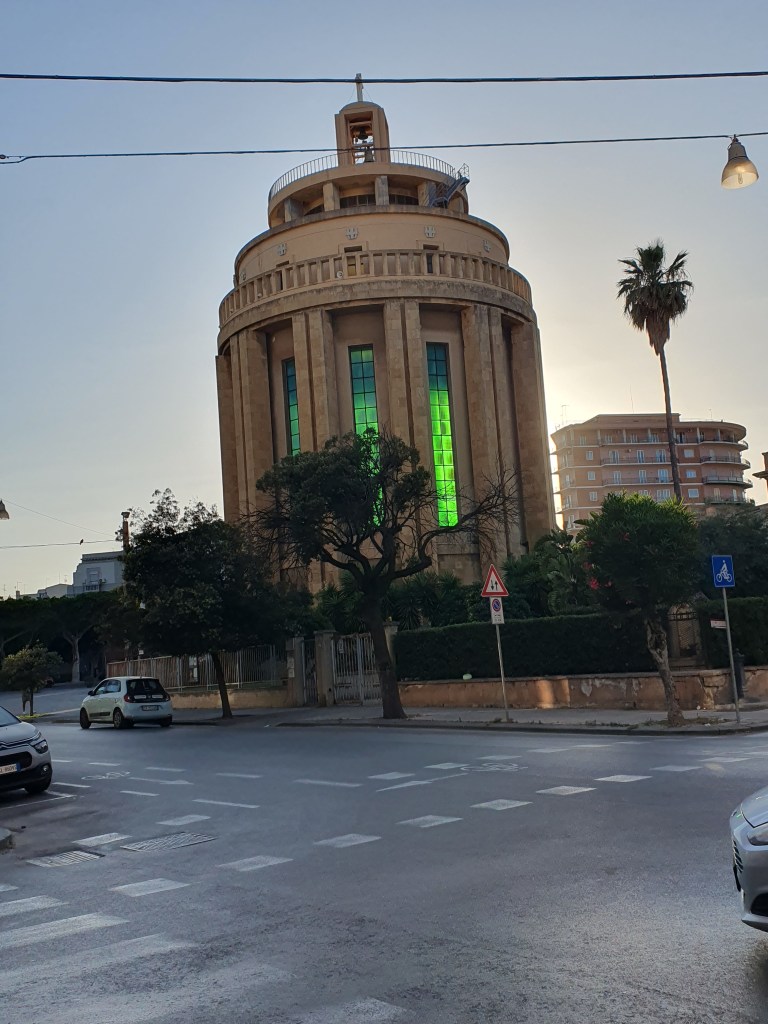
My evening beer is in the brilliantly named Civico Maltato (the malted city) near the amazing cylindrical church of St Thomas of the Pantheon where the setting sun catches the stained glass dramatically. I had food left over from last night’s culinary efforts so it’s back home to eat and pack.

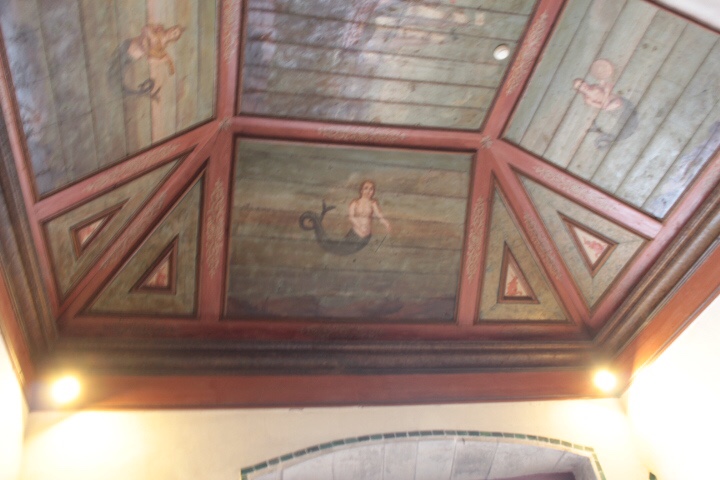
 I decided to give it a try and having made my way up (160+ steps) through a variety of eras, styles and rooms with multiple purposes, I decided it had been worth while. There’s a blend of Islamic, Christian and some pagan imagery in the palace and the hits for me were the ceiling of swans each posed differently, the magpie room with the motto “For the Good” when magpies are usually written off as thieves and a mermaid room that stirred memories of a wild correspondence a few readers will recall.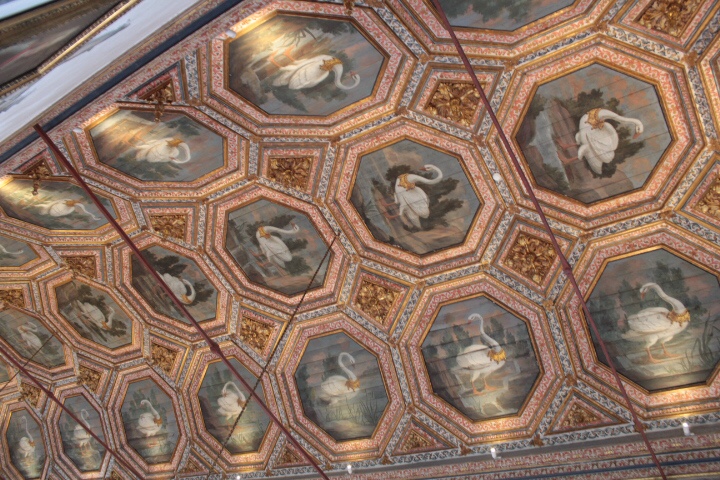
 As I stood at the top of the palace I looked up at a mist-swirled castle and said to myself, “No”.
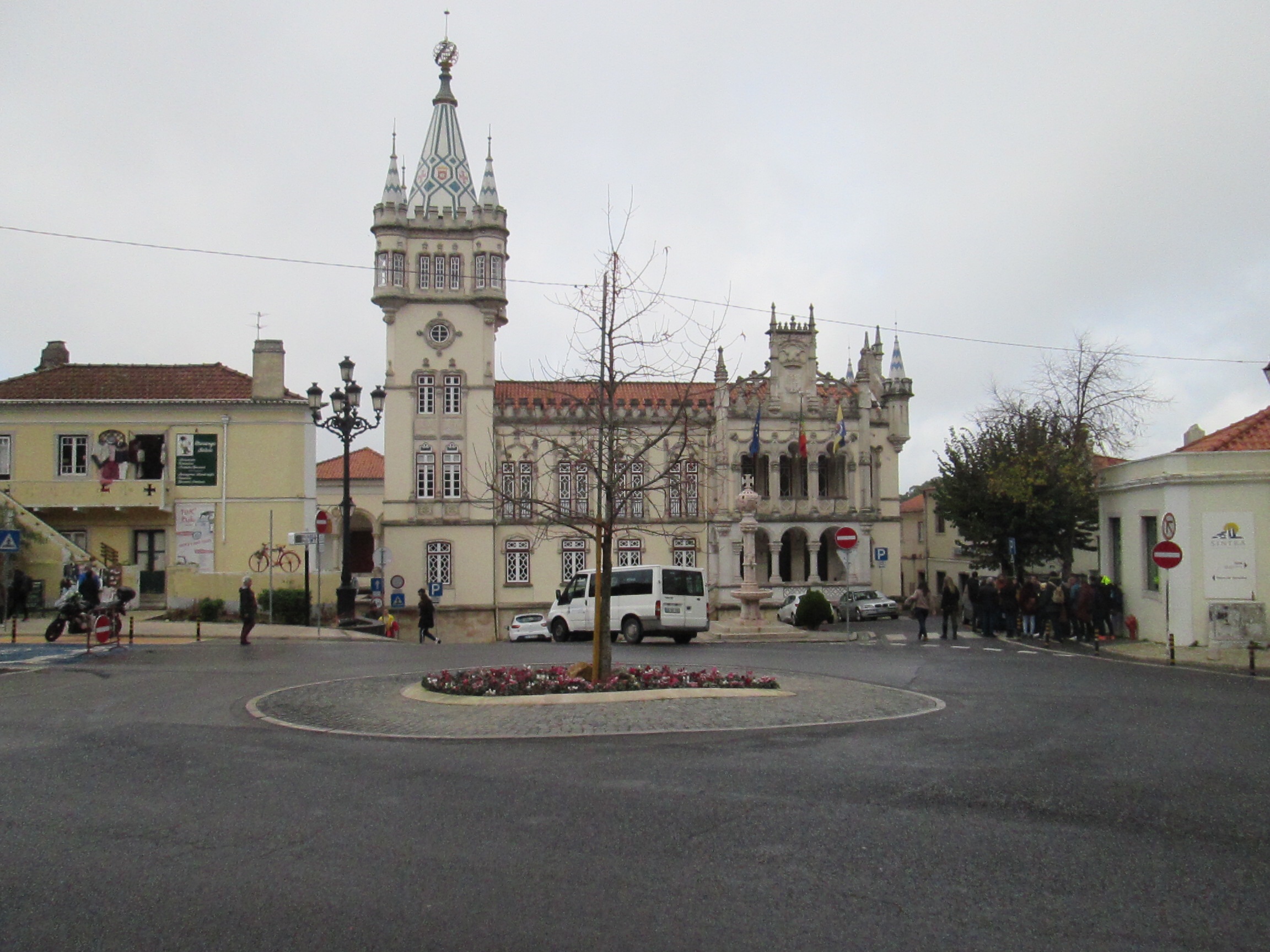
 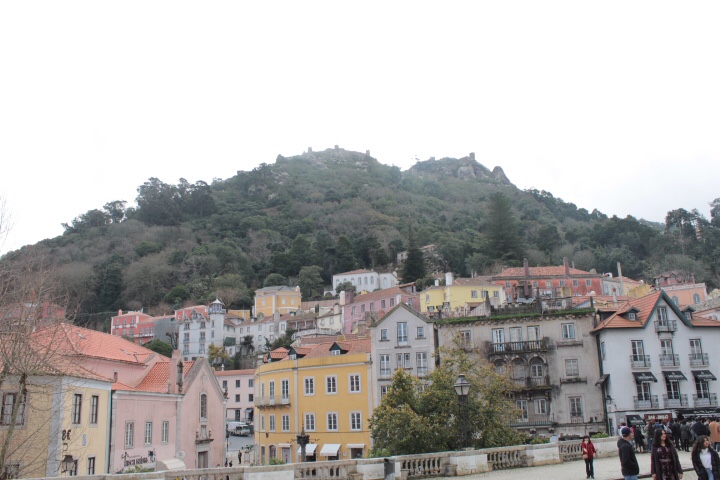 Instead I walked through the old part of the town, thanking my lucky stars I was here at his time of the year. I can just imagine how rammed it would be at peak holiday seasons. There are a few signs of a real town but it has largely been taken over as a tourist destination and small buses whizz you from one palace to the next.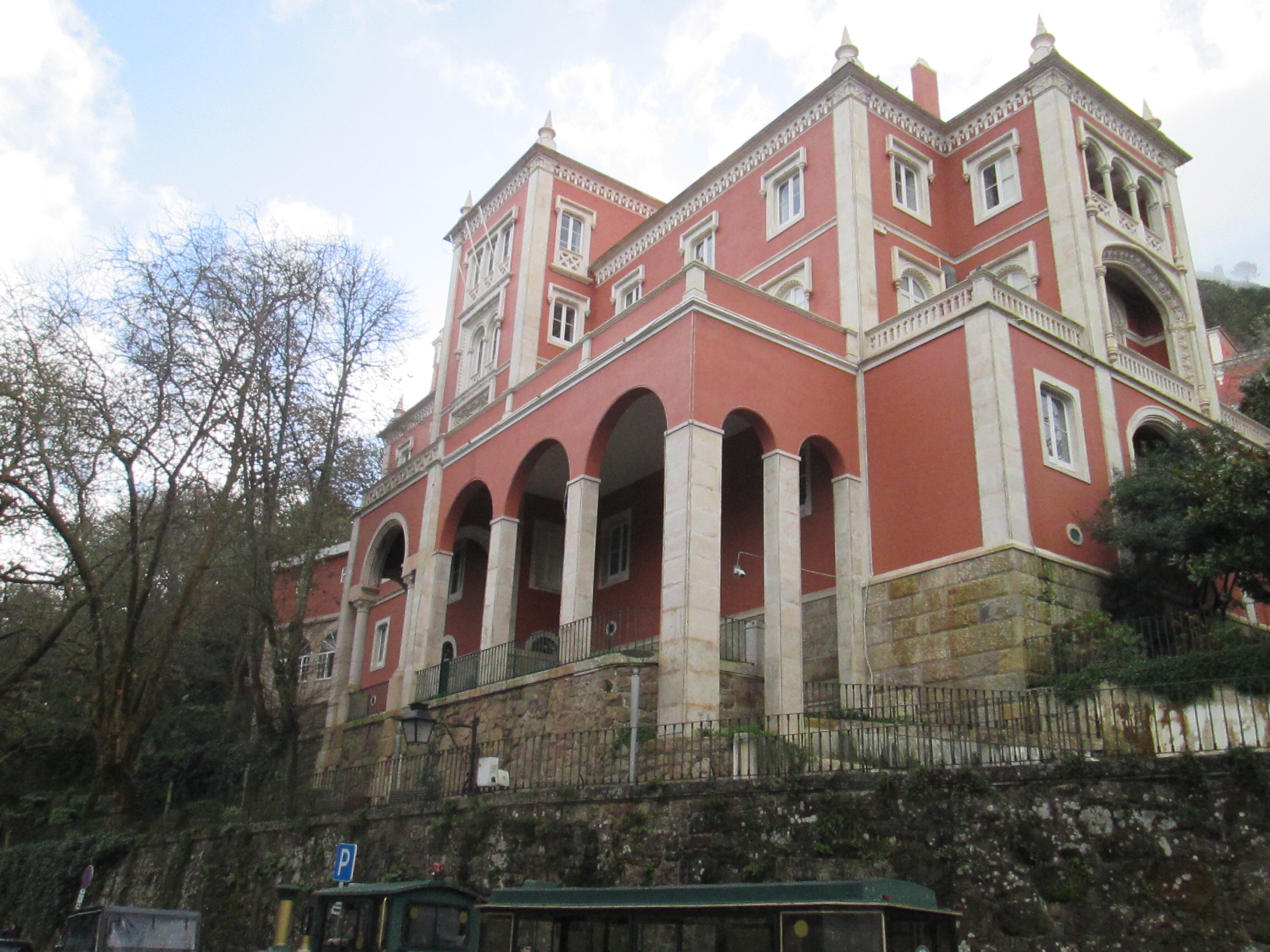
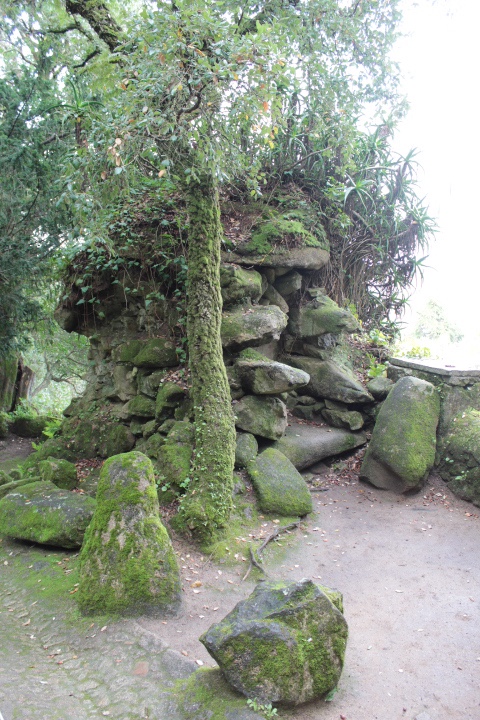
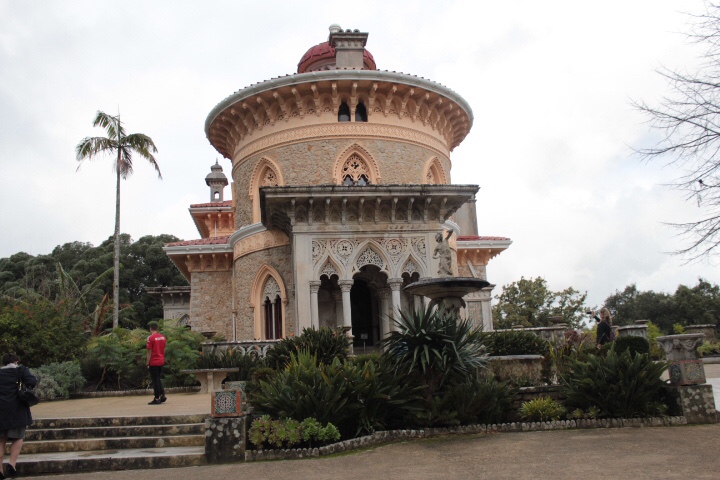
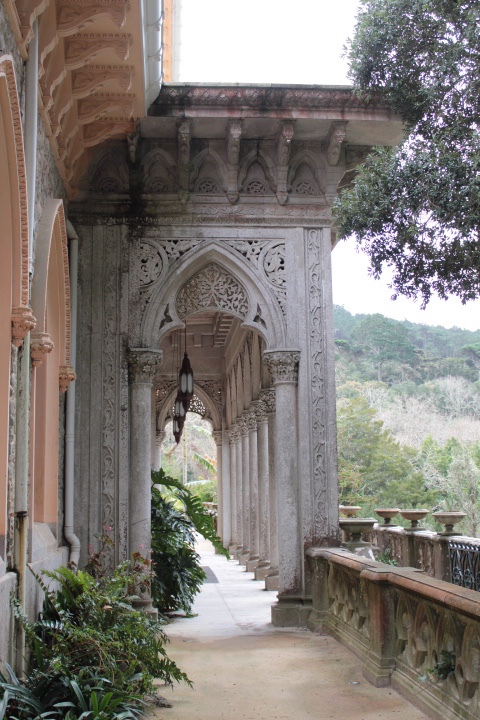
 After a big palace I fancied something on a smaller scale and took the bus to Monserrate which has several British connections. It has a large park complete with artificial waterfall designed by a Brit William Beckford, thought to be the richest non-titled gent of his era, he was at Monserrate from 1793 to 1799. The guide book says he was forced to flee Britain after being found in a “compromising position” with a sixteen year old boy. I visited his falls and shortly afterwards on the way down to the palace at the heart of the estate, a cromlech folly. Now one of my friends who may read this, Gwyn Headley, (Google him) is the world’s expert on follies so I guess he knows all about this but I have pictures just in case.

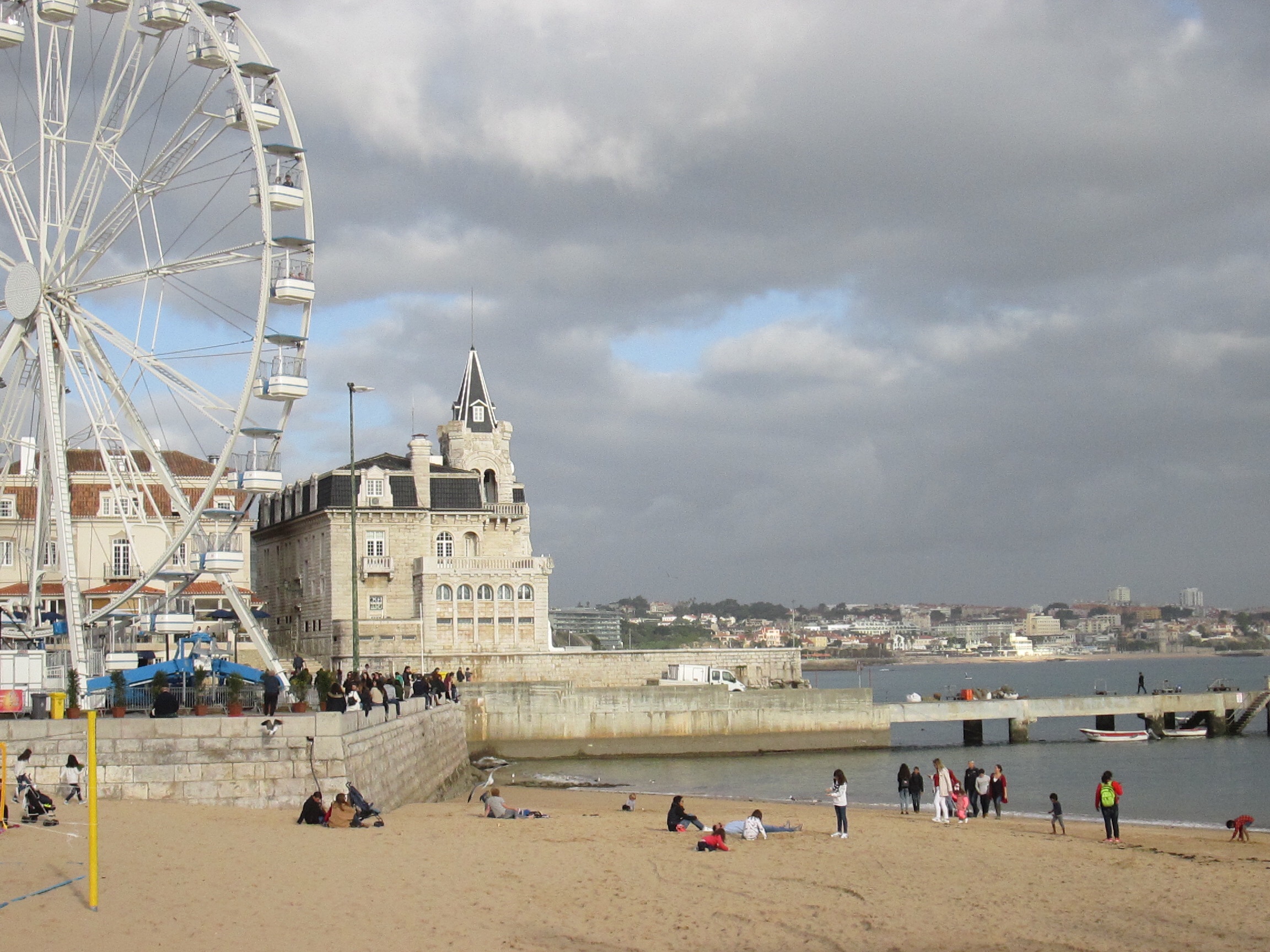 The famous street pavers had overdone it here with a wavy patterns than made me quite dizzy as it looks like the paving is in peaks and troughs but is all flat. However grilled sardines with butter, sea salt and parsley were a grand recompense for holding off lunch till nearly four o’clock, Facing me was a wheel, at 32 metres the biggest in Portugal according to the display on the screen beside it. After lunch I walked along the seafront passing another cove before coming to the station. Again the evidence of crowded summer visits was everywhere as only about half of the souvenir and ‘craft’ shops were open and I could feel the potential of the August crush.
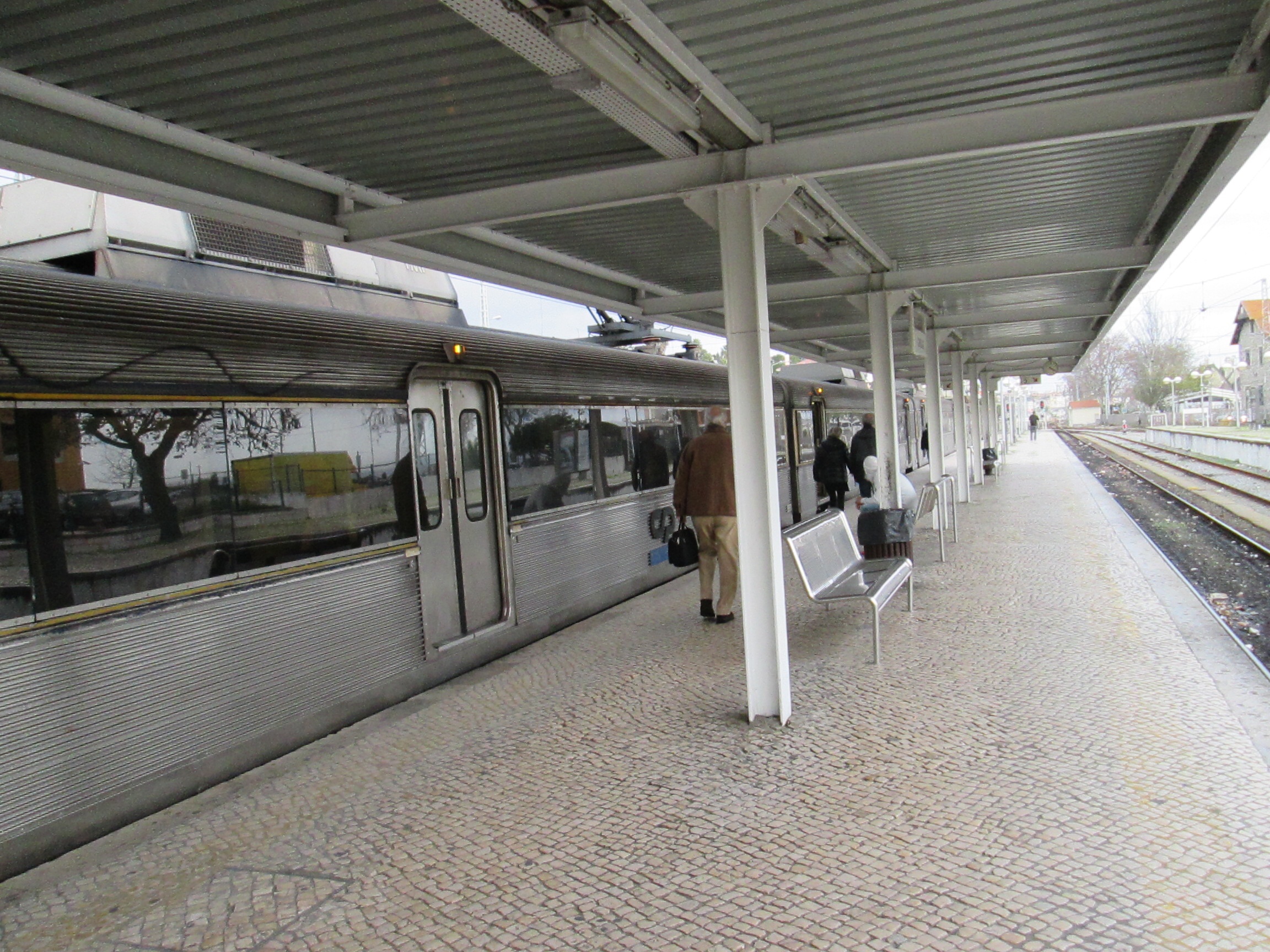 A train was leaving a few minutes after I arrived and it hugs the coast all the way back into Lisbon with occasional great views interspersed with the backs of apartment blocks. Not as dramatic as Dawlish to Teignmouth in Devon but a fun ride. As it was nearly dark and beginning to rain I decide not to get off at Estoril which I’ve herd from many is a fine town – well it’s something to look forward to.
 As it’s my last night in Lisbon I should be going to enjoy the nightlife, find some jazz (I did look and there’s none till Saturday) or a Fado club to hear blues singing, but I had had a bad night, a very active day with lots of up, a late lunch and so I’m staying in to write this, listen to music and read a book (a real one courtesy of Richard S). Sorry!
 mikeandmurakami.com