
I have always been a big fan of Federico Garcia Lorca as a poet, playwright, composer and martyr. He came from Granada so I had to take the opportunity of exploring his heritage in and around the city. I had seen the stunning Harriet Walter in The House of Bernarda Alba on stage and Glenda Jackson playing Bernarda in the film. And both Juliet Stevenson in a regular performance of Yerma followed by Bille Piper’s stunning portrayal in the adaption at the Young Vic showed the current relevance of Lorca’s work. l’m renting a car later in the week to visit his birthplace and early home in Fuente Vaqueros and Valderrubio but today is concentrated in the city itself. I decide not to breakfast in the Cafe Futbol again as I need to head off in the opposite direction. I do find the requisite juice and coffee but then get sidetracked on the way. I later discovered it was just as well as the FGL Centre doesn’t open until 11:00.
First I walk past this arched entrance which I discover is to El Corral de Carbon which dates from the early 1300s and was an al-fundaq – a corn exchange and lodging house for merchants bringing wheat to the city. It has a splendid courtyard with huge grape vines climbing up its pillars to form a canopy – sadly bare at this time of year.


Then I was back at the market – one of my weaknesses in any town or city. The Mercado de San Agustin did not disappoint with its superb seafood and ham stalls, lots of bars and lots of noise.


By now it is well past opening time and I set off for the first objective of the day. Spot the writer!

It took a long time and a lot of wrangling to get a centre to celebrate Lorca in his home province – Madrid and New York got there much earlier. This modern building houses the archive of his works that was assembled by family after a) his death, secretly and b) after Franco, more openly. There are thousands of manuscripts of plays, poems, songs and prose; extensive exchanges of correspondence with publishers and producers; recordings of poetry readings; many, many photographs and some video and the big surprise to me lots of his sketches and paintings. I knew he pretty much defined polymath but the paintings and drawings echoing Miro and Dali, Braque and Picasso had escaped my appreciation on previous encounters with his work.

The main display area is on the second or third basement floor – I stopped counting the steps – and has objects, dresses worn by Marianna Xirgu at the premieres of Bernarda Alba and Yerma and letters, press cuttings, brilliant period posters, photographs and the drawings.
I had just started to snap a few when a museum lady came to ask where I was from. She seemed delighted I was from Londres, But also told me photography was forbidden. So all I’ve got are his typewriter and his amazing signature.

I spent a couple of hours soaking up all this Lorciana during which time my appreciation for him grew even more – he was only 38 when they shot him so what might he have gone on to achieve? One of the posters was for a performance by his touring theatre group La Barraca which he founded to take drama to the villages and the people and an incarnation of which still exists. Dee and I saw them perform one of his farces, the very sexy Don Perlimplin in Ubeda a few – probably fifteen – years ago. We didn’t have much Spanish at the time but the action told the story very clearly as explained by the play’s subtitle “An erotic lace-paper valentine in three acts and a prologue”. Happy memories came back as I looked at a Barraca poster.
Fortunately I found a lift to take me from -3 to 0 which saved the legs doing all those stairs upwards. The outside world was perfect with sun, not a cloud to be seen and pharmacy signs indicating 16 degrees. Time for a stroll to the next location the Parque FGL about fifteen minutes away. As so often the walk passed through a couple of the delightful squares that seem to be a characteristic of Granada and indeed many Spanish cities. This one was Plaza Trinidad and there was a long queue for what was obviously a popular bakery kiosk and of course you can’t escape him for long in Granada.


A sense of déjà vu occurred as I crossed the Camino de Ronda where I’d changed buses on Sunday. I was soon at the entrance to the park which is extensive with a number of different areas.


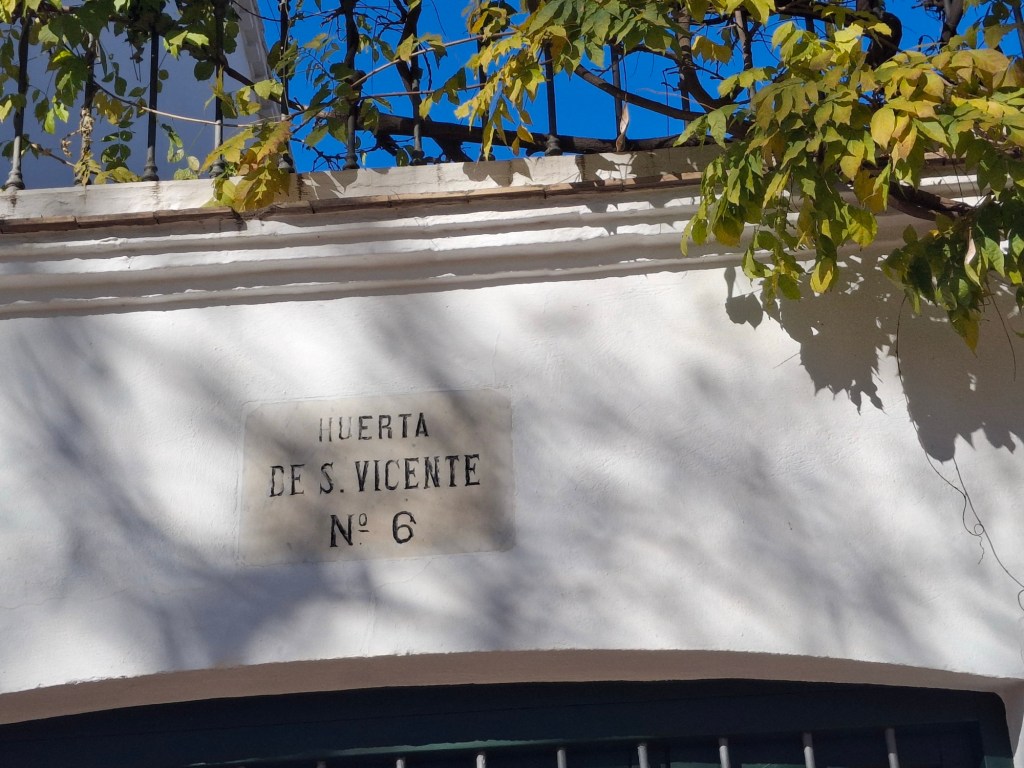
It also contains the Huerta de San Vicente, the Lorca family summer home in Granada. It narrowly survived a demolition order in 1975 – was Granada still run by Francoists? But public outcry saved it and created the park around it. It’s now a museum but is closed on Christmas Eve but I may get back down later in the week.

I was moved to write a poem while in the gardens which I’ve shared with my BBPC colleagues but won’t bore you all with here. I walked back into the centre along Calle Recogidas another posh shopping street halfway along which I spied a rather nice looking courtyard in the sun – ideal for a beer – first of the day at 14:30 – call this holiday! The courtyard I discovered is part of a smart hotel Palacio de Los Patos in the Hospes hotel chain. We had stayed in one of these in Valencia a few years back ad had enjoyed it very much. But posh street, posh hotel. I could have stayed for 1.75 nights for the price I’m paying for seven nights at my Palacio de Las Navas. Maybe when I win the lottery! But they did give me a free tapa of couscous with seafood.

The street leads back to the Puerta Real which is close to home and I think about getting some lunch remembering that everything shuts in the evening on Christmas Eve in Spain. Lone eating is difficult when you occupy a table that could take two but on this day it was looney.
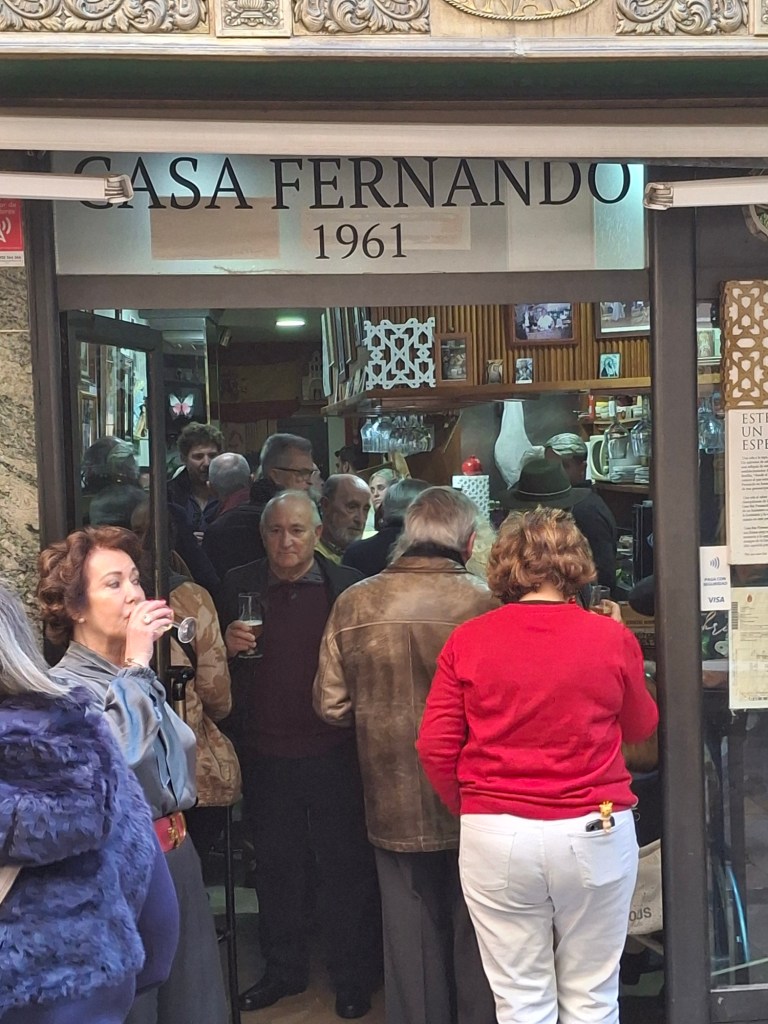
This was the state of one of the bars further up Calle Navas – utterly rammed – as were all the others and I received a lot of shaken heads and “lo siento“ responses. I eventually found a pizza place that could give me a pavement table and had a rather good ravioli with roquefort. I then repair to the grocery shop to get some cheese, ham and chorizo for an evening picnic as all the restaurants said they were going to close.
In the evening, Netflix told me a film I’d like was expiring on 31 December so I watched Todos lo Saben (Everybody Knows) a convoluted family drama and kidnap story with Penelope Cruz and Javier Bardem. It wasn’t brilliant but showed current village/small town life in a way I’m sure Lorca would have approved. Peasants not the posh centre stage.




 mikeandmurakami.com