Sicily day 2 – the fun continues

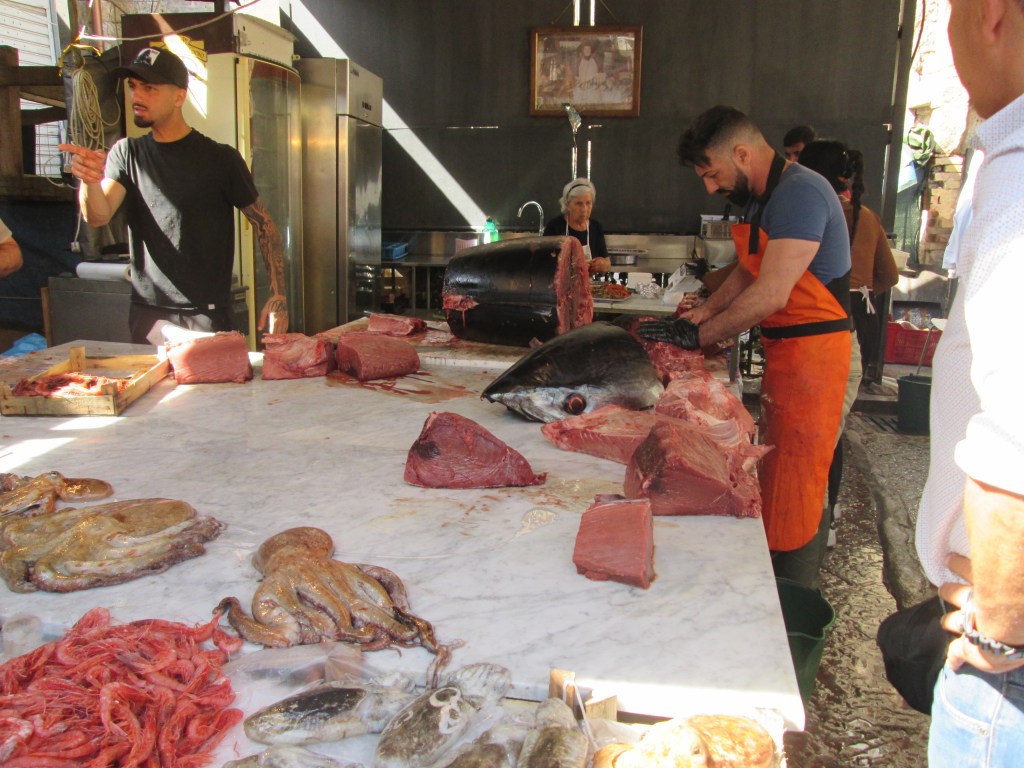
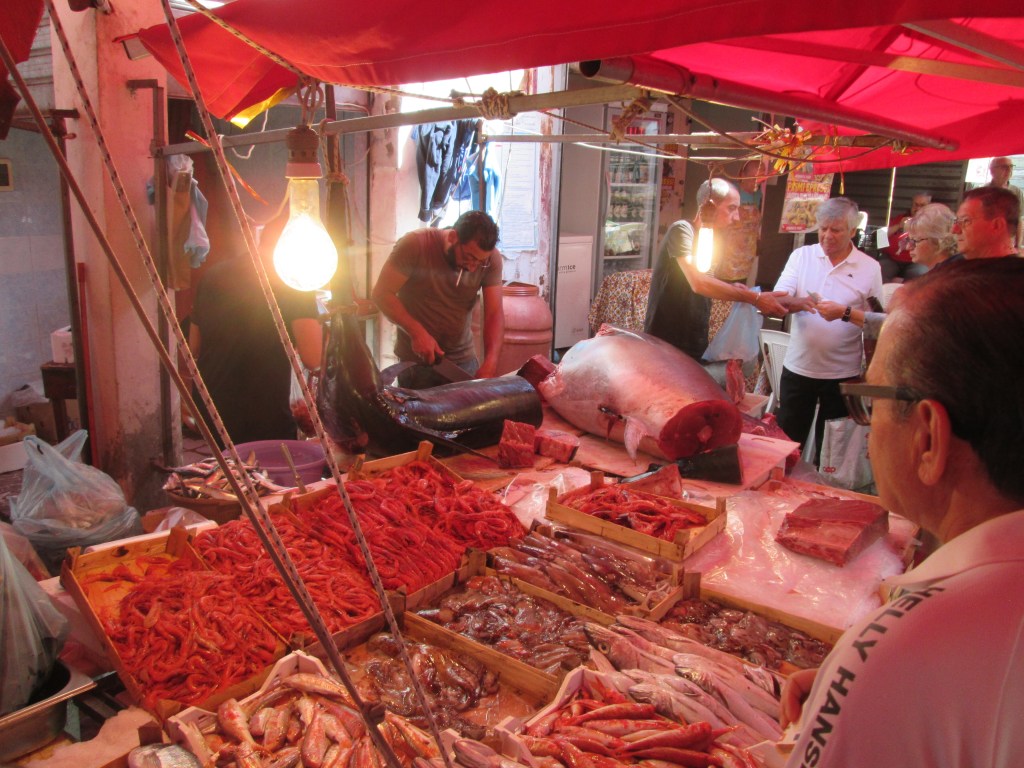
I’d booked a tour of the Palazzo Conte Federico from the UK as I thought it might be interesting to do a ‘Stately Home” tour abroad – and it was to be conducted by the current count. That was for 11 o’clock so I had a while to wander in search of breakfast and the famed Ballaro market. Previous readers will know how much I love a market. And in Siracusa I’ve arranged to stay in an apartment with cooking facilities so maybe I can buy something in the market there. But back to Ballaro – not the elegant framework of La Boqueria in Barcelona or those in Valencia, Madrid and Palma but a sprawling muddle of streets – one actually via Ballaro – with pub umbrellas (mostly Messina beer), tarpaulins stretched over metal frames and a variety of stalls with staff hawking their produce. It was hot, it was colourful, it was lively and it was fun. It also provided A stall with seats, freshly squeezed orange juice, coffee and a croissant so breakfast was ticked off. And I may well have seen the swordfish being cut up that I had for lunch later. Certainly the guy was making a fine job of carving up tuna.

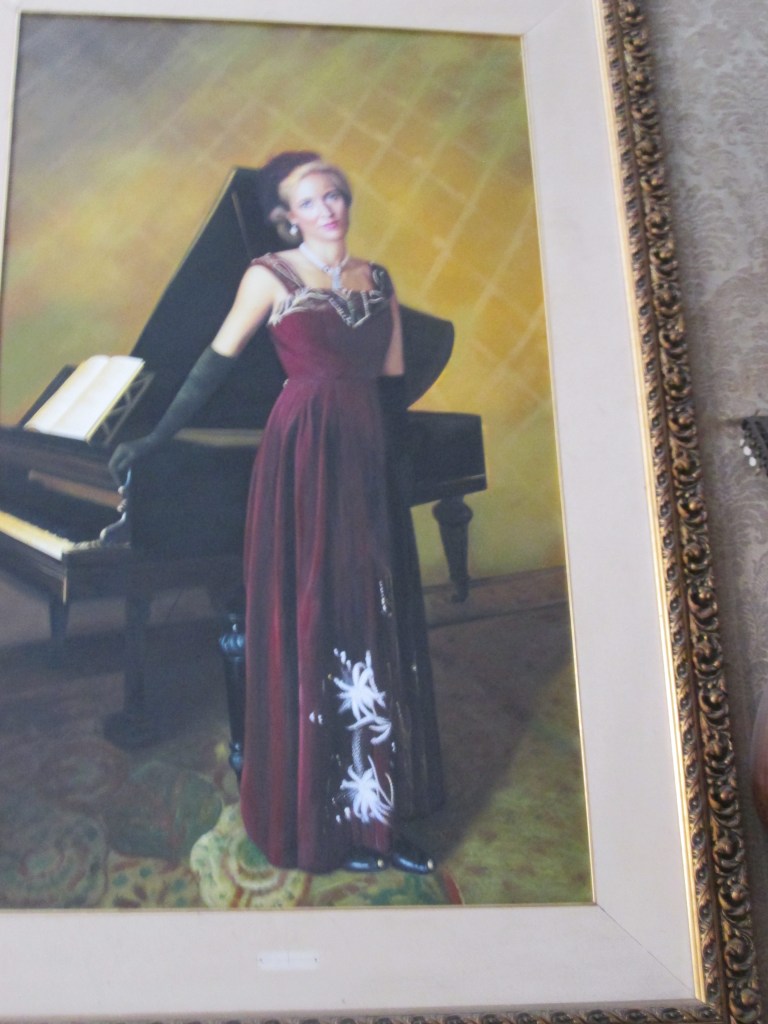
I strolled through the streets in the neighbourhood, narrow, golden sandstone, church at every corner and found the Palazzo a little ahead of time. The young count, Andrea, was preparing to take tickets and asking people to wait but nobly allowed me in to use the loo. They may be one of the richest families in Palermo but they buy their hand wash in Lidl! I know the Cien brand well. The tour was fascinating and the palazzo deceptively large given it’s street frontage. It contains within it the last of 26 original lookout towers from the medieval city when it stood on the edge of the harbour. We’re now a good mile inland and most of newer Palermo has been reclaimed at various periods of history, including a large area using bomb damage wreckage after the Second World War. The website gives you a good impression of what I saw. The fun bits for me were that the 86-year-old count was and is a highly decorated racing driver and now ventures outside Italy to race since anyone over the age of 80 is prohibited from competition in Italy. His wife is a gifted soprano and we entered her studio to find a prized Pleyel piano apparently played by Richard Wagner on a visit. This is my third Pleyel – Chopin’s in Mallorca and de Falla’s in Granada. And I’m planning to hear some Wagner on Friday evening.

It was a fascinating tour, well handled in alternating Italian and English by Andrea and gave one an insight into how the other half lives – or lived perhaps if you need to have paying tourists traipsing though your home between 11:00 and 16:00 every day except Sundays. There were lots of stairs too so the hip got a good workout.

As I exited and walked down a narrow street what should I see but a lady with a clapper board marking a take. A minimal crew was shooting what appeared from the OTT acting on show to be a dramedy, comedy drama or outright farce.

Next stop was for a coffee near the epicentre of the city – Quattri Canti where the posh streets Corso Vittorio Emanuele and Via Maqueda meet. It’s very busy but coffee is still only one euro twenty despite the tourist nature of the area.

Next was a visit to the famous, or infamous because of its nudity, fountain Fontana Pretoria. It has no water flowing but is an impressive structure.

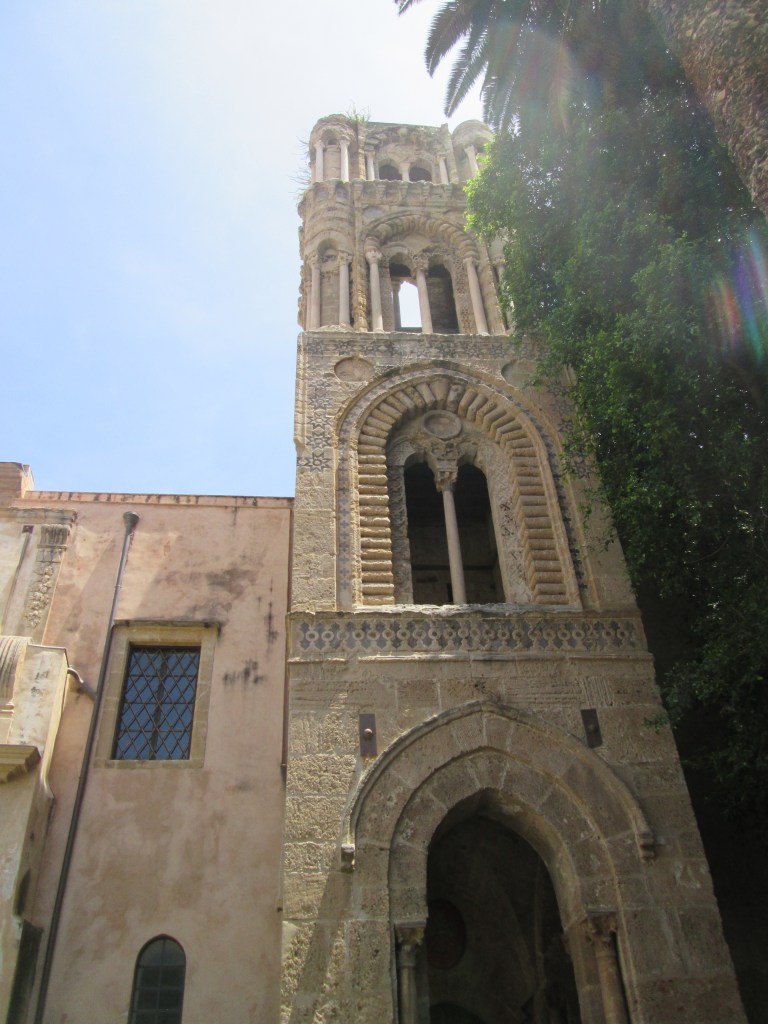
And then on to a pair of churches – one of which had just closed! But the Chiesa de San Cataldo was wonderfully calm and simple – a blessing after the ornate nature of the majority. It also has three red domes and some impressive brickwork and a great stained glass cross.

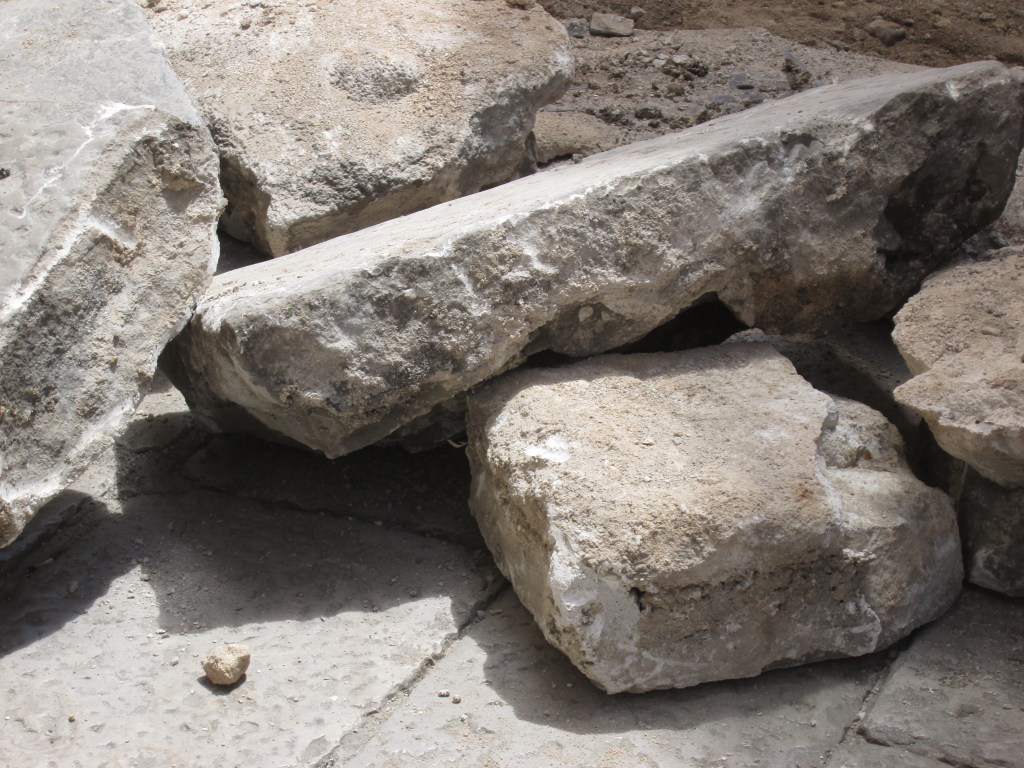
Lunch nearby was pasta al pesce spada e melanzane – there were lots of both swordfish and aubergines in the market and it restored me for the next visit. This was only a short distance away but almost unreachable because of workmen relaying the enormous slabs that make up Palermo’s streets.

The Galleria d’Arte Moderna proved a bit of a misnomer as paintings in the collection stopped at 1935 and was almost entirely figurative. There were several paintings I really liked however so despite expectations not being met, I was glad I’d gone.

It was time to rest the feet after a day of constant movement. But on the way back passing Giardino Garibaldi I was struck by this massive Ficus macrophylla reputed to be 150 years old. It’s what we know better as the banyan tree.

As I was walking along via Torremusa I noticed white carpet on the church steps and popped in to catch a wedding ceremony in full flow. Another enormous and brilliantly decorated church like so many in the city. This one was the Chiesa Parrocchiale di Santa Maria della Pietà. I was very discreet and didn’t even offer to make a speech.

Back at the apartment for a brief rest, a shower and then out for dinner locally with a whitebait starter and some sausages to follow. They were quite spicy – close to merguez. Well as Paola said when I told her I was going to Sicily “Sicily – it’s Africa!” She’s from Rome.

Music, markets and Moritz

I’ve managed to do a few things I wanted to experience while in Barcelona but a combination of occasional hip gyp (osteoarthritis quite advanced) and less breath from the lingering flu, I’ve not been roaring about the place as I maybe would have in the past. I love the fact that the city is so well supplied with benches so I can sit and take a rest when necessary. Isabel Allende has a fine quote in her book I just read A Long Petal of the Sea: ‘Pain is unavoidable, suffering is optional’. As I set out on Christmas Eve to enjoy the guided tour of the Palau de la Musica, I was able to have a coffee, perch on a bench and contemplate life at a slower pace.

Benches and cafes on the Rambla de Catalunya.

It also gives me a chance to look around and see elegant buildings like this. There have been some rather (imho) unsuitable replacements and refurbishments to the classy streets of the Eixample, the area into which the wealthy of the city expanded in the early twentieth century with its grid of vertical and horizontal streets so it’s hard to get lost. Enough rambling – on to the Palau.

At the Palau, I join a group of two Americans, one Hungarian and eight Chinese – probably statistically representative of relative populations. Our guide is Marta who is Catalan and a pianist with the organisation who also used to play cello but gave it up as too difficult. As often, the tour begins with a ten minute video of the history and diverse nature of music played at the hall – Montserrat Caballe and Pablo Casals of course but also Ute Lemper and Herbie Hancock. Marta returns and asks if any of us has ever been so I can show off with my attendance two nights ago. I can also answer her enquiry as to whether anyone knows the architect. I do – it was Lluis Domenech i Muntaner, another of the famous group of modernista artists, which included Gaudi. Together they designed the Catalan equivalent of art nouveau or Jugendstil elsewhere in Europe. What I couldn’t answer was how long it took to build – a staggering two and a half years. My guess would have been ten. There were obviously lots of wealthy merchants investing their profits from the Americas in a cultural centre of some magnificence in Barcelona.

The interior is just breathtaking. Every surface is decorated with trencadis, there are thousands of plaster roses – the flower of Catalunya – and sculpture and plasterwork of great significance. There are lots of red and white cross flags which are familiar in England especially around football tournaments. St Jordi (George) is the patron saint of Catalunya too. Lluis certainly thought about what he was building. Alongside the name of the Palau are the words Orfeo Catalana reflecting the origins of the hall as a place for choirs to practice and sing – well they couldn’t watch Strictly or The Voice so they had – and still have – lots of local choirs. I’m hoping to see some of them at the special Sant Esteve (Boxing Day) concert which is said by some I’ve spoken to to rival New Year’s Day in Vienna. As with the exterior a few photos won’t do the venue justice but let’s just say a bust of Beethoven surmounted by horse-riding Valkyries on one side of the stage and sculptures of all the muses behind the performers on stage make this a very special place. The glass sunburst at the centre of the ceiling which allows natural light through is a masterpiece of both design and engineering.

The sunburst with Valkyries behind.

After a coffee in the cafeteria, I set off through the old city centre towards the cathedral – I’ve never seen it without works going on, maybe one day. Then I just have to stop for a beer in Plaza Reial a long-time favourite. One of the limited advantages of travelling alone is that I’m doing far more reading than usual. Instead of chatting over a beer, out comes the kindle. So far I’ve read William Boyd’s rambunctious The Romantic in which we meet Byron in Italy and discover the source of the Nile. This was followed by Kate Atkinson’s fabulous Shrines of Gaiety featuring the dodgy world of nightclubs in interwar London. And as mentioned before, Isabel Allende’s epic Long Petal of the Sea which begins with the horrors of the Spanish Civil War in Catalunya and escape to France and from there to new lives in Chile only to become involved in another coup there. And now I’m enjoying Hotel Iris by Yoko Ogawa – another tantalising excursion into the strange world of Japanese fiction. And the Mcs are lined up next Ian McEwan and two from Cormac McCarthy.

From here it’s a short step along the Rambla to the Liceu opera house which sadly had nothing I wanted to see this trip and then for a walk through the fabulous Boqueria market. I’ve probably rambled on about my love of local markets and my regrets at living in a hotel – maybe an apartment next time. The colour, the noise, the camaraderie of the market is infectious. No room at the market bars though so I found a small bar in a side street for some gambas al ajillo and esparragos.

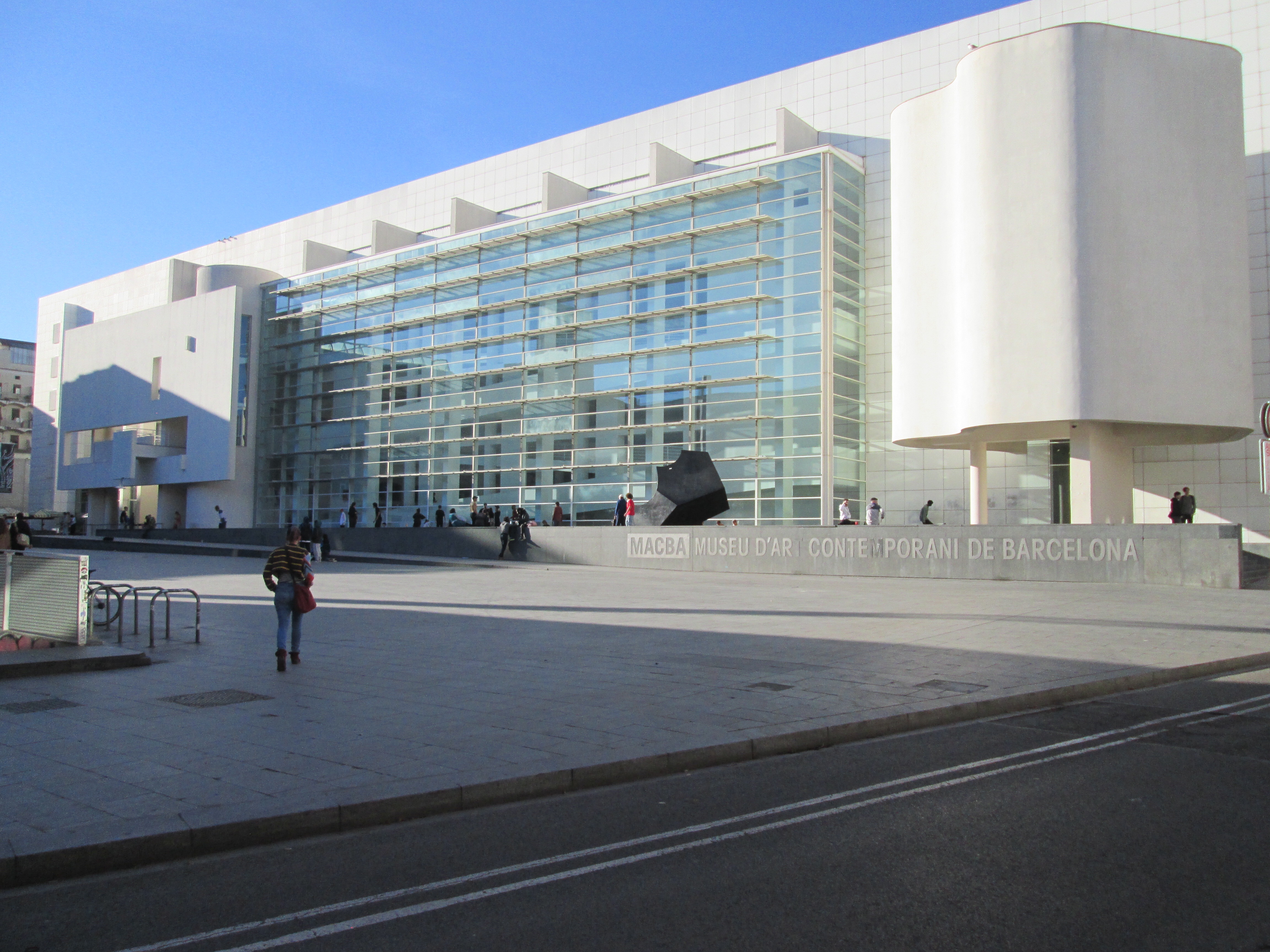
I have another short stroll to my next destination MACBA the museum of contemporary art in Barcelona. It’s new to me although it opened in 1995 so we must have missed it on previous trips. It’s a great white palace with a warning to watch out for skateboarders on the approach – what is it about art centres and skaters? One attractive aspect is that it has slopes not steps to link the various levels – reminding me a bit of the XXI gallery in Rome I visited in 2017. My appreciation of cutting-edge contemporary artwork is somewhat unrefined but I found two of the artists exhibiting here quite affecting. The Colombian Maria Teresa Hinchcapie which involved performance art, exploration of every day objects and photography gave me plenty to think about. Cynthia Marcelle is a Brazilian artist who had given a number of collaborators some materials to arrange as they wished. The result reminded me of a Cornelia Parker explosion of objects. There was another exhibit based on a Mexican Mixe myth which I found impressive in scale and impenetrable in meaning.

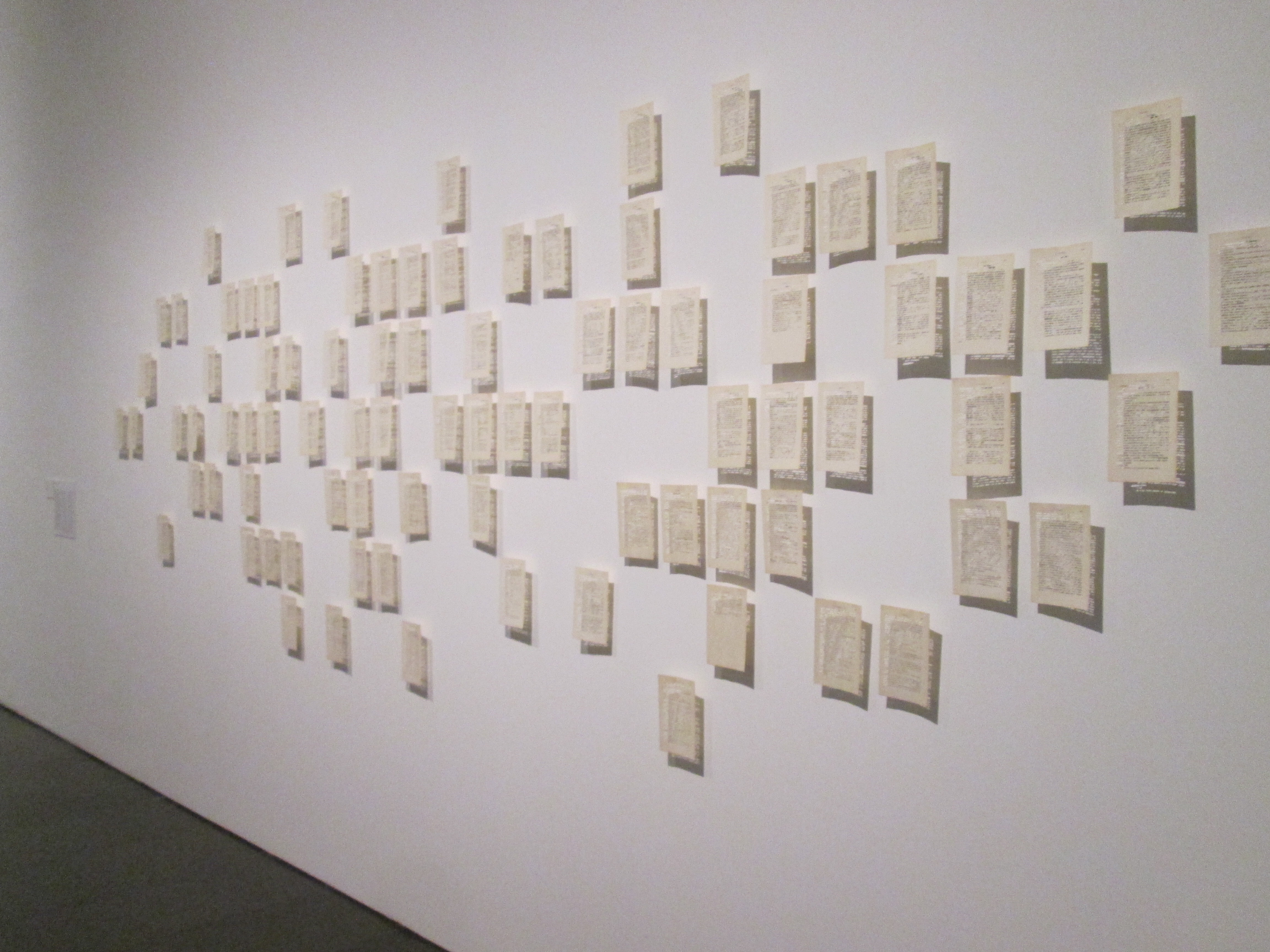
In the permanent collection were a number of pieces I really enjoyed – a Tapies bed and a series of pages taken from a book as if they had been typed without a ribbon so that light projected the text onto the wall. It’s by Mar Arza and is called Nada reiterada (nothing repeated). Most enjoyable for a bibliophile.

Sudden Awakening Antoni Tapies 1993.

The evening was rounded off in a convenient microbrewery Moritz opposite the hotel which was one of the few places open on Christmas Eve. It has a fine selection of house beers – lagers, IPAs a red IPA and a porter style Moritz Negra (black beer). Oh and it had a perfectly fine food menu too.