Last day dilemma

Last days of holidays are often a bit of a problem. You have to check in for a flight by a certain time but what do you do with the time in between? In my case it’s a three hour drive direct to the airport at Palermo and I need to drop off the car around two o’clock to make the two hour check-in slot. Breakfasted and out before nine, what’s to do? I have a nerdy rush of completism. I’ve been in/by the Mediterranean Sea at Agrigento and Modica Marina and the Ionian Sea at Siracusa and Taormina but Sicily is a triangle and the long top side has the Tyrrhenian Sea. There’s a town called Cefalu that sounds interesting and that’s an hour from Palermo so I’d have the advantage of puting most of the drive in first thus reducing the get-to-the-airport-on-time panic factor. On the triangle thing, I’d been ignorant of why I keep seeing three-legged figures everywhere like the one below on airport floor tiles. So I looked it up and it’s the Trinacria the symbol of Sicily first adopted in 1282 which became an official part of the Sicilian flag in 1943. The woman is Medusa with her snakey hair, wheat ears for fertility and the three legs represent Sicily’s three capes at the points of the triangle – isn’t the internet useful sometimes.

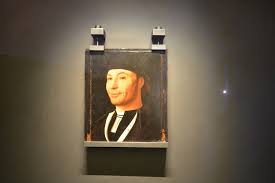
So I leave my pleasant home for four days and set off for Cefalu. The first part of the journey is a repeat of yesterday as far at Catania but then veers off through the centre of the island on the A19. The A suggests autostrada or motorway and bits of it are but I reckon 30% of my journey was in slow single file traffic through mostly invisible roadworks – the odd digger made you think some work might be going on now and then. The landscape is generally brown and pretty dull until I get to Enna where on entering the Madonie mountain chain where the massive Pizzo Carbonara (o not a duly noted) is the second highest peak after Etna. I was surprised to see a ski lift sign by the roadside but there’s a resort here, Piano Battaglia, and a further two on Etna. Then it’s a long descent towards Palermo before a side road heads off to Cefalu. I’m glad I made the detour. It’s a very pretty town in a splendid bay and therefore totally touristy – but that’s no bad thing. It reminded me a bit of the Concha beach in San Sebastian (Donostia for any Basque readers). A long promenade, colourful beach umbrellas, the fight for a stretch of the strand, warm sea and bright sun – all the ingrdients for a fun holiday. So I headed to the ‘second most important cathedral after Monreale’. It’s, of course, up a flight of steps and built in Norman style between 1131 and 1240. Like Monreale it has a lot of gold and the altar piece is a massive and incredibly detailed mosaic of Christo Pancreator. And the museum nearby has a portrait by Antonello da Messina (of Annunciata fame) of a smiling boy. He was good.

A quick coffee and then off to the car hire return place, confirm no damage to report and take the shuttle bus into the airport. As this was my first journey since the operation, I’d been a bit worried about my hip through scanners but in both instances I just pointed to it and said either “metal hip replacement” at Stansted or point at hip and “metallico” at Palermo. In both instances I had a further wand wafted over me before being allowed to proceed. I did have a photo on my phone and my hospital discharge papers just in case but they weren’t required. The flight was delayed by 30 minutes but was happily uneventful. It was clearly not a busy time but still took 30 minutes to slalom our way through passport control. My suitcase had at least arrived by then so I retrieved it, I got the Stansted shuttle bus to the long stay car park, took a few moments to realise I didn’t have to change gear any more and arrived home having had a thoroughly enjoyable holiday in Sicily.

Noto bene, Ragusa rifusa e Medic-toeranneo

So after a local day yesterday and still glowing from last night’s theatre trip – I know family and friends have seen opera in Verona but this was a first for me and was just astounding – I planned to venture south to Noto and Ragusa both highly recommended both by the book and Gwyn and Von. Giulia Googlemappa took me on an interesting route when I’d clicked no motorways. It wended its way through flat areas near Siracusa with citrus fruit and olives, gradually segueing to slightly more upland areas near Avola of wine DOC fame where slopes were covered in poly tunnels and black and red vine protection nets. Necessary eyesores I suppose but not pleasant companions among rural roads fragrant with rosemary (I nicked some for later) and other odours.

I could see that Noto was a seriously hilly town so I made my way quite a way up, found a parking spot, shot the street name so I could find my way back and set off up to the centre. My first encounter in a pleasant, not quite yet awake square, was the Chiesa di Santissimo Crocifisso. I mounted its steps and entered a really splendid space. Apart from the church itself there was a pair of Roman era lion sculptures which used to be outside but were moved into the nave in 1984 to prevent further environmental damage – early onset climate change awareness, perhaps.

Walking around in 32 degrees brings on a thirst but as I’m driving and it’s only 10:30, I settle for a granita. I’d had it explained somewhere that the granita started in Sicily because they brought down great blocks of ice from the mountains to preface the refrigerator and a bright spark said we can make money out of this. Siracusa lemons are also highly regarded so I was honoured to receive this refreshing dish – served with a spoon rather than in a glass with a straw as in Spain. Off to find the cathedral and town hall both must-see buildings in a town where at every corner you are stunned by the architecture and the expense of constructing these palazzos.

A random palazzo of which there are so many.
Noto Cathedral.

So of course there are more steps up to the cathedral and from the top I look back at the town hall which was built in 1746 in a style ‘inspired by French palaces’. Well just wow. Twenty arches on thin columns defying gravity. I prefer the baroque cathedral of Saint Nicholas myself from1776.

Inside the cathedral I was able to have a moment of levity with my grandson Jake by WhatsApping him a pic of his namesake suggesting he was praying for good A level results – pre-university entrance qualifying exams for those not familiar. Poor Jake some of the worst exams of your life. But you’ll be fine, I’m sure.

I think I could have happily spent more time in Noto, but Ragusa called. The drive there was exhilarating through undulating foothills and then into switchback roads through Modica and then into some real valleys, nay gorges Agrigento, as we approach Ragusa. It’s perched across a hillside and gave me a first problem. Note to self number whatever by now: be precise with Giulia delle mappe. There are two Ragusas and she takes me quite logically to the one where you can drive, park your car and enjoy a bland modern city. However I need to be in Ragusa Ibla further across the hill. Two towns joined by a staircase threatens the guide book. I follow brown Ibla signs and being turned back by a cop at a another road sign that said ‘city centre permit holders only’, I do a U-turn and find a convenient parking place and start to walk up into the real Ragusa. At first sight it reminded me of Deja in Mallorca clinging to its hillside. However this was a really big hillside and after 170-odd steps with a few bits of level in between I seem nowhere near reaching the centre. I also missed my footing a couple of times as the steps are uneven and recalling a broken elbow in Mallorca and my daughter’s admonition “You are old” I regretfully abandon Ragusa, retrace my steps, carefully, back down to the car and head off back to Modica for lunch. This may be a major regret of my life as Ragusa sounds amazing. Tant pis! I am old!

Sitting with a beer and a ham and mozzarella cannoli in Modica, feeling a little crestfallen let’s admit it, two thoughts occur to me: Italian pastry is very stodgy and I’ll avoid it in future – understand it’s role is to be filling while hiding the fact that fillings are the expensive bit while flour and water are plentiful, Second I’m on holiday on an island and while I’ve seen the sea I’ve not really been that close or indeed to the seaside. So Giulia is tasked with taking me to Modica Marina which sounds like it should be on the coast. It is and it’s lovely. Free parking until the season kicks in on June 25, a sandy beach and a promenade which I guess would be filled with eateries when the season starts, and aloo. I sit on an bench for an hour and read Colm Toibin’s fabulous sequel to Brooklyn, Long Island. I’m biting my nails with the jeopardy at every turn. What a writer! This is what holidays are meant to be. Eilis takes a dip in freezing Irish Sea in the chapter I just finished.

Encouraged by this I took myself to the strand, removed my shoes and exposed the wounded Birkenstock toe to the healing influence of the warm and salty Med. Seems to have worked as it’s not leaking stuff anymore. Now I’d said to lots of people I was booking a BnB in Siracusa so I could market shop and cook one night or so, because I love markets and regret not being able to shop because I’m in a hotel. Well Monday I’d just arrived, Tuesday was the theatre trip and a huge lunch so now looked like the tine. A local supplier allowed me to purchase one potato (cubed and fried in olive oil with the rosemary I’d knicked), an aubergine, a pepper and he had a piece of pork fillet (unusual in Sicily) an attractive option after an almost entirely, and happily fish diet, it seemed a good idea. I cubed the pork and made a mini-ratatouille with the veg and enjoyed it with the only possible wine since I’d driven through Avola in the morning.

The paper gods

So it’s Tuesday and Syracuse. I’m booked for Fedra at the Greek theatre at 19.30 so decide Ito spend the day doing a tour of Siracusa’s famous island Ortygia. There are two bridges onto the island and the main street close to my apartment, Corso Umbero I, leads directly to one of them.

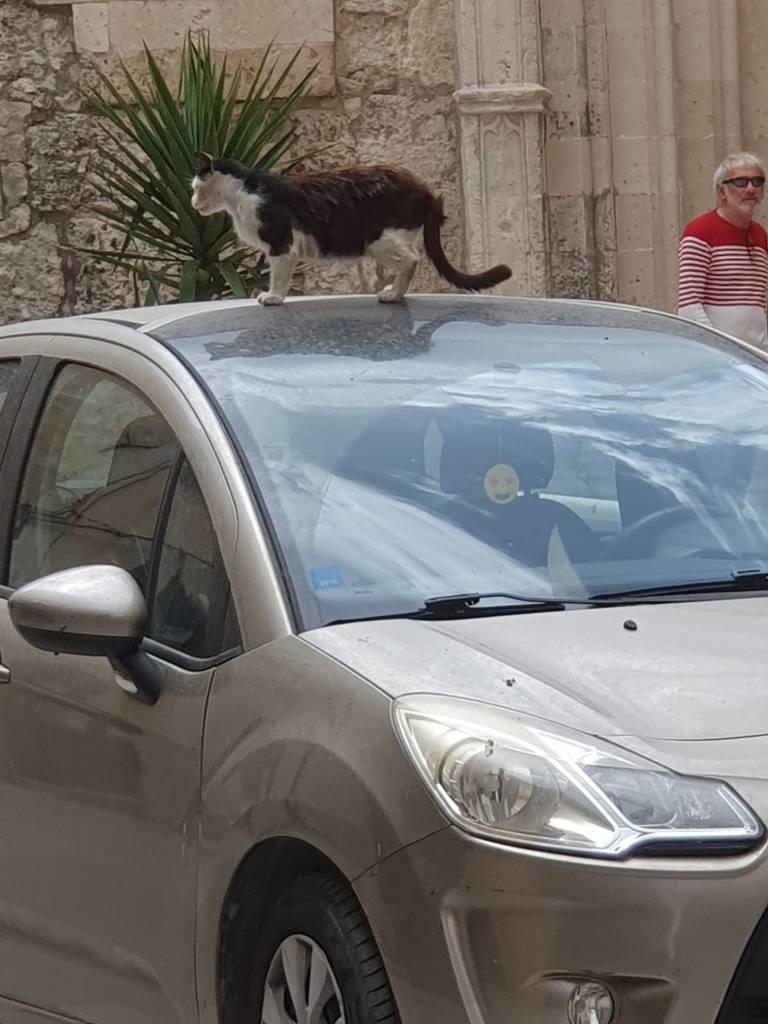
Confronted almost immediately by a cat on a hot car roof, I have to head off the way it’s pointing. So I go there and admire the ruins of the Temple of Apollo – grey not the golden stone of yesterday’s ‘Valley’, but impressive in scale. And it dates back to the sixth century BCE.

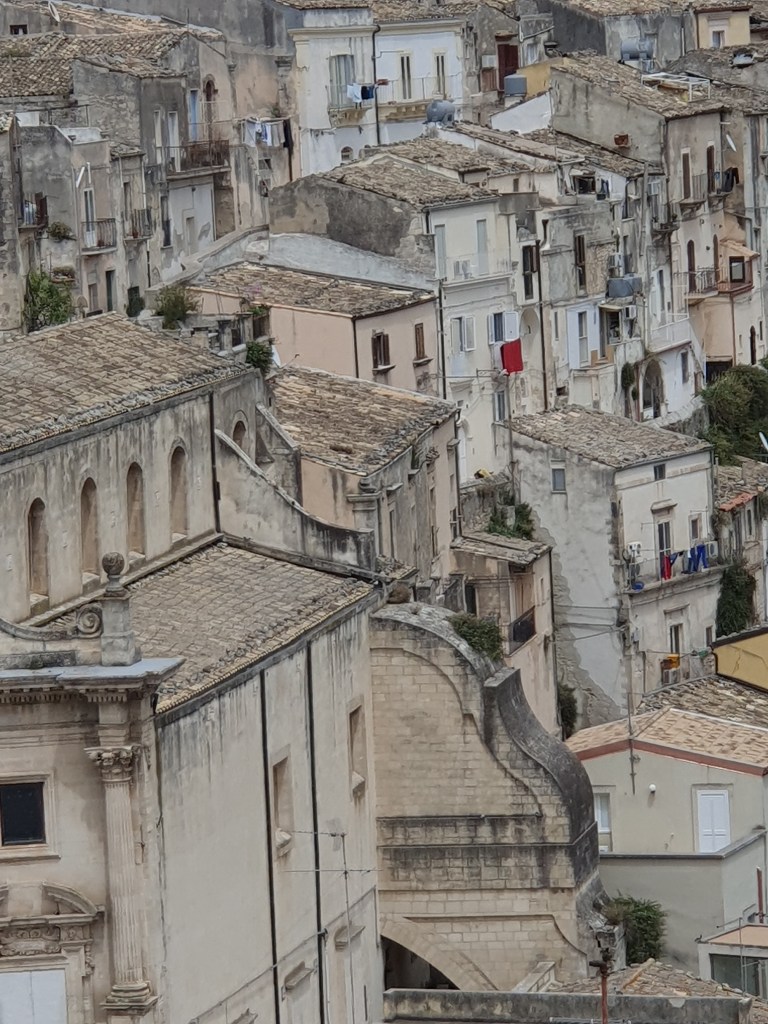
I walk on through the Jewish quarter, cursing Netanyahu for giving them an undeserved bad name, and find myself enchanted by a tiny church (San Paolo I think) with a magical Catalan style multi-column arch – just so elegant. As I pass through the narrow streets I am often lured by planting displays into dead ends – hey, that’s discovery! I emerged at a seaside street and opposite was a building that made me think I’d chosen the right BnB.

Shortly after this, as a self-styled writer, I was intrigued by the Museum of Papyrus. Yes I known it’s importance and Egypt and all that but why in Sicily? So I have to go in and find out. It transpires that in times past papyrus plants came to Sicily as part of conventional trade deals and found a home on the river Caine, where it has flourished. It’s not just a museum it’s a whole research centre into papyrus ancient and modern with rooms stacked with files and specimens that we could not enter. But where we could go was fascinating with a video tracing Carrado Basile’s fascination with all things papyrus, the production process and examples of works on papyrus from many different centuries. And of course they had papyrus boats which I had heard of before. I was particularly struck by an ancient Egyptian palette and pens.

After an unexpectedly interesting hour and a half (always keep an open mind!) I walked on around to the easternmost point of Ortygia but I couldn’t see the mainland., but the sea was good and the prospect appealing.

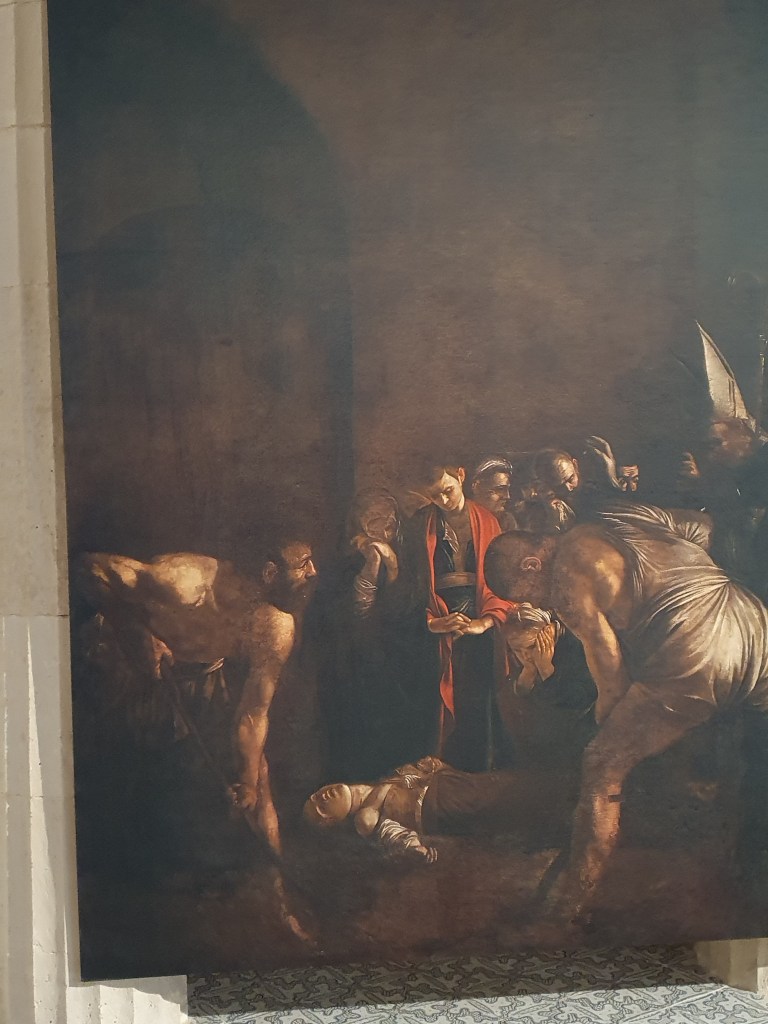
It proved even better in that a bar with a beer was close by and restored me to walk into the main square in quest of Caravaggio. One of his paintings The Burial of Santa Lucia is in a church here. It isn’t, but there’s a technologically brilliant facsimile involving hi-res scanning and 3-D printing. It’s in a room with a modern take on the subject that I liked for it’s expressionism and a photographic tableau recreation that was quite scary.

This church dedicated to Lucia the patron saint of Sicily is at the edge of a very impressive main square with the cathedral and of course lots of restaurants, It’s a fine cathedral too.

It’s time for lunch and I take it back by the other bridge off Ortygia, A seafood mixed grill gives me two enormous prawns, octopus tentacles (sorry!) and a squid and a slice of swordfish, full stomach, oily fingers and a good local crisp wine to set it off,

Next step was to book a cab for the Teatro Greco and sadly do some laundry. I’d packed a few pairs of pants and a couple of tops too few. The dryer on the balcony was struck by a Saharan sand storm in the night so I had to do it all again next morning. Reassurance – I do have clean pants.

But the theatre visit was incredible. Loads of young people thronging their way in – set book at school? The amphitheatre is a stunning semicircle and despite the cushions (thanks) you can still see much of the original stone seats. It gradually filled up.

I had an interesting exchange with a group of young women who asked whether I’d understand a word. I told them I knew the story and loved theatre and wan’t going to pass up a probably once-in-a lifetime experiences. They sang Happy Birthday to me and we were friends for the duration – I did feel a little uneasy as an 80 year-old among teenagers but soon the play was the thing and we all became absorbed by a production directed by the Scottish Paul Curran. And what a production! A huge godhead formed the main set dressing, otherwise mostly scaffolding, A mix of wafty mauve-tinged shifts for the chorus, dramatic yellow for sad Oenone, black for Fedra and an amazing gold outfit for Aphrodite. The opening Chorus scene was a great dance routine The opposing armies were in rescue services hi-vis gear and helmets.. And as so often with Greek drama it all ends in tears and cheers. The audience stood as one at the end to salute the performers,

The Valley (!) of the Temples and sea to sea

After a pleasant breakfast on a sunny terrace at the BnB with views up to the top of the old town and out to sea, I set off for Selinunte, the amazing archeological site just ten minutes from the centre of Agrigento. I noted as I went to the car, that inverted umbrella displays were not the sole prerogative of Valdepeñas where I’d first seen streets full of them a few years back.

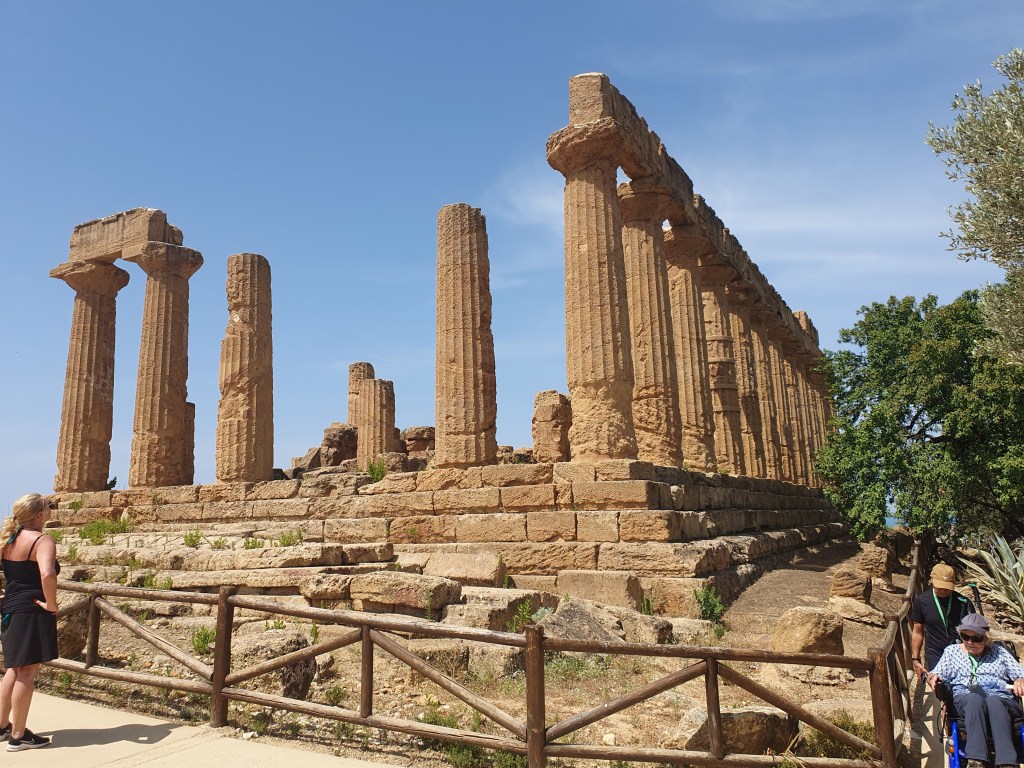
As you approach the main entrance this magnificent ruin dominates the hill – yes hill – in front of you.

The Temple of Juno Lacinia built between 460 and 430 BCE

I wanted to stop the car to shoot it from a distance but the stream of visitors’ vehicles would not permit that. Just believe me it’s a breathtaking moment, like first seeing downtown Boston from the I-93 or the City of London from the M11. There was chaos at Gate V so I carried on to a gate at the other end of the site where there was no access, for no specified reason. I was told to return to Gate V. There was less chaos by now and I was able to park under a shady olive tree, buy my ticket and trudge up the hill. It is steep and it’s definitely not a valley. There are lots of useful information boards in Italian, English and French and the site goes on for a long distance from this eastern end along a ridge towards the sea. It is quite stunning.

This first temple of Juno is obviously a ruin and as I walk along the hill/ridge I pass burial chambers and evidence of multi-cultural appropriation. The Romans desecrated the Greek buildings and remade them. The Arabs had a go too and finally the Christians took over and the original worship of Gods various and Nature were subsumed by the dominant faith. Original fortifications became burial sites since they thought they were safe from invasion. I was reminded of the triple-whammy of Empuries in Spain where the Carthaginian original settlement was successively taken over by Greeks and Romans all with their own ideas of what’s to do with the place.

Then as you walk musing about all this along you come upon this:

The almost complete Temple of Concord from 440-430 BCE.

I really needed hiking poles (not available) to scale the outcrop to get this shot – but I was very careful, I promise. (For new readers I have a recent history of falls resulting in stitches to the head.) It is a stunning piece of craftsmanship and design and crowns the site with its awesome presence. Even I’d be inclined to pray. There are lots of other ruins, sculptures and relics scattered over the hill but there’s also a garden and you know how i like a garden. It had oleanders, rosemary, lavender and herbs I wasn’t sure about but a lovely fragrant and cooling period on the hillside at 32 degrees.

Oleander, olives and prickly pear – very Mediterranean!

Around this point I decided I’d gone far enough and found this excellent shady arbour for my return. The only problem was that I was accosted by a lizard and history tells what trouble that can get you into. (Again for those who weren’t there, an inquisitive lizard in Ibiza led to a group of us entering a team of plastic lizards in a local 5-a-side football tournament. Full story is in YBR 39 available from https://thewatfordtreasury.com/ or I can send the text of the article as a pdf to anyone who cares.) Happy memories of absent friends.

On my way back I passed an enclosure celebrating the return of the mountain goat to the – signboard quote – mountainside. I guess the threat of sacrifice has passed and they can safely graze. There was a cafe nearby so a late morning coffee set me up for a cross-Sicily drive. I hadn’t covered the entire site but had spent a full two and a half hours of marvelling at the ‘Valley’ of the Temples.

My next four days were to be spent in Siracusa so I needed to traverse Sicily from the Mediterranean Sea on the west coat to the Ionian Sea on the east. With a co-navigator I might have drifted about the centre from town to town, but as a lone traveller, I decided to take the A19 motorway that cuts straight through the middle. It was a scenic journey nonetheless, with the lush citrus groves near the coast, giving way to olives and almonds and then to a rugged landscape of harvested cornfields, rock outcrops and an overall brown-ness. It was very hot today but we were clearly gaining height as warnings about winter tyres being obligatory were joined by snowflake signposts and skidding dangers when icy. Hard to imagine that today. But like roads everywhere there were many stretches with road woks reducing the dual carriageway to two-way operation. What I did note was that in every lay-by there was scattered litter – some loose, some in plastic bags. From my limited experience I would say that Sicily is a mess when it comes to both clearing up rubbish – and I regret to say dog shit – which is everywhere.

Another aspect of Sicily that’s rubbish from my sample of one is the food on offer in service areas – I stopped at one for a late lunch and fuel. Everything was in bread including a soft bread bun that contained breadcrumbed chicken fillets! No salads just ciabatta, panini, focaccia and buns. I finally settled for a lemon Fanta and a bag of crisps. And I have to say that the offer was familiar from a number of the numerous ‘street food’ outlets in Palermo and Agrigento.

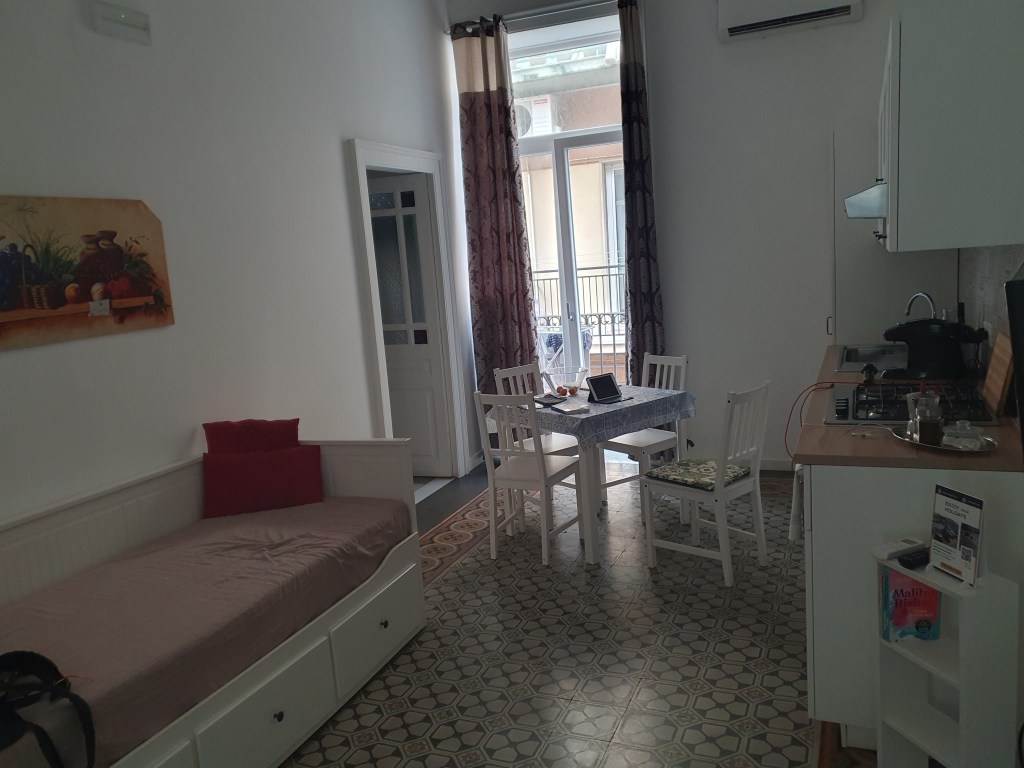
For once I found the BnB very easily but had to wait for someone to come and let me in. He was pleasant, efficient and explained that the breakfast part was served in the Hotel Mediterraneo two minutes walk away. He also carried my suitcase up these and into my very pleasant apartment which has this open plan living kitchen, dining area and a bedroom and bathroom and a balcony with clothes drier. Good choice I think.

Parking is free in nearby streets – narrow and mostly one way – I had to move my car to let someone else pass while waiting for the guy to arrive. So I went and parked, returned to put the phone that’s done sterling SatNav duty and charging block on to charge, unpack and then set out to explore the immediate neighbourhood. Luckily just round the corner is a bar with a much-needed post-driving beer. I start walking towards the sea and passed a garden that made me stop and think because of its very explicit signage. I’m used to Jewish quarters in lots of Spanish cities and had read that the Giudecca is one of the areas to explore on Ortygia, the island that forms a large part of Siracusa.

I make it to the twin bridges across to Ortygia but had planned that for tomorrow so I do a restaurant recce, buy some basic supplies for ‘home’ drop them off and then go to eat Siracusa-style tuna, cooked with onions peppers and tomatoes, helped along with an Etna red, half with the meal, half carried through the streets to enjoy while unwinding with music and a book. Buonanotte.