
So it’s Tuesday and Syracuse. I’m booked for Fedra at the Greek theatre at 19.30 so decide Ito spend the day doing a tour of Siracusa’s famous island Ortygia. There are two bridges onto the island and the main street close to my apartment, Corso Umbero I, leads directly to one of them.
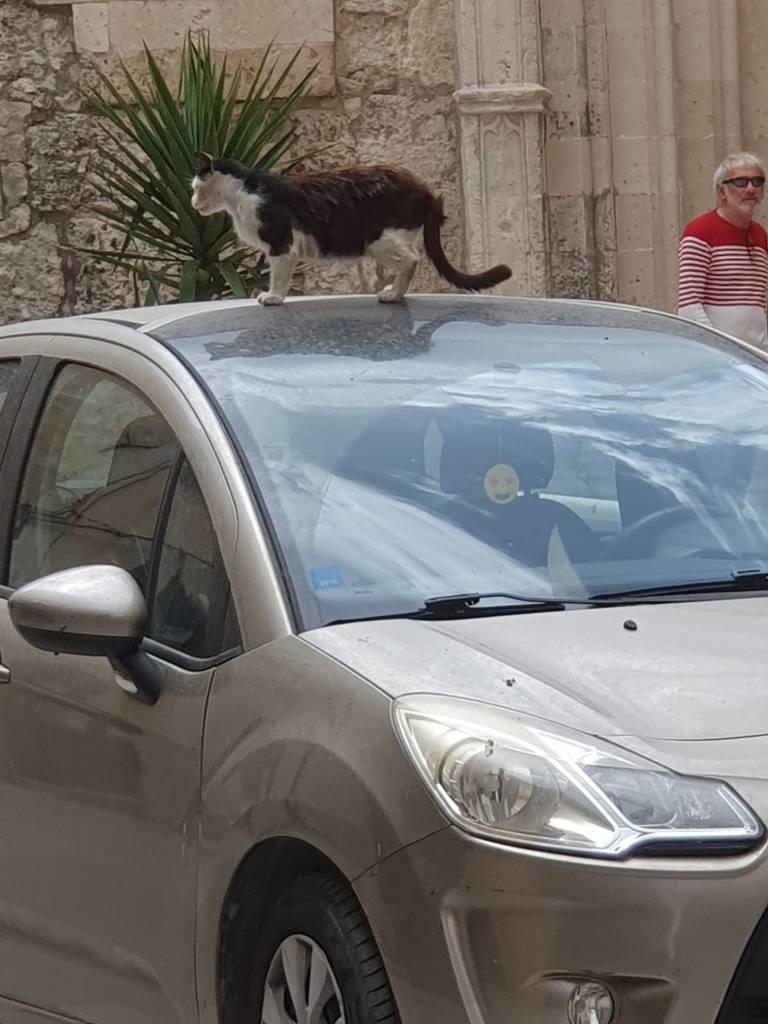
Confronted almost immediately by a cat on a hot car roof, I have to head off the way it’s pointing. So I go there and admire the ruins of the Temple of Apollo – grey not the golden stone of yesterday’s ‘Valley’, but impressive in scale. And it dates back to the sixth century BCE.


I walk on through the Jewish quarter, cursing Netanyahu for giving them an undeserved bad name, and find myself enchanted by a tiny church (San Paolo I think) with a magical Catalan style multi-column arch – just so elegant. As I pass through the narrow streets I am often lured by planting displays into dead ends – hey, that’s discovery! I emerged at a seaside street and opposite was a building that made me think I’d chosen the right BnB.


Shortly after this, as a self-styled writer, I was intrigued by the Museum of Papyrus. Yes I known it’s importance and Egypt and all that but why in Sicily? So I have to go in and find out. It transpires that in times past papyrus plants came to Sicily as part of conventional trade deals and found a home on the river Caine, where it has flourished. It’s not just a museum it’s a whole research centre into papyrus ancient and modern with rooms stacked with files and specimens that we could not enter. But where we could go was fascinating with a video tracing Carrado Basile’s fascination with all things papyrus, the production process and examples of works on papyrus from many different centuries. And of course they had papyrus boats which I had heard of before. I was particularly struck by an ancient Egyptian palette and pens.


After an unexpectedly interesting hour and a half (always keep an open mind!) I walked on around to the easternmost point of Ortygia but I couldn’t see the mainland., but the sea was good and the prospect appealing.

It proved even better in that a bar with a beer was close by and restored me to walk into the main square in quest of Caravaggio. One of his paintings The Burial of Santa Lucia is in a church here. It isn’t, but there’s a technologically brilliant facsimile involving hi-res scanning and 3-D printing. It’s in a room with a modern take on the subject that I liked for it’s expressionism and a photographic tableau recreation that was quite scary.
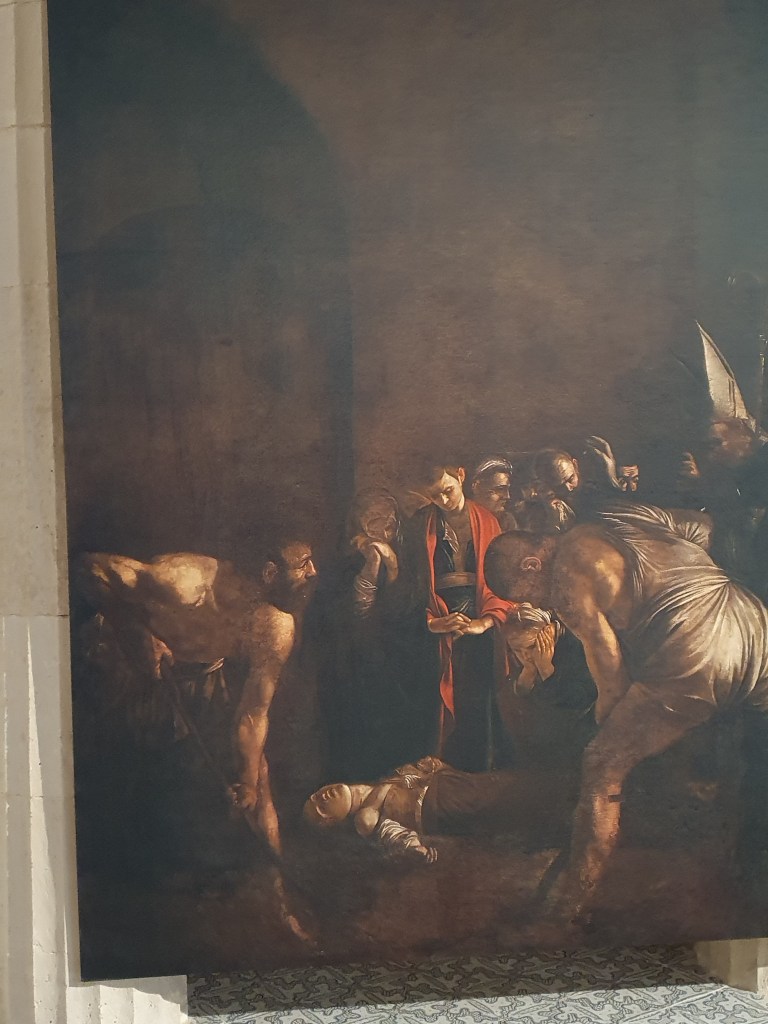


This church dedicated to Lucia the patron saint of Sicily is at the edge of a very impressive main square with the cathedral and of course lots of restaurants, It’s a fine cathedral too.


It’s time for lunch and I take it back by the other bridge off Ortygia, A seafood mixed grill gives me two enormous prawns, octopus tentacles (sorry!) and a squid and a slice of swordfish, full stomach, oily fingers and a good local crisp wine to set it off,
Next step was to book a cab for the Teatro Greco and sadly do some laundry. I’d packed a few pairs of pants and a couple of tops too few. The dryer on the balcony was struck by a Saharan sand storm in the night so I had to do it all again next morning. Reassurance – I do have clean pants.
But the theatre visit was incredible. Loads of young people thronging their way in – set book at school? The amphitheatre is a stunning semicircle and despite the cushions (thanks) you can still see much of the original stone seats. It gradually filled up.


I had an interesting exchange with a group of young women who asked whether I’d understand a word. I told them I knew the story and loved theatre and wan’t going to pass up a probably once-in-a lifetime experiences. They sang Happy Birthday to me and we were friends for the duration – I did feel a little uneasy as an 80 year-old among teenagers but soon the play was the thing and we all became absorbed by a production directed by the Scottish Paul Curran. And what a production! A huge godhead formed the main set dressing, otherwise mostly scaffolding, A mix of wafty mauve-tinged shifts for the chorus, dramatic yellow for sad Oenone, black for Fedra and an amazing gold outfit for Aphrodite. The opening Chorus scene was a great dance routine The opposing armies were in rescue services hi-vis gear and helmets.. And as so often with Greek drama it all ends in tears and cheers. The audience stood as one at the end to salute the performers,


 mikeandmurakami.com