Lorca Day 1

I have always been a big fan of Federico Garcia Lorca as a poet, playwright, composer and martyr. He came from Granada so I had to take the opportunity of exploring his heritage in and around the city. I had seen the stunning Harriet Walter in The House of Bernarda Alba on stage and Glenda Jackson playing Bernarda in the film. And both Juliet Stevenson in a regular performance of Yerma followed by Bille Piper’s stunning portrayal in the adaption at the Young Vic showed the current relevance of Lorca’s work. l’m renting a car later in the week to visit his birthplace and early home in Fuente Vaqueros and Valderrubio but today is concentrated in the city itself. I decide not to breakfast in the Cafe Futbol again as I need to head off in the opposite direction. I do find the requisite juice and coffee but then get sidetracked on the way. I later discovered it was just as well as the FGL Centre doesn’t open until 11:00.

First I walk past this arched entrance which I discover is to El Corral de Carbon which dates from the early 1300s and was an al-fundaq – a corn exchange and lodging house for merchants bringing wheat to the city. It has a splendid courtyard with huge grape vines climbing up its pillars to form a canopy – sadly bare at this time of year.

Then I was back at the market – one of my weaknesses in any town or city. The Mercado de San Agustin did not disappoint with its superb seafood and ham stalls, lots of bars and lots of noise.

By now it is well past opening time and I set off for the first objective of the day. Spot the writer!

It took a long time and a lot of wrangling to get a centre to celebrate Lorca in his home province – Madrid and New York got there much earlier. This modern building houses the archive of his works that was assembled by family after a) his death, secretly and b) after Franco, more openly. There are thousands of manuscripts of plays, poems, songs and prose; extensive exchanges of correspondence with publishers and producers; recordings of poetry readings; many, many photographs and some video and the big surprise to me lots of his sketches and paintings. I knew he pretty much defined polymath but the paintings and drawings echoing Miro and Dali, Braque and Picasso had escaped my appreciation on previous encounters with his work.

The main display area is on the second or third basement floor – I stopped counting the steps – and has objects, dresses worn by Marianna Xirgu at the premieres of Bernarda Alba and Yerma and letters, press cuttings, brilliant period posters, photographs and the drawings.

I had just started to snap a few when a museum lady came to ask where I was from. She seemed delighted I was from Londres, But also told me photography was forbidden. So all I’ve got are his typewriter and his amazing signature.

I spent a couple of hours soaking up all this Lorciana during which time my appreciation for him grew even more – he was only 38 when they shot him so what might he have gone on to achieve? One of the posters was for a performance by his touring theatre group La Barraca which he founded to take drama to the villages and the people and an incarnation of which still exists. Dee and I saw them perform one of his farces, the very sexy Don Perlimplin in Ubeda a few – probably fifteen – years ago. We didn’t have much Spanish at the time but the action told the story very clearly as explained by the play’s subtitle “An erotic lace-paper valentine in three acts and a prologue”. Happy memories came back as I looked at a Barraca poster.

Fortunately I found a lift to take me from -3 to 0 which saved the legs doing all those stairs upwards. The outside world was perfect with sun, not a cloud to be seen and pharmacy signs indicating 16 degrees. Time for a stroll to the next location the Parque FGL about fifteen minutes away. As so often the walk passed through a couple of the delightful squares that seem to be a characteristic of Granada and indeed many Spanish cities. This one was Plaza Trinidad and there was a long queue for what was obviously a popular bakery kiosk and of course you can’t escape him for long in Granada.

A sense of déjà vu occurred as I crossed the Camino de Ronda where I’d changed buses on Sunday. I was soon at the entrance to the park which is extensive with a number of different areas.

It also contains the Huerta de San Vicente, the Lorca family summer home in Granada. It narrowly survived a demolition order in 1975 – was Granada still run by Francoists? But public outcry saved it and created the park around it. It’s now a museum but is closed on Christmas Eve but I may get back down later in the week.
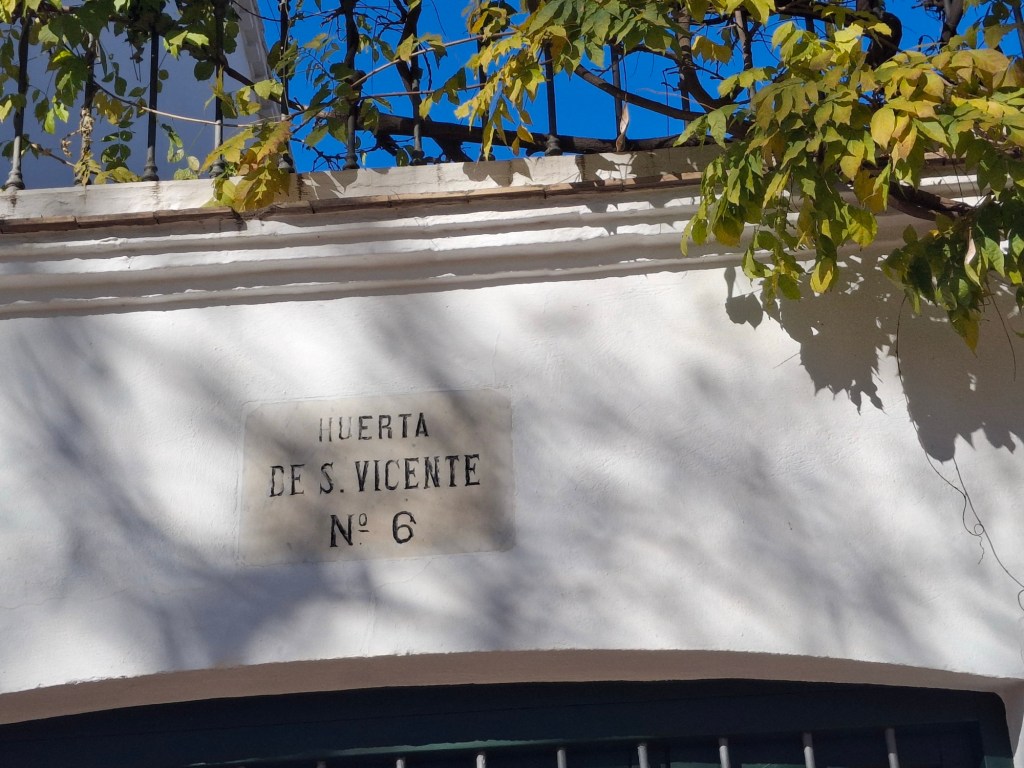
I was moved to write a poem while in the gardens which I’ve shared with my BBPC colleagues but won’t bore you all with here. I walked back into the centre along Calle Recogidas another posh shopping street halfway along which I spied a rather nice looking courtyard in the sun – ideal for a beer – first of the day at 14:30 – call this holiday! The courtyard I discovered is part of a smart hotel Palacio de Los Patos in the Hospes hotel chain. We had stayed in one of these in Valencia a few years back ad had enjoyed it very much. But posh street, posh hotel. I could have stayed for 1.75 nights for the price I’m paying for seven nights at my Palacio de Las Navas. Maybe when I win the lottery! But they did give me a free tapa of couscous with seafood.

Patio at Palacio de Los Patos a bit earlier in the year (thanks Tenedor)

The street leads back to the Puerta Real which is close to home and I think about getting some lunch remembering that everything shuts in the evening on Christmas Eve in Spain. Lone eating is difficult when you occupy a table that could take two but on this day it was looney.
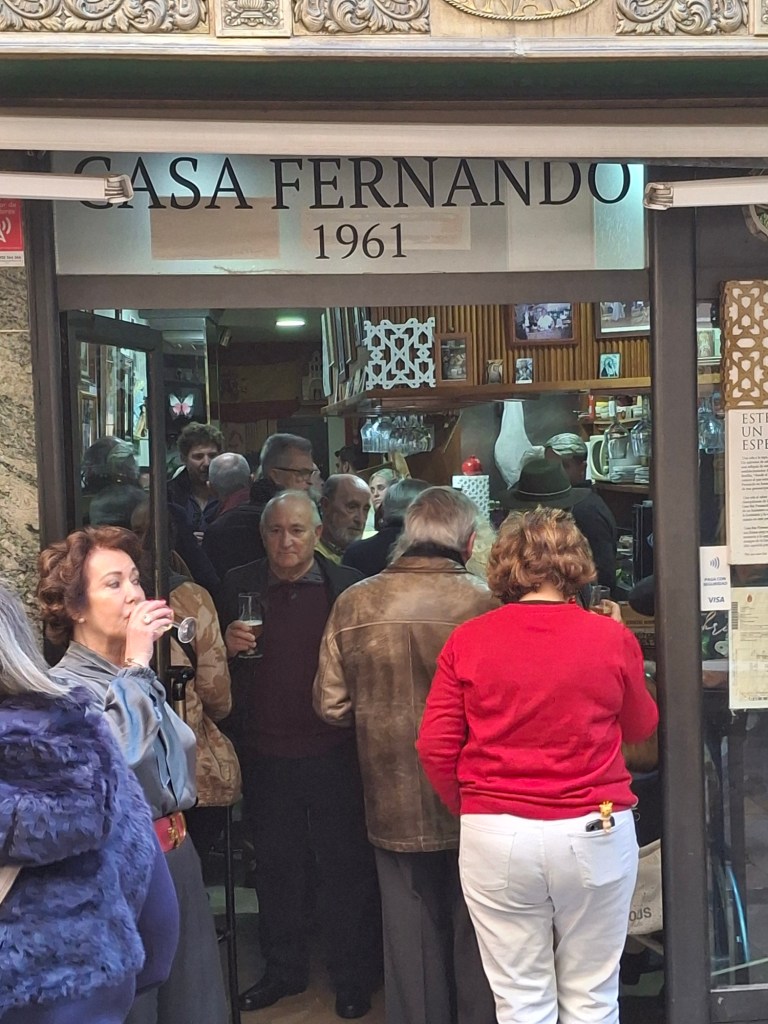
This was the state of one of the bars further up Calle Navas – utterly rammed – as were all the others and I received a lot of shaken heads and “lo siento“ responses. I eventually found a pizza place that could give me a pavement table and had a rather good ravioli with roquefort. I then repair to the grocery shop to get some cheese, ham and chorizo for an evening picnic as all the restaurants said they were going to close.

In the evening, Netflix told me a film I’d like was expiring on 31 December so I watched Todos lo Saben (Everybody Knows) a convoluted family drama and kidnap story with Penelope Cruz and Javier Bardem. It wasn’t brilliant but showed current village/small town life in a way I’m sure Lorca would have approved. Peasants not the posh centre stage.

A day of two halves and day

27 sushi pinkWhy do dismay and

       delight  so often mix in   

       one and the same day?

So I’m writing this after a Saturday that was not quite what we had hoped for. All things being equal however we should get to go to one more soccer match this season and see Watford promoted through the play-offs instead of automatically. What a horrific game to watch with Jonathan Bond seriously injured by a Watford player Ikechi Anya after a deliberate push by on him by a Leeds player. Sheer nerves gave away two unfortunate goals (sadly it was Jack Bonham’s first appearance as keeper for the first team after the injury to Bond) and we now have to do it all again with possibly only a rookie keeper. Ah well.

First disappointment was to discover that you can’t actually visit the Imperial Palace except on two days of the year. We had been hoping to have a touristy morning starting with a trip across town to Tokyo Station and then a stroll to the Palace gardens at least. Well Tokyo Station which we’d only ever seen from inside is a true delight of a building and an exhibition was being held to celebrate its twinning with Grand Central in New York and its centenary next year – a year after Grand Central. Outside – after the traffic control crash barriers and so on – there is a great open space with fountains and granite benches. Granite is cut and polished so beautifully throughout Japan as seating and ornamentation in public spaces, as indeed is wood.

IMG_2504 IMG_2529

Tokyo Station                                                                       Us at the “Imperial Palace”

We made our photostop at the point where you can glimpse an outbuilding above the impressive high walls and wide moat and then crossed over to the first surprise and delight of the day – Hibiya Park – forty acres of endlessly changing green spaces right in the heart of the government and business district. It was Japan’s first European style park and opened as such in 1903, having previously been a military manoeuvre and parade space for the shoguns. From the first little hill we encountered with its replica of Philadephia’s Liberty Bell, past tennis courts, rose gardens, lawns, lakes, fountains and performance spaces the park revealed its clever landscape. It’s an obvious venue for glorious wedding photography as we saw and has a hint of Central park. From time to time you would see cars driving around the perimeter but noiselessly in that weird sound barrier parks can sometimes erect.

IMG_2546  IMG_2555

We next caught the subway to Akasaka to look for a number of key locations in several Murakami books. However it was time for lunch first which after inspecting several back street establishments behind the station we elected for a stand-up bar where the only offer was tako yaki octopus balls – precision grilled by the chef and served by a smiling host. They needed careful consumption as the interior was volcano hot. They came with a choice of three toppings and were delicious – excellent serendipitous street food. Then off to the police station, the Nogi Shrine and Park – yet more ceremonial photography – and some streets on the Akasaka-Roppongi boundary. A brief stop was in order at a smart cafe near Suntory Hall called “Randy, Beverly Hills and Tokyo” which also had a display of tempting craft items on sale. The Ark Hills development here is stunning with apartments, offices, concert halls, open spaces and of course shops and cafés.

IMG_2581  IMG_2626  Randy's cafe IMG_2650

Then finally we set off for the Hotel Okura where heroine (?) Aomame undertakes a seriously important mission in 1Q84. It also happened to be where I stayed in 1979 and 1981. Funny how when the Japanese Government is paying you get to stay in a top hotel at a current rate of £250+ a night and enjoy its facilities but when it’s on your own personal budget the Sunroute Plaza Shinjuku seems perfectly adequate. My recollections of a really chic, smart hotel were dashed by the exterior which is unprepossessing to say the least. The vast lobby is unchanged and the pink clad elevator attendants are as I remembered them. There was a bonsai exhibition as part of a bigger gardening show. Now neither of us are great enthusiasts but these were truly works of art with their shaping – perfect cones, leaning layers or cascades. Back to the hotel to change and off to Roppongi to watch the sad game of football and eat chicken wings, ribs and fries which I’m afraid to say felt totally alien after only three weeks away. The staff kindly assisted in our efforts to raise the Orns but you know what happened.

IMG_2660  IMG_2687

Sunday started with a lengthy browse around a flea market at the Hanazono Shrine which we had visited on our first day in Tokyo. Lots of kimonos, jewellery, fans, prints, household objects and the usual mix of real antiques and not-so-real “antiques”. A few small purchases were made before we took the subway north to explore Waseda University where Murakami studied. It had a real Oxbridge/Ivy League feel and wandering between buildings old and new in a mixture of expressive and utilitarian architecture which, as at so many universities, reflects the periods in which construction took place. Many people are also of the opinion that Waseda is the model for Toru Watanabe’s unnamed university in Norwegian Wood so it was interesting from that point of view as well.

IMG_2713 IMG_2719

Next big question: where to get lunch in Waseda on a Sunday with few places open in this classy suburb. We got lucky by penetrating the blue curtains of a sushi bar where a venerable chef prepared a plate of superb authentic sushi – no extra wasabi was even hinted at. They also very kindly recharged my camera battery as we ate. Such service.

IMG_2745  IMG_2743

A scampering afternoon of visits to Ikebukuro to find the Traditional Japanese Crafts Centre only to discover it’s relocated to Aoyama. So we enjoy briefly the mad atmosphere of Ikebukuro with stilt walker, performance artist, pavement painter and jazz combo – just like being in Covent Garden then off to Aoyama where the boulevard features in several of the novels and we do find the craft centre which holds a wonderful display of regional work from all over Japan. A great collection but a little on the expensive side for our pockets, if not our taste.

IMG_2760  IMG_2772

Ikebukuro Square                                                                 

Another domestic early evening at the coin op laundry in the basement, map finding and precision timetabling for tomorrow’s planned trip to Chiba Art museums and Kamakura and then dinner in a restaurant Maimon not far from the hotel. As well as some delicious yakitori with leeks we had a dish new to us bagna cauda which was fresh raw vegetables which you dip into a fondue-like bowl of a sauce consisting of soy, garlic, milk, sesame and anchovies – oishigatta as we say repeatedly – and so good for us too.