Music, mystery, movement and more

I had the privilege a couple of weeks ago of seeing an hour of the technical rehearsal of The Unbelievers at the Royal Court as part of Frances’s patrons’ deal. It was fascinating and set up a sense of great anticipation for the play itself. It did not disappoint. The central performance of Nicola Walker was quite stunning as a woman grieving the mysterious disappearance of her teenage son. Spoiler alert – he doesn’t appear but his absence hangs over the three intercalated time periods after his failure to return home.

The whole cast remains on stage throughout except for a couple of costume and role changes in a set that has a sparse domestic interior at the front with what looks like a police or doctors’ waiting room at the rear. Fear, anger, incomprehension, blame and violence swirl through the mother, her two ex- husbands, children and step-children. Some people, it seems, found the mingling of the day after, a year after and seven years after time periods confusing but I thought it added to the power of the writing, depicting clinically the way grieving does affect your sense of reality and time. It sounds bleak but had quite a few moments of hilarity. A serious examination of grief, guilt and sanity leavened by tender, moving and funny moments.

Next it was off to the downstairs theatre at Hampstead where new playwrights are given space to experiment. The Billionaire Inside Your Head by Will Lord was an examination of greed, ambition, entitlement and fantasy in an office setting. Echoes of Glengarry Glen Ross and other Mamet two-handlers spring to mind as a thruster and a slacker trade dreams and insults. The entitled slacker Darwin is the son of the company’s owner who as well as appearing in the drama, opens it with a chorus-like prologue as The Voice, that sets the scene for us all to examine our thoughts. The debt-collection nature of the company is perhaps a bit less exciting than Mamet’s realtor wheeler dealers but the tension between Darwin and the OCD Richie is well depicted. It was exciting, engaging and thought-provoking – just what Hampstead downstairs aims to be.

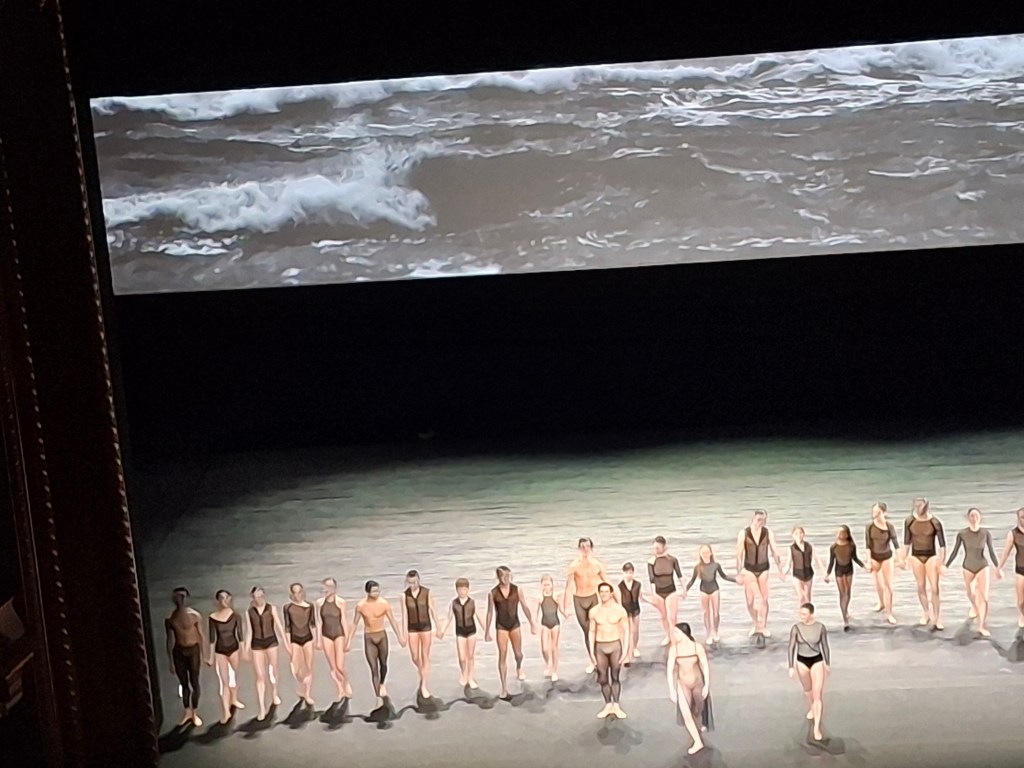
There was lots of the movement of my title in both the above but the prime expression of it this week came in Akram Khan’s Thikra: Night of Remembering at Sadler’s Wells where I had the pleasure of Rosa’s company. Devised in conjunction with the Saudi visual artist Manal AlDowayan, this is an intense hour of modern dance infused with classical Indian forms and a sound track that moves from a foreboding drone through ragas, Balkan chorale, drumming and hints of Purcell.

The twelve female dancers all have waist-length black hair that forms an important part of the performance. Would have been an interesting casting call: “Find me twelve women with equal-length black hair who can dance classical Bharatanatyam choreography”. Nine of the dancers were uniformly clad in olivey long dresses while the sacrificial victim was in white, the matriarch in red and her sister in black. AlDowayan’s involvement gave it a very graphic look that comes from her work in exploring cultures, heritage and change. The narrative didn’t really matter but was essentially about annual rebirth and renewal through sacrifice. Visually stunning, musically stimulating – an hour of total transportation into a world of magic and wonder. You can get a short glimpse of it here.

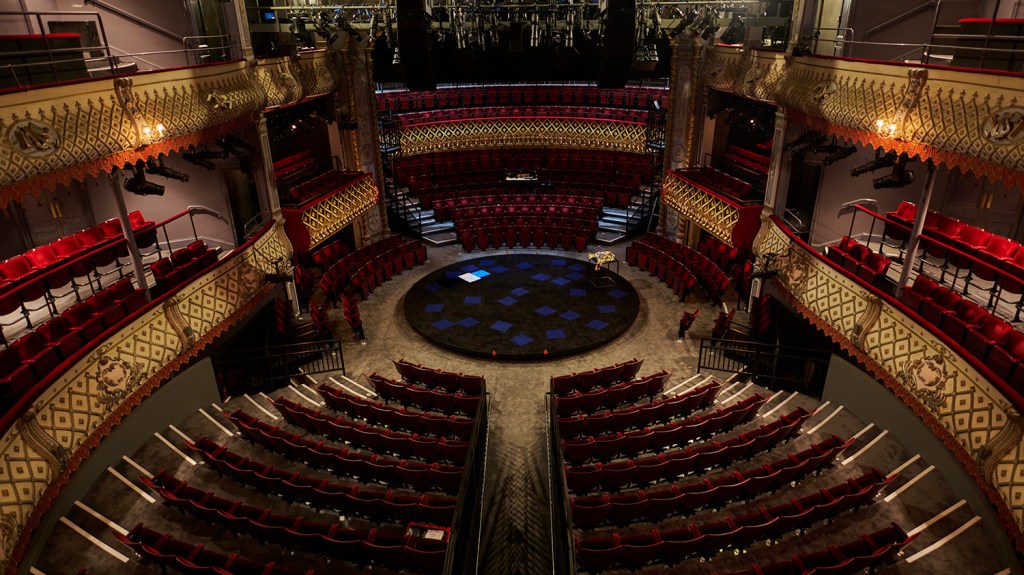
A select group of us returned to the Bridge Theatre for The Lady from the Sea. I haven’t been there for ages as it’s been wall-to-wall Guys and Dolls. I wrongly thought this was a version of Hedda Gabler but Ibsen actually wrote a play with this title so I need to brush up my Scandi classics knowledge. This was a Simon Stone adaptation, so after the Billie Piper Yerma, expectations were high for something off the wall. And we got it – the usual Ibsen anguished captive bride played bravely by Alicia Vikander resisting the cage into which her husband Andrew Lincoln, in great form, had placed her. The drama plays out on a thrust stage (the Bridge is so versatile as a space) which becomes soaked with rain in Act 2 and then turns into a swimming pool. Writing, acting, sound and lighting were all excellent but the award of the evening has to go to the set design and build – the vision of Lizzie Clachan. Another exceptional evening of entertainment.

After all this fun it was back to work – as a producer! A couple of times a year for the last few years, I’ve recorded an audiobook version of a reader for use in teaching English as a Foreign Language in Germany. I’ve now, it appears, done 11 of them – here are a few from Hueber Verlag in Frankfurt.

I have a small repertory company of actors who are brilliant at producing a range of characters in the course of the narrative – teenage protagonists, their parents, threatening outsiders, police and other officials. The stories are often a bit Famous Five but tackle issues like single parenthood, criminal behaviour, the environment and relationships. For this one, Joining the Circus,I invited Gyuri Sarossy, who I met at a Hampstead Theatre party a while back, to perform the script. It doesn’t sound the most likely name for an English language project but he is English born of a Hungarian father and English mother. The story involved a farming family setback by the father’s accident and a circus family devastated on finding their usual pitch was waterlogged and wouldn’t work. Gyuri was born in Bristol so we opted for a West Country accent for the farmers and an East Midlands for the circus people. It worked extremely well and I am constantly amazed at how these actors can switch characters seamlessly in a single sentence. After the recording Gyuri was off to Budapest to record his final scenes in a vampire movie. Another spoiler – he dies. A week later we hear that the client likes the results of the session. Great news – we’ll all get paid! A little.

It was then on to my main unpaid role as a trustee of the British Bilingual Poetry Collective. I was invited by the publisher of the collective’s anthology Home and Belonging, which resulted from a series of translation circles like the last blog’s reference to the Barbican, to chair a discussion panel at the Palewell Press Literary Festival. The day also included readings from a number of poets including Chika Jones and Nasrin Parvaz who feature in our anthology. It was fixed a long time ago and so I missed Watford’s best game of the season so far, a 3-0 demolition of Middlesbrough – such dedication to the cause, such a fair weather fan!

However the occasion was very interesting with my panellists translating from Arabic with Dr Amba Jawi and Catherine Temba Davidson as collaborators, Barbara Mitchell who translates from Spanish and Caroline Stockford who does Turkish and Welsh and finds striking and unexpected parallels. We ranged over the process of translation and the difficulties of rendering essence and spirit rather than words, the degrees of faithfulness and liberties translators are allowed and the reactions of the original authors.

In all the cases featured here there were difficulties since all the authors were in prison on political charges. Palewell Press specialises in human rights publications so this was only to be expected. The overriding message was that all art forms have to continue to expose and challenge human right abuses whever they occur.

Next day, to make it a full weekend of poetry, I co-hosted BBPC’s annual contribution to the Tower Hamlets Season of Bangla Drama. The season has a theme each year – we’ve done ‘love’ and ‘hope’ and this year it’s ‘kindness’. We decided to go all alliterative and call the session Kindness with Kazi using the poems and songs of the national poet of Bangladesh Kazi Nazrul Islam. Shamim Azad and I hosted the occasion which had performances by the brilliant singerJoyeta Chonchu of a couple of Nazrul songs , my colleague Milton and I recited one of his most famous poems “I Sing of Equality” followed by a discussion of his work and influence on people’s lives. After a short break we then broke up into pairs to talk about kindness given or received in our personal lives after which everybody wrote a short poem or piece of prose. There were some very moving contributions and very positive feedback that participants found it both enjoyable and valuable.

Monday saw me joining Frances at the Orange Tree Theatre for Hedda. Ibsen is all the rage these days it seems – well I guess he has been for a while. This is an adaptation by Tanika Gupta – well really more of a new play based on – Hedda Gabler, relocated to Chelsea in the post-war, post-partition of India period. Tanika’s take is based around the need to conceal the ethnicity of Hollywood’s Anglo- Indian stars, in particular Merle Oberon. The evening was pacy, directed by Hettie Macdonald, twisty and with a full range of emotion, fear, deception, devotion and angst.

From the dramatic opening with her lifelong maid, brilliantly portrayed by Rina Fatania, asking which face whitening she’d like today through to the realisation that she’d made a disastrous marriage believing her screen career to be over, Pearl Chanda was Merle Oberon.

A powerful performance with hints of her former influencer status dashed by the creeping reality of her current dull life. It touched a real nerve with me as I was currently reading Kiran Desai’s Booker nominated The Loneliness of Sonia and Sunny which brilliantly examines the whole question of identity, ethnicity and personal authenticity. I was fortunate to be able to speak to Tanika about our Kindness event and she said her father used to sing Nazrulgeeti (KNI songs) around the house all the time. That was before seeing the play so sadly I wasn’t able to tell her how much I enjoyed it.

Another part of the Season of Bangla Drama was a presentation of kindness stories collected by long-term Bangladesh resident Peter Musgrave who had taken part in our BBPC Kazi session so it seemed only right to go to his. An added attraction was that Gitabini, the singing group featuring my friend Rumy Haque was to perform. There were stories to bring hope of new flood resistant ways of building houses and farming being demonstrated by NGO staff to educate the Bengali populace, particularly in the most threatened areas. One of the countries most prone to disappearing into the Bay of Bengal if climate change continues unchecked – not sanguine about the current COP to prevent it – but good to see alternative approaches to mitigate the effects. Gitabini sang a Kazi Nazrul Islam song and Rumy recited her conservation-oriented poem about a banyan tree and I was able to chat with a number of old and new friends at the post-event Koffee and Kake.

Gitabini performing

I’m fortunate to call the young composer Dani Howard a friend and so when her saxophone concerto was finally to receive its UK premiere I just had to whizz off to Poole to the Lighthouse Arts Centre to hear it. I did some voluntary work a few years back for the London Chamber Orchestra which had originally commissioned the concerto but then got into financial difficulties and couldn’t complete the contract. So I’d waited nearly two years to hear it. Stockholm Philharmonic and the Bournemouth Symphony Orchestra came to the rescue and while I didn’t make the world premiere in Sweden, I wasn’t going to miss out on the first UK performance. The journey was horrendous. The train was 30 minutes late arriving at Waterloo because of earlier signalling problems, and quite a bit more than that departing. Then we couldn’t get into Southampton Station because of other trains blocking our platform. Finally they decided to skip some stops and head directly to Poole after Bournemouth. At least Delay Repay will kick in and I’ll get some dosh back. By the time I’d checked in to the hotel, checked out the location – my first time at The Lighthouse – and gone for a walk down to the Quay it was dark. I guess one benefit of this was the bright lights of the Poole Museum shone out. A quick beer and back to the hotel to prepare for the concert. Was all the hassle worth while? Oh yes.

The concert opened with a Wagner piece I’d never heard – the overture to his first opera, a comedy called Forbidden Love. A comedy from Wagner! It failed miserably and lasted for only two performances in 1836, but the overture was fun, very jolly and lively, opening with castanets of all things! But the main event came next. Dani had written the concerto specifically with the versatile Jess Gillam in mind. In three contrasting movements the music showcased Jess’s talent but also wove evocative call and response moments with different sections of the orchestra. Lush pastoral passages alternated with bold percussive swathes and the brass were strongly featured – Dani does like her brass – one of her first pieces I heard was her trombone concerto for Peter Moore at the Barbican in April 2022, another amazing performance. Dani says the concerto is a homage to Adolf Sax who invented the wonderful instrument which finds its place more frequently in jazz clubs than in the concert hall. I love the way Dani combines pure and simple sounds from nature with a clear understanding of the power of complex orchestration. She’s a master of the medium. The Times critic liked it too: The first movement bubbles and chatters, passing ideas between soloist and orchestra, while the finale is a dazzling moto perpetuo, dispatched with seeming ease by Gillam. Best of all was the central movement, an extended cadenza for Gillam, who made it seem as if we were hearing Sax’s innermost feelings

Jess Gillam is a master too and for her encore, chose a piece she’d played in BBC Young Musician of the Year in 2016 – Pedro Itteralde’s Pequeña Czarda – when the conductor was Mark Wigglesworth, now principal conductor of the Bournemouth Symphony Orchestra, whose home base is the Lighthouse. Most appropriate. After the interval we heard the orchestra in full flow with Berlioz’s Symphonie Fantastique. It will be interesting to compare this rendition with the Orchestra of the Age of Enlightenment’s approach in June next year on period instruments under Sir Simon Rattle.

What made the evening extra special was that Dani invited me to the pre-concert reception where I met her mother, Belinda, again – we had both been at the Barbican gig in 2022 – meet her sister Sam for ther first time and catch up with boyfriend Sion Jones who I’d met at the Colin Currie percussion concerto at the Wigmore Hall. Dani was of course the centre of attention with a former pupil effusing over her influence on his career and her former music teacher from Hong Kong, now working in Poole, bringing a class of her primary pupils to say hello. After the concert, Dani had some formal duties but after a while she and Sion were able to join Belinda, Sam and me in the pub where I’m afraid we stayed till they kicked us out. After all the music it was an evening of fascinating conversation eavesdropped and joined in with by locals Jeff and Jonny and covering coping with bereavement, mine and the Howards’ who lost a husband/father last year, music, the arts generally, contracts, 2027 paradigm shift and blogging among others which were continued outside the pub until we all decided to head for our rather tardy beds in three different hotels.

No Mow – No Blog – May

Well the lawn didn’t quite escape the mower despite the warm weather and slow growth of grass but it had to have a tidy up. What did escape was the keyboard – too busy to type this month! It all started on Saturday 3rd with the last game of the season – unlucky draw – followed by a farewell to the season lunch at L’Artista and then Frances, Rose and myself whizzing off for a pre-concert Guinness in the Toucan with Ian Prowse (he didn’t have one) before he took to the stage at the 100 Club. It was as always with him a brilliant evening’s entertainment.

Then on Monday 5th Fran and I went to see the new Conor McPherson play The Brightening Air at the Old Vic. It’s a wonderful depiction of dysfunctional Irish rural family life with a standout performance from Rosie Sheehy as the disruptive Billie. The next day I had to record one of the English Language Teaching audiobooks that I do a couple of times a year. My voice over actor John Hasler (doing 16 different voices in Aussie accents around an RP narration – amazing) is about to rejoin the cast of Fawlty Towers at the Apollo Theatre with a bigger role than he had in the first run so I’ll probably catch that at some point in the run that starts late June.

Next up was a favourite ukiyo-e printmaker Hiroshige at the British Museum. I am familiar with most of the images displayed but seeing the vibrancy of the originals compared with reproductions was astonishing. The exhibition also included several indications of the complexity of making multi-coloured woodblock prints, inking them up and making sure paper is accurately registered. A technical triumph but also witty, emotional and dramatic scenes of love, life and landscape. It was interestingly curated too with prints fixed to scrolls which themselves were often the destination of woodblock prints.

With my mind firmly back in Japan I spent the evening downstairs at the Hampstead Theatre in the midst of a video game. The play was Personal Values and combined characters’ real lives with their personae in the game they were endlessly playing. As a non-gamer it left me a bit confused but others enjoyed it very much.

Back at Hampstead the following Monday saw a very different set of games presented. This was an adaptation by Richard Bean of David Mamet’s 1987 film, Mamet’s debut as both writer and director. It was powerful, twisty, scary and shocking but immense fun. I hadn’t seen the film for ages but recall it being altogether darker and while there were some elements of that here, it was as you’d expect with Richard Bean rather more about the laughs. I’m looking forward to more card games and sleaze when we see Dealer’s Choice at the Donmar next month.

Music started the month and gave me a real highlight in the middle. Sunday 18th found me in the Temple of Art and Music in Mercato Metropolitano, the sprawling food fest at the Elephant and Castle. The group in which my granddaughter plays keyboard, flute and does backing vocals – elegantly called Soulstice – were asked to headline a Youth Open Mic session. There’s a clip here – not very well recorded and not by me! They are usually an all girl band but their drummer couldn’t make the gig so a brother kindly stepped in. I’m prejudiced of course but they are actually rather good with a soul-tinged mix of their own originals, Sade, Amy Winehouse and so on..

Different but no less enjoyable was the Orchestra of the Age of Enlightenment’s concert at the Royal Festival Hall with Sir Andras Schiff conducting from the piano in a Schumann programme with a little Mendelssohn in between. It started with the Konzertstück which is a very lively piece for piano and orchestra and was followed by familiar passages from Mendelssohn’s Midsummer Nights’ Dream and Schiff played Schumann’s only piano concerto after the interval. He had talked last year at an open rehearsal of his pleasure in having a brown Blüthner fortepiano rather than the shiny black Steinways that are usually provided.

He had it again tonight and did us proud, not only in the opening piece and the concerto, but gave us a solo encore of Brahms’ Albumblatt and then closed the piano lid very firmly and got the whole orchestra to play Mendelssohn’s Fingal’s Cave as a bonus encore. Coming at the end of an eight day tour to Vienna, Graz, Antwerp, Amsterdam and Munich the energy of Sir Andras and the orchestra was quite amazing. And with even more bonuses – a preconcert talk with Laura Tunbridge, professor of music at Oxford, and an interval drinks reception for friends – it was a night to remember.

Sir Andras Scxhiff leaves the stage, leaving behind his favourite instrument.

On my way to the OAE concert I went to the National Portrait Gallery to see the exhibition of Edvard Munch portraits. These were very impressive with clear characterisation of friends and family placed in relevant environments. He obviously didn’t like several of his subjects as these were not flattering portraits but reflected Munch’s relationship with them and indeed with himself. I couldn’t escape the musical theme of the month of May as my two favourites were The Brooch which is a lithograph of an English violinist who styled herself Eva Mudocci and a quick stetch of Edward Delius at a concert in Wiesbaden. I also liked his walking self-portrait and a double portrait of the lawyer Harald Norgaard and his wife Aase with whom he had a lengthy relationship. It’s an unusual composition and was quite striking. Munch knew Harald from his youth and painted Aase separately on a number of occasions.

I also made it to another British Museum exhibition after being a radiotherapy buddy to a friend who is going through the final stages of cancer treatment. She is great company despite the circumstances and we have spent some good times together. As I remember myself radiotherapy leaves you pretty wiped out so she declined the offer of accompanying me to the BM understandably preferring home and rest. The exhibition was mostly of objects from the museum’s own collections but shed a fascinating insight into the religions of India – Hindu, Jain and Buddhism through their artefacts and what they symbolised. The galleries also had birdsong, tolling bells and chanting played quietly to make it a multisensory visit.

My next adventure was into the world of words. The British Bilingual Poetry Collective resumed our Bi-monthly Poetry Meets at Bard Books on Roman Road in Bow. Shamim Azad and I led a session of poetry readings, discussion, translation and an open mic session which was much enjoyed by all present.

The late May bank holiday was spent having an early supper with Rosa and then a visit to the Wigmore Hall to hear the amazing percussionist Colin Currie. I wish they didn’t have a photo ban because the array of drums, marimba, vibraphones, glockenspiel and other thing you can bang to make music filled the entire stage. A varied programme showcased his ability to make exciting, moving, thoughtful and adventurous sounds emanate from this staggering collection of instrumental forces.

My main motivation for going was the world premiere of Vasa a Concerto for Solo Percussion by Dani Howard, a young composer I’ve been pleased to call a friend for a few years now. It was a complex piece featuring a series of different tempos, emotions and melodies. Dani had worked with Colin to devise the final form and told us later that she had to have a diagram of the stage layout of the marimba, two vibraphones, cymbals, drums and other devices, many of them foot-operated, so that she could ensure she was writing things Colin could physically move around the instruments to execute. It was a very rewarding evening concluding with some excellent conversation in the pub.

I had intended to give After the Act at the Royal Court a miss as I’m not a big fan of musicals. However the indisposition of Fran’s intended companion meant that she asked me to go. The content should have been – and was – of real interest. The ‘Act’ was the appalling 1985 Section 28 that forbade taechers in schools and colleges to mention homosexuality, Equally appallingly it was only repealed in 2003.

The play contained some verbatim quotes from individuals – teachers, parents and students – who had suffered from the act, recreations of protests including a daring 1988 abseil in the House of Lords and, for my taste, too many occasions when serious issues resulted in the cast of four bursting into song accompanied by onstage keyboardist and drummer.

The next evening was far more satisfactory. Because Terrance Rattigan’s The Deep Blue Sea was on at the Theatre Royal Haymarket we were able to pop into Yoshino for a quick pre-theatre sample of Lisa’s excellent cuisine and hosting. Some analysts feel that the doomed love affair represented in the play was Rattigan’s sublimation of his own homosexuality – still illegal when he wrote it in 1952.

Starring the wonderful Tamsin Greig with a fine supporting cast, this was a faithful period-set production that allowed the play’s veiled messages space to emerge from the context and the conversations around love and death, suicide and survival, protest and resignation, passion and comoanionship were brilliantly done, very moving and affecting.

Thursday saw Fran and I make our hat-trick of theatregoing with a trip to Islington to see Ava Pickett’s debut play 1536. The setting is sixteenth century Essex where three friends indulge in gossip – has Henry really ditched Anne Boleyn? – their own relationships with men and each other and the role of women in a patriarchal society. It’s bold, it’s funny. it’s sexy and it makes you wonder how much better things really are today. The rolling changes in friendships are brilliantly delivered in crisp dialogue and while history is all around, the play tells us a lot about today. As a writer on the brilliant The Great on Channel 4, Ava Pickett is clearly a name to watch out for.

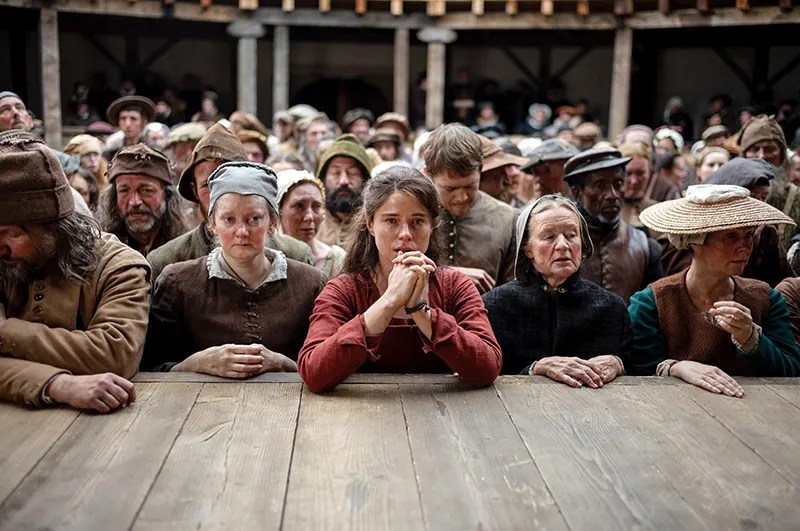
The month’s finale was a trip with Frances to see Simon Russell Beale in Titus Andronicus at the Swan Theatre in Stratford-upon-Avon. After a pleasant drive up we had a late lunch, checked into the hotel and then made our way to the theatre. It was my first time in the Swan and we were a bit surprised that this production was in the smaller space, not the main hall. However the intimacy of the location made the horrors of Shakespeare’s most violent play (or is it Coriolanus?) very clear.

The production certainly didn’t stint on Kensington gore but used brilliant lighting and sound effects to protect us from witnessing the worst atrocities. SRB was his usual excellent self but was by no means outstanding. The whole cast under the direction of the versatile Max Webster was superb and brought the subtleties of the text into play as well as the torrid drama. And on reflection, yes this is the most violent of Shakespeare’s works.

We went out to Anne Hathaway’s house next morning for a walk around the orchards, had an enlightening tour of the house from excellent guides and then made our way back to London. A fine ending to a full and varied month of culture. As Shakespeare’s contemporary Thomas Dekker put it “O, the month of May, the merry month of May”.

Art imitates life

Three plays this week featured real life events dramatised by outstanding writers. At the Royal Court Manhunt written and directed by Robert Icke recreated the events of 2010 which saw the nation’s longest search for the fugitive murderer Roaul Moat. The play examined Moat’s mental state, childhood, failed relationship and his conviction that Northumberland Police had it in for him. The dramatic opening with an overhead camera projecting Moat’s pacing in his prison cell set the tone for a psychological and emotional thriller. In the lead role Samuel Edward-Cook was all muscle, repressed violence and angst in an outstanding piece of acting. Multiple-character supporting roles made for a fascinating examination of the factors contributing to his undoubted guilt. I remember the events clearly as I was held up on the way to a shoot by closed roads around Rothbury where he was finally caught. There was a post show talk in which an interesting aspect discussed was whether there was at the time a north south divide where, in the south, he was regarded as something of a hero for evading arrest for so long – seven days, in contrast to the north where he posed a real threat. Lots of food for thought.

Another favourite playwright, James Graham, featured an event from his native Nottingham. His The Punch at the Young Vic dramatised the cause and effects of a notorious one-punch death in 2011. Convicted of manslaughter and having served his sentence, Jacob Dunne was one of the first to experience restorative justice on his release from prison and it was the series of meetings between him and the victim’s parents that formed the core of this moving and enlightening evening. Directed by Adam Penfold the play was originally seen in Nottingham and transferred to the Young Vic with the same outstanding cast with once again a truly memorable central performance from David Shields as Jacob supported by a fine group of multi-character actors among whom I would single out the wonderful Julie Hesmondhalgh as, among others, the victim’s mother and campaigner for restorative justice. Her dancing is worth the modest ticket price.

I went to a completely new venue on Saturday – the Morocco Bound Bookshop and Café in Bermondsey – it’s name alone took me back to my early career in publishing where I knew about, but sadly never had the opportunity, to lavish a Morocco Binding on any of the books I produced. It looks to be a lively place with poetry open mic nights, jazz gigs, a book club and more. My visit was for the launch of a poetry anthology which contained a poem by my friend and British Bilingual Poetry Collective founder Shamim Azad. Published by a magazine ‘The Other Side of HopeOther Tongue Mother Tongue contains twenty poems on themes of immigration in eighteen languages. Given BBPC’s experience with Translation Circles, this was obviously an event not to be missed. Shamim read her poem to open the event and then closed it with a rhythmical Bengali poem that had the audience all clapping along.

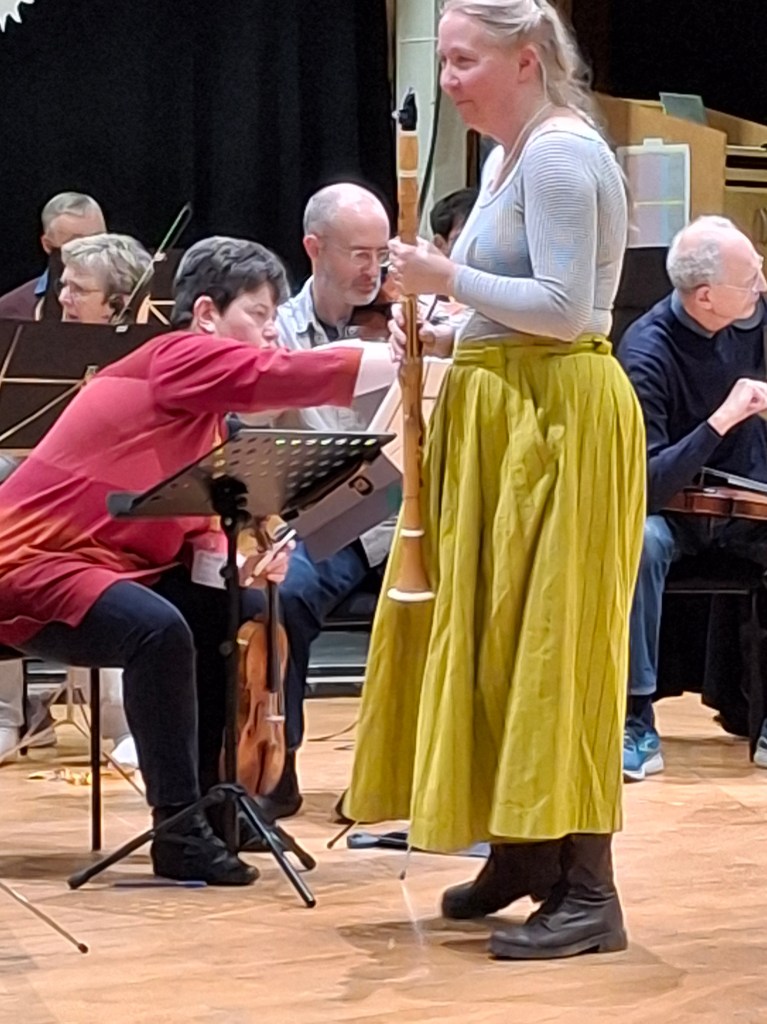
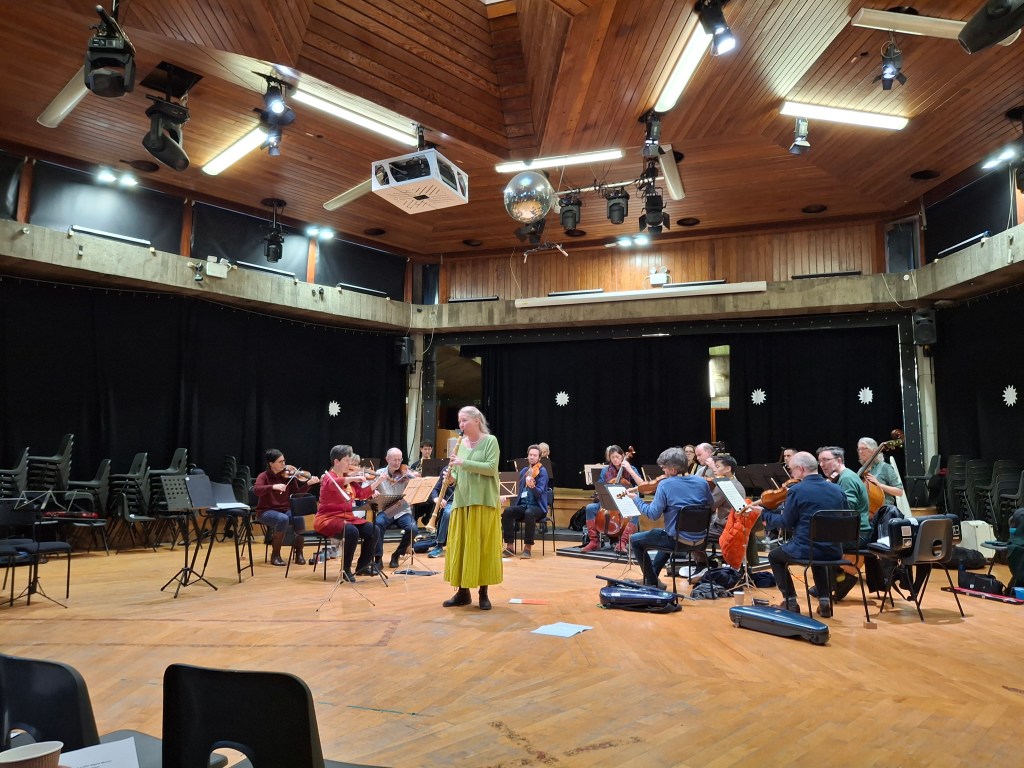
Monday morning had a musical start with a trip to the Orchestra of the Age of Enlightenment’s base in Acland Burghley School in Tufnell Park. This was a Friends’ opportunity to observe 100 teenagers from ABS and Swiss Cottage School rehearsing for a performance at the Albert Hall on Wednesday as part of Camden Schools Music Festival. The OAE’s education director Cherry Forbes was at the heart of proceedings with music director James Redwood. It was fun, engaging and again encouraging to see so many young people enjoying the opportunity to sing and make music together. And it’s always a delight to be in the fabulous hexagonal Brutalist hall.

Tuesday saw me set off to the Romanian Cultural Institute in Belgravia for an evening of music performed by Romanian soprano Madalena Stan and pianist Lidia Butnariu. It’s in one of those magnificent houses in Belgrave Square. I went with my friend Daniela Tifui, who is of course Romanian, and she enjoyed her first visit to the Cultural Institute, the music and the chance to meet new people and speak in her first language. The concert had a number of popular opera arias, some Gershwin and a world premiere of a song specially compsed by Calin Huma who has been an envoy to the UK but is now about to transfer to Italy, combing music composition with his consular responsibilities to very good effect. There was a glass of wine afterwards and an opportunity to chat with Madalena and Lidia and other interesting people who regularly attend these events. And if Saturday gave me a throwback to my publishing days, today was back to my early days of filming as the piano was lit by a redhead – a rarity these days when most lighting is done with LED panels.

A third play based on real life completes my week. Ben and Imo by Mark Ravenhill was first seen at the Royal Shakespeare Company in Stratford but is now relocated and adapted to the intimate space of the Orange Tree in Richmond. Directed by Erica Whyman, It covers the fiery, feisty, often fraught relationship between Imogen Holst and Benjamin Britten in the period before his opera Gloriana was to be staged in a gala performance to celebrate the coronation of Elizabeth II in 1953. The powerful two-hander with Samuel Barnett and Victoria Yeates covers immense issues like the creative process, ownership of ideas, state funding of the arts and personal relationships during a period of intense work in which Imo’s role and remuneration were never adequately discussed, so trust, credit, job description and accountability were always tiptoeing or slipping on the shifting pebbles of the beach at Aldeburgh.

Imo’s dance demonstrations were a highlight as indeed were the musical elements woven into the script – Britten, Dowland, Wagner et al – all played by Connor Fogel. The evening was enhanced by a Q&A with Mark Ravenhill and Orange Tree’s Creative Director Tom Littler. Mark was delighted to have approval of his version of events from two singers in the audience who had worked with both Ben and Imo on his operas and her community projects.

One key element for me was how the very talented Imogen Holst subjugated her own creativity to serve first her father Gustav, and then Britten. I was impressed by the archive of her papers at the Red House where Britten lived with Peter Pears which is well worth a visit. Dee and I went in 2016. Writer Leah Broad who has pioneered the restoration of female composers in her book Quartet commented elsewhere on Imo: ‘few musicians have had such a wide-ranging impact on music in the UK as Imogen Holst, having turned her hand to everything from composition to conducting, teaching, public speaking, musicology, concert organising and musical administration. The full legacy of her work has yet to fully be understood – but as a composer, at least, new recordings and publications are paving the way for her to emerge from the combined shadows of Britten and Gustav Holst, and to receive the acclaim that her own modesty never allowed her to pursue.’