Gardens, Masterpieces and Wagner

I had a problem with uploading photos from my camera so there area few gapsnow filled in on my return to London and a full laptop.

Oh dear, I wake up and the sky is blue, the sun is shining and I’m still in Sicily. Today’s plan is to visit the Botanic Gardens I can see from the apartment, do a museum recommended by my friend Gwyn, check out the walk to Teatro Massimo and get back home relatively early to shower and frock up for the opera.

The day started well as the garden opens at nine and has a cafe where juice (bottled not freshly squeezed like yesterday’s – trading standards might need to investigate). However with that and a good coffee hit I was ready to meander. And it’s that sort of garden with nicely laid out routes of varying lengths and also the capacity for random twiling (copyright S Todd RIP but we still twile). And the labelling is very clear, often in Italian and English so you know what you are looking at.

One of my first encounters made me think of friends Gwyn and Yvonne who had highly recommended Sicily after a visit they made a few years ago. They have an 80-year-old tortoise in their garden so I immediately felt welcomed to the Giardino Botanico. Now I’m not sure whether this creature was a tortoise, a turtle or a terrapin but it gave me a friendly nod.

The Botanic Garden was divided up into several areas and had displays of various plantings – bamboo reminding me of Bangladesh, palms, cactus including a cactus nursery and again making me feel at home an experimental coffee growing area. There were some pleasant glasshouses – but what can compare with Kew – and is was good to see a number of school groups making the garden tour.

The coffee trial plantation to see if they can grow coffee here. Interesting development and a reflexion on climate change perhaps like red wine in Kent.

My next planned visit was to a half-completed church, Lo Spasimo, which I suspect, as the world’s expert on follies, my friend Gwyn was claiming as one. It was abandoned in 1475 when stone was more urgently required for fortifications against the threat from the Turks. Sadly it was closed so I’ll take Gwyn’s word for its intrinsic value. Disappointment calls for coffee which was provided bay a barely-open bar in via Spasimo. Then it’s on the short walk to the Palazzo Abatellis which houses the Galleria Regionale di Sicilia.

This gallery contains two absolute must-see items and a lot more of significant interest. Once again it’s a magnificent 15th century palazzo and shortly after entering you are struck by masterpiece one. The Triumph of Death is remarkable in so many ways. It’s a fresco from elsewhere that was carefully removed and repositioned here. It’s from the fifteenth century by an unknown artist. You can see it here at ground level and then again from above when you go upstairs. It reflects on the devastation of the Bubonic plague in Europe. Can’t wait for the Covid Guernika-style fresco. Death is an armed skeleton riding a skeletal horse which has great yellow teeth. There are so many brilliant mini-stories going on all over the wall that it’s hard to drag yourself away but something perhaps even more special awaits.

It was also interesting as always to see a conservation team at work on one of the collection’s pieces – mahl sticks, minute brushes and multicoloured palettes. Oh we do like seeing other people work!

The gallery has a very large number of fairly gloomy religious woks – well we are in very Catholic Spain – but one of them is in joyous calm counterpoint to all these. It’s known as the Mona Lisa of Sicily and is called Annunciata and was painted by Antonello da Messina in around 1475, so predating Leonardo. It gets very special treatment in a mobile display unit in the middle of a room. She’s in great demand so you have to be very patient and wait your turn to go and monopolise the space. It’s worth the wait. It is thrilling in it’s simplicity. Mary looks off camera presumably listening to angel Gabriel telling her she’s pregnant. Her raised right hand might just be saying “No way!” The restrained colour palette, the beauty of her features and the arresting composition make this a picture I covet. They did give me a free postcard so maybe I’ll frame that.

Among the other delights are a very rude-girl looking Maddalena and a room full of paintings claiming the influence of Caravaggio. But nothing can surpass the galleries two nailed-on star exhibits. From here I decide to walk to the Teatro Massimo and then back to the apartment to check my departure time for the opera tonight.

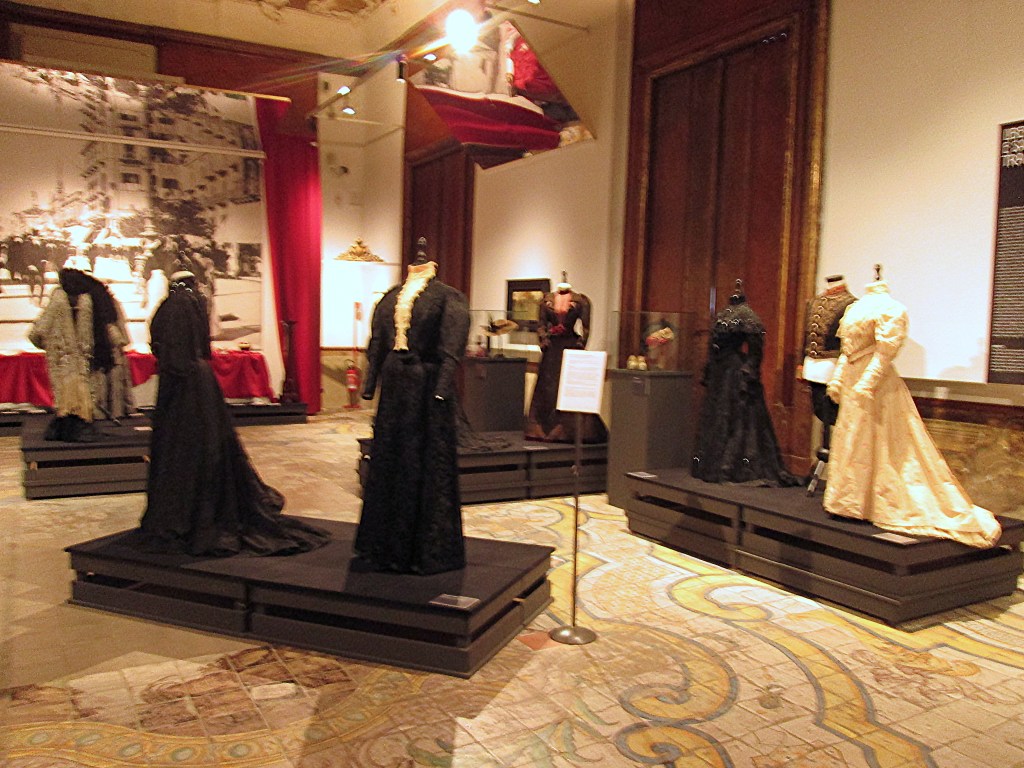
I do walk it in stages but get waylaid by the need for a beer – it’s now after two for goodness sake. Opposite the cafe on via Maqueda is the Palazzo San’Elia another gorgeous edifice advertising an exhibition called Palermo Liberty The Golden Age. Oh if only Dee was here, she’d have loved it, We shared a love of Deco and Art Nouveau and the poster was very enticing.

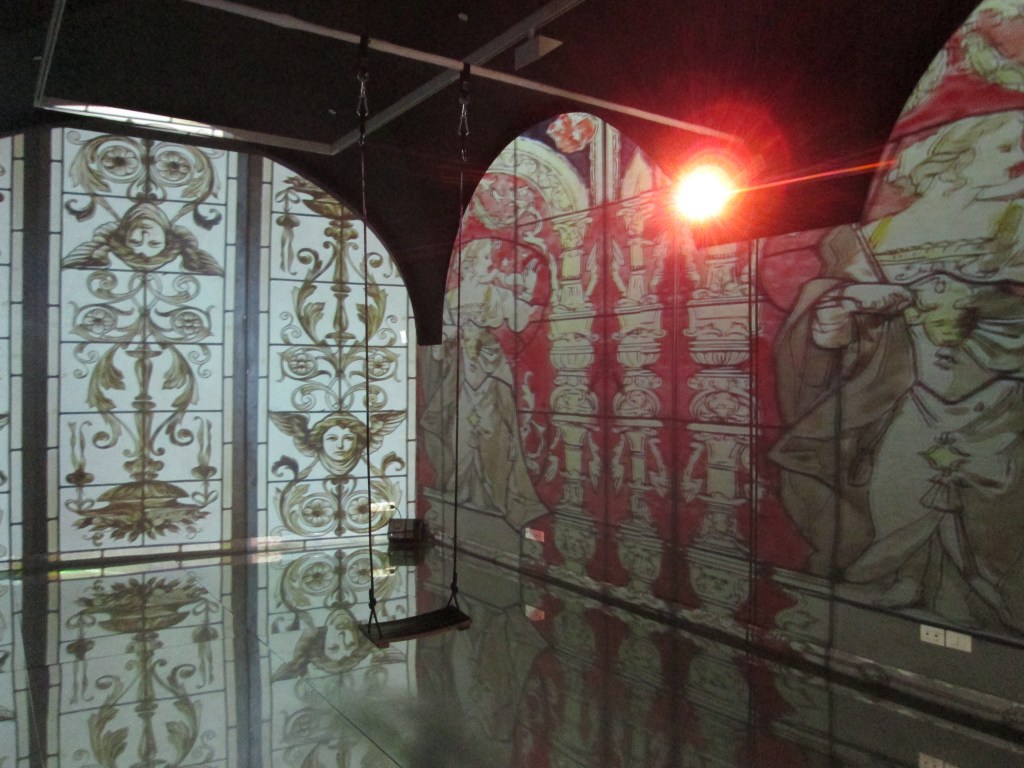
It started with an immersive video room in which the walls displayed changing decorative motifs from the tiles, logos and fabrics of the period. It reminded me of the Kusama mirror rooms. The rest of the exhibit depicted life and taste of the Period and brought back vision of Casa Battlo and the furniture rooms on Montjuic in nBarcelona. There was the restoration of a famous bakery’s facade, great graphics, photographs, furniture and frocks. I really might have enjoyed living then – if I’d been among the better off.

With all this enjoyment I find I’ve basically left it too late for lunch as many kitchens close at three so I end up with a tuna panino and beer at a street food stall near the station and home. I then repair to the apartment shower and frock up ready for the opera. I discover that my trusty Birkenstock flip-flop style sandals have caused a bloody blister on the top of my middle toe on my left foot – have my toes got fat during my periods of inactivity. Well it’s socks and proper shoes for the opera and I have other options. This and my peregrinations have convinced me that the sensible option is not a 25-30 minute walk in a suit in 26 degrees and that a 10 euro taxi ride is the sensible option.

I arrive in good time and can explore the building a bit before finding my seat in a loggia box which already has one young woman installed. We say hello and admit our mutual lack of each other’s language. Later two other ladies arrive but the sixth chair is left unoccupied so we all have space and a good view. In-performance phone abuse is as rife in Palermo as in London and I feel like throwing darts at people below me. They’ve paid twice what I have to sit in the stalls. Why are they here?

It’s a somewhat strange ‘concept’ production which starts as a rehearsal with a tee-shirted conductor playing piano on stage then joining colleagues in the pit via the audience. Singers also enter via the stalls and sing first parts from scores on music stands. It then segues into a full production midway through Act 1. There’s the now familiar mix of modern and ‘period’ dress but there’s a big shout out to the naked pink-winged Cupid who made many appearances throughout. I have to question why the similarly naked female in Act 3 was allowed knickers! They were small but covered her pubes. Musically it was excellent with good orchestral colours and contrasts.

The singers especially Brangene (Irene Roberts) were excellent but at the end I was astonished at how quickly the pit cleared. I know musos like a drink – but all overboard! Shame on me for such evil thoughts. After the principals’ curtain calls the back curtain rose to show all the orchestra member within their instruments where portable. Something I had never seen before – a nice touch.

I feared for my stomach as most places close their kitchens at 11 and we were after that by the time I’d got out. However a place on via Maqueda was still serving and I had an aubergine, celery and tomato and some mistranslated sardine meatballs – surely fish balls! However they were very tasty, went well with a crisp half-bottle of local white and I chickened out on the walk back and took a cab. Well after midnight and buzzing with the music and the occasion, I slept very badly – not good preparation for my last day in Palermo – a planned trip to Monreale.

Sicily day 2 – the fun continues

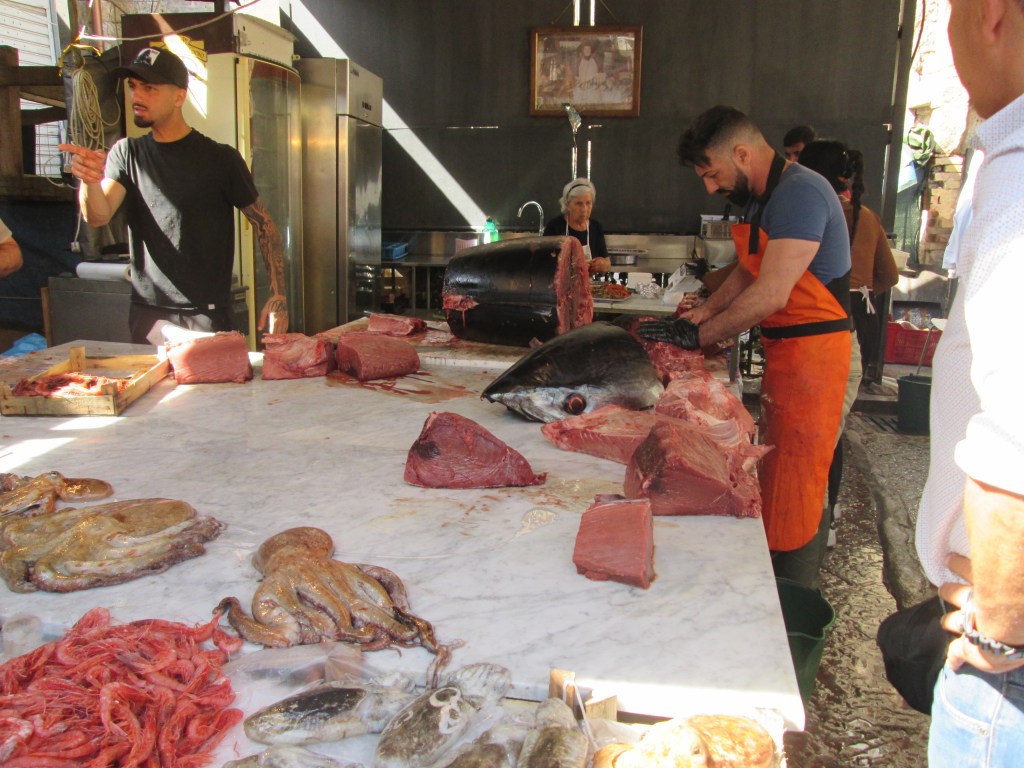
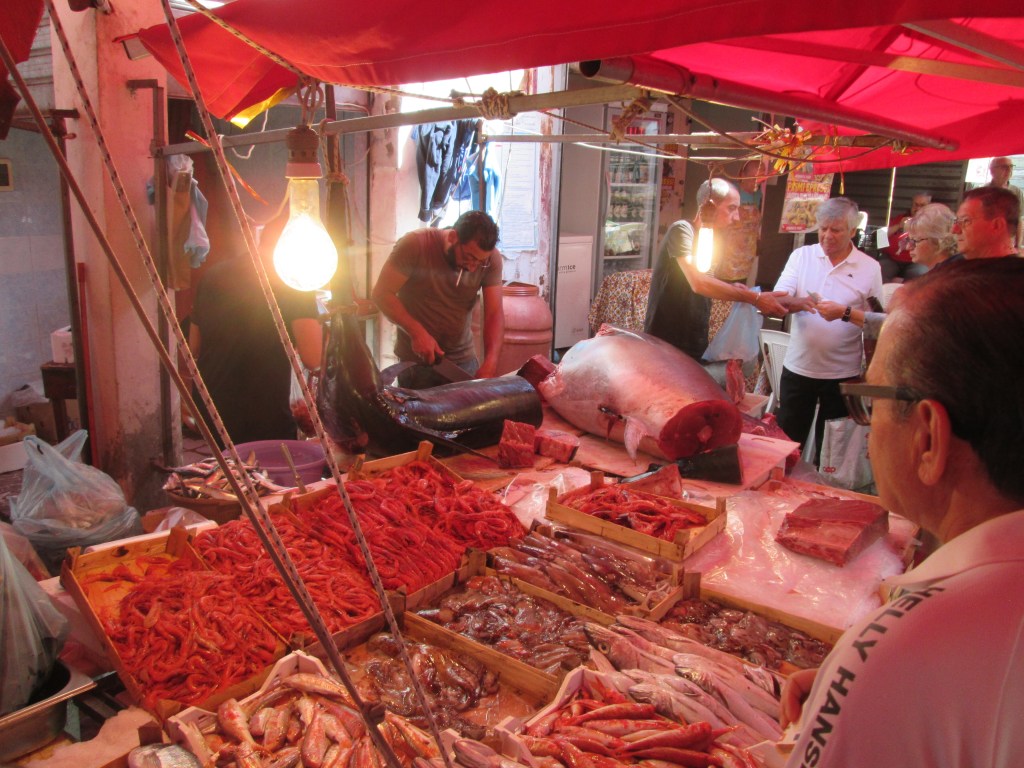
I’d booked a tour of the Palazzo Conte Federico from the UK as I thought it might be interesting to do a ‘Stately Home” tour abroad – and it was to be conducted by the current count. That was for 11 o’clock so I had a while to wander in search of breakfast and the famed Ballaro market. Previous readers will know how much I love a market. And in Siracusa I’ve arranged to stay in an apartment with cooking facilities so maybe I can buy something in the market there. But back to Ballaro – not the elegant framework of La Boqueria in Barcelona or those in Valencia, Madrid and Palma but a sprawling muddle of streets – one actually via Ballaro – with pub umbrellas (mostly Messina beer), tarpaulins stretched over metal frames and a variety of stalls with staff hawking their produce. It was hot, it was colourful, it was lively and it was fun. It also provided A stall with seats, freshly squeezed orange juice, coffee and a croissant so breakfast was ticked off. And I may well have seen the swordfish being cut up that I had for lunch later. Certainly the guy was making a fine job of carving up tuna.

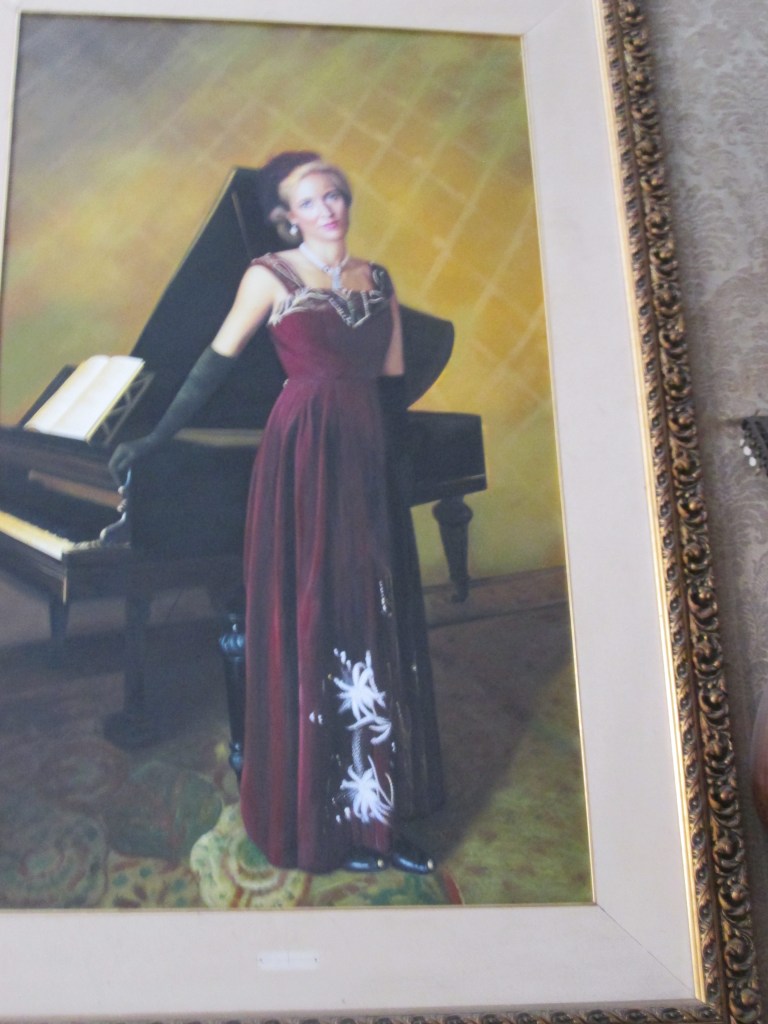
I strolled through the streets in the neighbourhood, narrow, golden sandstone, church at every corner and found the Palazzo a little ahead of time. The young count, Andrea, was preparing to take tickets and asking people to wait but nobly allowed me in to use the loo. They may be one of the richest families in Palermo but they buy their hand wash in Lidl! I know the Cien brand well. The tour was fascinating and the palazzo deceptively large given it’s street frontage. It contains within it the last of 26 original lookout towers from the medieval city when it stood on the edge of the harbour. We’re now a good mile inland and most of newer Palermo has been reclaimed at various periods of history, including a large area using bomb damage wreckage after the Second World War. The website gives you a good impression of what I saw. The fun bits for me were that the 86-year-old count was and is a highly decorated racing driver and now ventures outside Italy to race since anyone over the age of 80 is prohibited from competition in Italy. His wife is a gifted soprano and we entered her studio to find a prized Pleyel piano apparently played by Richard Wagner on a visit. This is my third Pleyel – Chopin’s in Mallorca and de Falla’s in Granada. And I’m planning to hear some Wagner on Friday evening.

It was a fascinating tour, well handled in alternating Italian and English by Andrea and gave one an insight into how the other half lives – or lived perhaps if you need to have paying tourists traipsing though your home between 11:00 and 16:00 every day except Sundays. There were lots of stairs too so the hip got a good workout.

As I exited and walked down a narrow street what should I see but a lady with a clapper board marking a take. A minimal crew was shooting what appeared from the OTT acting on show to be a dramedy, comedy drama or outright farce.

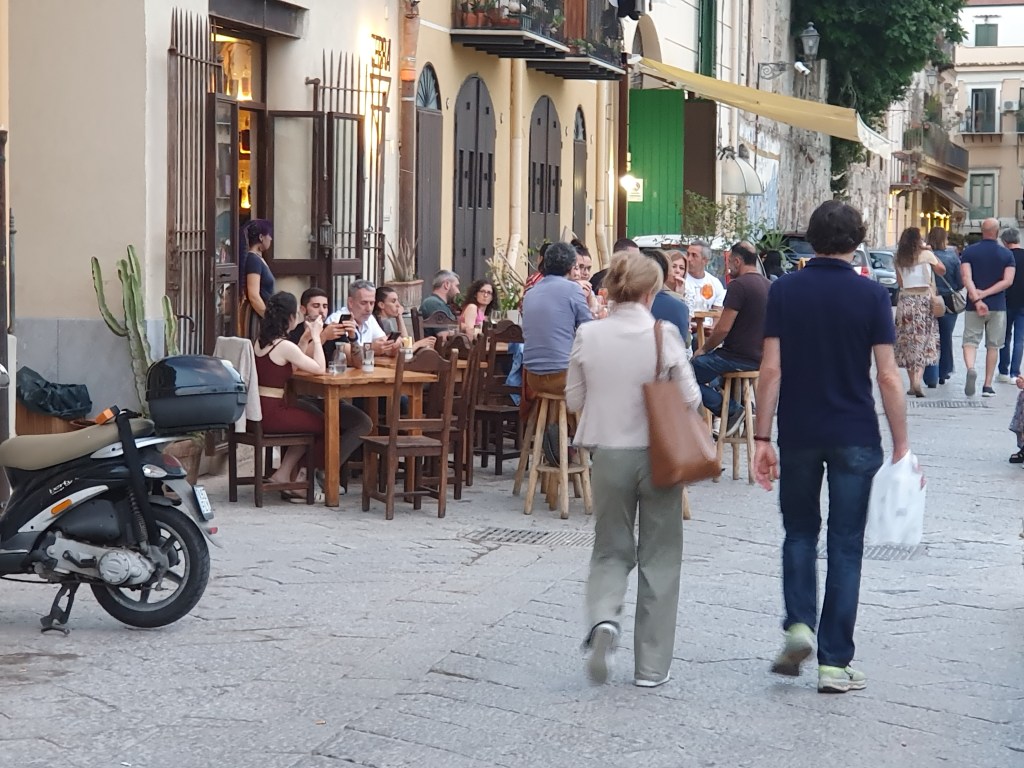
Next stop was for a coffee near the epicentre of the city – Quattri Canti where the posh streets Corso Vittorio Emanuele and Via Maqueda meet. It’s very busy but coffee is still only one euro twenty despite the tourist nature of the area.

Next was a visit to the famous, or infamous because of its nudity, fountain Fontana Pretoria. It has no water flowing but is an impressive structure.

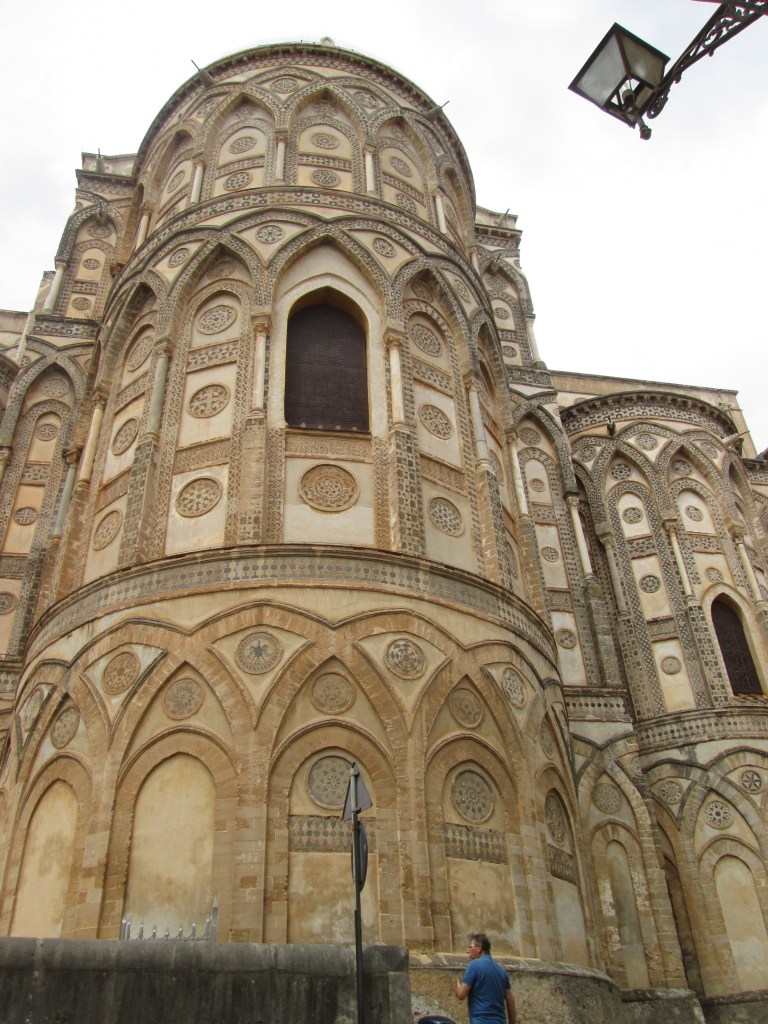
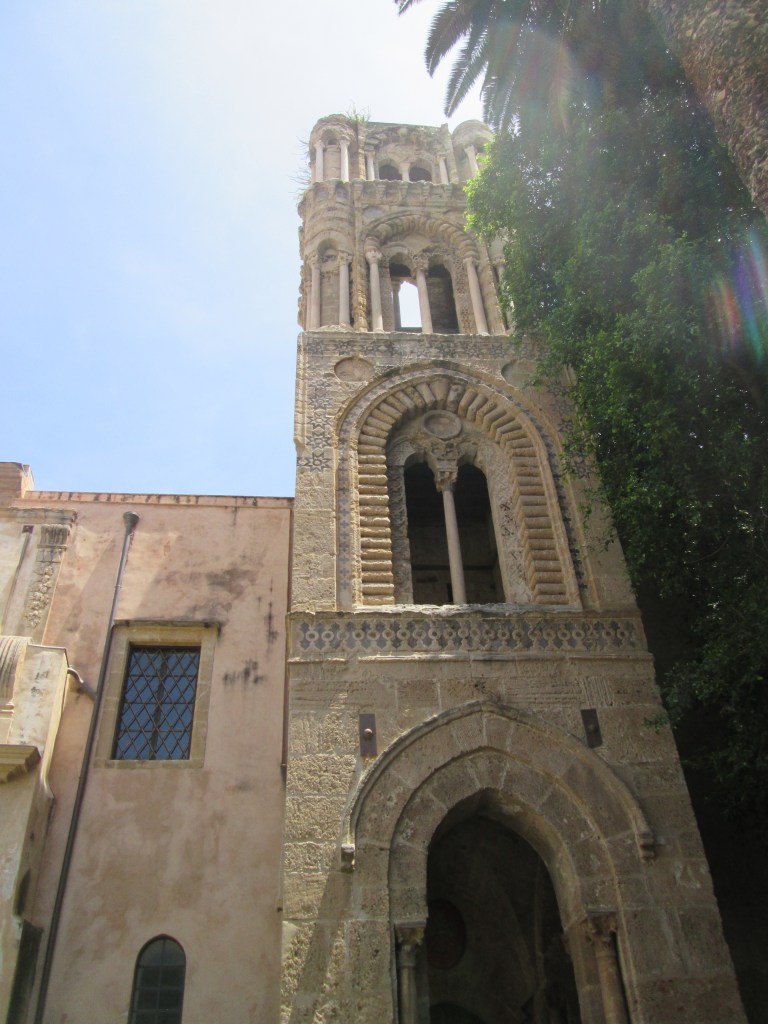
And then on to a pair of churches – one of which had just closed! But the Chiesa de San Cataldo was wonderfully calm and simple – a blessing after the ornate nature of the majority. It also has three red domes and some impressive brickwork and a great stained glass cross.

Lunch nearby was pasta al pesce spada e melanzane – there were lots of both swordfish and aubergines in the market and it restored me for the next visit. This was only a short distance away but almost unreachable because of workmen relaying the enormous slabs that make up Palermo’s streets.

The Galleria d’Arte Moderna proved a bit of a misnomer as paintings in the collection stopped at 1935 and was almost entirely figurative. There were several paintings I really liked however so despite expectations not being met, I was glad I’d gone.

It was time to rest the feet after a day of constant movement. But on the way back passing Giardino Garibaldi I was struck by this massive Ficus macrophylla reputed to be 150 years old. It’s what we know better as the banyan tree.

As I was walking along via Torremusa I noticed white carpet on the church steps and popped in to catch a wedding ceremony in full flow. Another enormous and brilliantly decorated church like so many in the city. This one was the Chiesa Parrocchiale di Santa Maria della Pietà. I was very discreet and didn’t even offer to make a speech.

Back at the apartment for a brief rest, a shower and then out for dinner locally with a whitebait starter and some sausages to follow. They were quite spicy – close to merguez. Well as Paola said when I told her I was going to Sicily “Sicily – it’s Africa!” She’s from Rome.

Starting out in Sicily

Well already I like this place! The plane arrived on time, my checked bag came through and the bus from the airport cost only 6 euros for a 40 minute ride. The scenery near the airport was pretty standard Mediterranean Karst and with mountains on one side and the sea on the other it was a pleasant trip into the Central Station. It reminded me a bit of going into Malaga from the airport although it took much longer before the common suburban retail and warehouse sprawl started to appear. At the station, Google maps wasn’t working for some reason and so I approached the taxi rank to get someone to take me to the Hotel Villa Archirafi where I was to spend my four nights in Palermo. Two cabbies refused, saying it would cost 20 euros but was only five minutes walk, saying they’d have to make big detours through one way systems. So I walked and rather foolishly asked for directions when I was standing right across a junction from the hotel. And half-hidden by a tree. I later discovered it’s easier to spot at night!

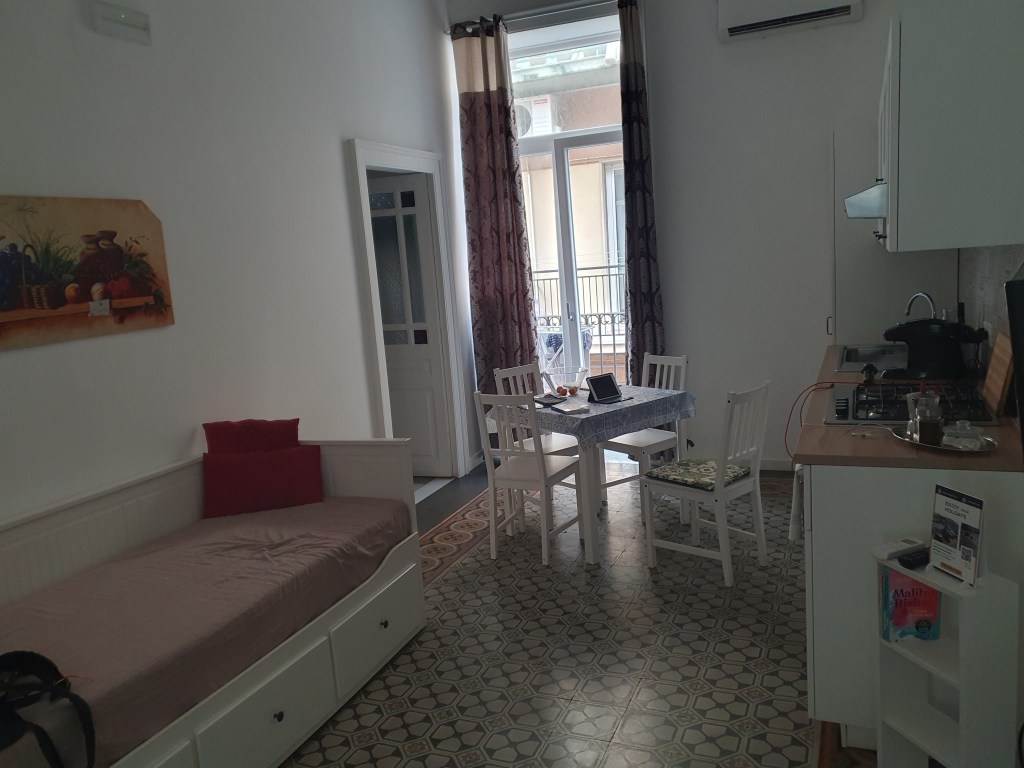
At reception, a genial gentleman asked whether I wanted the single or the double room of the two in my name. Somehow Booking.com had made two reservations for me. We resolved the confusion and then the signor asked whether I would like to stay in the hotel or in an apartment next door with views over the Botanic Garden. As this was on my list of places to visit, I jumped at it and am now ensconced in this excellent apartment with a small balcony overlooking the garden and with a sea view. And the tamarisks are in their full purple splendour. I am liking Sicily!

As I’m unpacking, there’s a knock at the door and another signor introduces himself as the owner of the hotel, had heard I was going to the opera on Friday but wondered if I’d like to go with him tonight as he had a spare ticket and it was a different singer in the Isolde role – in fact Nina Stemme who I’d heard at the Royal Opera House. We’d leave in fifteen minutes. Hot and a bit weary from travel, I politely declined. Even for a Wagner fan Tristan twice in three days might be de trop or perhaps überflüssig.

So instead I decided to go in quest of a beer – first of the day – which I found a few metres from the Archirafi opposite the Botanical Garden. I then walked down to the sea front where the view was spoiled by one of those hulking cruise ships in one direction but perfectly fine in the other. There was a message to people like me shared with many other locations around Europe. Should I even be here?

As I walked up through the La Kalsa district, I was struck by this huge mural with another heartfelt message and one which I hope the world increasingly shares.

Back for a quick shower and then out to find dinner which proved conveniently close in Piazza Magione where the several restaurants were doing excellent business for a Wednesday evening but at Ciccio Passami l’Olio they were able to find me a table and I had a great aubergine and ricotta starter and (I confess) a fine veal chop accompanied by an organic Nero d”Avola from Trapani. Day One was fun!

Culture crash

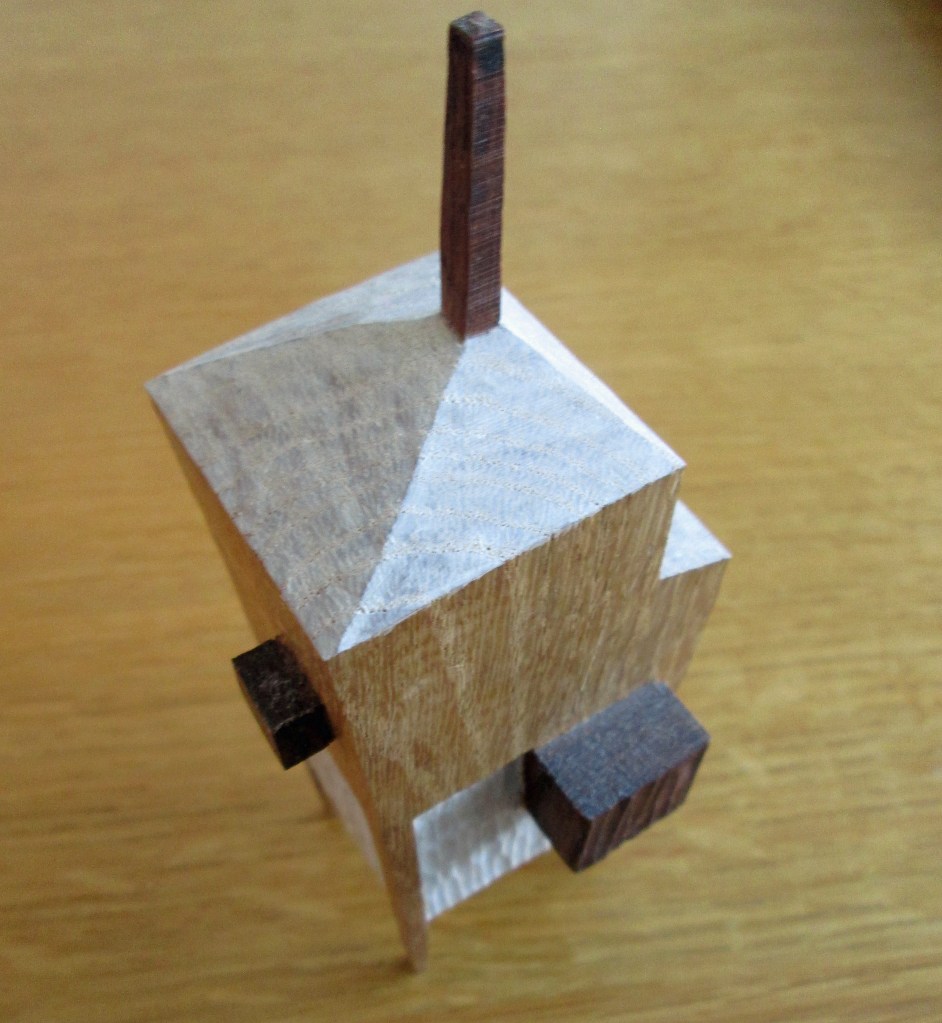
Well I usually only blog when I’m travelling and this was going to be about a planned trip to The Hepworth Wakefield, Ian Prowse’s Mersey Hyms gig at Appletreewick in the Dales and the Yorkshire Sculpture Park, where there’s an exhibit of works by Yukihiro Akama – one of which I was given as a birthday present by Dee in 2015 according to my meticulous (nerdy) records of art we own .

What is brilliant is that they are all carved from a single piece of native English wood (oak in this case) and signed underneath. The chance to see a major exhibition of his work in Yorkshire where he’s lived since 2011 after being trained and working as an architect in Japan, combined with these other cultural events and staying in Bradford with our friend Graham was a great excuse to head north.

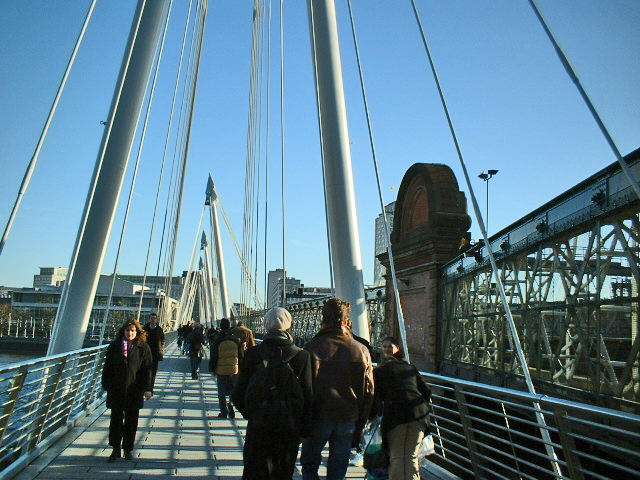
The week started well with a visit from our friend Daisy Scott from Boston. We first met and worked together in 1994 on an English language project for the publisher Longman, so a thirty-year friendship called for a celebration. But then disaster struck. When deciding on a title for this piece a number of puns occurred: Cultural Awokening; The Tripping Point; A Bridge to Fear; Anatomee of a Fall and so on since the week was curtailed by me catching my large left foot on a paving stone on the Hungerford Footbridge across the Thames, getting a serious gash in my forehead – again! – and taking Daisy for a new but non-cultural experience – a visit to St Thomas’ A&E (Emergency Room for her). I later emerged looking like this:

By this time Daisy had left after looking after me extremely kindly. Let me add some context to all this. On Sunday we had a Sunday lunch in the Queen’s Arms in Kensington, probably annoying the patient staff by taking far too long with catch up chat to order any food. But we did eat well and then went to see the Yinka Shonibare exhibition at the Serpentine Gallery. I’d known his work from other galleries and the fourth plinth in Trafalgar Square but Daisy knew nothing of him at all. We were both completely in awe of his creative imagination and power and the technical command of the technicians in his atelier to put such an amazing show together. Check it out from the link above and if you can get there – GO!

We had arranged by email to do a theaterathon (AmEng spelling works better) on Wednesday before Daisy flew back to Boston on Thursday. It was to start with lunch at the Union Club where Dee and I took Daisy many years ago but which is always a delight. We met there, ate well and started our thespy adventures by walking to the Theatre Royal Haymarket where Daisy in the States had managed to get two tickets for the utterly sold-out Portrait of Dorian Gray with Sarah Snook of Succession fame, She had warned me that we were in the gallery and needed to climb 65 steps to get there – a good test for the hip. Because we were going to be so high up I’d brought opera glasses – we had his and hers from the Royal Opera house in red velvet bags and I gave Dee’s to Daisy as a gift which she received with some emotion – they were great friends too,

In the event, the stairs proved doable as people were moving quite slowly and the opera glasses redundant as the whole perfoprmance is a mixture of theatre and live television with images displayed on a number of large screens around the auditorium. The sheer brilliance of Snook was matched by the choreographed balletic movements of the camera technicians, make-up artists, prop, wig and costume handlers who shared the stage with the actor who played 26 characters without breaking step. I was relieved I wasn’t vision mixing the feeds from on stage cameras with pre-recorded clips in a seamless two hours that flew by. The story might have got lost in the pizzazz but it didn’t. The production and her performance were truly phenomenal and it was very gratifying to see her call all the techies on to share the curtain call. We descended the steps light as air and proceeded to make our way to part two of our excursion buzzing with excitement at what we’d just seen and marvelling at how it had been achieved.

We had ample time to stroll across Trafalgar Square, through Charing Cross Station and use the eastern side of the Hungerford Foot Bridge to head for a cuppa and then the National Theatre for The Underdog, the Other, Other Bronte. And that’s where it all went wrong. The aforemention trip occurred – no alcohol involved yet as we didn’t want to fall asleep in the plays – and the day descended into (literally) a bloody mess.

Daisy was an absolute star, failing to panic, prodiucing tissues and keeping me talking to check I wasn’r concussed. We were soon joined by a group of passersby who gave my faith in humankindness a massive boost. Another Daisy – tall and curly haired rather than short and with cropped hair – rapidly called 999 and was giving them information about me and the accident when a women in a striking red dress bent down beside me and said “I’m a doctor. I’m from Belfast, I’m here for a conference. Let me have a look at you.” and then: “That’ll need stitches.” Daisy S was now the possessor of a pharmacy worth of wet wipes, tissues, plasters all handed over by concerned tourists and locals. I had by now assumed a sitting rather than a sprawling pose and was helped to my feet by two gentlemen each with a arm under my shoulders. We thanked everybody most warmly and assured them that we would be fine getting to A&E. So many kind, concerned and helpful people! My big worry was that I might have smashed my new hip but I was able to walk quite freely off the bridge down the steps past the Festival Hall and find a taxi to take us to St Thomas’ Hospital. The driver demurred at first: ” There were others looking for me … ” – then saw my face and said “Get in!”

There was a queue of about fifteen people waiting in and outside the A&E entrance and I pushed my way to the triage desk with apologetic hand signals and, I’m pleased to say, encouragement from those in line. We waited a few moments, gave my personal details and described the accident and were then directed to the Urgent Care Centre where Annabelle cleaned up the wound, let me wash my bloody hands and arms in the sink, put a temporary dressing on the gash and sent me to wait for treatment. One of our plans for our early arrival at the NT was for Daisy to find a quiet spot and good wifi to have a video call to her husband Jerry back in Boston as they’d been missing each others’ calls. There was a conveniently vacant children’s area where Daisy managed to connect and also brought the phone so Jerry could admire my wound and say Hi. As time went by I despatched Daisy to the National so that one of us a least saw the play. She later reported that we’d seen the better play in the afternoon. I might still catch it one day although I have a lot of outings in the coming weeks

When you are in it the NHS is just so excellent. I think I was probably waiting for about 90 minutes before Amy called me in and was such a calm, efficient and friendly nurse pratitioner who cleaned me up fully, gave me a full concussion test, told me I had a build up of ear wax while checking my vital signs and then put in the six neat stitches you saw at the top of the blog. We had such a relaxing conversation about all sorts of things and I just pray – and will vote in such a way – that the NHS which can give me a new hip and make me feel safe and better after a stupid, self-inflicted accident is rescued from the predators.

Last day – more art and a celebration

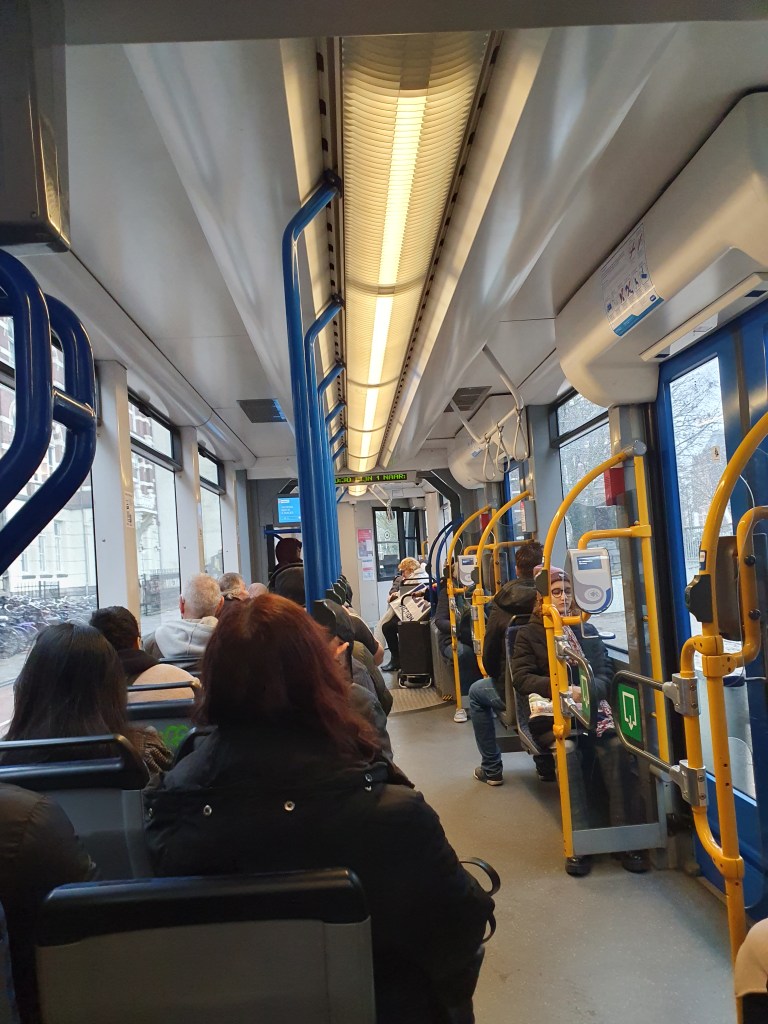
Last day of the trip and we decide to eschew the buffet breakfast at Cafe Moer and take our suitcases for a short walk up Overtoom to the Toasty Cafe we’d walked past on Monday’s exploration. Pink grapefruit juice, coffee and croissant and we’re off to the tram stop heading for Leidseplein – getting the hang of direction of travel and so on by now. The trams are very frequent and easy to use. You can buy a transport card or just touch in and out with a credit card or phone. They look quite small from outside with just two coaches but have Tardis-like interiors.

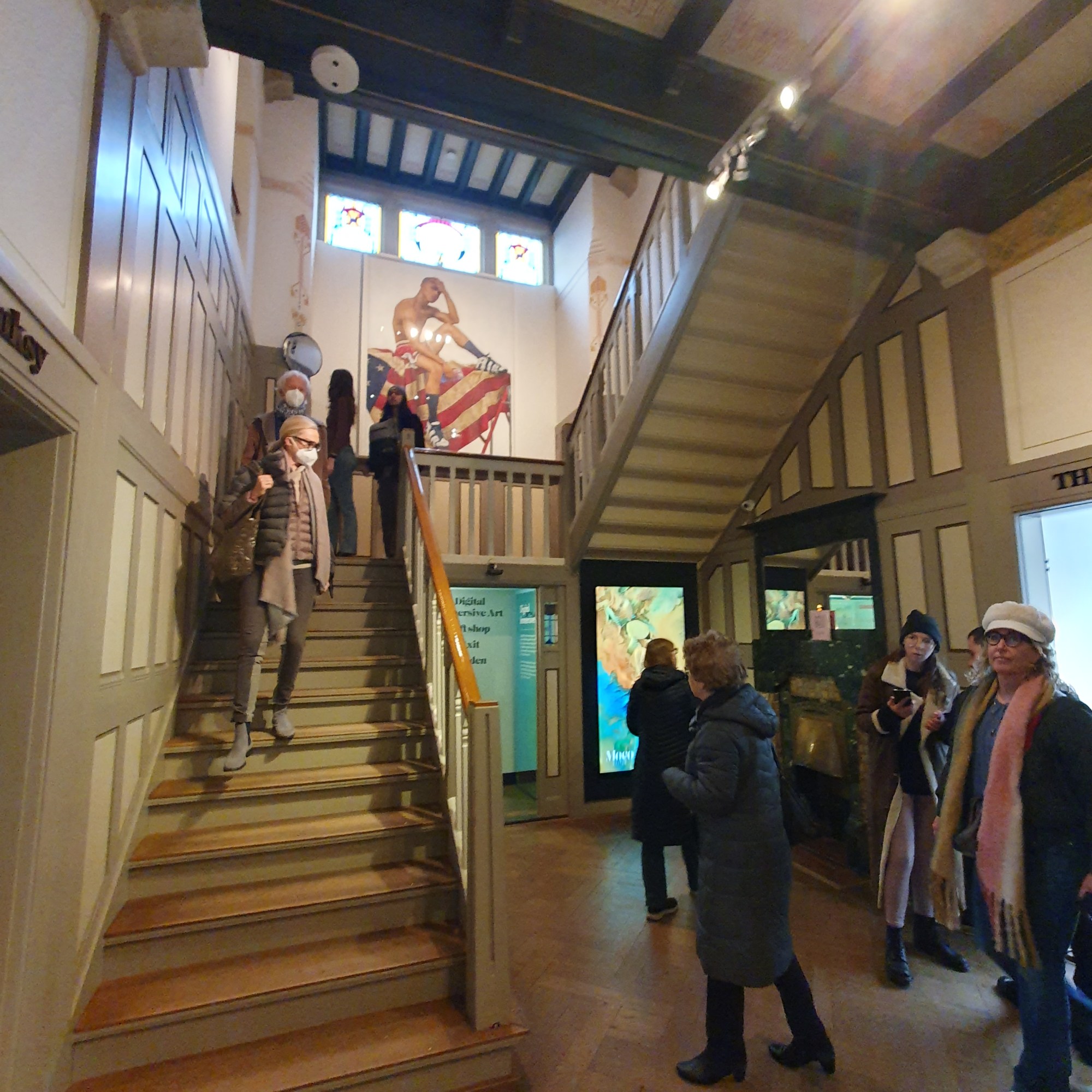
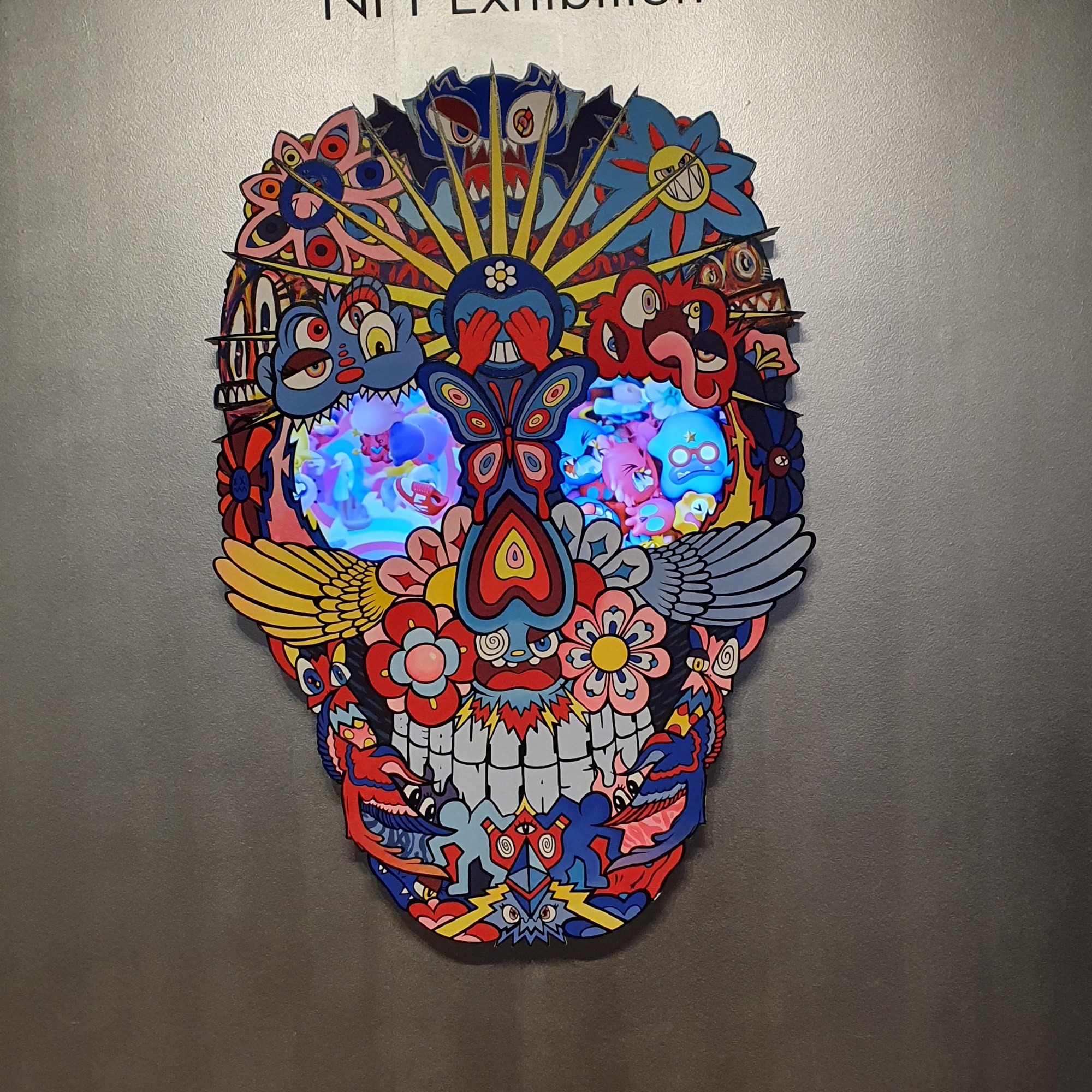
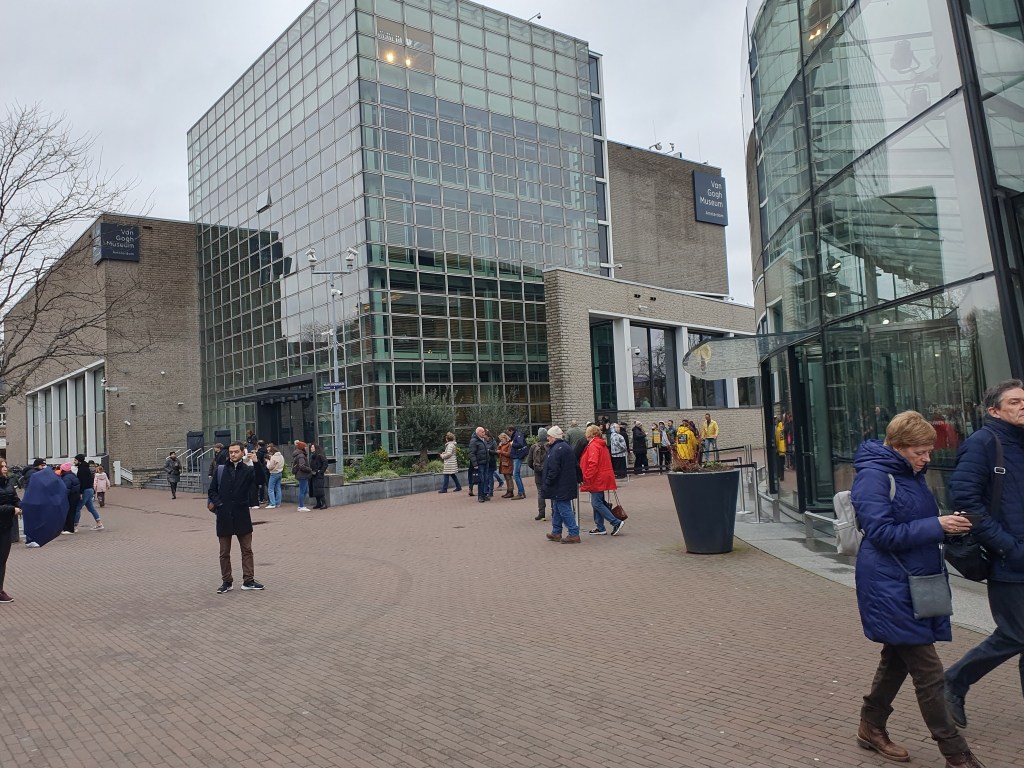
As we walked across Museumplein yesterday, we’d spied a locker storage facility in the Q-Park garage and so our first port of call was here to leave our suitcases knowing we could retrieve them later and get a tram back to Centraal Station from the stop opposite the Concertgebouw. This proved very easy and secure and saved us either trekking back to the hotel or going to the station twice. We had two more museums to tick off before checking in for the return Eurostar jouney at three-thirty. I had been to the Moco in Barcelona at Christmas and so was keen to visit the original in Amsterdam. Their mission is to present modern and contemporary artists in elegant surroundings. In Barcelona the museum occupies the fine old Palacio Cervelló not far from the equally impressive Picasso Museum. In Amsterdam they took over the historic Villa Alsberg next to the Van Gogh Museum. They have a significant number of authenticated Banksy originals and prints, some Yayoi Kusama pumpkins, a couple by Warhol, Basquiat and Keith Haring – and a Damien Hirst. There were also many artworks and video installations which were fascinating to explore. Some left me cold and uncomprehending, others I revelled in. That’s art I guess. One area was devoted to NFTs which despite all attempts I still don’t understand. One artist in the NFT exhibit that really appealed to me was Andres Reisinger whose environmental messages video Arcadia is accompanied by narration and an undulating minimalist music track. It has some phenomenal animation in the visuals and the poetry is very affecting. The room had a mirror wall so seeing ourselves and the video images stretching off into infinity reminded me of walking the great length of Hockney’s Normandy frieze at Saltmills in Bradford a while back. You can see Arcadia on Vimeo and Reisinger, composer RAC and poet Arch Hades talk about making it on YouTube.

Moco museum exterior and stairwell, Banksy’s faceless policemen, Kusama pumpkin, Takashi Murakami X Virgil Abloh sculpture and an animated NFT

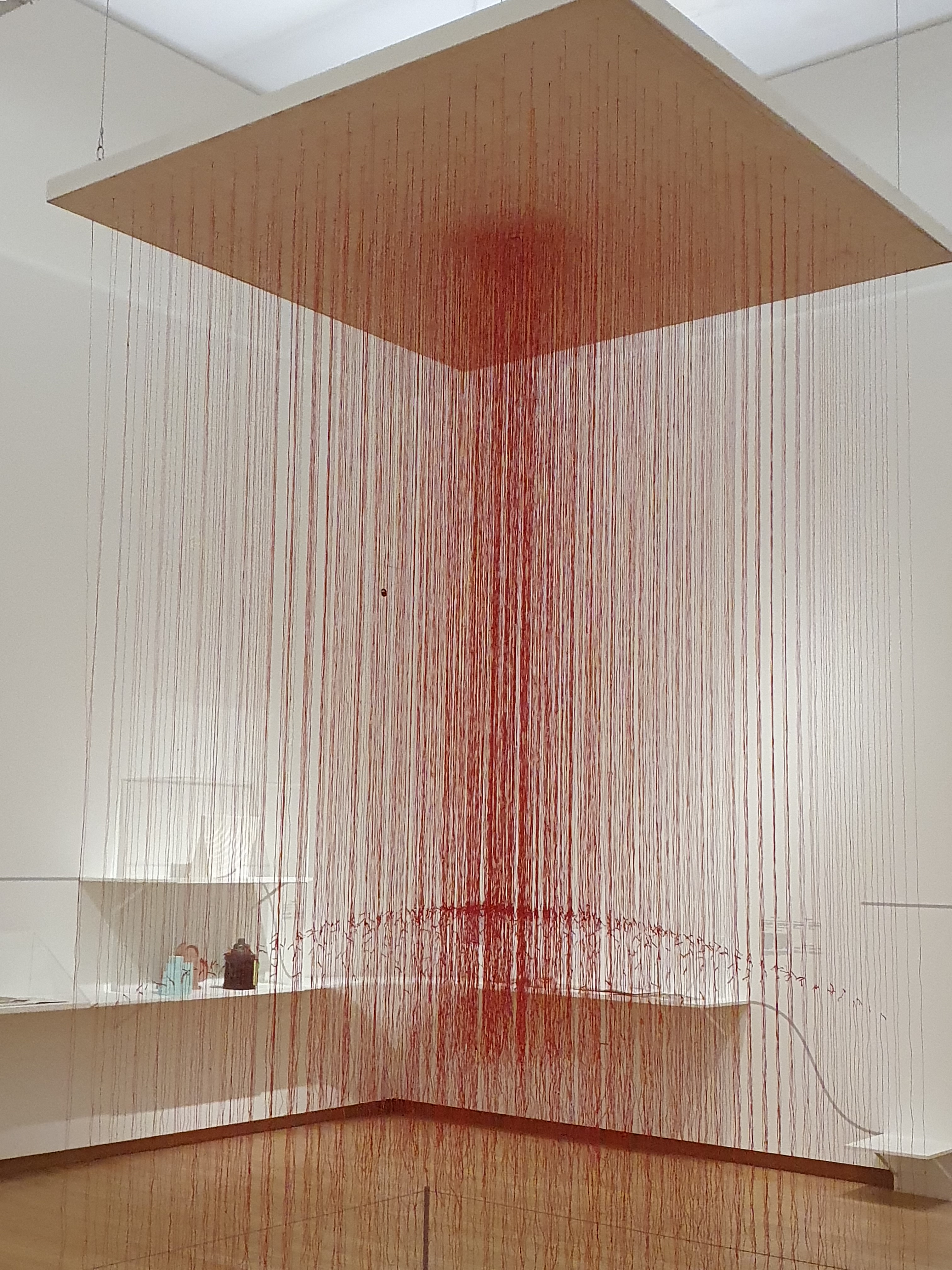
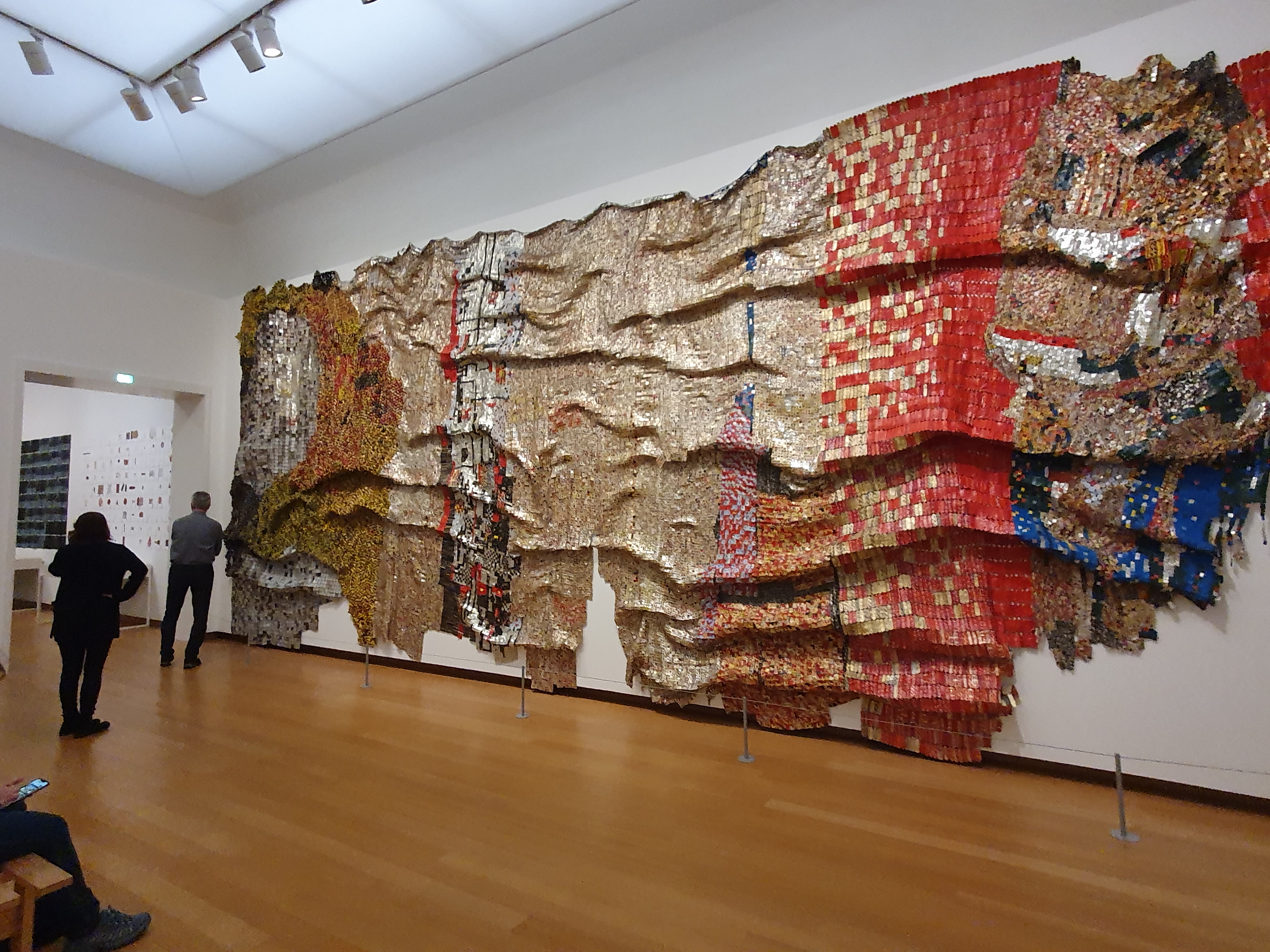
Time for lunch now and we decided to take it in the elegant cafe at the Stedelijk Museum which was to be our last port of call on our cultural marathon. The museum is in someways I suppose the Tate Modern to Tate Britain comparison with the Rijksmuseum. The permanent collection is divided into three sections: up to 1950, 1950-80 and 1980 to the present. It’s striking modern entrance hall conceals a fine Victorian edifice from 1895. I guess we might be having art fatigue but I found it the least interesting of our visits although there were still quite a few objects that caught my eye.

Stedelijk Museum exterior, Vanishing Point cotton sculpture by Lenore Towney, El Anatsui’s In the World But Don’t Know the World made from bottle tops and found objects which reminded me of the huge Miro tapestry with umbrellas I’d seen in Barcelona at Christmas and Paul Citroen’s Escher-like Metropolis.

We set off to collect our luggage with Fran nobly fetching mine as well, as I’d omitted to take photos of the museums as I’d originally thought I wouldn’t be writing a blog about this trip. But we’ve had such a good time I just thought I had to share. We board a tram at Concertgebouw and soon arrive at the main station – another impressive building.

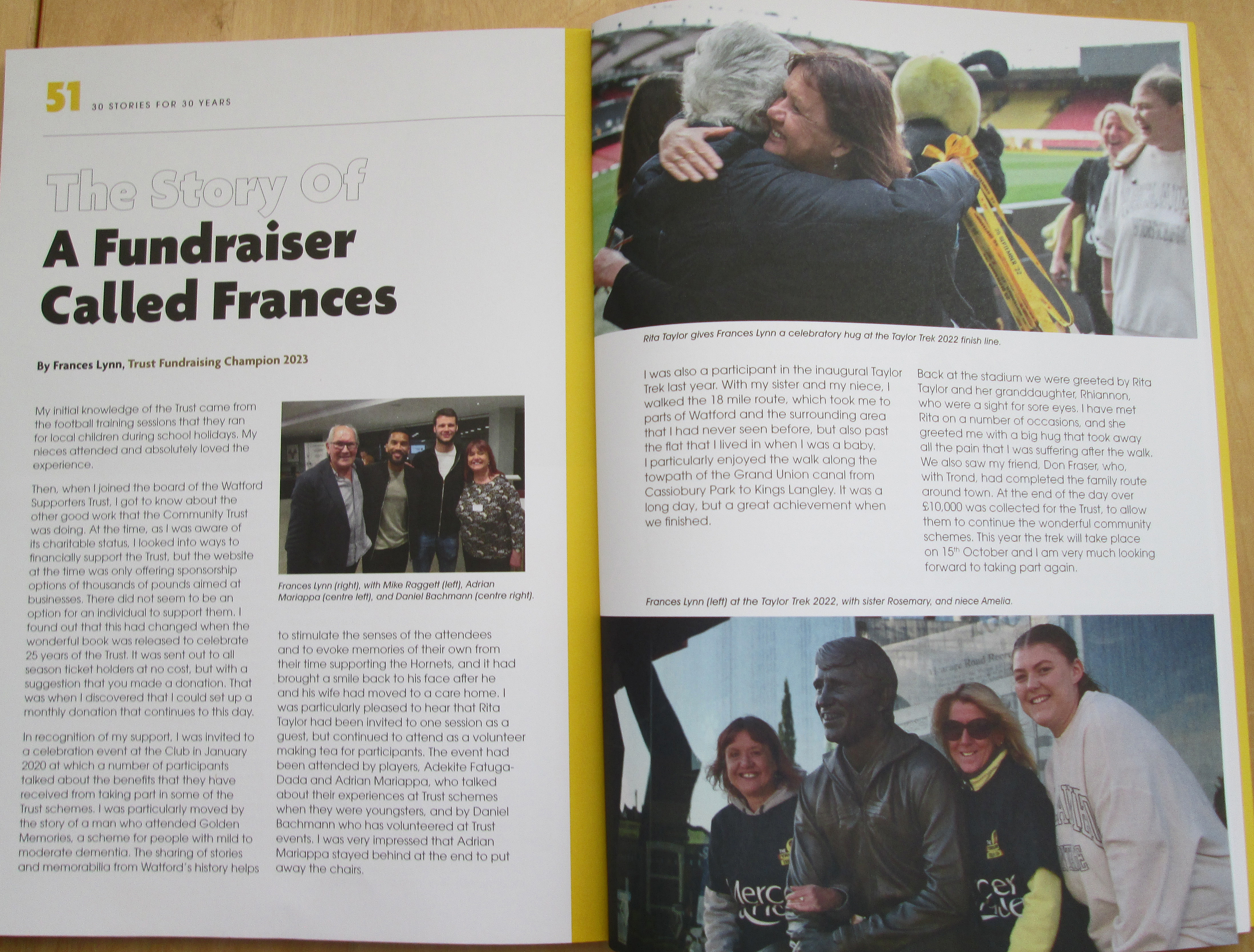
Check in at Amsterdam was less good than in London as we were all cooped up for an hour in a small enclosure on Platform 15 with few seats and no food facilities other than a vending machine. Every visit we’ve made this trip has been followed, almost instantly, with a request for feedback. I am very bored with this constant search for meaningless comment and generally disregard them but I did fill in Eurostar’s with my thoughts about the check in arrangements in Amsterdam. The journey itself was impeccable, so much so that at one point I said to Fran that we must be nearing Lille and she replied that we were already in England. We parted at St Pancras with the words ‘See you tomorrow’ since the reason for our return was to attend Thursday’s Gala Dinner for the Watford Community Sports & Education Trust to celebrate 30 years. Can it really be five years ago that I wrote a book for them? The evening was a total delight with many current and former players present as well as many friends and colleagues. We were presented with a substantial book containing the annual impact review and thirty stories from Trust supporters. Fran and I were delighted to find ourselves on adjacent pages.

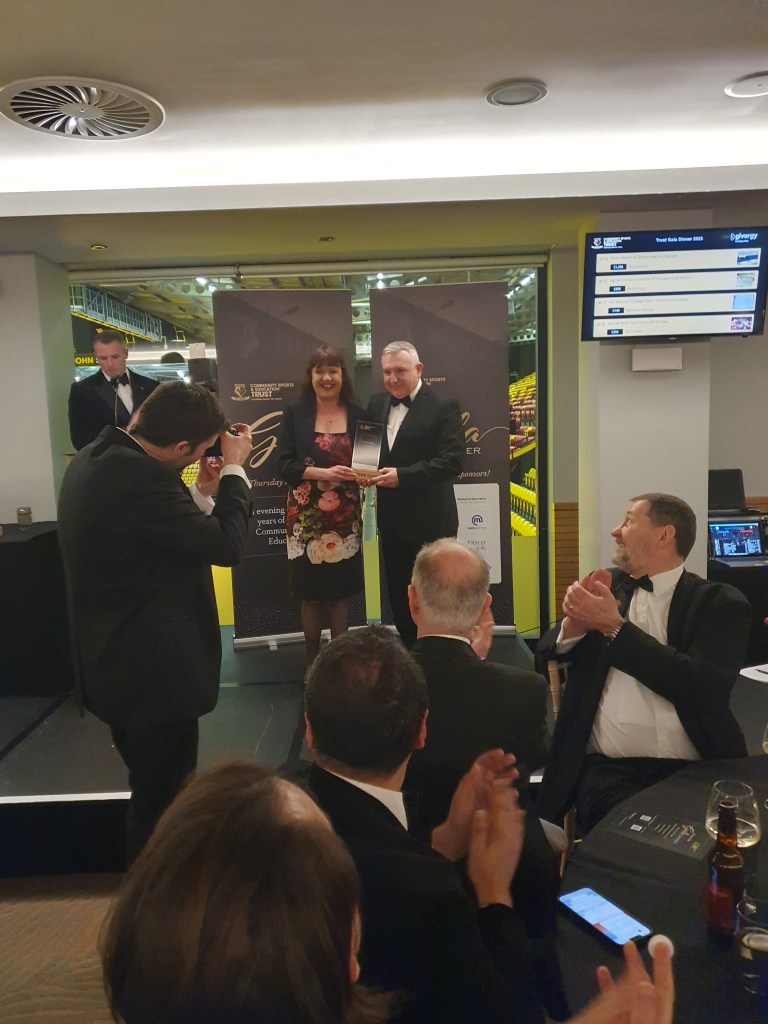
The evening was made even more special when Fran collected an award for being the Trust’s Fundraising Champion. We then stayed partying until far too late but it was a brilliant culmination of a week celebrating all the things we love – art. music, travel, beer and wine, food, friends and football.

Culture vultures

So day two of our culture trip dawned with a pleasant buffet breakfast in Cafe Moer and then a twenty-five min ute walk through Vondelpark heading diagonally for the Van Gogh Museum which I’d sensibly prebooked for 11:30, which was of course 10:30 on our body clocks and quite early enough to start the serious part of the day. Vondelpark is a huge green space with lakes and ponds, cycleways and roads and some pedestrian paths but it was our first moment of realising just how profuse and dangerous cyclists are in this city. Add to their sheer numbers the fact that motorised vehicles like scooters and golf buggies also use the cyclepaths and you take your life in your hands every time you cross one. It’s also sometimes difficult to know which is the footpath and which the cycleway.

Vondelpark today and as I saw it with skaters in March 2018.

We arrived slightly early at the Van Gogh Museum to see a sign saying ‘Sold out for today’ so feeling very smug at having booked from the UK in advance, we strolled past the waiting line into the museum. It houses the biggest collection of Van Gogh’s works in the world. We had booked for the special exhibition Choosing Vincent. Portrait of a Family History which made it clear to us why this was the case. Vincent’s sister-in-law was married to Theo for less than two years before he died soon after Vincent. But Jo van Gogh-Bonger and later her son – also Vincent – were largely responsible for promoting Van Gogh’s reputation as a major artist and later establishing the museum which bears his name.

The Van Gogh Museum, Amsterdam. Circular entry lobby on the right and the manin collection on the left.

We had time to explore the main collection before and after visiting the fascinating family story which was elegantly curated by getting you to follow a timeline on the floor which led to information panels, personal objects, photographs and paintings. It was staggering to find that at periods of his life he turned out a painting a day. It was also interesting to see how his style varied continually – a carefully painted image with oils thinly applied one day and the next the fervent impastoed brush stokes we generally associate with him. It was then time to head of in search of lunch before the manin event – Vermeer at 14:30. My memory from five years ago failed us so we had quite a roundabout trek to Leidseplein where I remember there being lots of bars. I was shocked when we did get there that so many are now chain operations rather than the local bars I recalled. However we found a very pleasant bar-restaurant under the Casino called Grand Cafe Lido in tribute to its predecessor which had been a landmark in the area since 1937. We had a canalside table (indoors), good beer and food and lots of boating and bird activity on the Singel or Leidsegracht canal (not sure what it’s called at this point).

Our rather damp entry to the Vermeer exhibition at the Rijksmuseum.

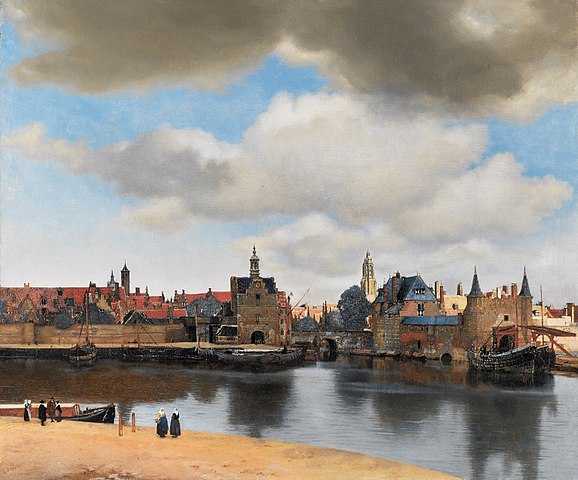
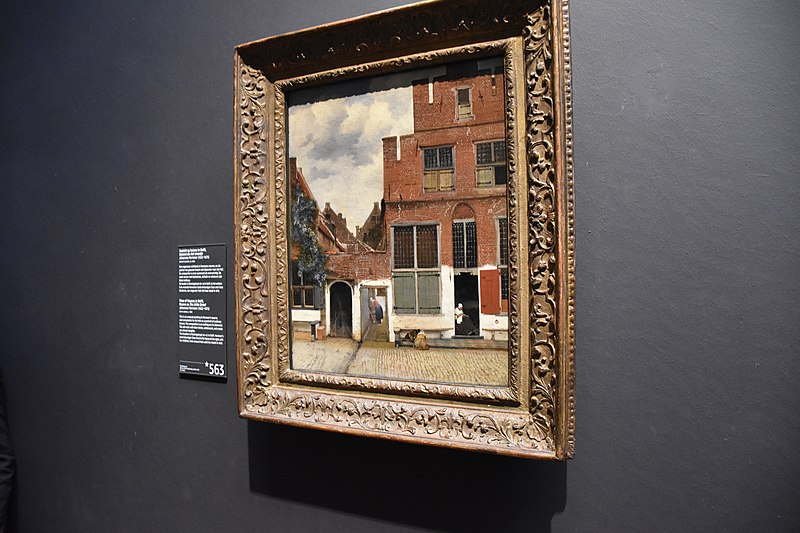
But it was well worth it. Again with prebooked tickets we breezed in deposited coats and bag and entered the intimate worlds created by Johannes Vermeer. Having said that, the first thing we see is a View of Delft and Little Street both of which are exterior views of aspects of life in the city. The degree of detail in the characters in each picture is remarkable. You can almost hear the conversations.

The whole exhibition just grew from this simple start. Paintings were elegantly displayed against the dark grey walls. Captions were clear and available from a QR code on my phone and the 28 paintinbgs were all well spaced so although the exhibition is a complete sell out you didn’t feel unduly crowded and had ample time to look at each painting. The most exciting innovation for us was the semicircular barrier at just below waist height around the majority of paintings which meant you could wait briefly for your turn to be one of the six people in the front line with an uninterrupted view. As we moved around it was fascinating to see how the same window, ther same model, the same yellow, fur-edged jacket, a globe and other props from his studio cropped up time and again. It seems that after that early blast of the outdoors he shut himself in his studio and just painted there. One aspect of his work I thought I knew was that subjects were always lit from the left. Quite a shock then to find three lit from the right: Girl with a red hat, Girl with a flute and The Lacemaker.

We took our time and wandered hither and yon, sometimes together sometimes not until we met up the the last room but as we prepared to leave we asked each other ‘Did you see her?” ‘No,’ was the response. We knew the Girl with the Pearl Earring was going back to its usual home the Maritshuis in the hague on 30 March but she should be here still. We retraced our steps, enquired of a guide and did get to admire perhaps, thanks to Tracy Chevalier, his most famous work. And very wonderful it is too. I have been reluctant of late to buy art exhibition catalogues but this was one I had to have and a fine exploration of his work it is. Reproductions of all the paintings but also lots of small detailed views to explore Vermeer’s technique. Many of the paintings were worked on for a lengthy period with evidence of recomposing them with overpainting revealed by x-ray analysis. Worth the trip to Amsterdam? Absolutely and there’s more to come.

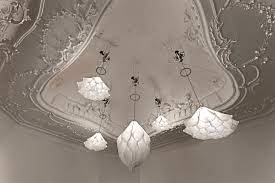
As we went down the stairs to the loos at the exit from the exhibition, I noticed white fluffy things whooshing down from ornately plastered ceiling. It was a great installation and from the information desk we managed to elicit that it was by Studio Drift. The web confirmed that it’s called Shylight and there’s a fascinating video of it on their website and on YouTube.

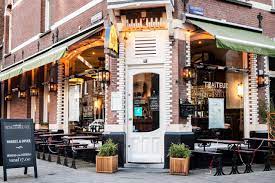
We now had a couple of hours to pass before gpoing to the Concertgebouw for a concert at 8.15 pm. As that would not finish until well after ten, we thought eating first might be a good idea. I remembered finding a great bar to the southwest of the concert hall so we set off in that general direction and happened across a very suitable place. It wasn’t the one I remembered from my last trip – I later discovered that Brasserie van Dam was just one block further west. However the Eetcafé Schotsheuvel did us very well. It was pretty empty when we arrived and we had a beer wondering whether to just have the one and move on before finally deciding to stay and eat. The staff were friendly and became increasingly busy as by the time we left to head back to our concert, the place was heaving with locals – always a good sign. Extremely tasty crab cakes and fries with garlic mayo and a substantial pork rib and a decent bottle of wine saw the time fly by and our decision to stay well justified.

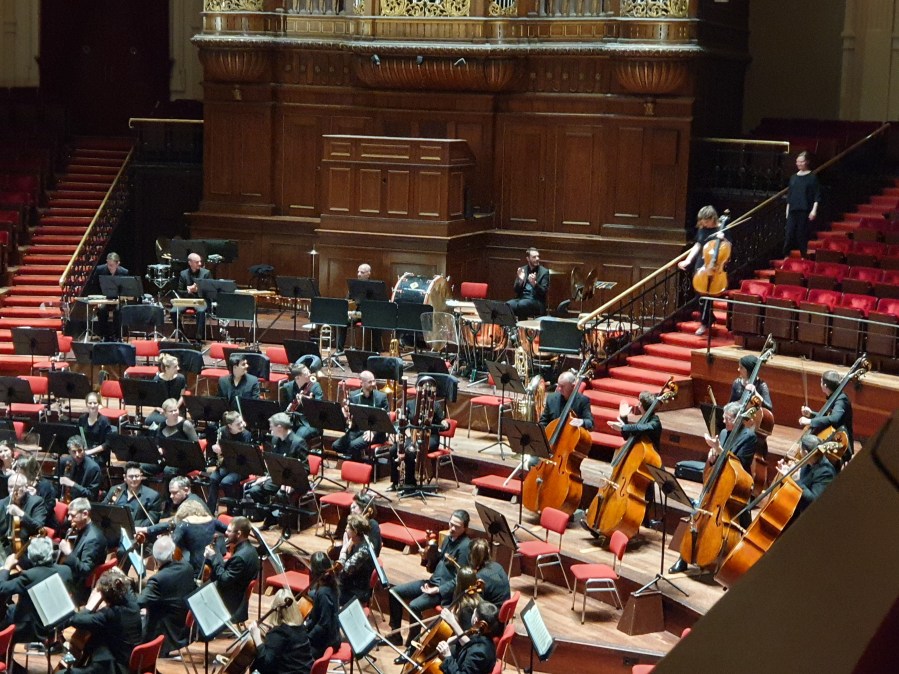
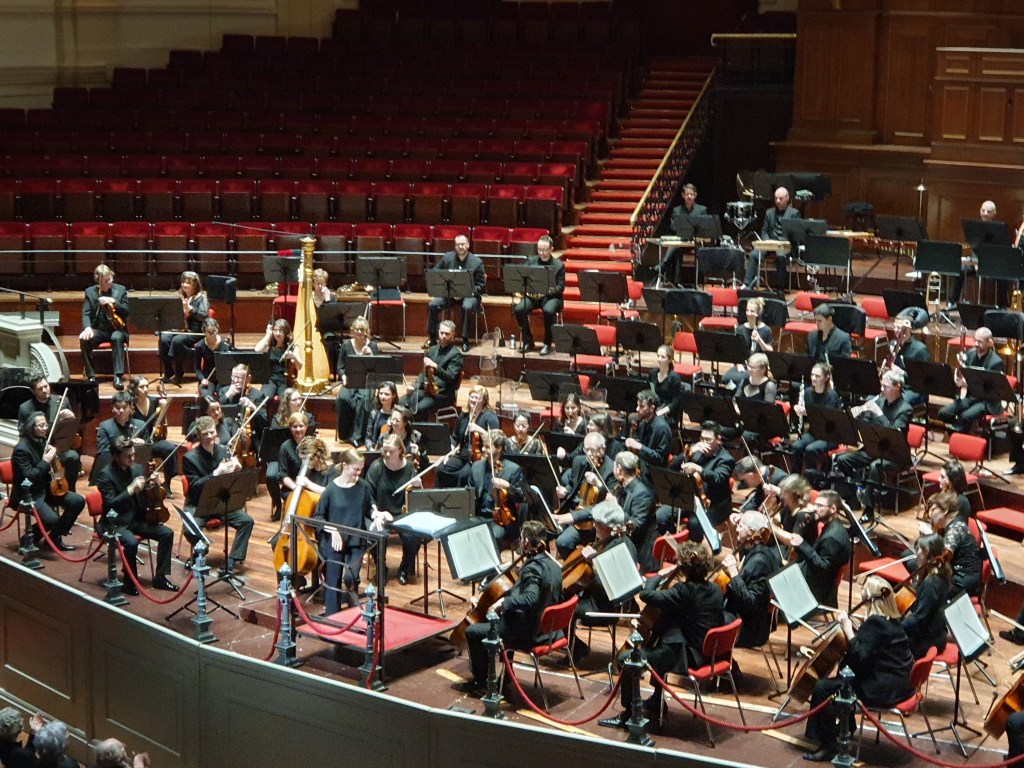
We make our way back to the Concertgebouw and settle into sided balcony seats with a good view of the stage. The concedrt is given by the City of Birmingham Symphony Orchestra which came to major international prominence under Simon Rattle who joined it in 1980 when he was just 25 and made it into a world renowned orchestra during his 18 years as music director. Tonight the baton is in the hands of the young Mirga Gražinytė-Tyla the Lithuanian conductor who became MD at the CBSO in 2016 at the age of 20. So what we were about to hear could be called ‘Simon Rattle’s Tyla-made Army’. Watford fans groan, others ask for an explanation in the comments!

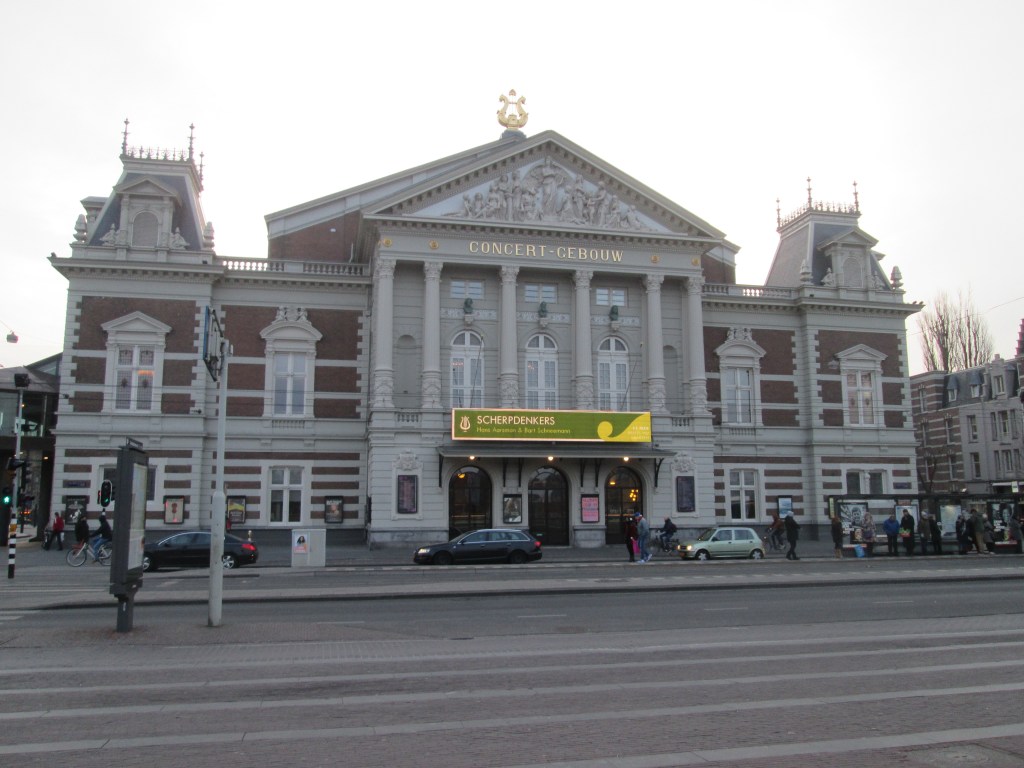
Concert-Gebouw exterior with excellent gold harp on the roof

The concert started with a piece I’d never heard of by Mieczysław Weinberg who was described as Polish-Russian and died in 1996. It was his Sinfonietta No.1 and was a rousing big orchestra number with loads of percussion – a big night for the glockenspiel and tambourine man – vast swathes of brass interspersed with lyrical folk tunes in the strings. It was 20 enjoyable minutes and had something of a film score feel to it. This was followed by the Shostakovich cello concert played by Julia Hagen a rising star according to the Citizens of Beethoven who awarded her the Beethoven Ring for 2022 and others. When I read she plays a cello made in Cremona in 1684, I was fearful of a trip on the lengthy flight of stairs conductor and soloists must use to make a grand applause-filled entrance. It was very well done and conductor and soloist clearly had a strong rapport. At the interval we went out into the bar and picked up a glass of wine at no charge. As Fran pointed out, it means they can get through the interval drinks dispense much more quickly when they are not faffing about with payments. We sat with two Dutch gentlemen who inevitably asked how we were enjoying Brexit. ‘Not!’ was our emphatic reply. They smiled wryly.

The second part of the concert was Prokoviev’s suite from the ballet Romeo and Juliet. It’s a work I know and love and I don’t think I’ve heard it played better than under Grazintye-Tyla here in Amsterdam. So many earworms from the dance of the Montagues and Capulets to the plaintive tune for the young Juliet – I’m still humming it now. After massive rounds of standing ovations we left the hall and knowing our hotel was in a street called Overtoom we boarded – at my insistence – a tram that said it stopped at Overtoom. Only it stopped at the wrong end and Google maps said we were 20 minutes walk from the hotel. I now know that Overtoom is straight as a die for slightly over 1.5 kilometres. So we walked back to the Rijksmuseum and the tram stop at Leidseplein and took the correct tram this time which left us with a mere six minutes walk to the hotel. Moral – swot up on the tram map before you dash onto the first one you see. So an amazing day of varied culture came to an end with a rewarding last glass of wine to round it off.

Last day observations

Despite not being in the best of health throughout, it has been a great stay in this wonderful city. I’ve visited familiar places and several new ones, heard great music and seen amazing art. I need to catch a train from Passeig de Gracia around 14:30 to get to the airport in good time for security and check in so decide to forgo further wide exploration today and walk about other part of the Eixample. Apart from the Berasategui restaurants, there are other reasons to come back – I didn’t do the ‘immersive Dali experience’ at IDEAL, the Digital arts Centre, I didn’t get to the European Museum of Modern Art and of course I’d love to go to the Liceu Opera house again to hear something to my taste performed.

One of the things I love are elegant shop signs from the golden age. Dee had an obsession with door knobs and knockers, mine is with shopfronts. Dee also loved hat shops so there’s one here for her! I collected a few more this morning as I strolled the nearby streets. It’s a little more cloudy today but still pleasantly warm although down a bit from yesterday’s 22 degrees (that’s 72 Daisy).

I also snapped a few more of the elegant houses that jump out from the streets at regular intervals. It’s a city where you need to be sure to look up as you walk through the streets.

But I needed to look down at the top of the Passeig as I came across this excellent manifesto which is something that as a sort of creative I feel very strongly about. It’s set in the pavement outside a Barcelona city office.

Just round the corner at the Palau Robert a poster for an exhibition reminded me of a day in the spring when Frances, Rosa and I went to see Pedro Almodovar’s Parallel Mothers. Alongside the usual convoluted emotional stories of two women, he finally addresses the horrors of the Franco era. The film involves a search for the body of a great grandfather in a mass grave. The poster examines 85 years of trying to reunite families with lost relatives. So far of the 114,000 ‘disappeared’ only 19,000 have been recovered. As Almodovar said in a Guardian interview, ‘Now is the time to remember Franco lest his victims be forgotten’.

Inside the Palau is a much happier image – Barca’s first heroes. There are displays of other sports – boxing and motor sport very popular – and fashion during the early part of the 20th century. This is the 1919-20 season team that won the Catalunya championship as well as that of all Spain. The caption claims that the 20s was the decade when football became a mass popular sport.

Sipping a last beer before boarding the train I noted that at none of the bars I’d been to had I been offered the little complimentary dish of olives, crisps or nuts that had been common on previous trips. Now whether this is a factor of the cost of living crisis or just a metropolitan thing I’m not sure. Certainly the news programmes were filled with analysis of the government’s crisis measures – reducing VAT on food staples, capping fuel prices and handouts of 200 euros to those most in need as well as some measures to encourage businesses to recover. I didn’t find Barcelona quite as depressing as London from the point of view of rough sleepers and boarded up shops – but I was in a rather posh part of the city for most of my trip. And as I descended to the train station my last view was of Gaudi’s brilliant Casa Mila known as La Pedrera (the stone quarry). It was his final civic architecture before devoting his life to the Sagrada Familia. A fitting end to an excellent week in this great city.

A day on Montjuic

I so enjoyed my visit to Miro’s studio in Mallorca last year that I decided to visit the Fundacio Miro in Barcelona. It’s situated up on Montjuïc the mountain where the Olympic Park was in 1992 and which continues to be a tourist attraction. Three stops on the Metro to Parallel and the the Funicular up to Montjuic.

It was a disappointing trip compared with the ones in Bilbao, Budapest and San Sebastián in that it’s almost entirely in a tunnel with just occasional sights of scrappy play areas and none of the vistas across the city I was hoping for. However, a few steps from the top of the funicular, my wish was granted with this view dominated by the magnificent Sagrada Familia.

On the way to the Miro Foundation was a sculpture garden with some of the worst signage I’ve ever come across – tiny aluminium stakes with titles engraved – totally illegible. At Miro, things were handled much better. There is a huge collection of paintings, sculptures, tapestries and found objects displayed in spacious galleries. I’m glad I’d been to the studio in Mallorca to get an idea of Miro’s working methods. It’s also good to see that artists who choose to follow a different kind of visual vocabulary are well grounded in basic draughtsmanship.

I particularly love his amusing sculptures from everyday objects. As a not-very-royalists person I was much taken by King, Queen and Prince (below right), the huge (nearly 6 metres across) Sobreteixim with eight umbrellas and the dramatic use of a coat hanger.

Another artist provides a fascinating object here. Alexander Calder was the only non-Spaniard invited to contribute to Spain’s pavilion at the 1937 Paris World Exhibition. Alongside several Miro canvases, Picasso’s Guernica, Calder’s Mercury Fountain was seen as a further protest against the atrocities of the Franco regime including the attack at Almaden the town that provided a substantial quantity of the world’s mercury. Calder donated the sculpture to the Miro Foundation and we view it from behind a glass screen since the toxicity of mercury has been discovered. Funny thing is the Egyptians knew about mercury too and thought it chased away evil spirits – may have killed some of them too.

A temporary exhibition here featured another favourite artist. It was called Paul Klee and the secrets of nature. It hads a fascinating collection of drawings and early paintings again demonstrating complete draughtsmanship abilities before going his own chosen way or ways in his case as there was so much variety in his work.

I had a coffee in the cafe before continuing my walk along Montjuic. I was heading inexorably to the National Art Museum of Catalunya, which I had told myself I wasn’t going to bother with on this trip. I remembered, bothwith the children ages ago, and with Dee more recently standing on its terrace on a Friday evening eagerly awaiting the magic fountain’s display. No use waiting for it on Wednesday afternoon. I do remember it as quite spectacular with water jets synchronised to different music genres at different times and changing colour appropriately. Looking down at it brought back good memories. I then thought ‘Well I’m here, it’s free with the Barcelona card so why not?’.

The majestic central dome covered an area in which there were easels for wannabe artists and a fabulous soft play area with kids swarming all over. If that what it takes to get folk in and keep galleries alive, I’m all for it.

I decide to eschew the old masters which I have seen before and head for the modern floor upstairs. Neatly divided into four areas it shows the development of Catalan art from the turn of the century to the present day. In the very first gallery devoted to modernisme, what did I see but the actual dining table Gaudi had designed for Casa Battlo.? There were lots of beautiful wooden, glass and metal objects in that fluid style.

As I progressed through the galleries I saw works by familiar names like Rusinol, Sorolla and Picasso. I was especially taken by a cunning Rusinol self portrait. Look carefully!

In the next room I was introduced to the work of a female photographer Mey Rahola who shared a love of sailing and photography with our friend Joe Weiler in Boston. She was lucky to be around at a period 1934-36 when it was OK for a woman to engage in such pursuits. The Civil War put and end to that as she went into exile in France but had developed her own documentary style and continued to take photographs professional during the Second World War.

A new set of rooms for 2022 are devoted to the art of the Civil War period and range from propaganda posters, depictions of the horrors of war reminiscent of Goya – one wall of etchings reminded me of Los Caprichos. It’s interesting to see how Spain is re-evaluating the whole period that was so traumatic for so many. When I raised the refugee elements in Isabel Allende’s book with Rosa and Pepita over lunch Pepita didn’t really want to discuss it as, although born after the end of the war, so much of her childhood and early years were shaped by it. One of Rosa’s video installations Lost was on the subject of babies stolen by the church during the Franco period. It casts a long shadow.

Enough gloom. Back out into the sunlight of Montjuïc and a walk through the Botanic Garden towards the Olympic Stadium where a convenient bus arrived and took me back to the funicular. A little later a further trip to the Cerveseria rounded off a thoroughly enjoyable day up above the city.

Ancient and modern

My children returned from a trip to Egypt raving about it and insisting it be added to the bucket list. When I mentioned this at lunch on Boxing Day, Pepita and Rosa who had both been and loved it, suggested I visit the Museu Egipci in Barcelona. My visit to the Sagrada Familia was booked for 14:30 so what better way to spend the morning? Also it was directly along Calle Valencia a left turn out of the hotel. It proved very rewarding. As all had said, the time zones are astounding. Craft, writing, tools of such complexity 3000 years BCE do blow the mind. Yes some of the names are familiar – Rameses, Ptolemy, Cleopatra, Tutankhamen – but how do they relate? The museum is small, on three floors of a town house, but highly informative with several modern x-rays conducted with Imperial College in London and others to analyse what had been collected over the years, by Howard Carter among others. These showed levels of skill that are mind-blowing given the eras involved. Quite a civilisation! Bucket list duly updated.

I headed off along Calle Valencia in the belief that this would bring Me to, or close to the Sagrada Familia. To my delight I found another local market on the way and decided to have an early lunch as everywhere near the basilica would charge a premium. I’m not entirely a cheapskate but don’t like being ripped off. I had a very fine fish soup with pan con tomate and was equipped to revisit the icon of Barcelona after a good many years. I first came when the children were young and we could roam among the half constructed towers, then later with Dee while they were still hoping for investment to finish it, probably ten years ago. As a deeply religious man, Gaudi would probably appreciate my OMG reaction on stepping inside. The nave is finished – it’s not open to the sky any more. The stained glass is all in place and it looks magnificent. Only once back outside do you see the tell-tale crane and realise that some of the towers are still to be finished. But they say it’s on track for 2025 only 135 years after the foundation stone was laid.

The exterior is equally brilliant with enough religious and natural symbolism to fill several volumes – available in the shop of course. But here are some of my favourite elements.

Having walked all the way there, I took the Metro back to Passeig de Gracia, put my feet up for a while in the hotel and then headed out to the Gastropub Obama – yes really – for a light supper. Claims to be British American but the most prominent beer on offer is Guinness. It was fun but the Cerveseria Catalana gets my vote for the best place in the area.

Nadal i Sant Esteve

Christmas Day was always planned as a quiet one. I needed to give my feet a rest so began the day with a leisurely buffet breakfast in the hotel for the first time (not included and cheaper on the Rambla!). A little light blogging, music and reading saw the morning whizz by. I decided to take a brief stroll around the neighbourhood finding a pretty passageway with orange trees – the mind turns to marmalade making in a month or so. There were a large number of other splendid examples of modernisme architecture – there were even plaques on the pavement showing on was on the correct route.

I’d been debating spending quite a lot of money on a meal at one of the two restaurants run by Martin Berasategui. Dee and I had a memorable meal in 2016 in San Sebastián at his original place. However I walked by them, looked online and Lasarte (3 Michelin stars) isn’t open until Thursday when I leave and Oria (just the one so far) on its site, won’t let me book for fewer than four people. My appetite is not that great at the moment so maybe I’ll leave it for another trip.

Boxing Day was all set up for a trip into the countryside to join Rosa and her mother Pepita for lunch. We’d agreed that I’d catch the 11:51 from Passeig de Gracia. I made an small error – I thought the Metro and train stations were connected – they are not – so I walk briskly to the train station three blocks up the Passeig. As I reach the platform the clock says 11:51 and there’s a train there so I jump on. After ten minutes it stops at Estacio de Franca which I think is jus a pause at a major calling point. After another ten minutes I investigate and find the train is at the buffers and I have to take the next one back to Passeig de Gracia and then get the 12:51 to Sils where Rosa will collect me. Quick WhatsApp to confirm late running and we’re underway again. We rendezvous OK and go to the lovely Terme Orion where Rosa and Pepita have spent the last three days relaxing after a flurry of family activity. My Spanish is a bit more relaxed this year and we are able to have a reasonable conversation with only occasional translating duties for Rosa. Food was great, wine all included and they wouldn’t let me contribute anything. A lovely afternoon – if a little shorter than planned.

Rosa and her mum are heading back home to Terrassa and fortunately Sils is on the way so they drop me off with twenty minutes to wait for a train that will categorically got me to the Passeig de Gracia – albeit ten minutes later than promised. It’ll be a bit tight to get to my Sant Esteve concert but more brisk walking to the Palau gets me there in time to hear the applause for the conductor coming on stage – from outside the door. They won’t let me in for ten minutes so I miss the first three items in full glory.

When I do get in I find that my seat is high up in the gods with only a partial view – I think I asked for ‘best available’ and it was certainly a sell out. In keeping with its Orfeo Catalana label, the only instruments were a piano, the giant organ and a trumpeter while there were choirs ranging from the junior and middle childrens’ choirs to the professional choirs of the Palau. There were some familiar carols – Silent Night, Little Town of Bethlehem and a Catalan one I’d heard at a concert by Pegasus the choir my son sings with back in London – Fum, fum, fum. It was a spectacular event full of joy and tradition and I think at one point there must have been close to a thousand voices on the stage and in the galleries on either side. Fantastic!

As an encore we had a rousing version of the Hallelujah Chorus which culminated in a flurry of unfurling of Catalan flags and shouts of ‘Independencia!’ It seems the prime minister has ruled out another referendum but there are general elections in May so it’ll be interesting to see what happens then.

I had a voucher for three euros so decided to have a glass of wine and send friends and family my reactions to the concert via WhatsApp What a great end to a great Christmas. As I walked back to the hotel I was struck by the variety of lights on each street – much less showy than London but original and (sorry) delightful. Here’s a selection.