After a week of brilliant music, family and theatre in London I now find myself in Alicante.
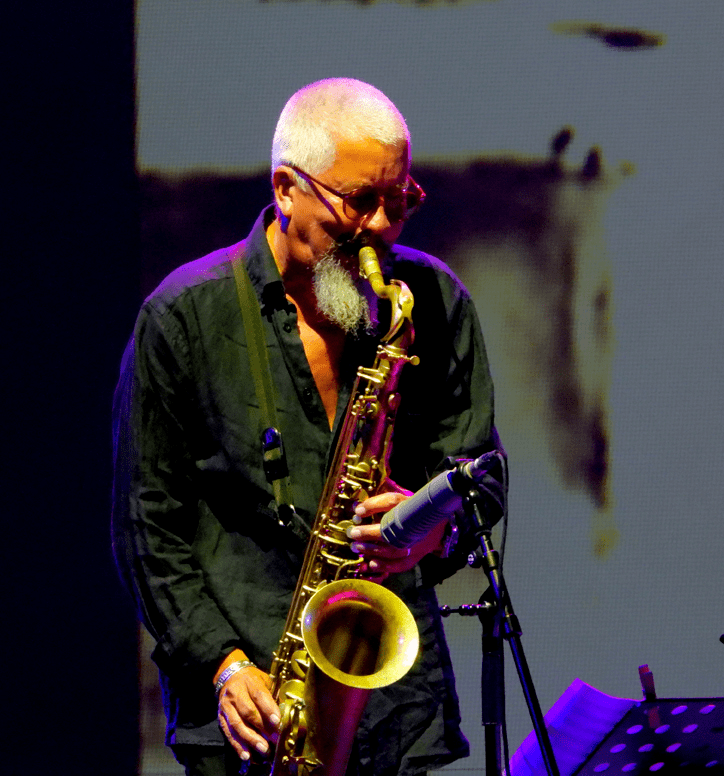
Thursday saw neighbours Les, Sean and Maria and me make our way to our local wine bar and then to Blackheath Halls to see the Andy Sheppard quartet. Dee and I and a colleague had recorded an hour long to show with Andy back in 1999 and guitarist John Parricelli was still part of the group.
He is still a complete master of the soprano and tenor saxophones and was given great accompaniment from Dudley Foster on bass and Nic France on drums in an evening of varied old and new material. He made me cry by playing ‘Dancing Man and Woman’ which Dee and I had as our play out music from our wedding back in 2001. Happy memories through the tears.
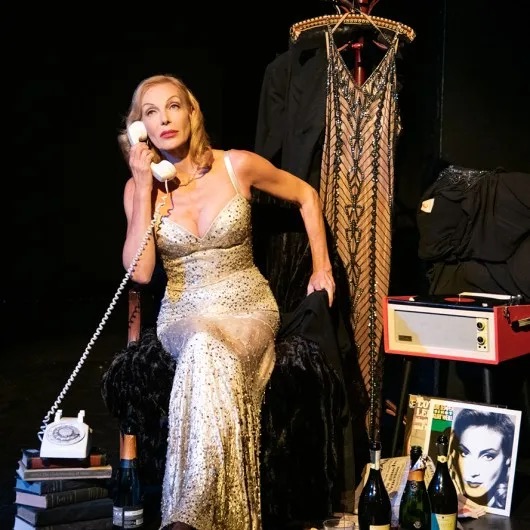
My friends Anna and Lisa ventured up from Ramsgate to see Ute Lemper visiting Marlene Dietrich. They had a spare ticket and invited me to join them.
I didn’t really know what to expect but thoroughly enjoyed Ute telling us about a three hour long telephone conversation she had with Marlene in Paris. She had written to convey her horror at the press calling Ute ‘The new Marlene’ and the diva had phoned her back. This story interspersed with the great songs made for a most enjoyable evening
Sunday was little short of a miracle when son and daughter-in-law, daughter and son-in-law, two grandchildren and I were all free for lunch at the same time. Amazing fun and great stories all round. A great start to Christmastime.
Monday saw me go with Frances to the press night of Indian Ink at the Hampstead Theatre. It coincided with Tom Stoppard’s funeral and we were a bit worried about how it might affect the cast, especially Felicity Kendall. They were all superb and particularly Felicity playing the older role rather than the one of poet Flora Crewe she had created twenty years ago and Ruby Ashbourne Serkis playing Flora in front of Felicity. Gavi Singh Chera was also excellent as the beguiling – to Flora – Indian painter. As always the witticisms and hilarity were countered with serious debate about the role of Britain in Empire. Not his best play but definitely worth seeing for the acting and the brilliant set and lighting design – oh and the incidental music is good too.
I had a lovely lunch with Camilla Reeve the publisher of BBPC’s anthology Home and Belonging. It was a generous thank you from her for my chairing the discussion panel at her literary festival back in November. An enjoyable discussion ranging over many topics.
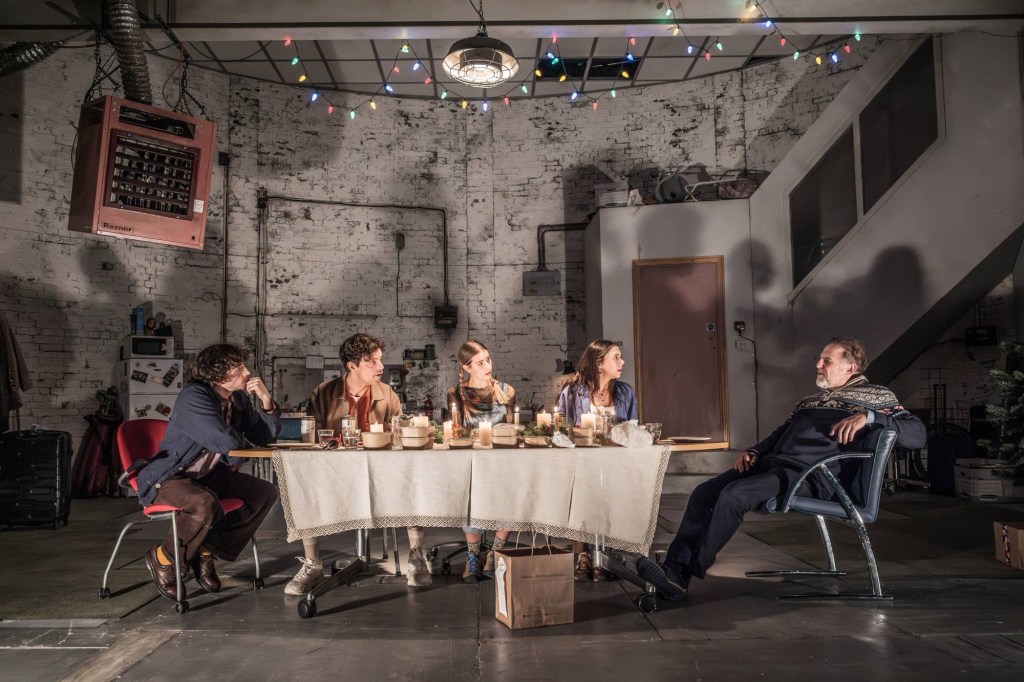
Wednesday was at the Almeida for Christmas Day, the second play in a month featuring a Jewish family (not) celebrating Christmas. This was provocative with references to Gaza and antisemitism, family bickering and made some good points but for me was a bit disjointed and I felt needed longer in development to get a better play out.
Twelfth Night came early with Frances, Farzana, Richard and me heading to the Barbican, some of us via the excellent Jugged Hare for dinner. This was the RSC`s production starring Freema Agyemang as Olivia and Sam West as Malvolio with Gwyneth Keyworth at Viola and Michael Grady-Hall as a brilliant Feste – brush up your juggling skills if you’re in the front rows! It was hilarious, but also touching, emotionally grabbing and was spoken with such clarity that your respect and admiration for the genius Bard of Avon rocketed even higher.
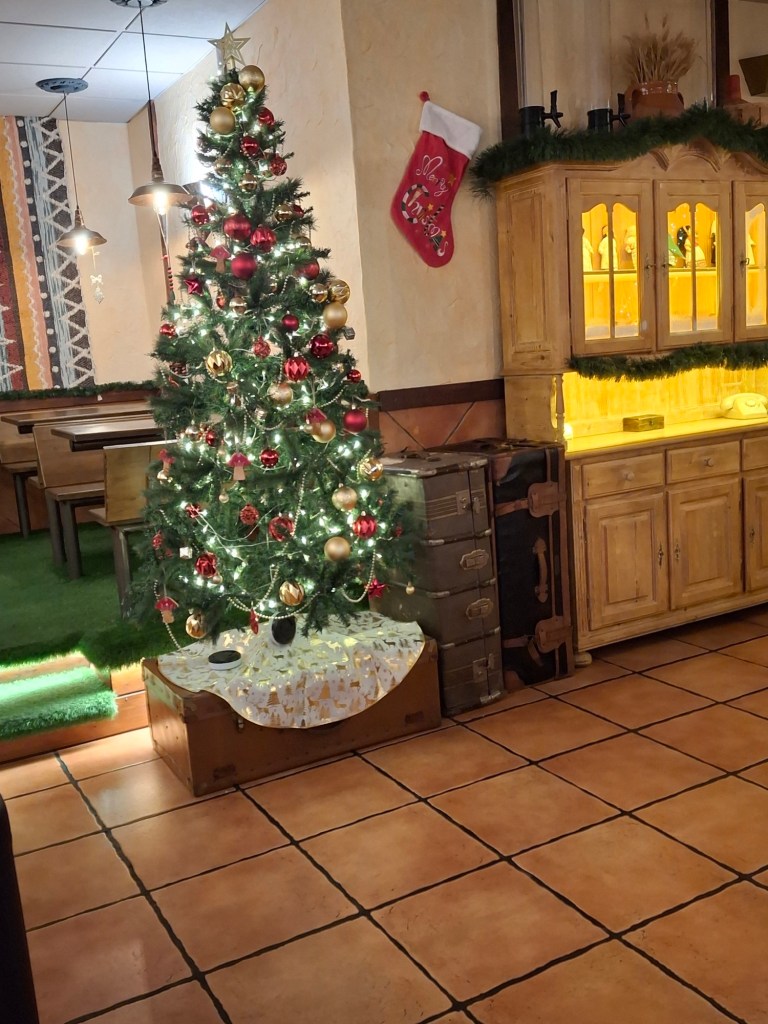
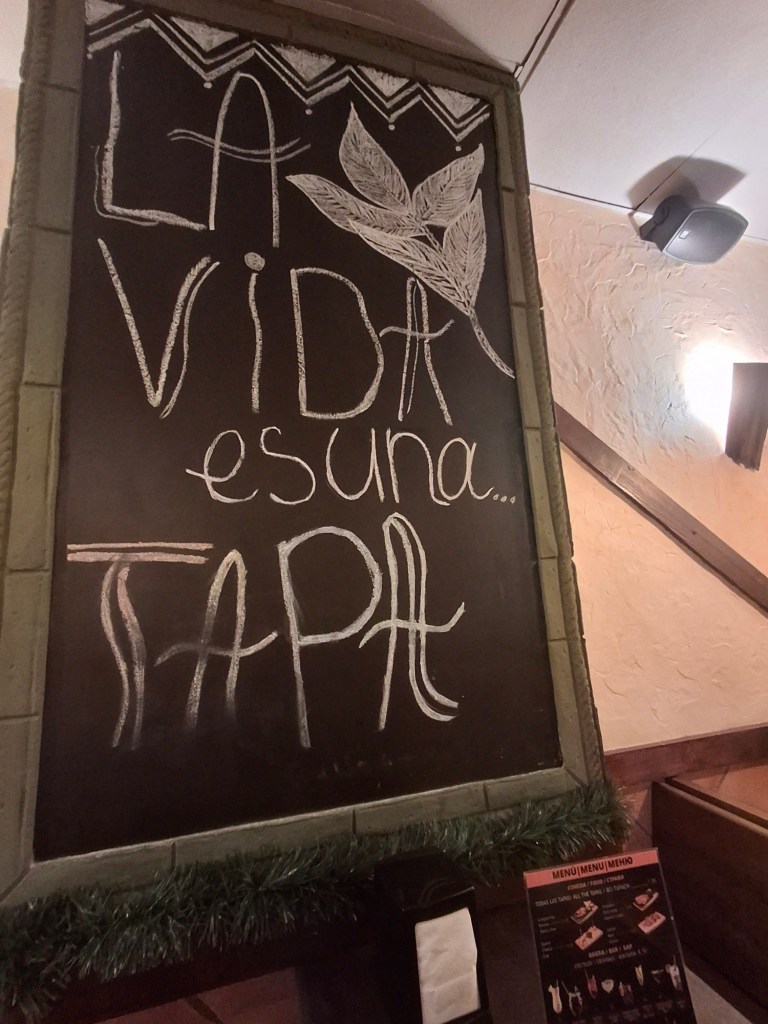
I had Friday at home to tidy up the place and think about packing. Saturday was my last Watford match of the year and we actually won 1-0 against Stoke, so another good omen for the festive season. Sunday evening I drove to Stansted in a horrific downpour which made my arrival in Alicante so welcome. I’d been equivocating about coming away for Christmas this year and am already glad I finished up with a decision to make the trip. I checked in to a very pleasant well-situated hotel where I think for the first time in my life my room is right opposite the lift not the 200 yards race I had to make last night at Stansted. Legs thus spared, I went walkabout to get my bearings in a city I have only been to once so long ago that not much sticks in the mind. A quick tapas lunch with a beer confirmed the decision to make the trip. The bar had no menu but served tapas of the day on wood blocks and a bit like Yo Sushi, they count up the blocks to make your bill. With a big party you’d get a Jenga game thrown in. The Christmas spirit and the love of tapas were well in evidence.
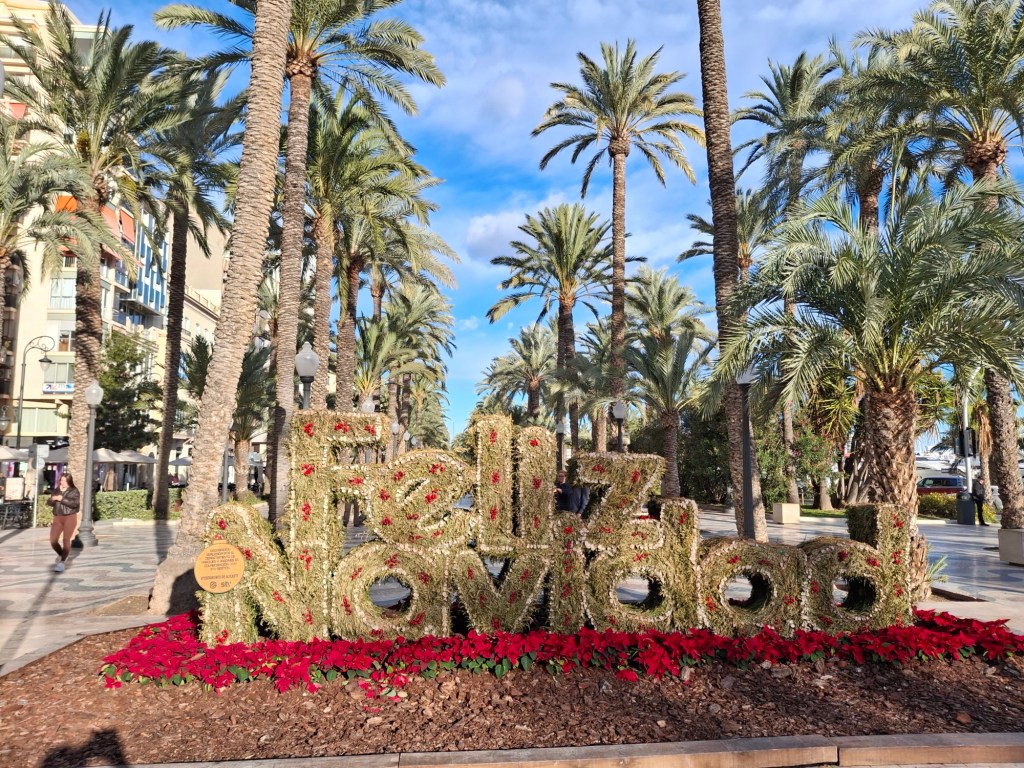
Further down towards the Mediterranean the welcome was even clearer at the end of the palm-lined promenade.
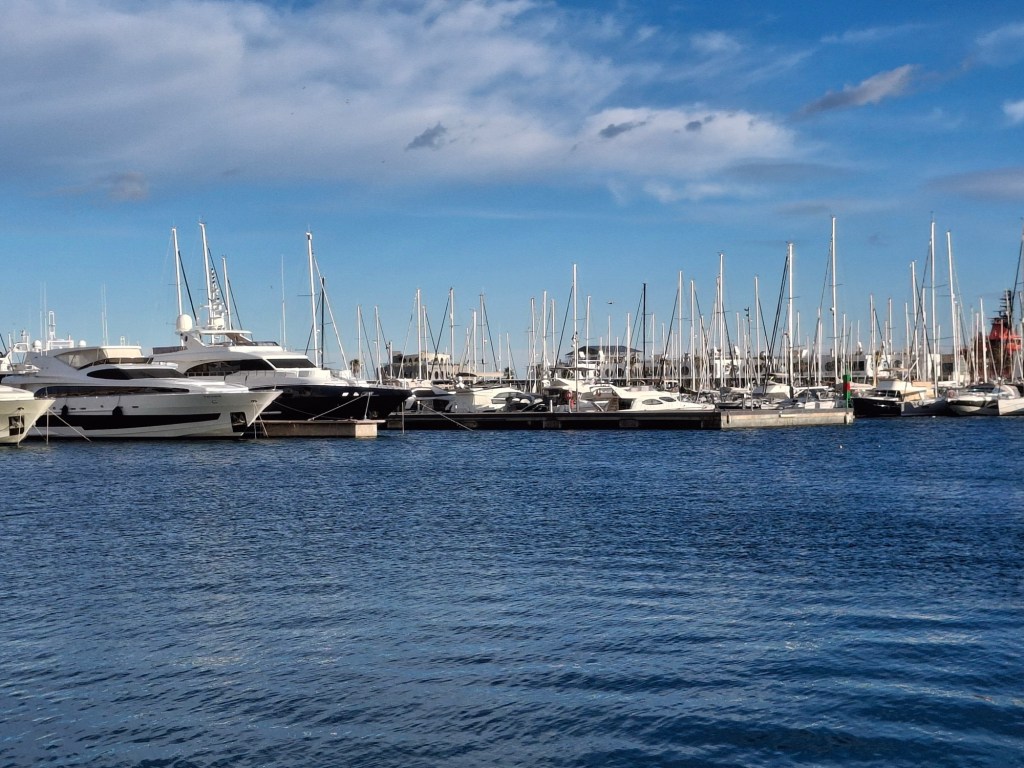
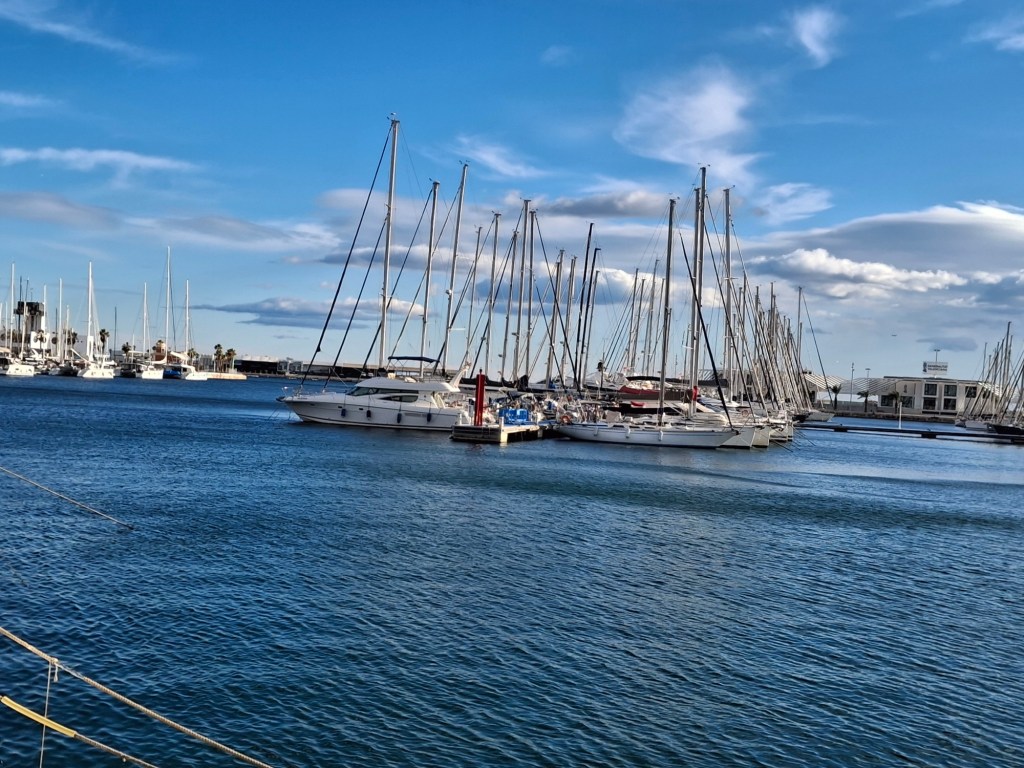
I then crossed to the marina to select my yacht when I win the lottery. It’s a very pleasant harbour to be further explored tomorrow.
And on the way back up (gentle slopes) through town there are some lovely examples of modernisme architecture which I shall also explore further.
Well the lawn didn’t quite escape the mower despite the warm weather and slow growth of grass but it had to have a tidy up. What did escape was the keyboard – too busy to type this month! It all started on Saturday 3rd with the last game of the season – unlucky draw – followed by a farewell to the season lunch at L’Artista and then Frances, Rose and myself whizzing off for a pre-concert Guinness in the Toucan with Ian Prowse (he didn’t have one) before he took to the stage at the 100 Club. It was as always with him a brilliant evening’s entertainment.
Then on Monday 5th Fran and I went to see the new Conor McPherson play The Brightening Air at the Old Vic. It’s a wonderful depiction of dysfunctional Irish rural family life with a standout performance from Rosie Sheehy as the disruptive Billie. The next day I had to record one of the English Language Teaching audiobooks that I do a couple of times a year. My voice over actor John Hasler (doing 16 different voices in Aussie accents around an RP narration – amazing) is about to rejoin the cast of Fawlty Towers at the Apollo Theatre with a bigger role than he had in the first run so I’ll probably catch that at some point in the run that starts late June.
Next up was a favourite ukiyo-e printmaker Hiroshige at the British Museum. I am familiar with most of the images displayed but seeing the vibrancy of the originals compared with reproductions was astonishing. The exhibition also included several indications of the complexity of making multi-coloured woodblock prints, inking them up and making sure paper is accurately registered. A technical triumph but also witty, emotional and dramatic scenes of love, life and landscape. It was interestingly curated too with prints fixed to scrolls which themselves were often the destination of woodblock prints.
An angry roosterMt Fuji and the Otomodome fallsThe scroll supportsMy favourite I think – so much emotion and movement battling through the snow
With my mind firmly back in Japan I spent the evening downstairs at the Hampstead Theatre in the midst of a video game. The play was Personal Values and combined characters’ real lives with their personae in the game they were endlessly playing. As a non-gamer it left me a bit confused but others enjoyed it very much.
Back at Hampstead the following Monday saw a very different set of games presented. This was an adaptation by Richard Bean of David Mamet’s 1987 film, Mamet’s debut as both writer and director. It was powerful, twisty, scary and shocking but immense fun. I hadn’t seen the film for ages but recall it being altogether darker and while there were some elements of that here, it was as you’d expect with Richard Bean rather more about the laughs. I’m looking forward to more card games and sleaze when we see Dealer’s Choice at the Donmar next month.
Music started the month and gave me a real highlight in the middle. Sunday 18th found me in the Temple of Art and Music in Mercato Metropolitano, the sprawling food fest at the Elephant and Castle. The group in which my granddaughter plays keyboard, flute and does backing vocals – elegantly called Soulstice – were asked to headline a Youth Open Mic session. There’s a clip here – not very well recorded and not by me! They are usually an all girl band but their drummer couldn’t make the gig so a brother kindly stepped in. I’m prejudiced of course but they are actually rather good with a soul-tinged mix of their own originals, Sade, Amy Winehouse and so on..
Different but no less enjoyable was the Orchestra of the Age of Enlightenment’s concert at the Royal Festival Hall with Sir Andras Schiff conducting from the piano in a Schumann programme with a little Mendelssohn in between. It started with the Konzertstück which is a very lively piece for piano and orchestra and was followed by familiar passages from Mendelssohn’s Midsummer Nights’ Dream and Schiff played Schumann’s only piano concerto after the interval. He had talked last year at an open rehearsal of his pleasure in having a brown Blüthner fortepiano rather than the shiny black Steinways that are usually provided.
He had it again tonight and did us proud, not only in the opening piece and the concerto, but gave us a solo encore of Brahms’ Albumblatt and then closed the piano lid very firmly and got the whole orchestra to play Mendelssohn’s Fingal’s Cave as a bonus encore. Coming at the end of an eight day tour to Vienna, Graz, Antwerp, Amsterdam and Munich the energy of Sir Andras and the orchestra was quite amazing. And with even more bonuses – a preconcert talk with Laura Tunbridge, professor of music at Oxford, and an interval drinks reception for friends – it was a night to remember.
Sir Andras Scxhiff leaves the stage, leaving behind his favourite instrument.
On my way to the OAE concert I went to the National Portrait Gallery to see the exhibition of Edvard Munch portraits. These were very impressive with clear characterisation of friends and family placed in relevant environments. He obviously didn’t like several of his subjects as these were not flattering portraits but reflected Munch’s relationship with them and indeed with himself. I couldn’t escape the musical theme of the month of May as my two favourites were The Brooch which is a lithograph of an English violinist who styled herself Eva Mudocci and a quick stetch of Edward Delius at a concert in Wiesbaden. I also liked his walking self-portrait and a double portrait of the lawyer Harald Norgaard and his wife Aase with whom he had a lengthy relationship. It’s an unusual composition and was quite striking. Munch knew Harald from his youth and painted Aase separately on a number of occasions.
I also made it to another British Museum exhibition after being a radiotherapy buddy to a friend who is going through the final stages of cancer treatment. She is great company despite the circumstances and we have spent some good times together. As I remember myself radiotherapy leaves you pretty wiped out so she declined the offer of accompanying me to the BM understandably preferring home and rest. The exhibition was mostly of objects from the museum’s own collections but shed a fascinating insight into the religions of India – Hindu, Jain and Buddhism through their artefacts and what they symbolised. The galleries also had birdsong, tolling bells and chanting played quietly to make it a multisensory visit.
Dancing Ganesha a fixture in all three religionsCan’t get away from music – a terra cotta lutenistSnake headed VishnuLakshmi Hindu goddess of fortune
My next adventure was into the world of words. The British Bilingual Poetry Collective resumed our Bi-monthly Poetry Meets at Bard Books on Roman Road in Bow. Shamim Azad and I led a session of poetry readings, discussion, translation and an open mic session which was much enjoyed by all present.
The late May bank holiday was spent having an early supper with Rosa and then a visit to the Wigmore Hall to hear the amazing percussionist Colin Currie. I wish they didn’t have a photo ban because the array of drums, marimba, vibraphones, glockenspiel and other thing you can bang to make music filled the entire stage. A varied programme showcased his ability to make exciting, moving, thoughtful and adventurous sounds emanate from this staggering collection of instrumental forces.
My main motivation for going was the world premiere of Vasa a Concerto for Solo Percussion by Dani Howard, a young composer I’ve been pleased to call a friend for a few years now. It was a complex piece featuring a series of different tempos, emotions and melodies. Dani had worked with Colin to devise the final form and told us later that she had to have a diagram of the stage layout of the marimba, two vibraphones, cymbals, drums and other devices, many of them foot-operated, so that she could ensure she was writing things Colin could physically move around the instruments to execute. It was a very rewarding evening concluding with some excellent conversation in the pub.
Bass drum and woodblocks were foot operated and 1-5 are various cymbalsColin and Dani after rehearsal
I had intended to give After the Act at the Royal Court a miss as I’m not a big fan of musicals. However the indisposition of Fran’s intended companion meant that she asked me to go. The content should have been – and was – of real interest. The ‘Act’ was the appalling 1985 Section 28 that forbade taechers in schools and colleges to mention homosexuality, Equally appallingly it was only repealed in 2003.
The play contained some verbatim quotes from individuals – teachers, parents and students – who had suffered from the act, recreations of protests including a daring 1988 abseil in the House of Lords and, for my taste, too many occasions when serious issues resulted in the cast of four bursting into song accompanied by onstage keyboardist and drummer.
The next evening was far more satisfactory. Because Terrance Rattigan’s The Deep Blue Sea was on at the Theatre Royal Haymarket we were able to pop into Yoshino for a quick pre-theatre sample of Lisa’s excellent cuisine and hosting. Some analysts feel that the doomed love affair represented in the play was Rattigan’s sublimation of his own homosexuality – still illegal when he wrote it in 1952.
Starring the wonderful Tamsin Greig with a fine supporting cast, this was a faithful period-set production that allowed the play’s veiled messages space to emerge from the context and the conversations around love and death, suicide and survival, protest and resignation, passion and comoanionship were brilliantly done, very moving and affecting.
Thursday saw Fran and I make our hat-trick of theatregoing with a trip to Islington to see Ava Pickett’s debut play 1536. The setting is sixteenth century Essex where three friends indulge in gossip – has Henry really ditched Anne Boleyn? – their own relationships with men and each other and the role of women in a patriarchal society. It’s bold, it’s funny. it’s sexy and it makes you wonder how much better things really are today. The rolling changes in friendships are brilliantly delivered in crisp dialogue and while history is all around, the play tells us a lot about today. As a writer on the brilliant The Great on Channel 4, Ava Pickett is clearly a name to watch out for.
The month’s finale was a trip with Frances to see Simon Russell Beale in Titus Andronicus at the Swan Theatre in Stratford-upon-Avon. After a pleasant drive up we had a late lunch, checked into the hotel and then made our way to the theatre. It was my first time in the Swan and we were a bit surprised that this production was in the smaller space, not the main hall. However the intimacy of the location made the horrors of Shakespeare’s most violent play (or is it Coriolanus?) very clear.
The production certainly didn’t stint on Kensington gore but used brilliant lighting and sound effects to protect us from witnessing the worst atrocities. SRB was his usual excellent self but was by no means outstanding. The whole cast under the direction of the versatile Max Webster was superb and brought the subtleties of the text into play as well as the torrid drama. And on reflection, yes this is the most violent of Shakespeare’s works.
We went out to Anne Hathaway’s house next morning for a walk around the orchards, had an enlightening tour of the house from excellent guides and then made our way back to London. A fine ending to a full and varied month of culture. As Shakespeare’s contemporary Thomas Dekker put it “O, the month of May, the merry month of May”.
On Monday I went with Frances to see Eugene Ionesco’s Rhinoceros at the Almeida Theatre. I’d read this in French as part of my studies at UCL back in the 60s, when we’d complained that the reading list was too classical and old-French oriented. The Theatre of the Absurd struck a chord with the young and foolish me and I even directed a production of fellow-absurdist Alfred Jarry’s Ubu sur la Butte in the Lycee Francais annual drama compettiton for London college French departments. We got the best actor award. The core of Rhinoceros was still there with its warning about totalitarianism embodied in the metaphor of the residents of a small town in France turning into rhinoceroses. But the adaptation with audience participation conducted by Paul Hunter though elaborate hand gestures and claps and rhinoceros roars with kazoos made it a very different spectacle. Translated and directed by Omar Elerian – he also did a great version of Ionesco’s The Chairs here a couple of years back – it incorporated humour, menace, slapstick and some cod metaphysical discussions and an interpolated song sequence in Italian by love-object Daisy sung brilliantly by Anoushka Lucas with back projected slogan “What do you want meaning for?” The playing for laughs may have detracted a little from Ionesco’s warnings of extremism but it was a fun night in the theatre.
Anoushka Lucas as Daisy and Sope Dirisu as Berenger in Rhinoceros.
Imagine my shock on Tuesday morning when The Guardian had the following headline. I had to send it to warn Frances in case they’d escaped from the theatre and were invading Islington and Tufnell Park.
Life really does imitate art
I’d been meaning to go to the Dulwich Picture Gallery to see the Tirzah Garwood exhibition for some time and now I had a chance. As with so many women artists I knew of her mainly as the wife of Eric Ravilious whose work I had always liked. Their artist enclave at Great Bardfield in Essex with Edward and Charlotte Bawden is well documented but I was delighted to find out more about Tirzah who admitted that managing the family and the household had interfered with her own artistic development.
And what an artist she was in so many media and despite all the household wrangling! She started out as a talented maker of woodcuts – and many know of my love of a print – and with Charlotte Bawden she established a reputation for marbling paper – all the rage for lampshades and book endpapers in the pre-war years. The exhibition features embrodery, a quilt, wood engravings and some model village collages in box frames which were inventive and charming. Finally she was able to turn to oil painting at which she adopted a somewhat naive style with surprising elements like the trees in the Photo Shoot below made with prints from gathered leaves. It’s well worth a visit and is on till 26 May. It’s also very funny – she obviously had a great sense of humour. That’s her in the train compartment.
Huge variety of textures in a woodblock printBaker’s shop box collageThe photo shoot with leaf prints
Thursday evening sees me join Frances again, this time at the Kiln Theatre in Kilburn to see Shanghai Dolls a new play by Amy Ng. The dolls of the title are two influential characters in Chinese history: Jiang Qing who as Mme Mao is generally regarded as the architect of the disastrous Cultural Revolution; and Sun Weishi who was the adopted daughter of Mao’s arch rival Chou En Lai and became China’s first female theatre director. Before the play we were able to introduce a friend who has recently moved to the area and her daughters to the Kiln which we hope will become a useful cultural hub for them – teenage eyes widened at the thought of £5 cinema tickets! I enjoyed the play very much despite some slightly melodramatic delivery from time to time., But it brought back some distant memories. I was in China in 1981 as part of a lecture and workshop visit when I worked for the Inner London Education Authority. This was five years after the end of the Cultural Revolution but we saw the effect it had had on artists with hands wrecked by rural toil, writers’ spirits broken through lack of books. Several people – including our interpreter Sho-jian asking if I could marry her so she could get out of China – were adamant that the movement had been an utter failure, but were still not willing to talk about it openly, only when we found quiet unmonitored corners.
People were keen to practice their English with us in Beijing in 1981
I had tickets for a Wigmore Hall concert on Saturday but thanks to a recommendation from Frances I went first of all to the Royal Academy of Arts to see the Brasil! Brasil! The Birth of Modernism exhibition. Good call Fran! The last time a major exhibition of Brazilian art was held in London was at the RA in 1944 – I didn’t go as I was one. The show featured ten different artists who had had an influence on mid twentieth century art movements in Brazil. Sadly it closes on 21 April but you can get a flavour here. Many of the artists had studied in Europe but most had a very distinctive local feel featuring indigenous characters and local traditions. Given that some of our friends are members of Morris sides, I liked the Brazilian equivalent.
Lasar Segal Boy with geckoCândido Portinari Coffee Plantation worker Flavio de Carvalho Portrait of Murilo Mendes Djanira da Motta e Silva Marrapaia Dance, Pariti
With time in hand I sauntered up Bond Street towards the Wigmore Hall and with sunny skies, warm weather I looked up and saw something i’d never noticed before. On the Time-Life Building half way up is a screen by Henry Moore from 1952. It’s appaerntly a very rare example of work of this kind in that he could sculpt both sides. I’ve walked along Bond Street many times but to my shame had never noticed it before.
And when I turned round from snapping one surprise, I got another. The Halcyon Gallery where I recently reported my surprise at Bob Dylan’s paintings, there’s a superb array of Hockney works on paper. These range from the early lithographs of Celia Birtwell and Californian pools to recent iPad drawings in Yorkshire and Normandy. I need to win the lottery before I can go back as a customer but the staff are most obliging and informative if you just want to look. Then it was time to make for the original target of today’s outing after some unexpected delights along the way.
I met a young music composition student Zyggy de Somogyi a couple of years ago at a weekend in Oborne in Dorset and we’ve remained in touch. Indeed I asked Zyggy to write the music tracks for the series of videos we made to celebrate 100 Years at Vicarage Road for Watford Football Club in 2022. Basing his work on some fan chants I sent he matched the predominant sounds of the decades – ragtime, swing etc to drive the narratives along. I’m here today to listen to the world premieres of two of his works commissioned by the Royal Philharmonic Society Composers Programme which gives young musiciians space to develop. Ten years ago Dani Howard was on the same programme and I met her at the same weekend in Dorset – small world.
Zyggy introducing the first work Music for the quarter life crisis Etude for synth. This was a solo work for Xiaowen Shang. It opened with dramatic synthesiser notes and segued into lyrical passages. Then recurring motifs transferred from the synth to an almost orchestral piano sequence. The playing was emotionally powerful and was rapturously received by a fair sized audience for Easter Saturday at lunch time for an all contemporary music gig.
Other pieces were a new work by Ashkan Layegh, a trio by Lowell Lieberman that showed off the skills of the group Temporal Harmonies Inc – Xiaowen on piano, Lydia Walquist on flute and Mikolaj Piszczorowicz on the cello, followed by Caroline Shaw’s wonderful In manus tuas is based on a motet by Thomas Tallis arranged for solo cello and Kaija Saariaho’s Mirrors for flute and cello. The concluding work was Zyggy’s second premiere IN THE EVENT THAT YOU STAY, This was written with the trio in mind and indeed with their collaboration. It’s in four movements which included drama, bombast, a peaceful second movement, a sense of progression and a finale which featured soft vocalising chanting of the title and eventually all members singing. It brought a lump to the throat. I was a very impressive work and I hope it enters the repertoire of contemporary chamber music.
Lydia, Xiaowen, Mikolaj, Zyggy and Ashkan taking a bow
I had a chance to meet with all the musicians in, and outside the Cock and Lion pub as well as several members of Zyggy’s family. His mum said she was pleasantly surprised with his compositions because there were tunes in his pieces which she thought he’d had knocked out of him at uni. “He used to write tunes,” she said “and then he didn’t.” There certainly were tunes and they were very professionally played. It was a real pleasure to listen to andf then spend time with these talented young musicians. Cuts notwithstanding, there’s great stuff going on out there.





 mikeandmurakami.com