Marching on …

Finally after all the gloom of the year to date we had a few days of sun and I was able to plant some vegetables – broad beans and parsnips so far – check on the onions and garlic planted last autumn and do the annual hack and slash of all the dead brush from last year’s flowers. Then as I turned to go indoors the sunset showed me my next big task. The tree in the left foreground is my quince which has given us so much membrillo and jelly over the years but has lots of overlapping branches and needs a really good prune. A start has been made.

My rather aching limbs picked up some energy on Monday evening as I set off fot the Wigmore Hall to hear the Irish Baroque Orchestra play The Trials of Tenducci as the first part of a tour to Dublin, Limerick, New York and Virginia. I’m a great admirer of Peter Whelan who leads the IBO and the energy and clarity the band brings to the repertoire.

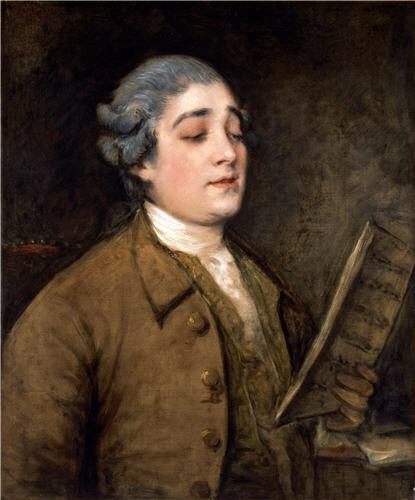
Tonight’s was an interesting programme based around the exploits of one Giusto Fernando Tenducci, a famous eighteenth century castrato singer. Born in Siena he came to London in 1758 and later moved to Dublin where he met and married Dorothea who later bore two children but later sued him for divorce for non-consummation. He became something of a celebrity – he was painted by Gainsborough, was friends with J C Bach and a singing teacher to Mozart. He was also to spend eight months in a debtors’ prison in London and later in Ireland. One admirer wrote of his voice: ‘neither man’s nor woman’s but it is more melodious then either’. Tenducci by Gainsborough in the Barber Art Gallery in Birmingham.
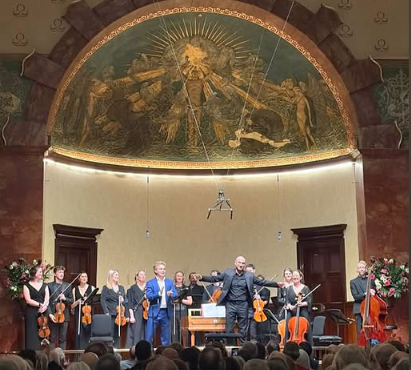
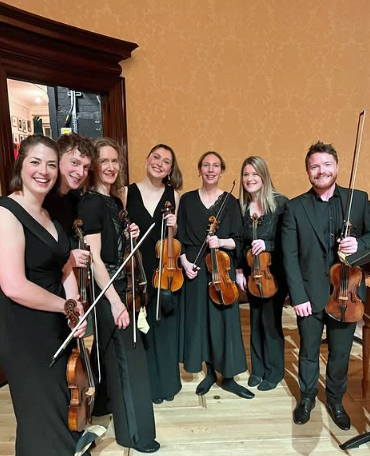
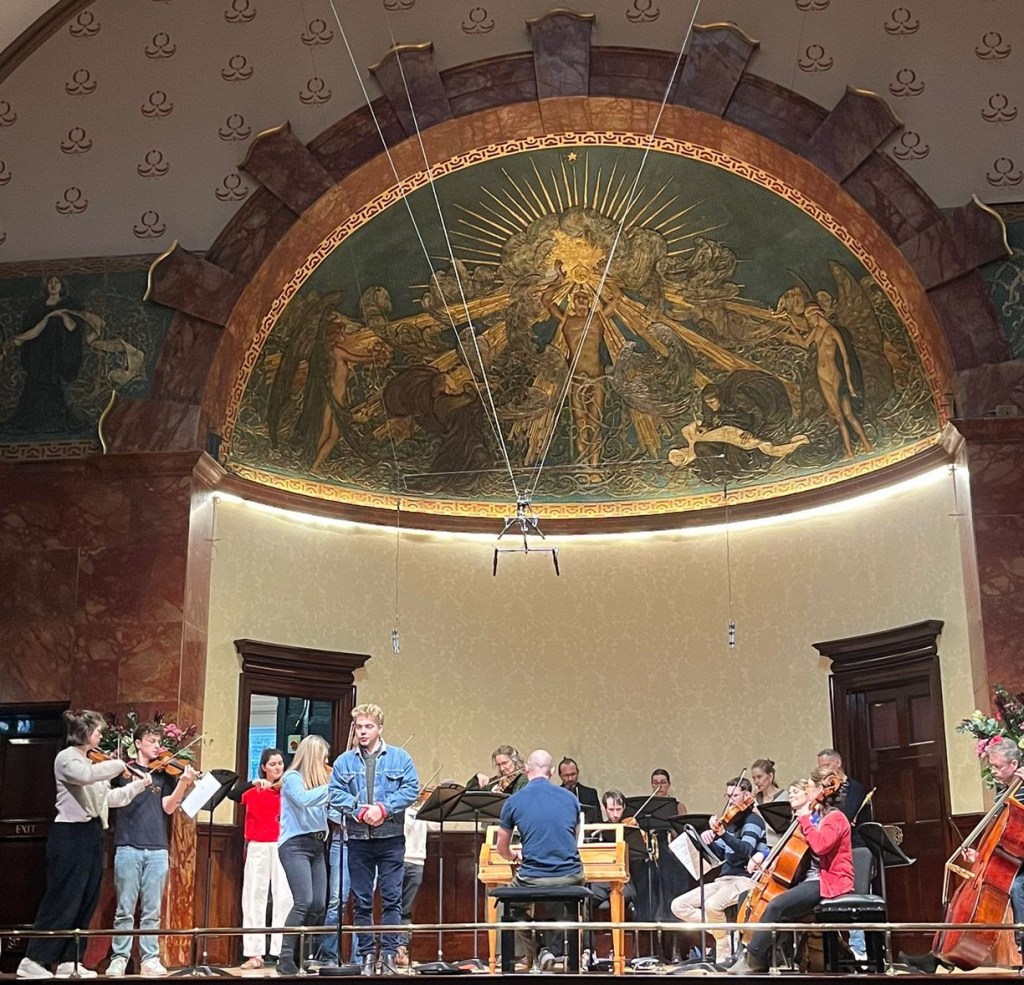
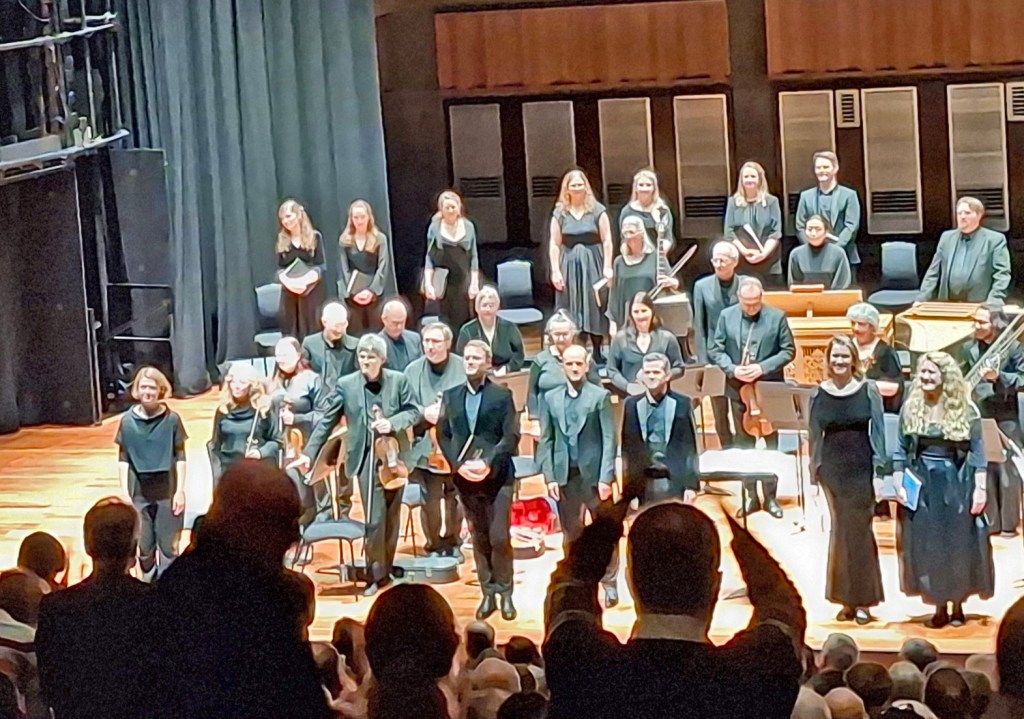
Having heard last week Mozart’s last three symphonies, each half of the evening began with two of his earliest ones, numbers 1 and 4. Short, sharp and lively, they set the sense of fun for the evening which involved works which Tenducci had sung or were by his friends and contemporaries. Tenducci’s role was taken by the excellent countertenor Hugh Cutting who expressed his delight that high range male soprano voices were no longer the result of mutilation. He sang arias by Gluck, Thomas Arne, J C Bach and Mozart and as an opera singer he filled them with expressiveness and drama. The orchestral playing in an oboe concerto by Johann Christian Fischer and the symphonies and a rollicking version of Tommaso Giordani’s Overture and Irish Medley which contained well-known Irish folk tunes was brilliant with a small orchestra filling the hall with an eclectic and delightful programme. And afterwards I was able to catch up with violinist Jenna Raggett as she and fellow violin players were taking a selfie. And the IBO conveniently posted photos of the rehearsal and the final bow.
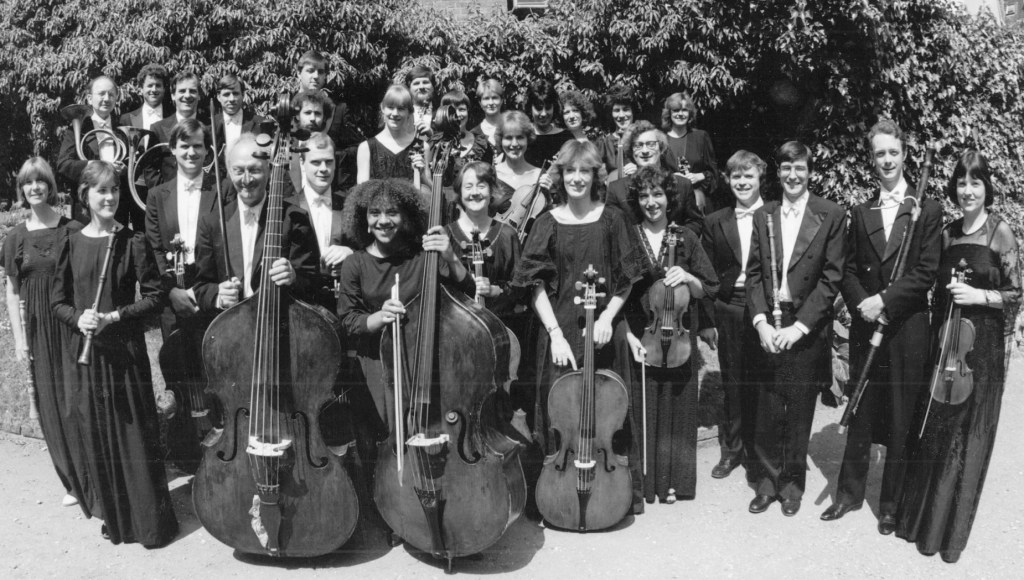
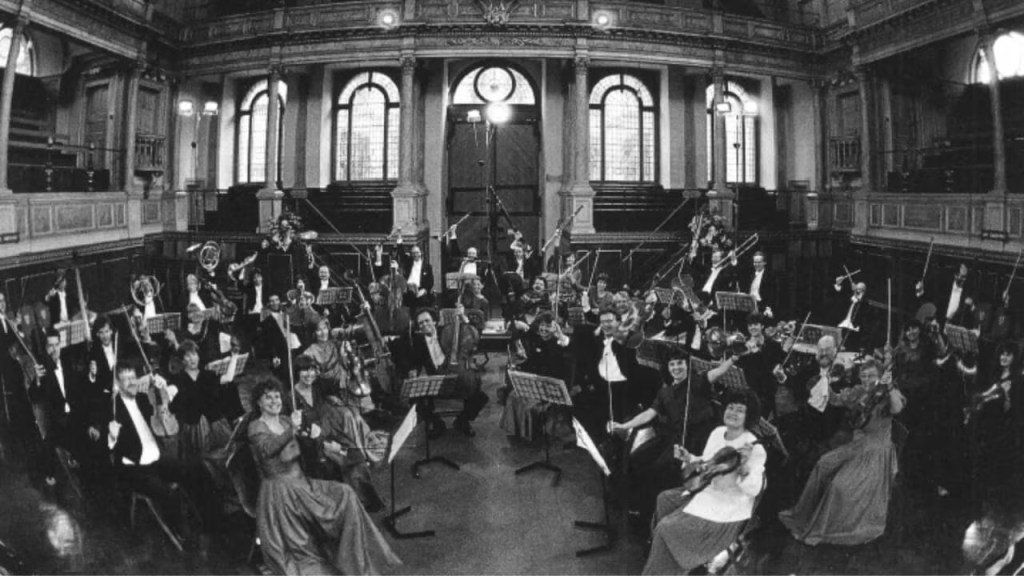
Later in the week my favourite orchestra the OAE held a session to launch its Southbank Programme for 2026-27, Held in the elegant hall of Acland Burghley School in Tufnell Park and hosted by Radio 3 and Proms star Katie Derham, the evening had music from a string quartet with vocals from tenor Hugo Hymas who was one of the OAE’s ‘Rising Stars’ in the 2019 cohort. While discussing each of the concerts with long standing players Annette Isserlis (viola), Cecelia Bruggemeyer (bass) and Martin Lawrence (horn), we also heard the fascinating story of the band’s formation back in 1986 when a number of players decided they were doing all the work and others were getting all the plaudits so they formed an orchestra that was run by its players not by a single celebrated conductor. It’s proved a great success for forty years and has allowed for concerts with a wide variety of conductors and several directed from within the orchestra itself. Another very pleasant evening in the company of friends and with some excellent music from Vivaldi, Bach, Handel and Mozart.
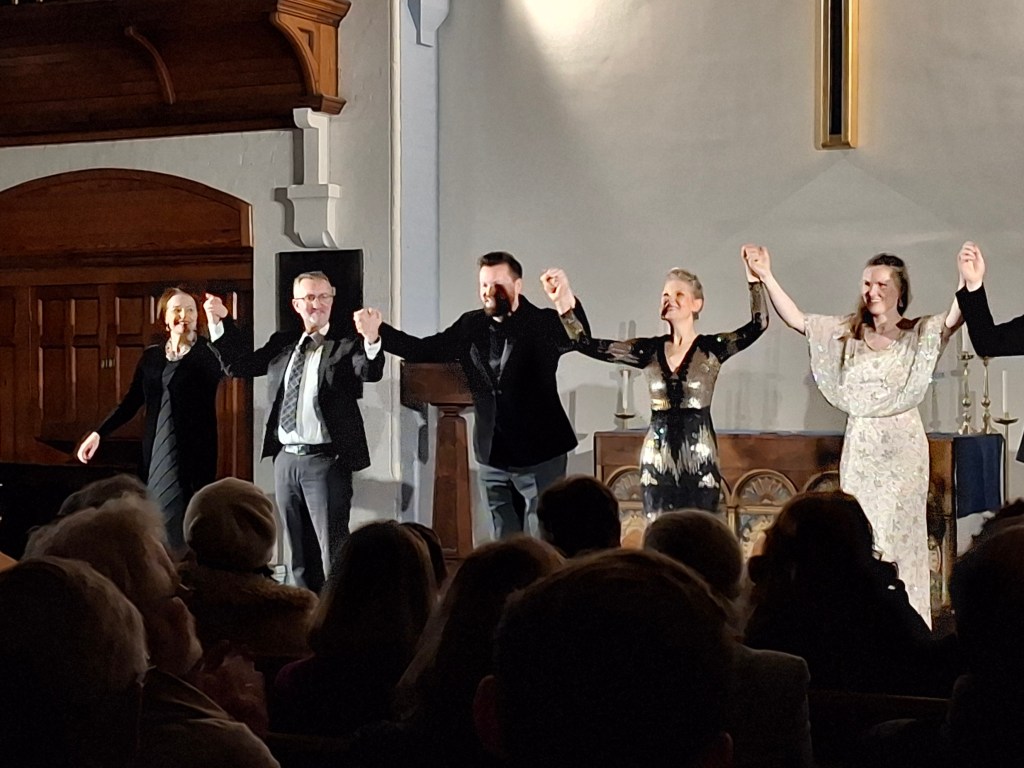
Friday brought a real surprise. Ace pianist and dear friend Susie Stranders invited me to a gala evening with St Paul’s Opera in Clapham. Well if Susie’s involved it will be good so off I set in a convoluted cross Sarf Lunnun jaunt with a bus, two trains and a walk to a wonderfully simple church, St Paul’s Clapham, to meet my friend Jadwiga who was coming from Putney. I’ve been previously to similar evenings in Fulham Palace and the Blackheath Halls and it appears that there are many occasional opera group and societies all over London and indeed the country. It’s great that there are so many opportunities for talented young singers to engage with diverse audiences in different locations. St Paul’s Opera has a dynamo at its heart in Tricia Ninian and the evening was billed as David Butt Philip and Friends. David has been associated with St Paul’s Opera since 2017 and gathered some great friends to perform arias and songs from Handel and Mozart through Wagner and Bizet to Britten and Bernstein. David was joined by soprano Ellie Laugharne, mezzo Marta Fontanals-Simmons and bass Liam James Karai. As accompanists for the four singers Susie was reunited with Eric Melear with whom she had been on the young artists programme at the Grand Opera Studio in Houston back in 2000. Both experienced repetiteurs, they managed to make the piano sound like a full orchestra in the fine acoustic of the church. I can’t make St Paul’s production of La Traviata this summer as I’m out of town at a wedding but I’m sure it will be worth a trip.
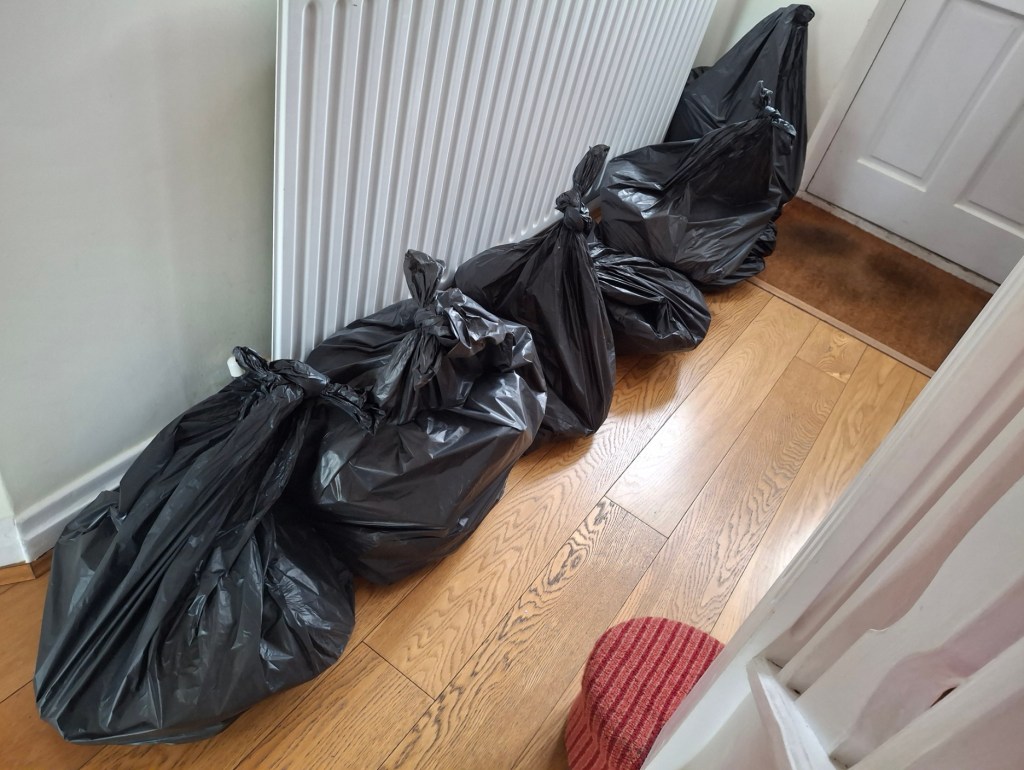
A business bagged up for shredding! 30 years of my various company documents all on their way to be shredded. Because many of the call sheets and contact lists, invoices and (remember them?) cheque stubs contain the names and details of several rather well-known names I’ve been lucky enough to work with over the years, they can’t just go into my Lewisham Council recycling bin. So off they go to Restore Data Shred for secure and certified destruction.

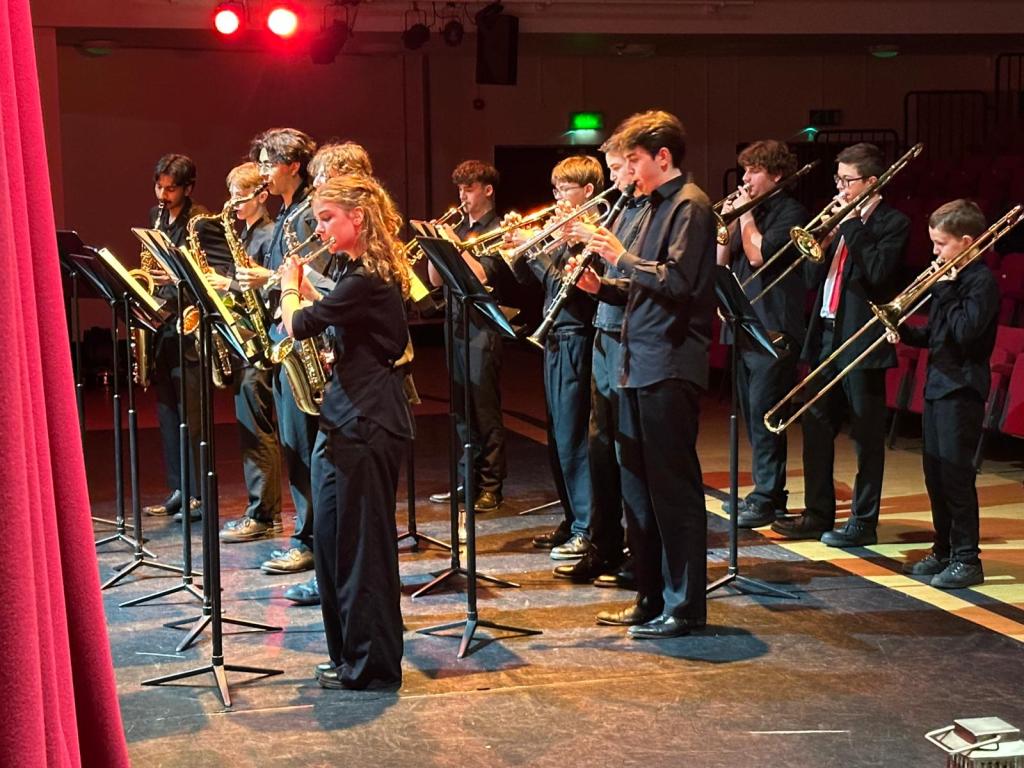
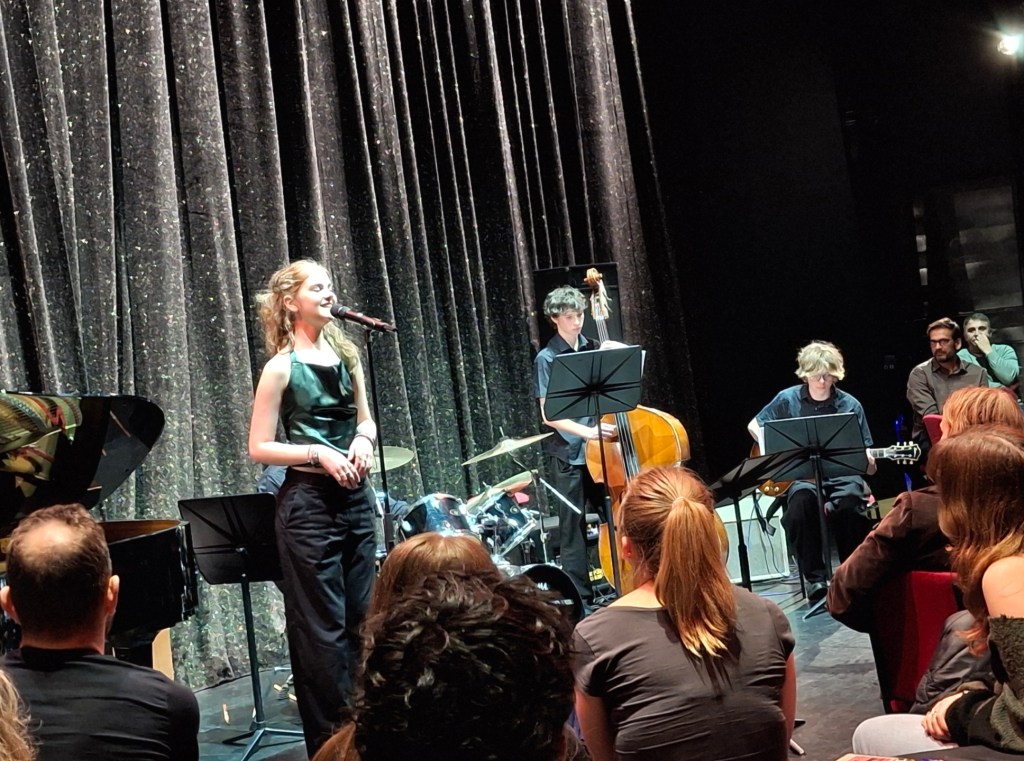
After that it was a visit to Langley Park Boys School for an ‘Evening of Jazz’ in which my granddaughter was playing flute in the big band numbers. The evening opened with a quintet featuring Sam on tenor sax who had guested with Soulstice last week at Off the Cuff. They were very good as were the big band that played a few standards. Then to my surprise after Soulstice lead singer Bea had sung Round Midnight, Trixi (Daisy) stepped up to the mic to sing Dream a Little Dream for Me. Her parents had failed to inform proud grandad that she was a featured soloist as well and she gave an emotional rendition of a fine thirties song imbuing Gus Kahn’s lyric with a real sense of longing. The whole evening was a further confirmation of the immense depth of talent that is produced when the arts in schools are properly respected and resourced. Soap box suspended for now!
Next to the Donmar for Anna Ziegler’s Evening all Afternoon – a tense two-hander with Anastasia Hille as Jennifer, a suspect new stepmother and Erin Kellyman, making her stage debut, as Delilah, the suspicious and resentful daughter. Both actors are superb – Hille is all internalised emotion, with staunch British values, stiff upper lip and sense of decorum, responding stoically to the taunts thrown at her. I really can’t believe that this was Kellyman’s stage debut – apparently she’s well-known on screen but not in shows I’ve seen. (I also note now that Erin will be in the TV show 2026 – the successor to the 2012 and W1A satires that lit up our screens with [presentation of wondrous, pretentious incompetence.)
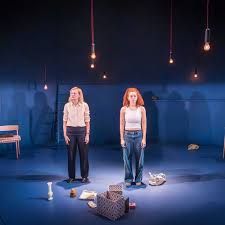
Jennifer is a young, bolshie, opinionated half Brit, half Brooklyn tornado who rages at her mother’s early death and her father’s gall in replacing her. The play revealed many ideas of grief, loneliness, age differences, relationships and an eventual uneasy and tentative rapprochement. With some scenes of dialogue between the two characters and others where they address us the audience directly the revolve stage worked really well against a dark blue brooding set. Lots of food for thought in a dramatic short play.

The next night at Hampstead downstairs we saw R.O.I. (Return on Investment) another short new play by Aaron Loeb which examined the releationship between creator and investor in the context of big pharma. Paul, Lloyd Owen, runs a venture capital fund with which he intends to change the world. His colleague May Lee, played by Millicent Wong, is on the hunt for a unicorn – a start up company with a $1billion valuation which will gain her a partnership and personal wealth. Along comes Willa, Letty Thomas, with a cure that will eradicate cancer from the entire world. I wondered if she was the real deal or another Elizabeth Holmes of Theranos ignominy – who did get a mention in the script. We were left to wonder throughout as the wonderdrug trials progress through successful initial stages into really murky territory to avoid scrutiny by the FDA. Add an affair between Paul and Willa, gaslighting May Lee, questionable views about ethnic types and a Congressional tribunal – there’s a whole lot going on in there, including a late appearance of The Woman (Sarah Lam) perhaps showing where May might be heading. It’s very sharp and witty in its dialogue and there are many moments of humour among the sad implication that power and money will always corrupt even the most well-meaning of souls.
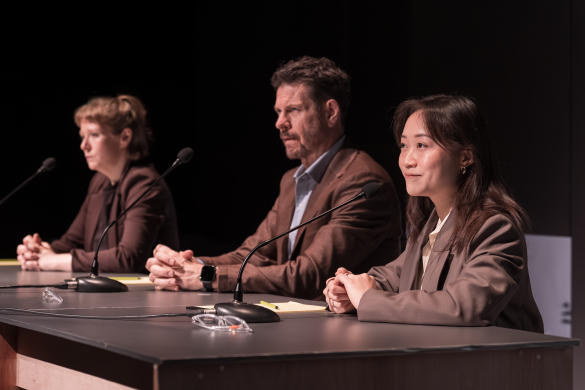
Willa, (Letty Thomas) Paul (Lloyd Owen) and May (Millicent Wong) at the tribunal.

Next was a trip to Richmond for Vincent in Brixton which I missed at the NT in 2002 but this seems to be a time of revivals what with Teeth and Smiles and Copenhagen on the horizon. Nick Wright’s imagined revelations of van Gogh’s year in lodgings in Brixton, while working as an art dealer in Covent Garden, was a delight. The amazing Niamh Cusack led a cast in which three of the four were making their stage debuts – quite a week for debuts! It’s a quiet domestic piece in which we are treated to the kitchen odours of cooking on a working stove and later shared Niamh’s pride at her separation of egg yolk and white done in real time. It’s like a mystery story where you know the outcome but the characters don’t. Vincent was scathing about the work of fellow lodger Sam but we didn’t see any of his own work or sense his promise. He was a confused young man in a foreign country experiencing strong emotions and desire for the first time. Initially attracted to the daughter Eugenie, it was to landlady Ursula that we are led to believe he lost his virginity. It’s a play about grief, Ursula still in widow’s black, restless relationships and passion and everyday life gently unfolding in the Orange Tree’s intimate space.
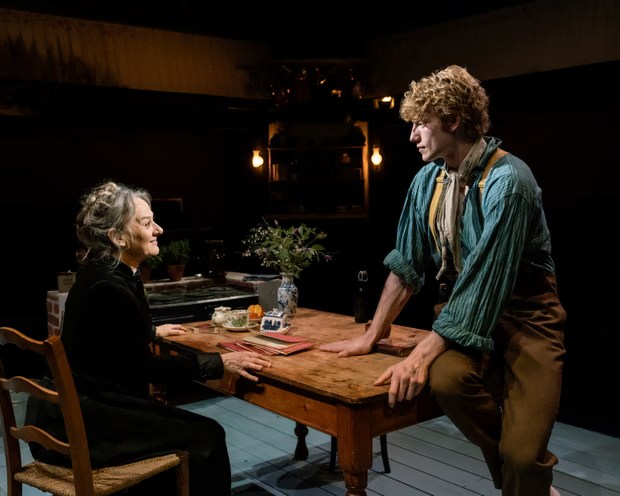
Niamh Cusack as Ursula with Jeroen Frank Kales as Van Gogh. 
Photograph: Johan Persson/Orange Tree

The next day Fran invited me to join her for a technical rehearsal of Copenhagen at Hampstead Theatre. This time I had seen the original production of Michael Frayn’s play back in 1998. The staging was very similar with a sparse set with three chairs. At Hampstead there is the addition of a spectacular set back wall which I won’t describe so as not to spoil your gasps when you see it. It’s fascinating to see how lighting, sound and movement blocking subtly affect your understanding of what is taking place. Can’t wait to see the whole thing in a couple of weeks’ time. It’s a real festival of Michaels – Frayn, Blakemore the original director and Longhurst this revival.
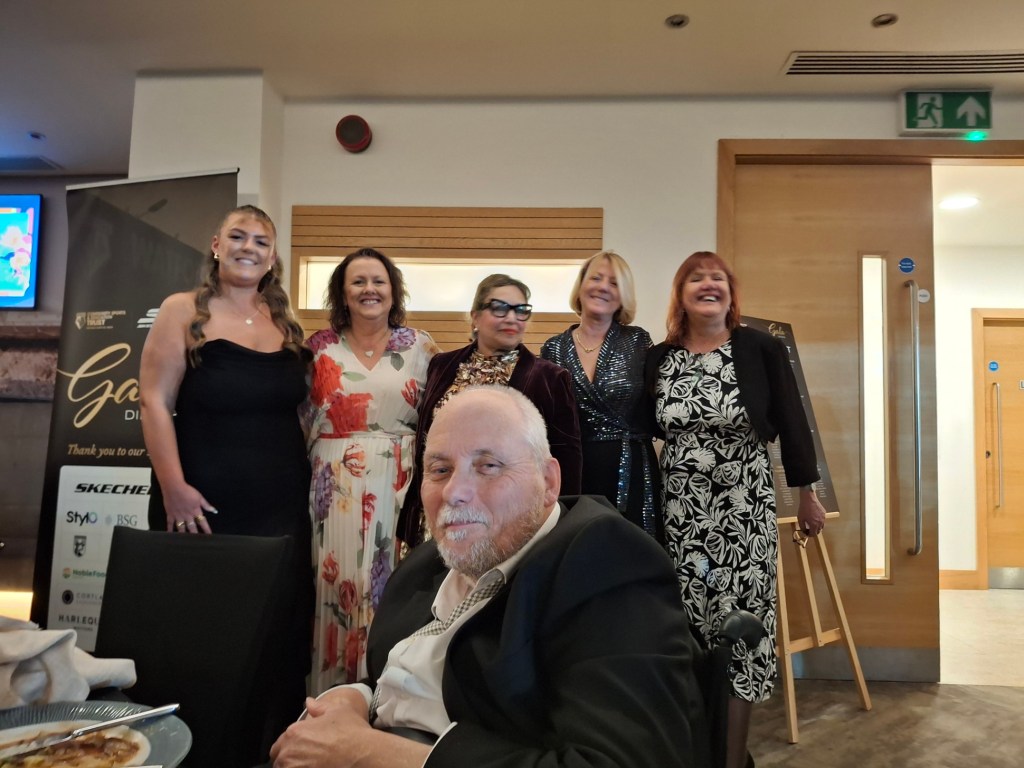
Thursday was the Watford Community Sports & Education Trust’s Annual Gala Dinner and so the usual suspects assemble at Vicarage Road for an evening celebrating what the charity has achieved against the gloom of the economy, through the dedication of staff and volunteers. It came as a pleasant surprise to me to discover that Frances’ sister Rose (second from right) has been asked to succeed Simon Macqueen as chair of the trustees. Well deserved for her energy and enthusiasm for the work it does. We all had a great time chatting to former and current players and meeting young people the Trust has helped over the years.

As it was a late finish, Rose had kindly invited Fran and me to stay with her and husband Mark in Bovingdon. This proved a great boon for me as I planned to catch my friend Kristina Ammatil giving a lecture/recital in Henley-on-Thames the next morning. So I set off for a pleasant drive through the Chilterns and made it in good time to hear Kristina discuss allegory in opera with the title: Love, Gods and Mortals. It was a well argued essay supported with slides and illustrated with excerpts from operas old and modern in Kristina’s powerful, melodic soprano accompanied by Jack Redman at the piano. She is particulary keen to perform contemporary repertory and introduced us to several pieces I didn’t know. I was very pleased to have the serendipitous chance to attend from nearby rather than making the trip from London.
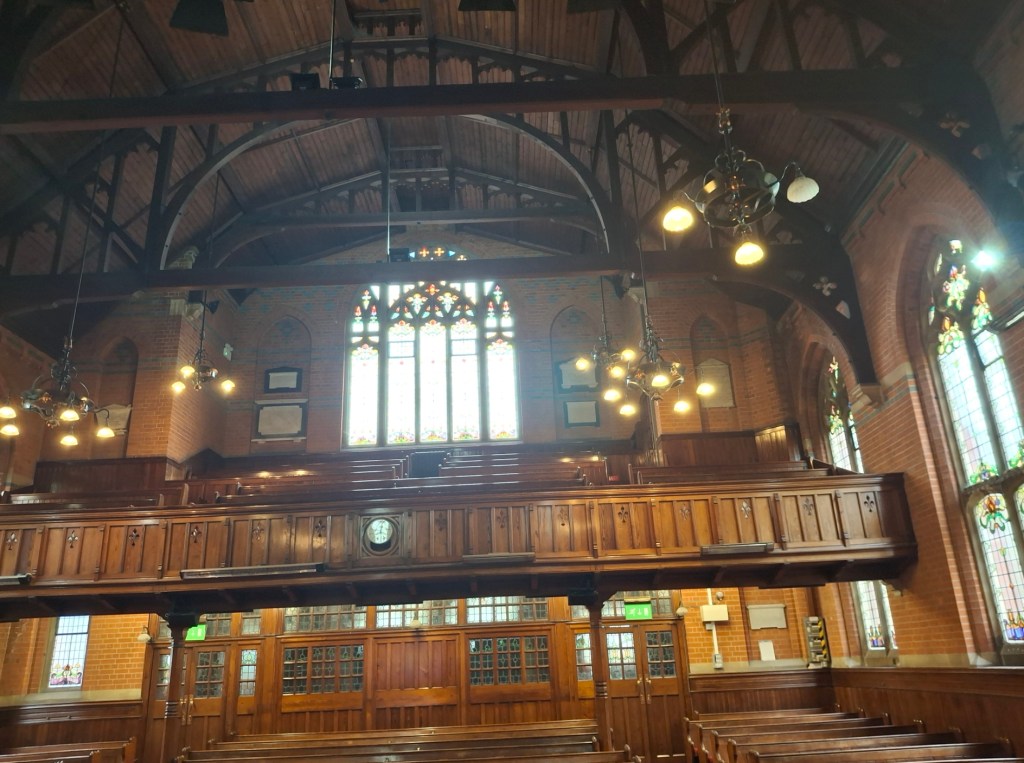
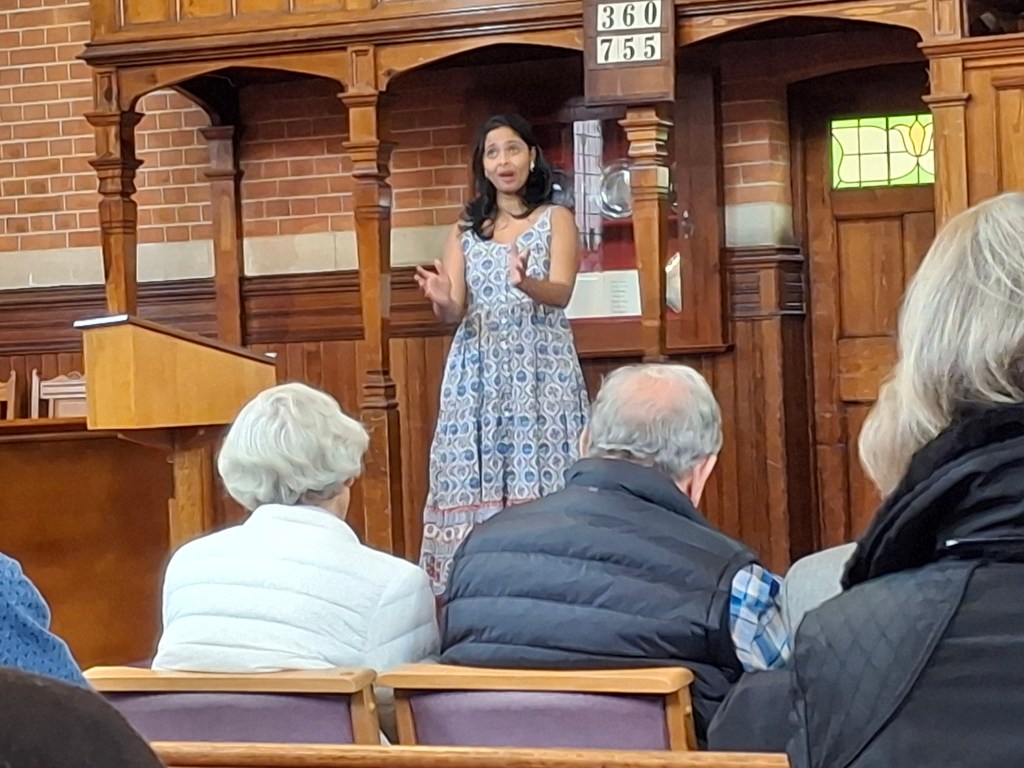
I had a chance to chat with Kristina and her boyfriend Luka after the event for a catch up before dashing (I wish! Thanks M25.) back home to park and unpack the car and catch a train and bus to Shoreditch for a performance of Handel’s Tamerlano from which I’d heard excepts but never seen the whole of this great opera. Part of the annual London Handel Festival this was taking place in a completely new venue for me – the splendid Shoreditch Town Hall.
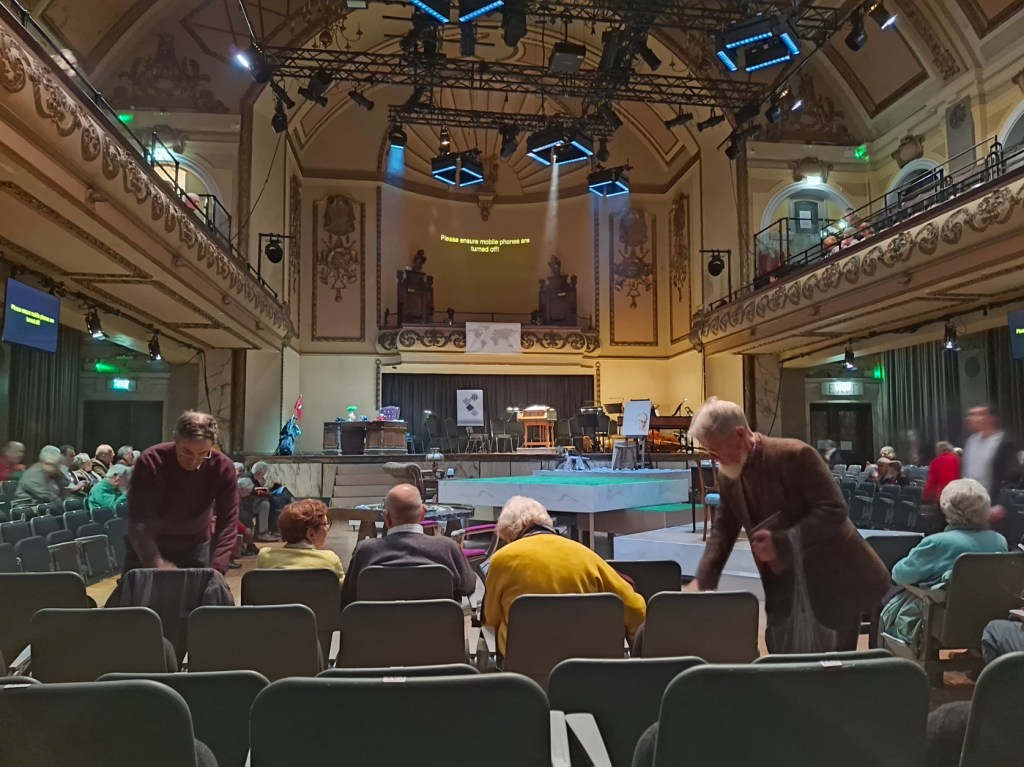
The orchestra under Laurence Cummings were superb and the production was delivered in a witty English language update of the original Italian. The design and concept led one to rename the opera Trumperlano since a blue suited, red tie wearing golfer Tamerlano, a Tartar emperor, tries to impose his will on the traditionally-costumed Turkish sultan Bajazet and grab his daughter Asteria who is in love with a Greek prince Andronico. It’s convoluted but hey it’s opera from 1724 and the London crowds loved it.
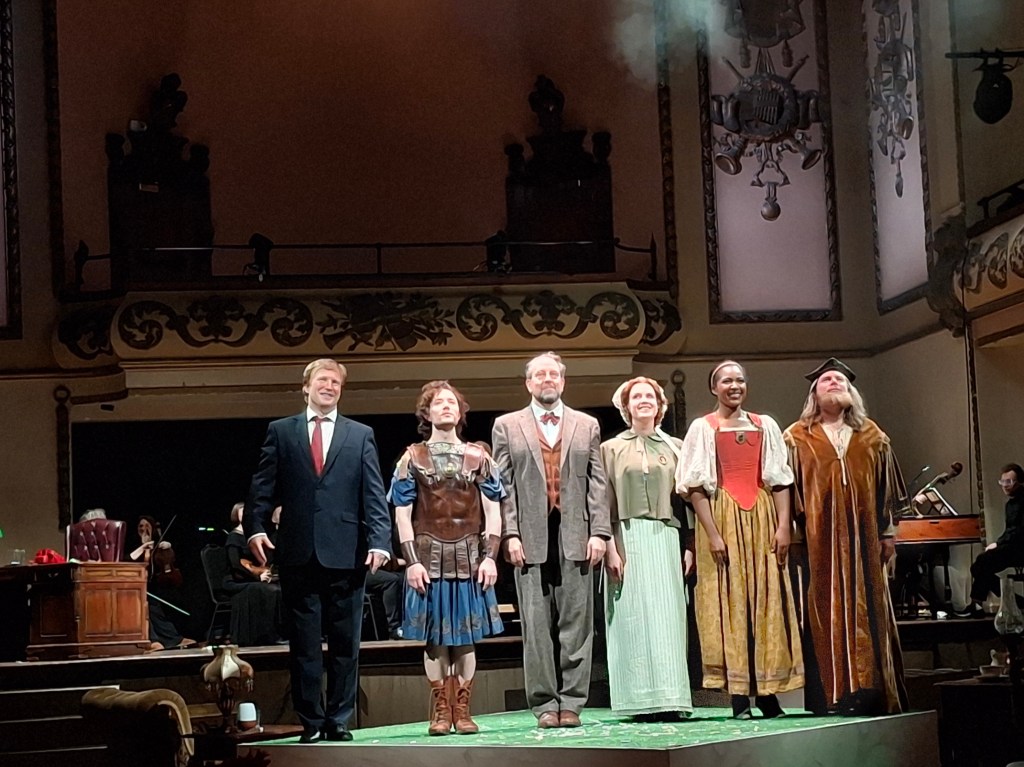
The year 1724 was a good one for Handel as he wrote Rodelinda and Giulio Cesare in the same year. I’ve now seen all three in the space of the last two years. They are all full of great tunes and high drama mixed in with a sense of humour which makes them very appealing. Certainly the Shoreditch audience loved the whole thing given the ovation the singers and players received at the end. A very varied musical day!

My last cultural outing of March also celebrated, by a weird coincidence, the year 1724 which just happened to be the date of Bach’s St John Passion which the OAE were performing in the Queen Elizabeth Hall. As a ‘friend’ I was also invited to attend the rehearsal with German conductor Johanna Soller making her debut appearance with the orchestra. She knows how to get asked back – she cut Sunday’s rehearsal by an hour – always goes down well with musicians! This rehearsal may have been brief but it was also fascinating. Ms Soller is clearly a producer as well as conductor, keyboard star and singer. She started by having the QEH staff move the rostra about so that the chorus formed a shallow horeshoe rather than a straight line; she moved soloists’ seats to better catch the hall’s lighting and during the course of the rehearsal frequently skipped off the stage, ran up the aisle to listen from the cheap seats and make sure we’d all get the best possible experience in the evening. She gave a number of notes and we could hear their immediate effect on volume, phrasing, pronunciation and diction. All very impressive but did it work?
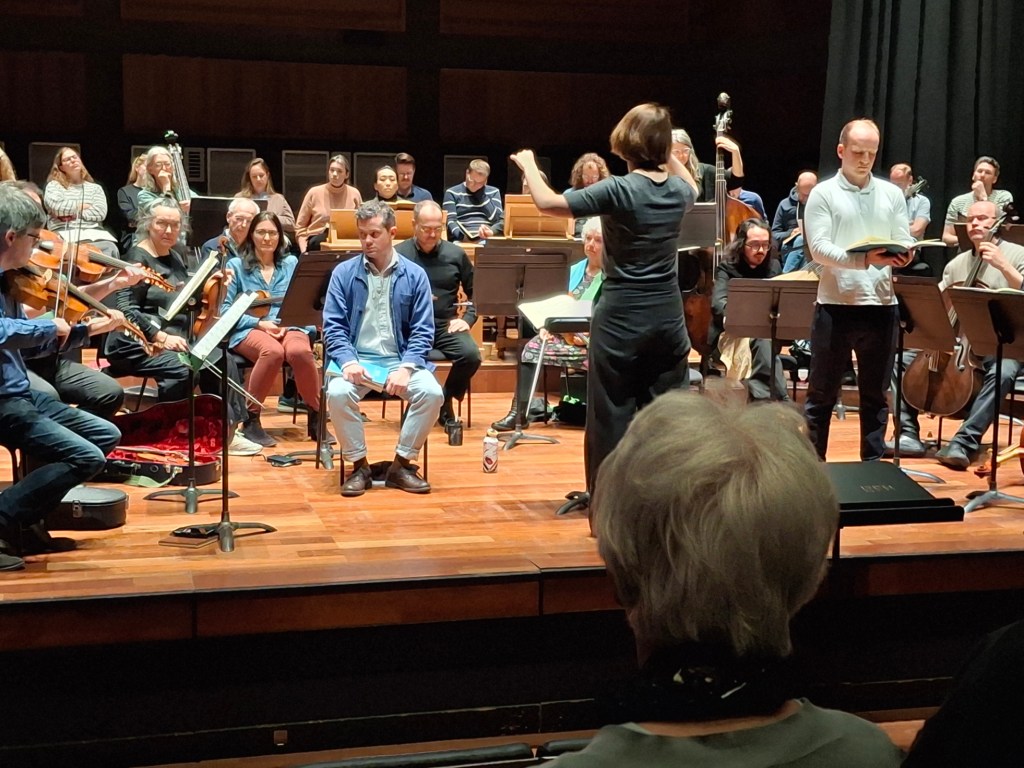
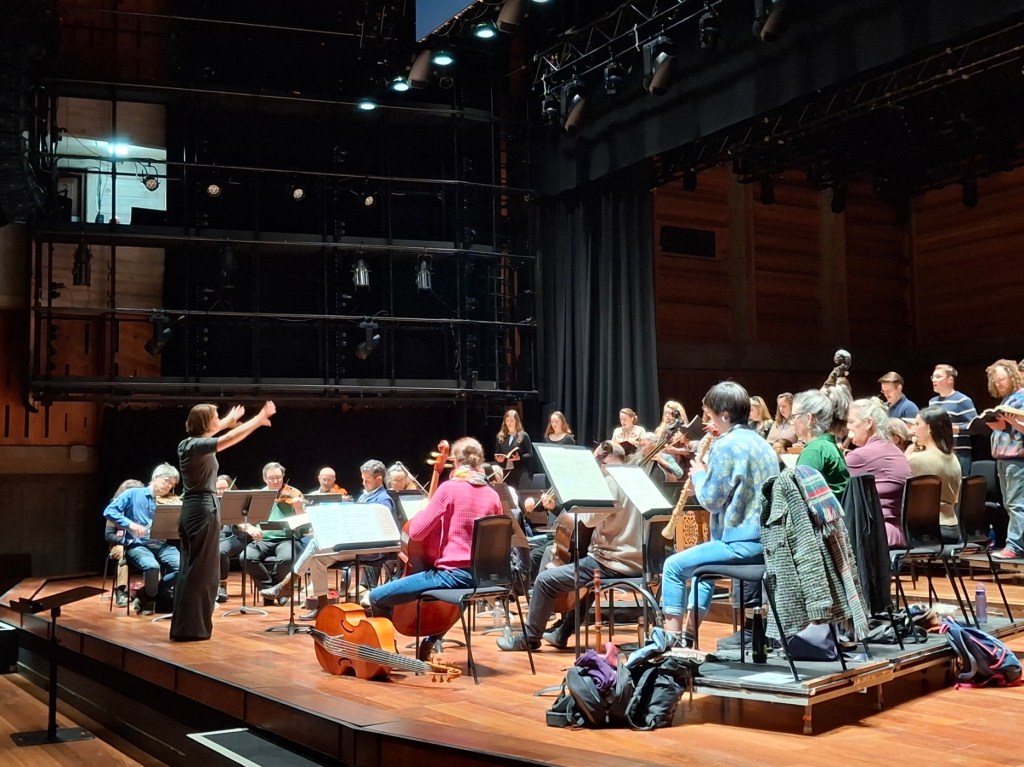
Emphatically, yes! Her energy and dramatic timing made this one of the most operatic readings of the mass and that includes Peter Sellars’ staged version with Simon Rattle and the OAE in 2019. The orchestra have played both Bach passions many times but sounded fresh and engaged last night. The score is so melodic and dramatic – the build up to scene 33 “And behold, the curtain in the temple was torn in two pieces from top to bottom. And the earth shook, and the cliffs were rent, and the graves opened up, and many bodies of saints arose.” shook the entire hall. This is in contrast to the beautiful alto aria “Es ist vollbracht – It is finished” sung by the wonderful Helen Charlston continuing her long assoctaion with the OAE having been one of its early Rising Stars. All soloists were excellent James Way as the evangelist, Peter Edge – one of the current cohort of Rising Stars – as Christus, Hillary Cronin, Jonathan Hanley and then Tristan Hambelton as Pilate was outstanding in his empathetic reading as the representative of Roman law. Johanna Soller congratulated all areas of the orchestra in turn and selflessly stood to one side as the band and soloists took their bow, A fine debut and let’s see much more of her in the UK.
‘Twas Valentine’s day in St Alban’s …

So after a busy start to February, its halfway point was marked with a trip to St Alban’s – the first for a long time for me. The occasion was the christening of the extended family’s newest addition Louisa Deeley. I was delighted to note that her middle names were Denise (my late wife) and her great grandmother Rosemary who was there and I was pleased to have a long chat with her over tea. The party decamped to a pub to watch Scotland demolish England in the rugby – large Scottish contingent present. I made my excuses and went to visit my composer friend Dani Howard who conveniently lives opposite the Mayflower pub in the city centre where we had a lovely few beers with her and her partner Sean chatting about all sorts of things musical and other. Dani has a busy schedule ahead with trips to Hong Kong for the premiere of her Cello Concerto to be played by her former mentor about which she’s a bit nervous, several performances of the Saxophone Concerto for Jess Gillam which I heard in Poole last year and concerts in Germany, the Netherlands and three weeks in Florida in October as a “Master-Artist” at the Atlantic Centre for the Arts Residency Programme working with composers, performers and poets.

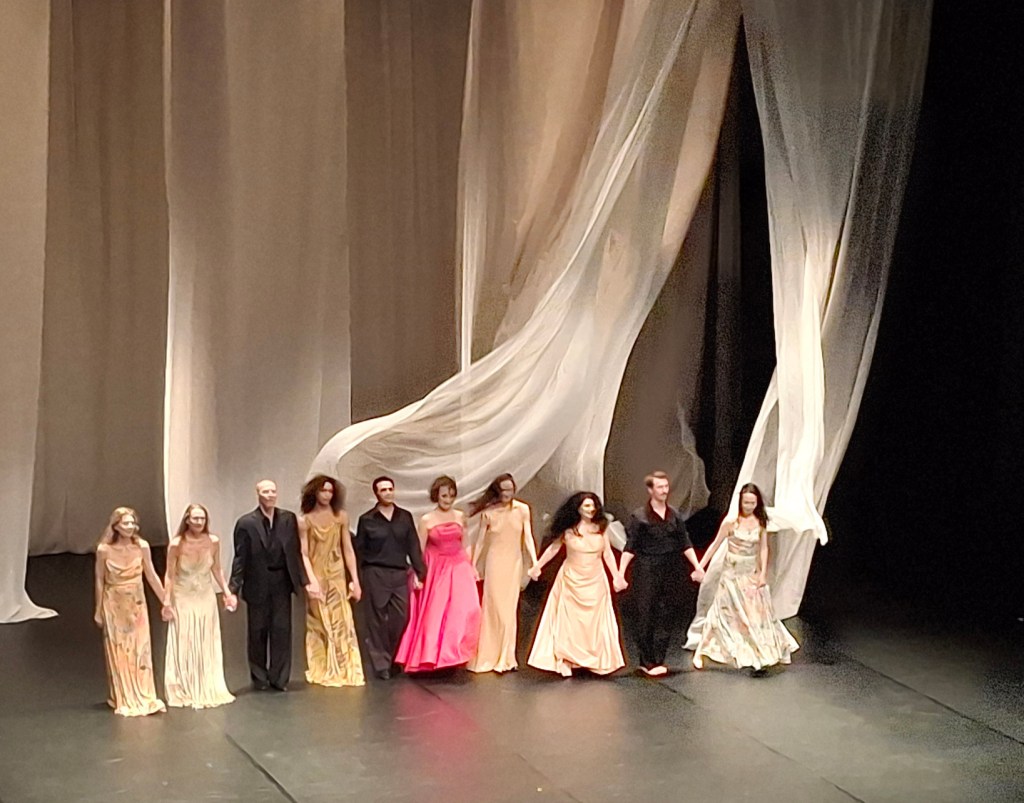
Then after a fairly quiet week a hectic weekend was upon us. On Friday I went with my friend Hattie to see Pina Bausch’s Tanztheater Wuppertal perform the amazing Sweet Mambo. With a flowing white drape background which sometimes billowed and was sometimes still and occasionally swallowed the dancers, the dance unfolded with a series of scenes in which women seduce and repel men, in which they find some common ground and other in which they have a laugh together. The fact that there are three men and six women probably indicates where Pina’s sympathies lie. The sound track is eclectic with classical, ambient, jazz and spoken words. As so often with her confections, it sounds like a mess but somehow it works with a mesmerising beauty. We left the theatre with big smiles on our faces.

Fabulous frocks and flowing drapes in Sweet Mambo

The next day promised to be a bit of a scramble with a trip to Watford for football followed by a cross London dash to the Arcola Theatre for a play in the evening. My initial journey was complicated by there being no Metropolitan Line trains to Watford – my usual route when not driving – as it deposits me much closer to the West Herts Sports Club, where we meet for pre-match drinks and chat, than Watford Junction. It was all worthwhile as our new manager – third of this season, 23rd since the Pozzo family bought the club in 2012 – coaxed the team to a 2-0 victory over Derby County. After the match two Overground trains took us via a highly complex platform change at Willesden Junction (thank goodness Fran was with me or I’d have got completely lost). We met up with Farzana in the Arcola bar before watching a highly entertaining one-man show with a Watford connection.

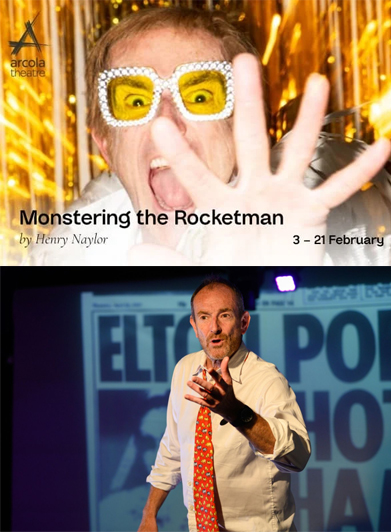
Monstering the Rocketman devised and performed by Henry Naylor was originally at the Edinburgh Festival but the excellent Arcola gave it a worthy London run. It featured the dreadful Kelvin Mckenzie’s vitriolic attack on Elton John, the total lack of facts and evidence for which resulted in the biggest libel suit in history with Elton taking on the might of The Sun and the power of the Murdoch empire. With video clips and garish headline displays Naylor told the full story in a variety of characters in a funny, terrifying and eloquent way. He was one of the lead writers for Spitting Image back in the day and his satirical skills enabled him to skewer McKenzie and cronies in a revealing and most enjoyable 75 minutes. As it was still early we three made our way to the excellent Five Fingers for a fine curry.

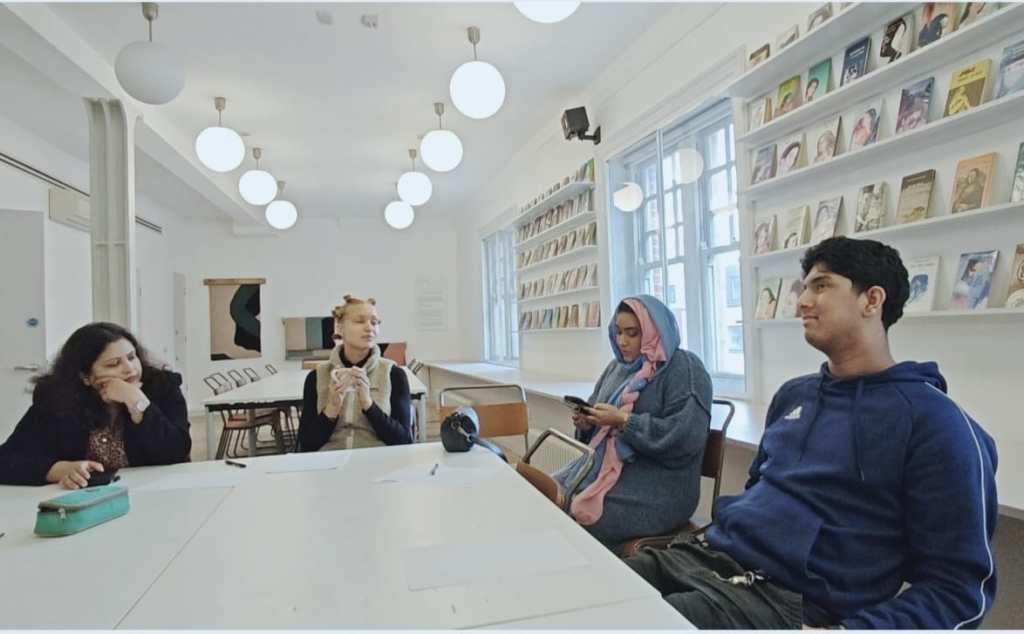
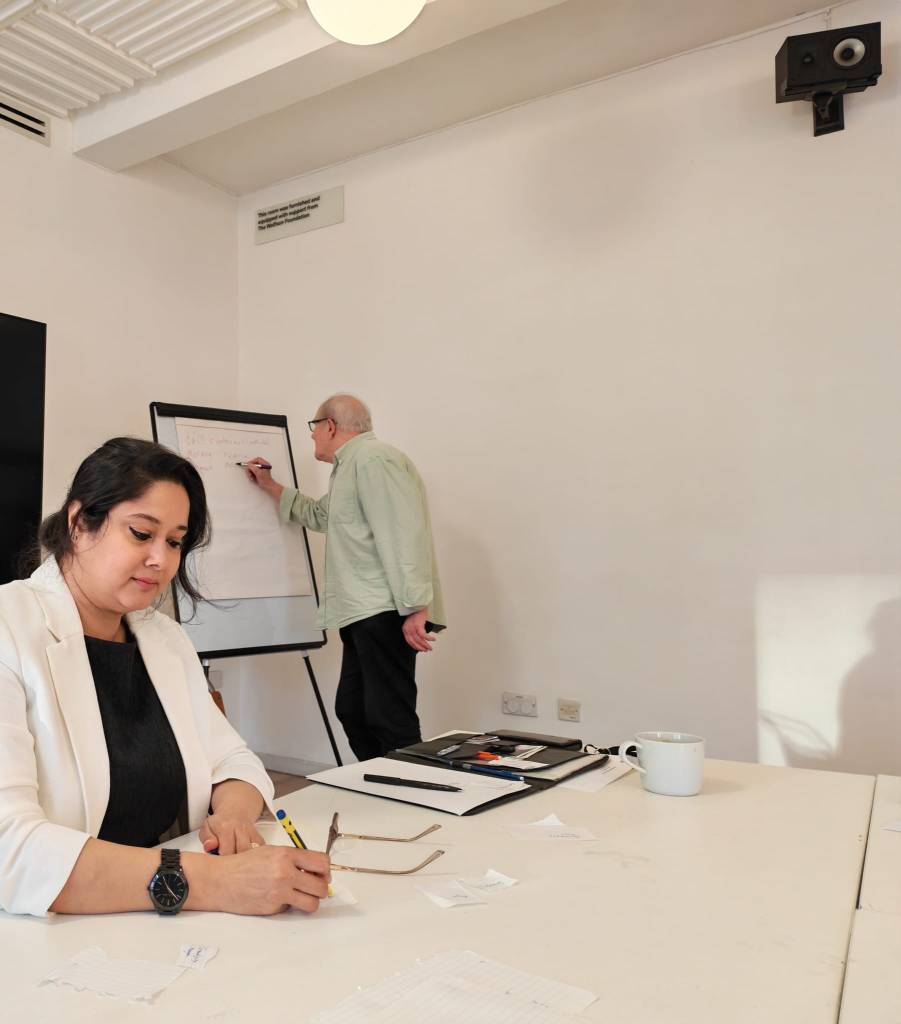
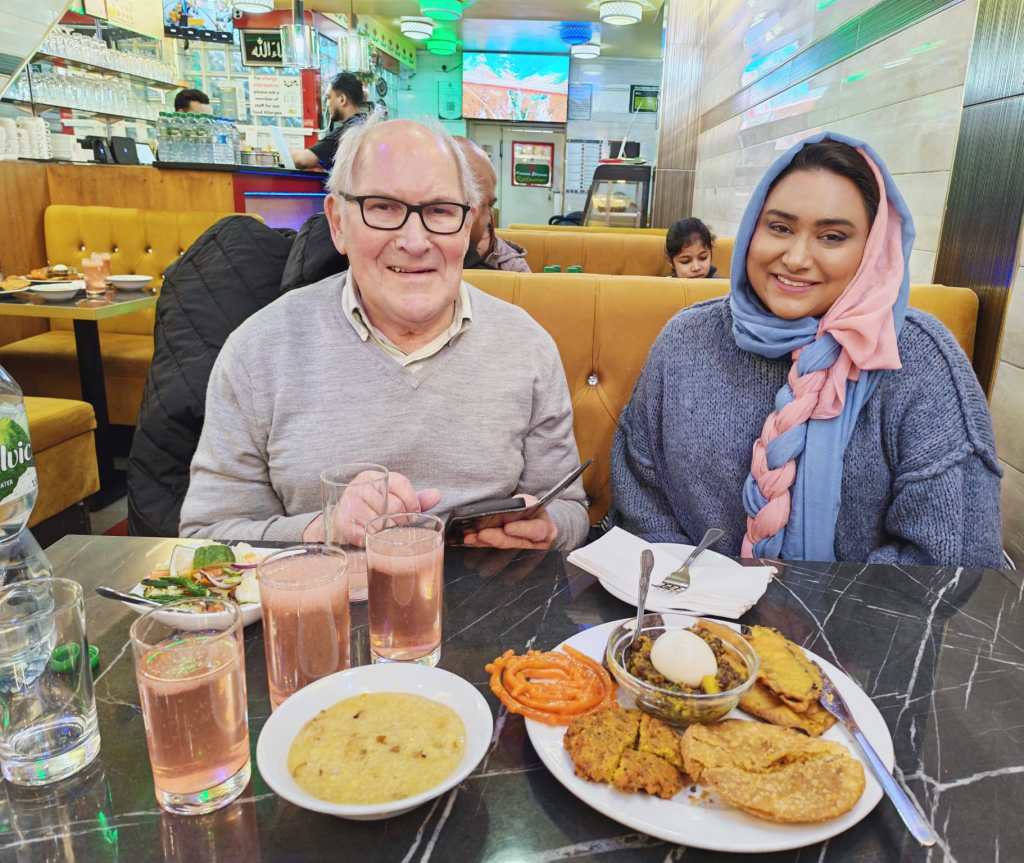
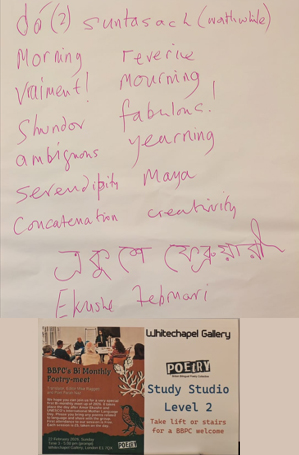
Saturday 21 was UNESCO International Mother Language Day so it was appropriate that our British Bilingual Poetry Collective (BBPC) group had our regular meeting on Sunday 22 and could focus on the topic with a group of regulars and two people joining us for the first time. I outlined the origin of the Day which started in Bangladesh when five students were executed for speaking Bengali rather tha Urdu and was observed there ever since. Then the government suggested to UNESCO that it should be global which it has been since 1999. I had asked my friend Shumi to bring her delightful poem Banglish about her experience of growing up bilingually in London, I had sourced a number of others I could read and a lively discussion ensued with contributions with many different experiences. We had a technical task to conclude in which all of us suggested two words which I then wrote up on the flip chart. The session’s ‘homework’ was to write a poem incorporating all the words. Three poems resulted which were not bad at all. If you want to give it a try the words are below. As some of the group were observing the Ramadan fast, we repaired to a local restaurant to enjoy iftar the moment the sun set. The chef did a count down for us and then promptly brought much-needed, by some, food.

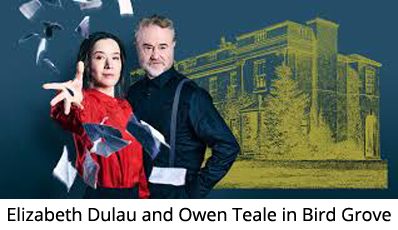
It doesn’t stop – Monday was off to Hampstead Theatre for the press night of Bird Grove by Alexi Kaye Campbell. It was a fascinating examination of the trials of a radical young woman Mary Ann Evans fighting a rigid father as well as contemporary mores. This radical young woman later still had to assume a male identity, George Eliot, in order to publish her seven novels and a number of short stories. Ironically she was allowed to publish translations under her own name. The play was rooted in the father daughter dispute and her association with some undesirably left wing friends.

A touch of near-slapstick was introduced through her would-be suitor needing a marriage to secure his inheritance. He was sent off with a flea in his ear. It was interesting with Mr Evans pouring guilt onto his daughter about overreaching their funds to put her in the titular grand house and her steadfast resolve to resist being bullied to church but it stirred up a wish for a play that reached further into her later life and success against the odds. Maybe that’s in the works.

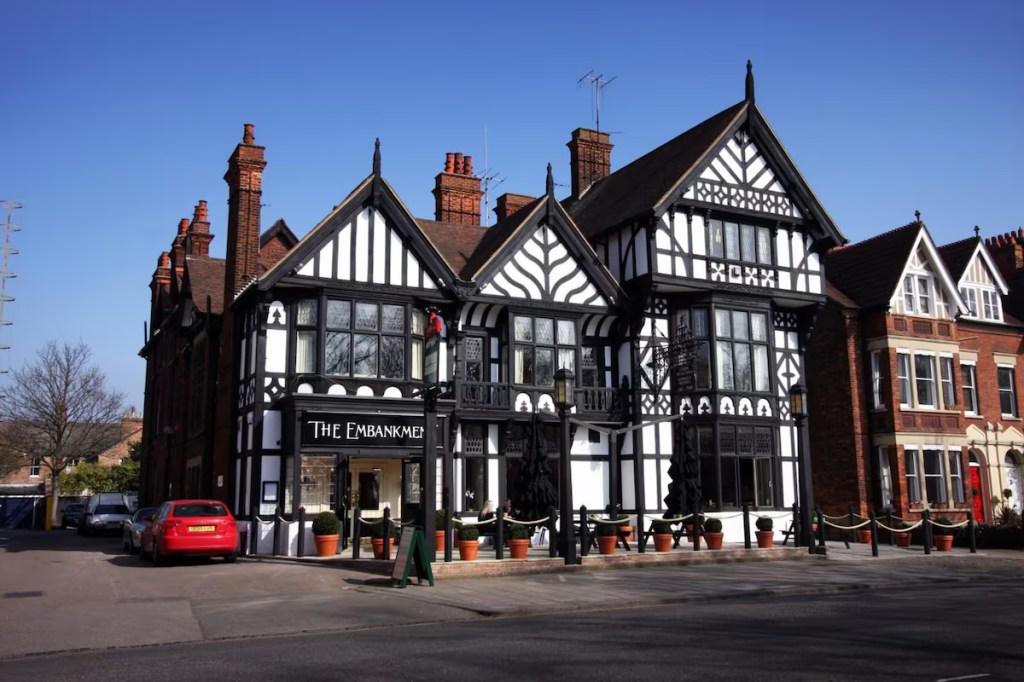
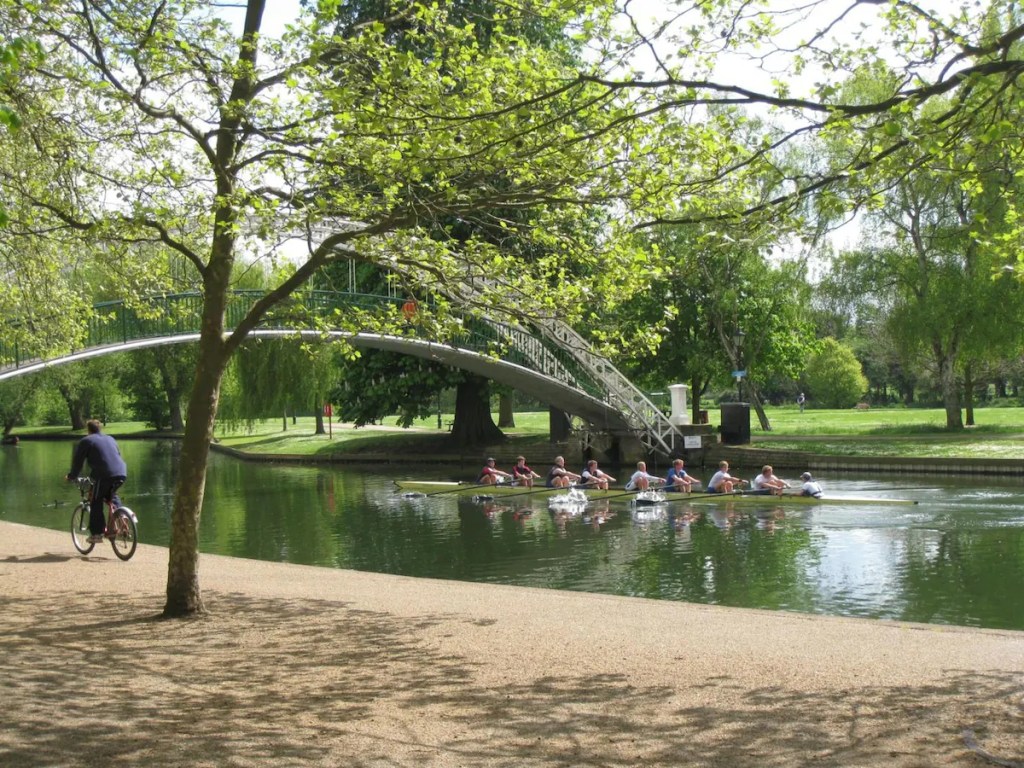
Tuesday was deadline day for BBPC to submit its proposals for the 2026 Season of Bangla Drama. We had discussed these as a group but it fell to me to get them in on time. Then on Wednesday I went to Bedford to have lunch with my friend Jossy who I hadn’t seen for a while. How lucky were we! After the murk and mizzle of the year to date we had a sunny day and could lunch in shirtsleeves on the patio of the Embankment pub (thanks to Pete and Julie Bradshaw for the local knowledge) overlooking the Great Ouse with its scullers, joggers, dog walkers and cyclists. The pub had good food and wine and apparently has rooms. We then strolled back to Bedford Station through a less beautiful part of the town but down by the river all was fine and we had a lively discussion on a wide variety of topics.

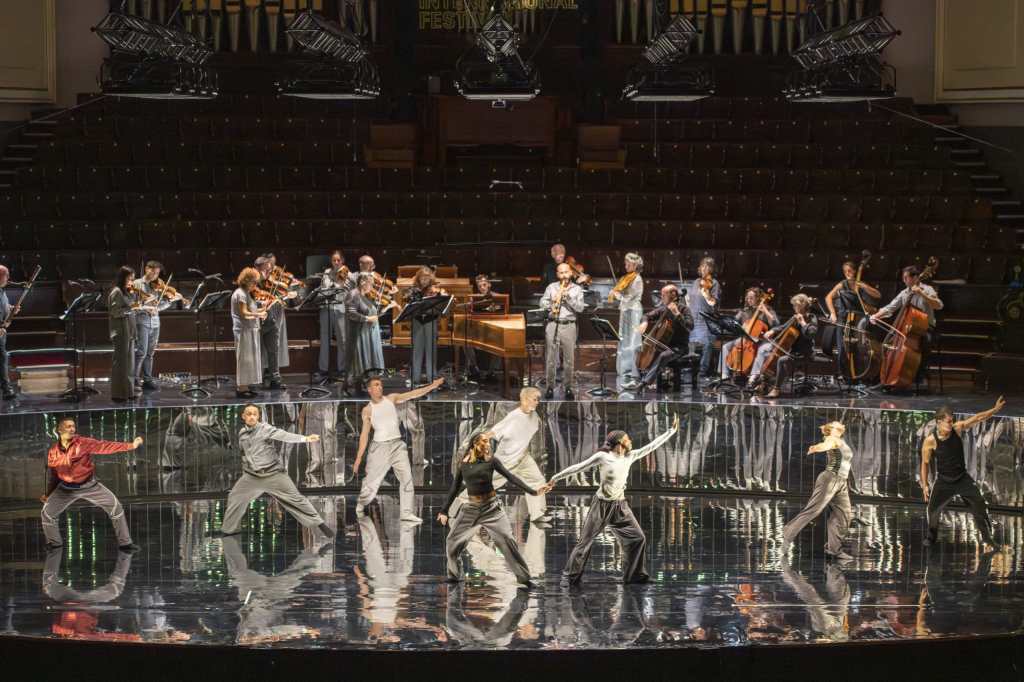
The Royal Festival Hall was full on Thursday for the OAE’s concert with Robin Ticciati – music director at Glyndebourne and familiar with the orchestra from its residency there. The programme was Mozart’s last three symphonies, 39, 40 and 41. These are pretty familiar items in the classical repertoire but are not often heard together, so a clever piece of programming. Once again, the conductor’s vision and energy, the orchestra’s use of period appropriate instruments made the works sound really fresh and new. The ‘Jupiter’, probably the most famous, occupied the second half and had atmospheric string playing in counterpoint with lush woodwind and powerful brass. A delight.

The evening was rounded off by the news from the Development Director telling me that the OAE’s sensational Breaking Bach project will have a series of performances in the UK next year and will be visiting the United States as well. Stemming from the orchestra being based in a school this ground breaking (sorry!) production deserves this exposure.

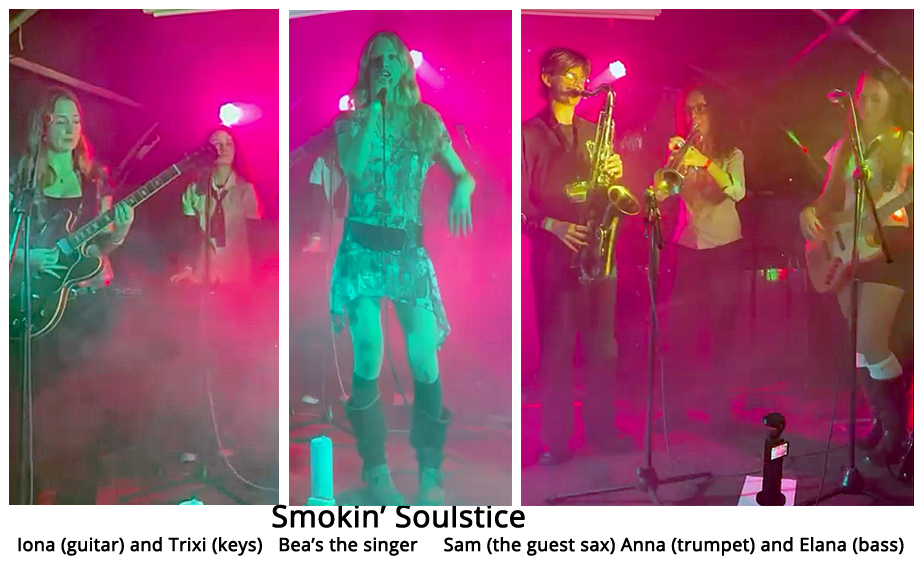
The next Sunday I had a music experience of a very different kind with a trip to an arch under Herne Hill Station to wear my SOULSTICE GRANDAD T-shirt with pride and see the group in which my granddaughter (Daisy but Trixi in the band) plays keyboard and flute and sings. Every time I see them they get better – different set list incorporating original material and covers, tighter arrangements and harmonies and tonight they had a guest saxophonist Sam to add to the exhilarating session amid the smoke machines and lighting of the Off The Cuff venue. (Image below contains stills from a video courtesy of Chris Addison as holding a pint in one hand and my coat in the other I couldn’t get my phone out.)

Two intense family dramas were next on the agenda. Richard Eyre’s adaptation of Strinberg’s Dance of Death at the Orange Tree was unremittingly bleak as a couple try to destroy each other. Updating it to the quarantine era of Spanish flu gave it an added claustrophobia as did the cluttered set. It was an evening to be admired for its production and acting rather than enjoyed. I knew a bit more what to expect the next night at the Young Vic as I had been to the Insight session last month. However the actual production came as quite a surprise. I’d seen the beige leather semi circle that forms a large part of the set previously but the red plush carpet on the floor and walls, the observation window and the fact that the audience reamined under the harshest of house lights as the action began were truly unexpected.

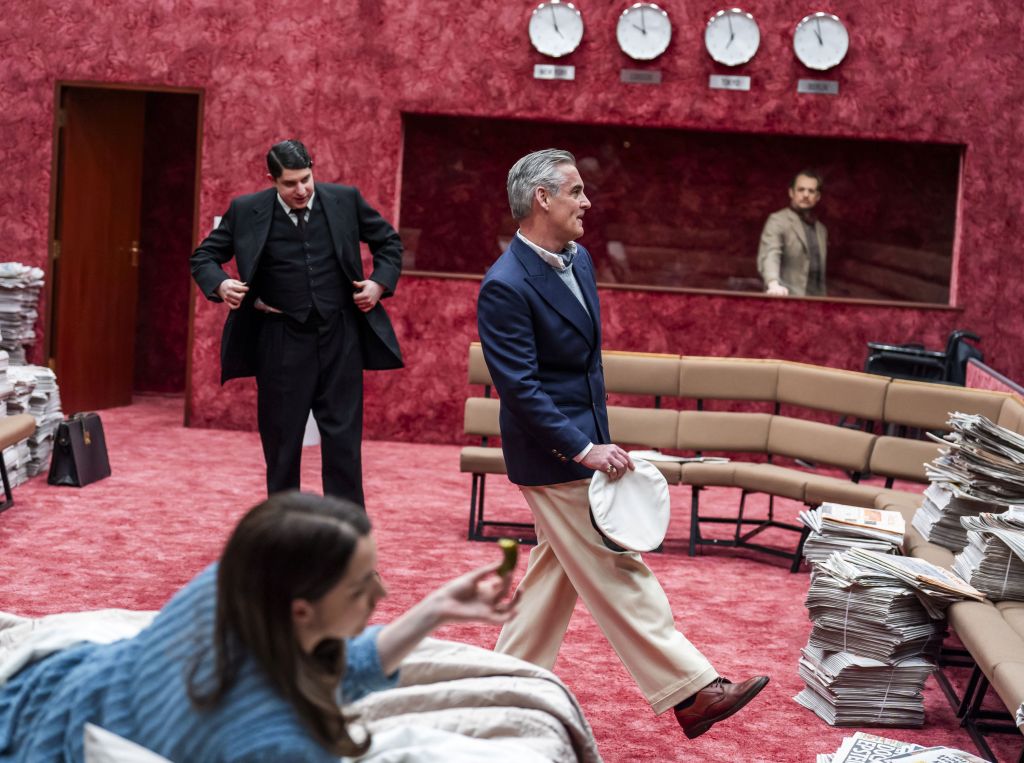
Arthur Miller is all over London at the moment, but Broken Glass is a late play and not often performed. The key element is the lower limb paralysis of Sylvia, played brilliantly by Pearl Chanda, a Brooklyn Jewish woman. After reading and hearing news of the Nazi Kristallnacht pogrom, suddenly her legs won’t work and she’s confined to bed. Attempting to explain this reveals all sorts of marital and family issues which see the characters unravelling before us, including a Dr Hyman played by Alex Waldman whose Freudian practices encourage Sylvia to imagine she’s sleeping with him. It was a demanding watch but made us think about current day issues of genocide to which many turn a blind eye – are we paralysed because there is nothing we can do? Leaving the lights on for much of the play was quite distracting as we were sitting opposite both Sir Lennie Henry and mostly significantly the Guardian theatre critic Arif Akbar. What would those hastily written notes revel in tomorrow’s paper? She’s usually quite a harsh reviewer but gave this four stars.

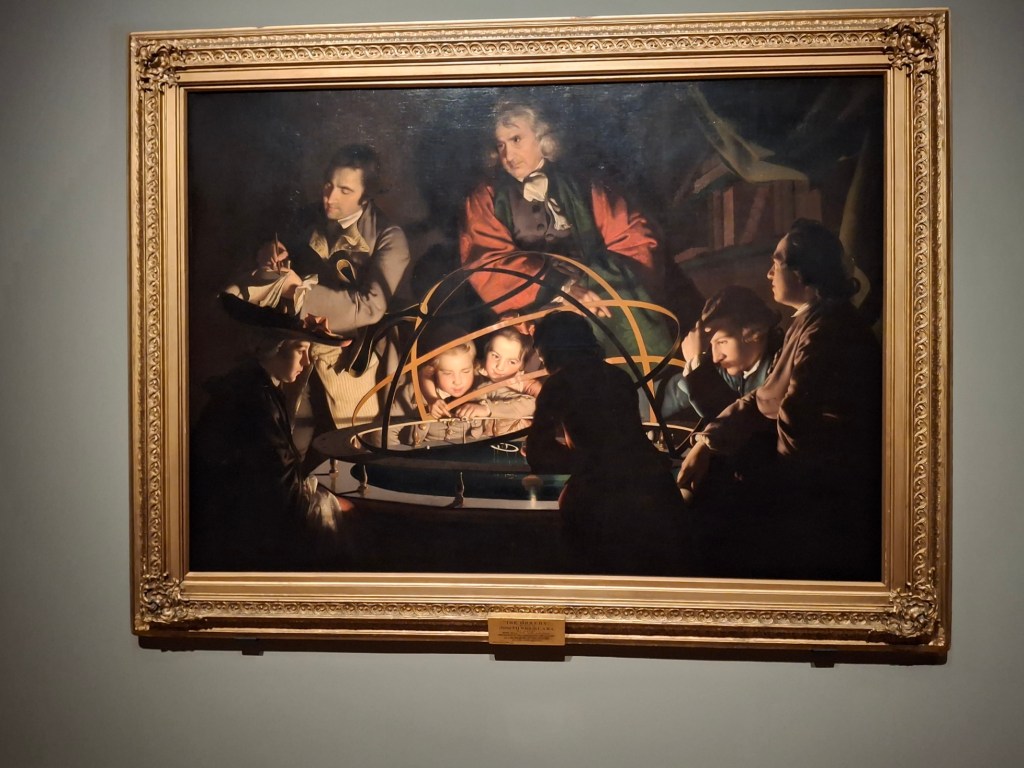
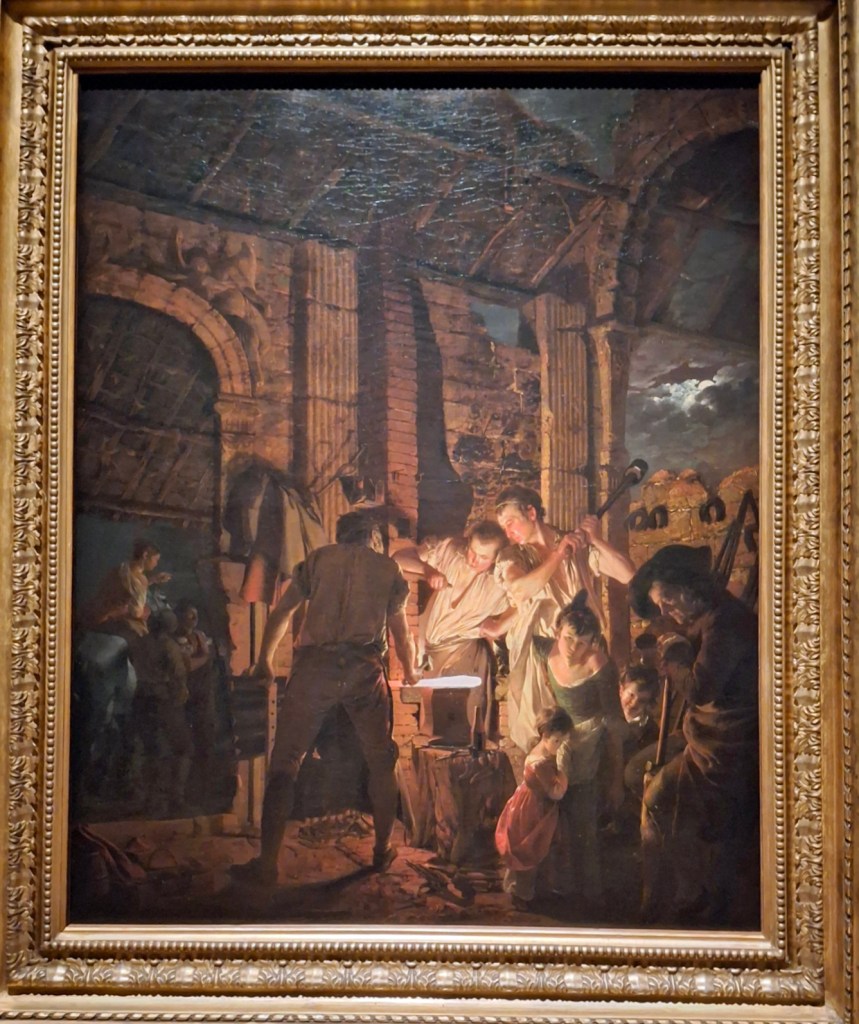
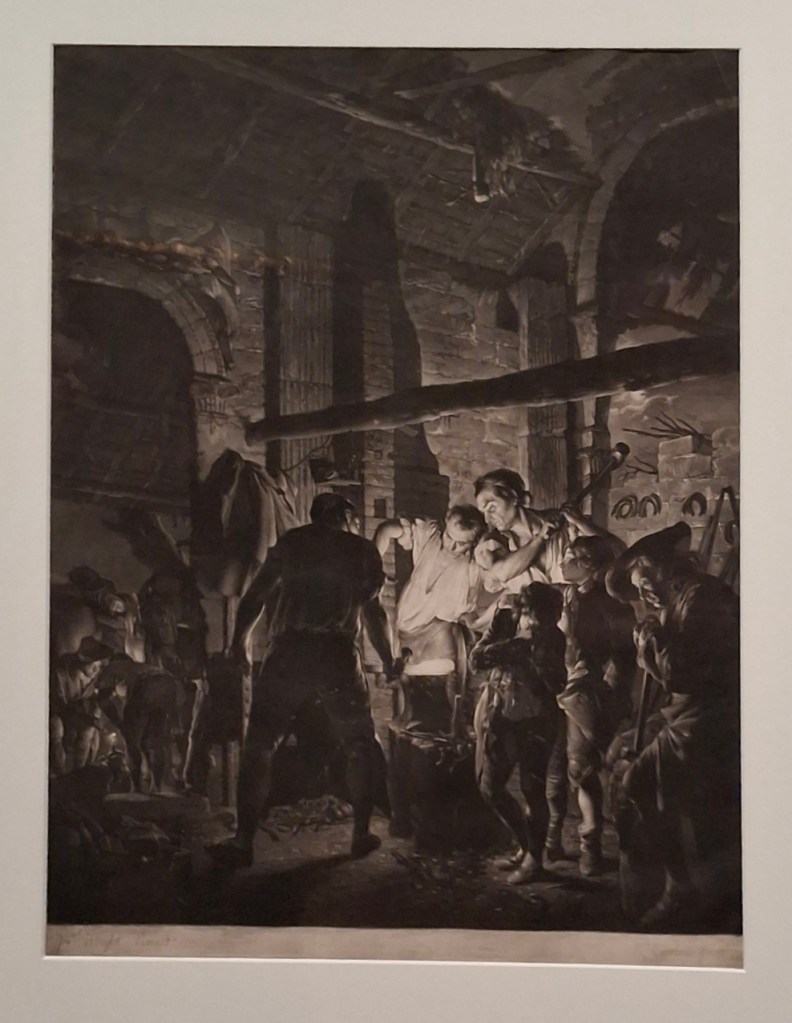
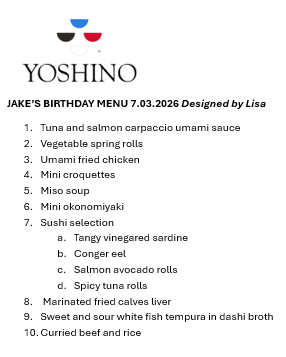
My grandson Jake, somehow turned 20 on Saturday and had decided that he’d like to go back to Yoshino for his annual birthday dinner. Ever happy to oblige I had words with Maitresse D’ Lisa and she came up with a really excellent menu for us. But before that, I decided to go to the National Gallery to see the Joseph Wright of Derby exhibition. I’d seen some of his paintings a few years ago in Norwich and was fascinated by his use of small and focused light sources. I gather his take on chiaroscuro is called ‘tenebrism’. In most of the paintings apart from the canndle or lamp light there was always a glint of moonlight in the background. As a big fan of printmaking as well as painting it was interesting to see mezzotint versions of his paintings which were obviously the main way of making money from your work at the time. Seeing them alongside each other was enlightening and the fact that one featured an orrery when I was about to meet my physics student Jake added another layer of interest. It’s a small show but well worth a visit. Walking through the other galleries it also remoinded me what a wealth of high class art is at our disposal for free still. I must go more often and revel in the Canalettos and Guardis and Turner v Constable without paying £24 for the privilege at the Tate. Oh and there are some favourite Goya, Velaquez and Murillo canvases I hadn’t seen for a long time – and as they say – so much more.

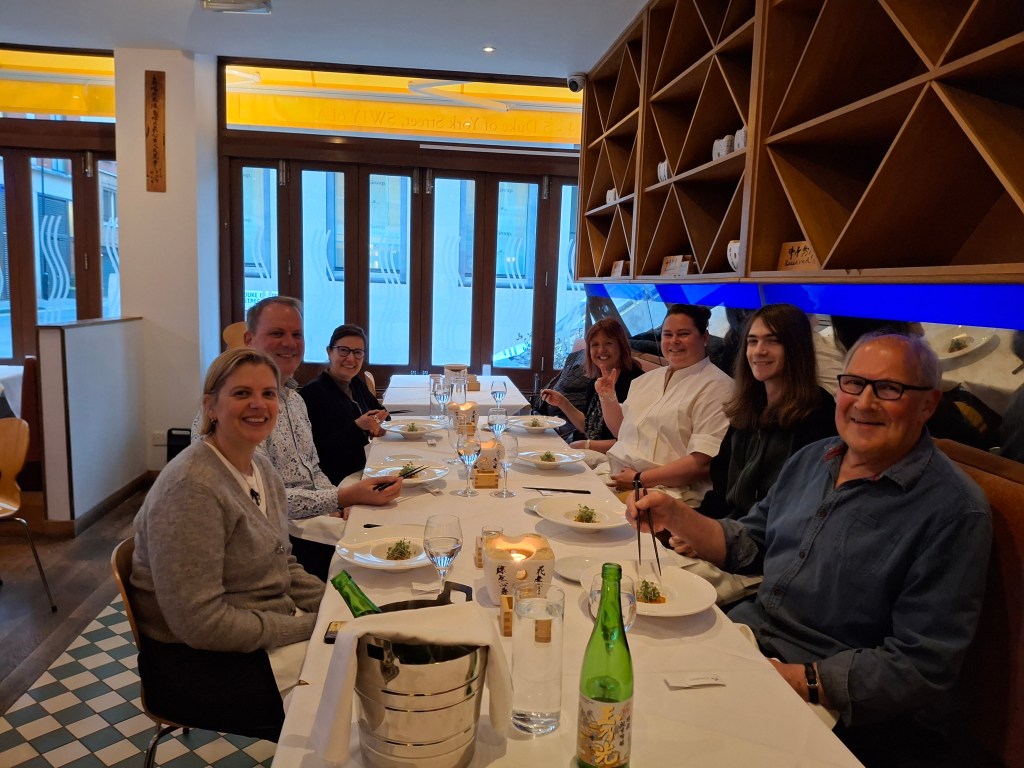
Then to the real business of the day. Anybody who has read previous blogs will know how important Yoshino is in my life. Dee and I first went to the old Yoshino in 2009 or 10 (I wasn’t blogging then or I’d know) when it was in Picadilly Place and came to know Lisa the Maitresse D’ quite well. Since then she’s been on a family outing to see My Neighbour Totoro at the Barbican and came to Glyndebourne with me in 2023 and we went as a family to the soft opening (right) of the new premises in Duke of York Street in April last year – minus Chris filming in Dublin and Daisy who didn’t fancy it, plus Rosa and Frances. So Lisa knows us all too.

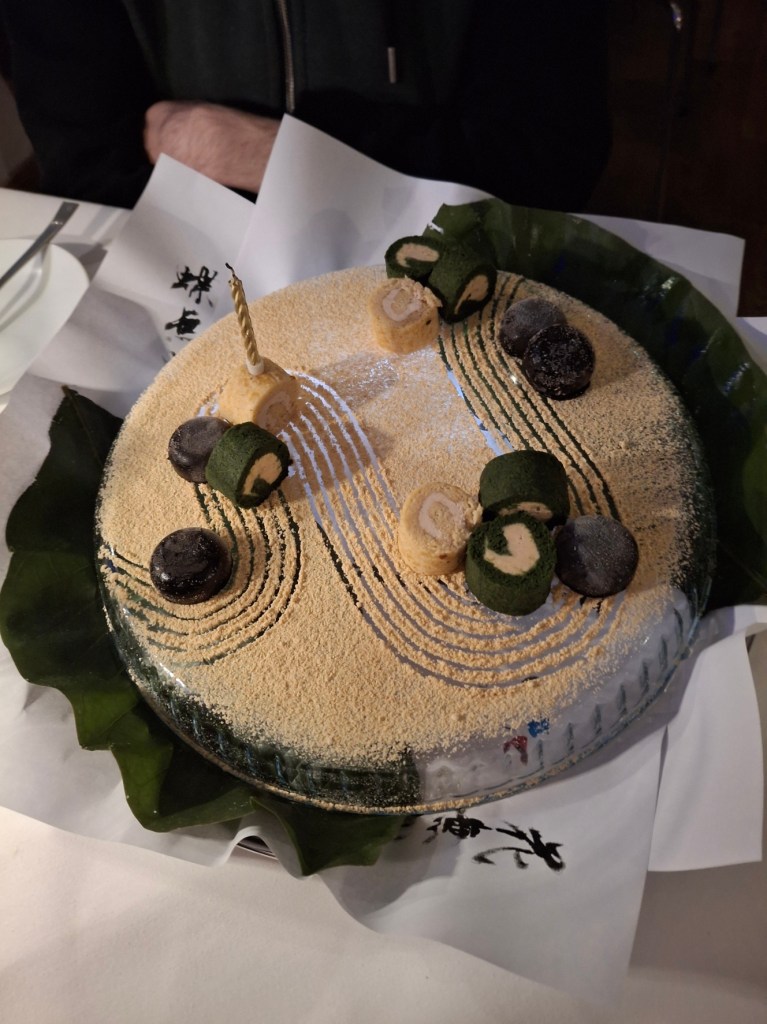
However when Jake said he’d like his birthday dinner at Yoshino there was rejoicing in lots of the family with a little trepidation on the part of a slightly picky Daisy. So I asked Lisa to book us in and design a menu for us with alternatives for Daisy. She pulled out all the stops and gave us an absolute feast of taste and texture sensations including making an alcohol free campari for non-drinker Jake. And as she had run out of my ‘usual’ sake – I wonder why – she offered me two options to taste before we settled on an excellent dry alternative. Daisy surprised herself and us by being really adventurous and enjoying things she wouldn’t have looked at – sake included. On a previous visit we’d tried a curry dish and had not been impressed. Lisa brought us a bowl of curry and rice saying it was spice combination number 47. Well this variety certainly hit the spot.This wonderful evening concluded with Lisa and her colleague Naomi bringing Jake a birthday cake of ice cream filled chocolates and soy and matcha mochi swiss roll slices all arranged on a raked zen garden. What a night! What service!

Another quiet week …

The week started with an interesting journey acrosss south London to see my granddaughter perform with the band Soulstice at BrockFest a music festival organised by Junior Open Mic which arranges monthly sessions for bands under the age of 18. This was a much bigger event in Brockwell Park in Herne Hill which I reached via a bus from home to Crystal Palace and then another to Brockwell Park. My daughter had equipped band and parents with branded merch. I had complained about being left out so today I was for the first time able to pull on my tee with SOULSTIC E GRANDAD appliqued on the back and keyboards on the chest as Daisy (Trixi in the band) plays the keys and flute. After some heavy metal and a plaintive female singer-songwriter it was time for Soulstice to perform their three-song set. The organisers had brought heir start time forward and there was a moment when they thought they may have to start with out their bass player. However she did make it on time – just – and they rocked the audience with a cover of Raye’s The Thrill is Gone and original compositions Still I Rise and Supersonic. As the applause rang out and they prepared to leave the stage the MC called them back for an encore and then a second one. A great start to the week and a proud grandad retired to the pub with some of the band and their parents to congratulate ourselves for the talent our genes had bestowed!

The next day it was me on the stage. I had been invited to read some poems at the Bangladesh Book Fair at the Brady Arts Centre in Tower Hamlets. I had a ten minute slot that I filled with a couple of poems inspired by my visits to Bangladesh back in 2009 and other more recent efforts which were politely received by the, fortunately, largely bilingual audience.

On Tuesday it was off to the Hampstead Theatre to see the transfer of Titus Andronicus from the Royal Shakespeare Company at Stratford. Having seen it there with Simon Russell Beale in the titular role it would be interesting to see how John Hodgkinson filled the space after SRB was sadly unwell and unable reprise his performance in London. Hodgkinson had apparently had only two weeks to learn the part and only one other public performance before we saw him. He was magnificent. His taller stature and natural authority gave the part a different feel. Despite the mutilations, murders and children-in-the-pie mayhem, you felt a degree of sympathy for Titus. The set had transferred to Hampstead slightly reducing the thrust which made it even more intimate than the Swan. Once again protective blankets were provided for front row guests against the blood spatter. The brilliance of Max Webster’s direction in using blackouts and audio to cover the goriest actions was still highly effective and the wardrobe choices for Romans and Goths worked really well. It was a stunning evening of theatre – again!

Then it’s off to the Kiln to see a play that Frances missed at the Galway Arts Festival last year but which has now happily got a run in Kilburn. The Reunion gathers a family on a remote island – maybe they used to holiday there when younger but I didn’t quite catch it – some coming from Dublin others from London – to commemorate the anniversary of their father’s death. After a cordial start, the cracks begin to show and develop into fissures and then chasms as sibling rivalry, jealousies, disapproval of lifestyle choices and parenting start to surface through the evening and into a nightmare of a night. There are a couple of great coups de theatre that I won’t reveal but alongside all the grief and misery there is a lot of humour, both verbal and physical.

And afterwards Fran had a chance to catch up with Paul Fahey the director of the Galway Arts Festival who remembered her photographer uncle Stan who used to photograph the festival for the local newspaper, about whom they chatted so it made for a great end to a fun evening.

I had missed Inter Alia at the National Theatre so was delighted that NT Live had recorded it and were showing it at the Greenwich Picturehouse on Thursday so I got three plays in three days albeit one of them on a screen.

The play is an amazing follow up to the sensational Jodie Comer spectacular Prima Facie and has an equally staggering performance from the central character Judge Jessica Parks played by Rosamund Pike. Unlike Jodie Comer, Rosamund is not alone on stage but still has the most incredible amount of stage business with props and costume changes as the awful story of a teenage rape unfolds through hints, evasions, suspicion and eventually confession. It’s a very moral exploration of social media’s effect on adolescents, understandings of consent and appropriate sexual behaviour – a theme explored in the eponymous Adolesensce on TV in 2025 and Micaela Coel’s I May Destroy You a couple of years ago. It’s a hot topic at present with toxic masculinity promoted seemingly unfettered by the big tech platform owners. The play calls for acting of a high order with both sides of dialogue in conversations, being an ever-present mother and a high-powered judge. Rosamund Pike delivers brilliantly with great support from her husband and son and a cast of children who pop in and out. It was most excellently filmed as NT Live shows usually are with enough wide shots including the audience to give a sense of being in the theatre but with the telling close ups of moments of joy and anguish that you don’t get when you are actually in the room. Shocking content, stunning performances, superb evening, applause in the cinema.

Having seen a part of the technical rehearsal for Creditors at the Orange Tree a couple of weeks ago it was now time to head off to Richmond to see the whole thing. Fortunately the journey time allowed me to watch the Red Roses complete their victory over France in the Womens’ Rugby World Cup and seal their place against Canada in next week’s final.

It’s been a week in which crucial issues have been aired in the theatre. War, power and empire building; family intrigue and betrayals; rape and social media and now Strindberg’s take on coercive control. The cast are outstanding in bringing a terrifying text of mysogyny and manipulation to us with compelling performances that deliver humour amid the horror and which draw gasps from the audience as Charles Dance’s Gustav ties Nicholas Farrell’s ailing artist Adolf in knots with a tissue of lies and innuendo. Missing for the first scene but the centre of the play is Geraldine James’s Tekla. She enters in scene two with comic flirting and her own level of manipluation of her husband Adolf to allow her to pursue other conquests in an ‘open marriage’. It all turns grim as Gustav’s poison pours out of Adolf in an attack on Tekla. Finally Tekla and Gustav play a scene in which many revelations occur. The adaptation by Howard Brenton and direction by Tom Littler make this a compelling evening in the theatre with actors at the peak of their powers. It appears that the three actors last worked together 20 years ago in the TV series The Jewel in the Crown. Their chemistry is intact.

And when I got home, there on the doormat was the latest edition of POL (Poetry Out Loud – Issue 7) in which I have a short story published. The magazine has a Bangladeshi slant and my story has a female British-Bengali protagonist in a tale of lost lovers reunited during a male lecturer’s trip to Yorkshire. You can get it from Amazon if you are interested.

No Mow – No Blog – May

Well the lawn didn’t quite escape the mower despite the warm weather and slow growth of grass but it had to have a tidy up. What did escape was the keyboard – too busy to type this month! It all started on Saturday 3rd with the last game of the season – unlucky draw – followed by a farewell to the season lunch at L’Artista and then Frances, Rose and myself whizzing off for a pre-concert Guinness in the Toucan with Ian Prowse (he didn’t have one) before he took to the stage at the 100 Club. It was as always with him a brilliant evening’s entertainment.

Then on Monday 5th Fran and I went to see the new Conor McPherson play The Brightening Air at the Old Vic. It’s a wonderful depiction of dysfunctional Irish rural family life with a standout performance from Rosie Sheehy as the disruptive Billie. The next day I had to record one of the English Language Teaching audiobooks that I do a couple of times a year. My voice over actor John Hasler (doing 16 different voices in Aussie accents around an RP narration – amazing) is about to rejoin the cast of Fawlty Towers at the Apollo Theatre with a bigger role than he had in the first run so I’ll probably catch that at some point in the run that starts late June.

Next up was a favourite ukiyo-e printmaker Hiroshige at the British Museum. I am familiar with most of the images displayed but seeing the vibrancy of the originals compared with reproductions was astonishing. The exhibition also included several indications of the complexity of making multi-coloured woodblock prints, inking them up and making sure paper is accurately registered. A technical triumph but also witty, emotional and dramatic scenes of love, life and landscape. It was interestingly curated too with prints fixed to scrolls which themselves were often the destination of woodblock prints.

With my mind firmly back in Japan I spent the evening downstairs at the Hampstead Theatre in the midst of a video game. The play was Personal Values and combined characters’ real lives with their personae in the game they were endlessly playing. As a non-gamer it left me a bit confused but others enjoyed it very much.

Back at Hampstead the following Monday saw a very different set of games presented. This was an adaptation by Richard Bean of David Mamet’s 1987 film, Mamet’s debut as both writer and director. It was powerful, twisty, scary and shocking but immense fun. I hadn’t seen the film for ages but recall it being altogether darker and while there were some elements of that here, it was as you’d expect with Richard Bean rather more about the laughs. I’m looking forward to more card games and sleaze when we see Dealer’s Choice at the Donmar next month.

Music started the month and gave me a real highlight in the middle. Sunday 18th found me in the Temple of Art and Music in Mercato Metropolitano, the sprawling food fest at the Elephant and Castle. The group in which my granddaughter plays keyboard, flute and does backing vocals – elegantly called Soulstice – were asked to headline a Youth Open Mic session. There’s a clip here – not very well recorded and not by me! They are usually an all girl band but their drummer couldn’t make the gig so a brother kindly stepped in. I’m prejudiced of course but they are actually rather good with a soul-tinged mix of their own originals, Sade, Amy Winehouse and so on..

Different but no less enjoyable was the Orchestra of the Age of Enlightenment’s concert at the Royal Festival Hall with Sir Andras Schiff conducting from the piano in a Schumann programme with a little Mendelssohn in between. It started with the Konzertstück which is a very lively piece for piano and orchestra and was followed by familiar passages from Mendelssohn’s Midsummer Nights’ Dream and Schiff played Schumann’s only piano concerto after the interval. He had talked last year at an open rehearsal of his pleasure in having a brown Blüthner fortepiano rather than the shiny black Steinways that are usually provided.

He had it again tonight and did us proud, not only in the opening piece and the concerto, but gave us a solo encore of Brahms’ Albumblatt and then closed the piano lid very firmly and got the whole orchestra to play Mendelssohn’s Fingal’s Cave as a bonus encore. Coming at the end of an eight day tour to Vienna, Graz, Antwerp, Amsterdam and Munich the energy of Sir Andras and the orchestra was quite amazing. And with even more bonuses – a preconcert talk with Laura Tunbridge, professor of music at Oxford, and an interval drinks reception for friends – it was a night to remember.

Sir Andras Scxhiff leaves the stage, leaving behind his favourite instrument.

On my way to the OAE concert I went to the National Portrait Gallery to see the exhibition of Edvard Munch portraits. These were very impressive with clear characterisation of friends and family placed in relevant environments. He obviously didn’t like several of his subjects as these were not flattering portraits but reflected Munch’s relationship with them and indeed with himself. I couldn’t escape the musical theme of the month of May as my two favourites were The Brooch which is a lithograph of an English violinist who styled herself Eva Mudocci and a quick stetch of Edward Delius at a concert in Wiesbaden. I also liked his walking self-portrait and a double portrait of the lawyer Harald Norgaard and his wife Aase with whom he had a lengthy relationship. It’s an unusual composition and was quite striking. Munch knew Harald from his youth and painted Aase separately on a number of occasions.

I also made it to another British Museum exhibition after being a radiotherapy buddy to a friend who is going through the final stages of cancer treatment. She is great company despite the circumstances and we have spent some good times together. As I remember myself radiotherapy leaves you pretty wiped out so she declined the offer of accompanying me to the BM understandably preferring home and rest. The exhibition was mostly of objects from the museum’s own collections but shed a fascinating insight into the religions of India – Hindu, Jain and Buddhism through their artefacts and what they symbolised. The galleries also had birdsong, tolling bells and chanting played quietly to make it a multisensory visit.

My next adventure was into the world of words. The British Bilingual Poetry Collective resumed our Bi-monthly Poetry Meets at Bard Books on Roman Road in Bow. Shamim Azad and I led a session of poetry readings, discussion, translation and an open mic session which was much enjoyed by all present.

The late May bank holiday was spent having an early supper with Rosa and then a visit to the Wigmore Hall to hear the amazing percussionist Colin Currie. I wish they didn’t have a photo ban because the array of drums, marimba, vibraphones, glockenspiel and other thing you can bang to make music filled the entire stage. A varied programme showcased his ability to make exciting, moving, thoughtful and adventurous sounds emanate from this staggering collection of instrumental forces.

My main motivation for going was the world premiere of Vasa a Concerto for Solo Percussion by Dani Howard, a young composer I’ve been pleased to call a friend for a few years now. It was a complex piece featuring a series of different tempos, emotions and melodies. Dani had worked with Colin to devise the final form and told us later that she had to have a diagram of the stage layout of the marimba, two vibraphones, cymbals, drums and other devices, many of them foot-operated, so that she could ensure she was writing things Colin could physically move around the instruments to execute. It was a very rewarding evening concluding with some excellent conversation in the pub.

I had intended to give After the Act at the Royal Court a miss as I’m not a big fan of musicals. However the indisposition of Fran’s intended companion meant that she asked me to go. The content should have been – and was – of real interest. The ‘Act’ was the appalling 1985 Section 28 that forbade taechers in schools and colleges to mention homosexuality, Equally appallingly it was only repealed in 2003.

The play contained some verbatim quotes from individuals – teachers, parents and students – who had suffered from the act, recreations of protests including a daring 1988 abseil in the House of Lords and, for my taste, too many occasions when serious issues resulted in the cast of four bursting into song accompanied by onstage keyboardist and drummer.

The next evening was far more satisfactory. Because Terrance Rattigan’s The Deep Blue Sea was on at the Theatre Royal Haymarket we were able to pop into Yoshino for a quick pre-theatre sample of Lisa’s excellent cuisine and hosting. Some analysts feel that the doomed love affair represented in the play was Rattigan’s sublimation of his own homosexuality – still illegal when he wrote it in 1952.

Starring the wonderful Tamsin Greig with a fine supporting cast, this was a faithful period-set production that allowed the play’s veiled messages space to emerge from the context and the conversations around love and death, suicide and survival, protest and resignation, passion and comoanionship were brilliantly done, very moving and affecting.

Thursday saw Fran and I make our hat-trick of theatregoing with a trip to Islington to see Ava Pickett’s debut play 1536. The setting is sixteenth century Essex where three friends indulge in gossip – has Henry really ditched Anne Boleyn? – their own relationships with men and each other and the role of women in a patriarchal society. It’s bold, it’s funny. it’s sexy and it makes you wonder how much better things really are today. The rolling changes in friendships are brilliantly delivered in crisp dialogue and while history is all around, the play tells us a lot about today. As a writer on the brilliant The Great on Channel 4, Ava Pickett is clearly a name to watch out for.

The month’s finale was a trip with Frances to see Simon Russell Beale in Titus Andronicus at the Swan Theatre in Stratford-upon-Avon. After a pleasant drive up we had a late lunch, checked into the hotel and then made our way to the theatre. It was my first time in the Swan and we were a bit surprised that this production was in the smaller space, not the main hall. However the intimacy of the location made the horrors of Shakespeare’s most violent play (or is it Coriolanus?) very clear.

The production certainly didn’t stint on Kensington gore but used brilliant lighting and sound effects to protect us from witnessing the worst atrocities. SRB was his usual excellent self but was by no means outstanding. The whole cast under the direction of the versatile Max Webster was superb and brought the subtleties of the text into play as well as the torrid drama. And on reflection, yes this is the most violent of Shakespeare’s works.

We went out to Anne Hathaway’s house next morning for a walk around the orchards, had an enlightening tour of the house from excellent guides and then made our way back to London. A fine ending to a full and varied month of culture. As Shakespeare’s contemporary Thomas Dekker put it “O, the month of May, the merry month of May”.