Cultural continuum

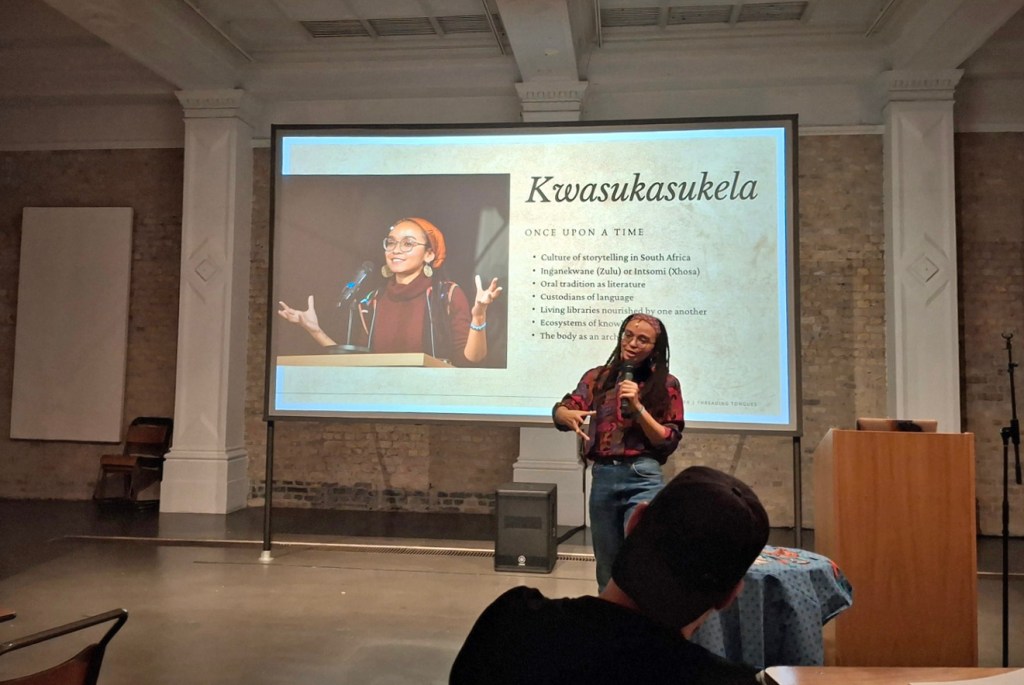
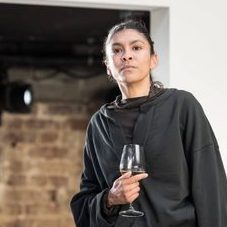
My first outing in April was to an event in the Whitechapel Gallery called Threading Words. The poetry group of which I’m a trustee has some connections with the organisers Babel’s Blessing. This charity arrnages language tuition in many tongues for recent immigrants to help them play an active part in British society. This session was led by a South African-German artist Nomakhwezi Becker who took us through a fascinating couple of hours of self-exploration based on her insights from Xhosa and other African cultures with a modern European gloss. Who knew that the intricate beadwork patterns so much a part of Zulu culture sent explicit messages such as ‘I fancy you’ or ‘Stay away’? I had a chance to chat to Khwezi and the Babel’s organiser Marina Castrillo and hope to see them both at our next BBPC gathering at the end of the month.

Nomakhwezi began by telling us about storytelling traditions which are so important in every culture – the screen reads ‘Once Upon a Time’ – and then asked us to identify things that were important to us in relation to colours, scents, the contents of drawers and handbags, the weather and places. I’m not usually a fan of heart searching in public but found Nomakhwezi’s prompts particularly well chosen so that I and those around me wrote copiously in response. I kept the messages that the session elicited and have found them helpful in planning my days.

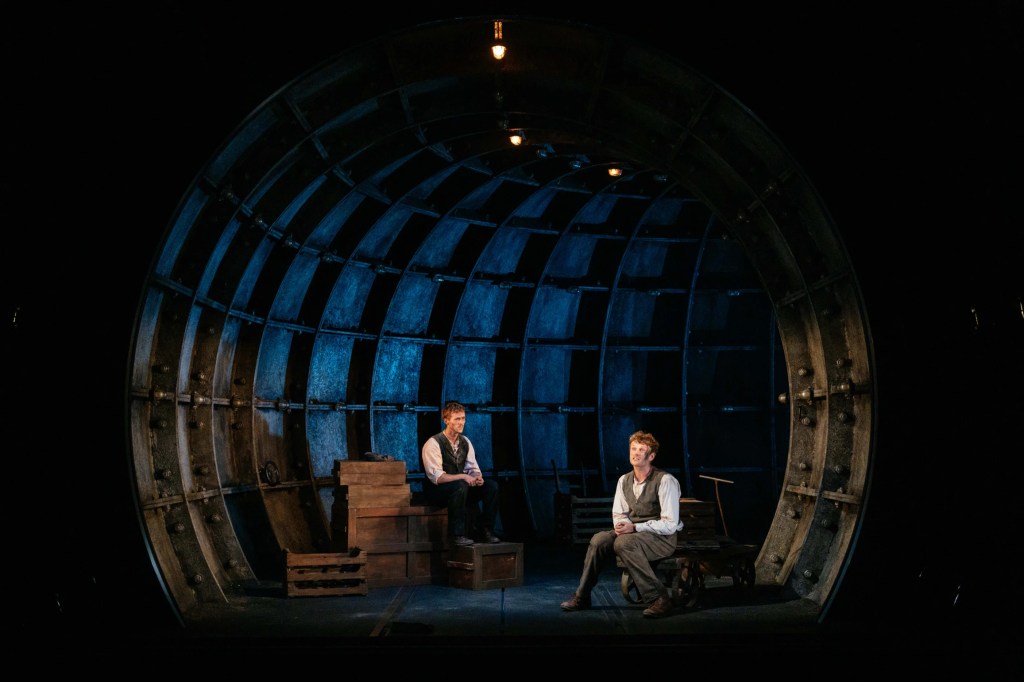
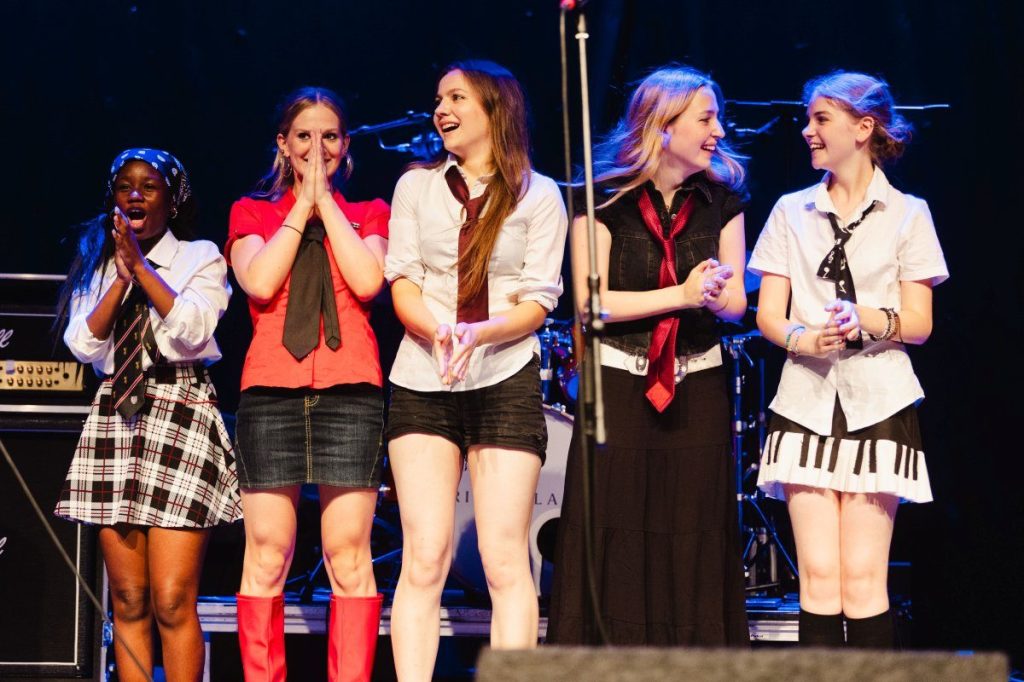
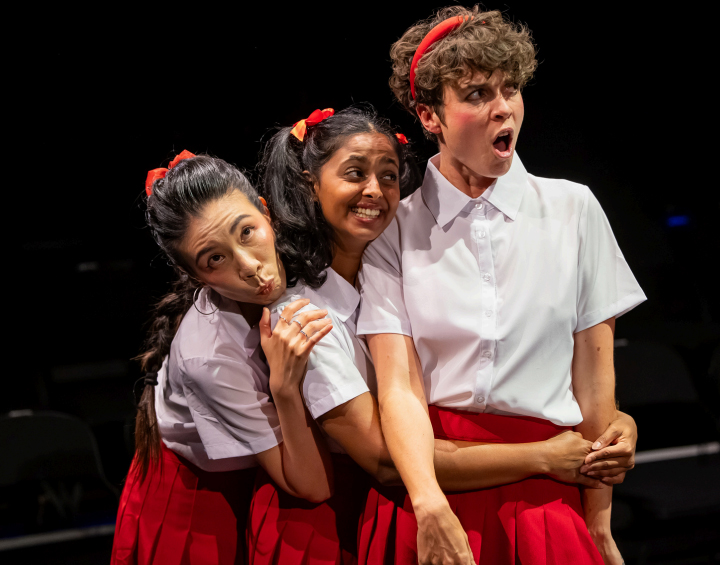
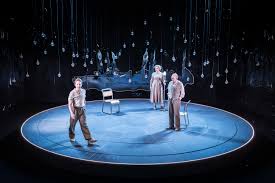
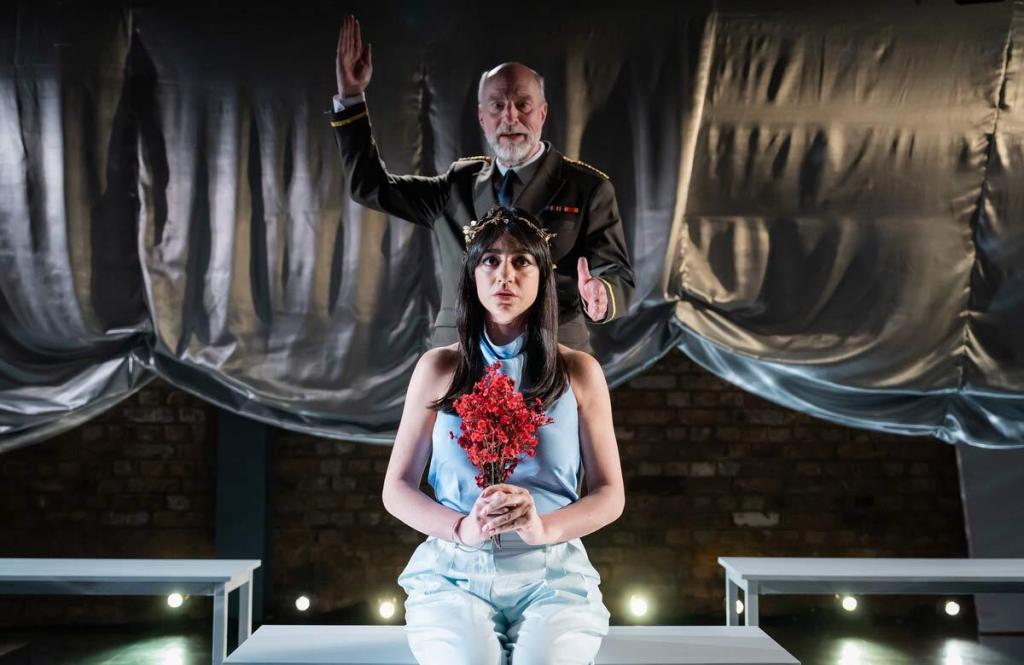
Some sensational retelling of a well-known story was taking place at the Royal Court Theatre. John Proctor Is the Villain is a retlling of Arthur Miller’s The Crucible by Kimberly Bellflower She relocates the action to a high school in Georgia where a group of – mostly – adolescent girls discuss the play with personal-inspired insights and some startling revelations. It’s set in the noughties and the young women want to set up a feminist society, I guess on the wave of #Metoo.The club is finally establshed after institutional doubts when the teacher suggests boys should be members too. The members all have clear characteritics – swot, rebel, newcomer, plus an absentee with a backstory of great importance to the subsequent revelations. The young cast – three making professional stage debuts – are outstanding and the denoument is a remarkable piece of modern theatre. Photo below courtesy Royal Court Theatre

It is getting a deserved West End transfer in 2027 when it will run at Wyndham’s Theatre from February through to April. Do go and see it – I’ll be going again. Another of this year’s highlights Arcadia is also transferring from the old Vic to the Duke of York’s in June. Miller and Stoppard are getting lots of exposure right now and rightly so.

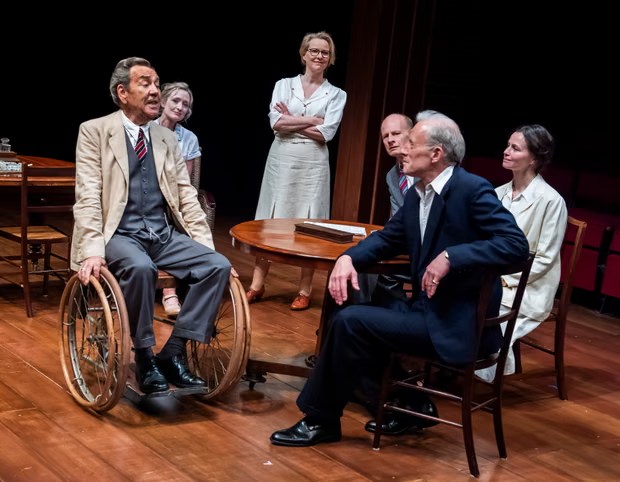
Having seen part of the technical rehearsal, it was with interest that I went to Hampstead with Frances to the press night for the revival of Michael Frayn’s Copenhagen. You know you’re getting old when you’ve seen the original version of so many plays being revived now – one marking its fiftieth anniversary! I noticed in the technical and tonight that the three actors were miced up and wore earpieces – a growing trend I’d noticed recently. I am used to presenters with lots of technical script to deliver having it replayed through an earpiece so they can be one-take-wonders. But actors! It was clear that Richard Schiff playing Niels Bohr needed some help as he was very stumbly – some kind audience members later said they found it effective characterisation of the older man. Alex Kingston playing Bohr’s wife Margrethe had a few flufs but brought some much needed warmth to the play while Damien Maloney as Werner Heisenberg performed with German efficiency.

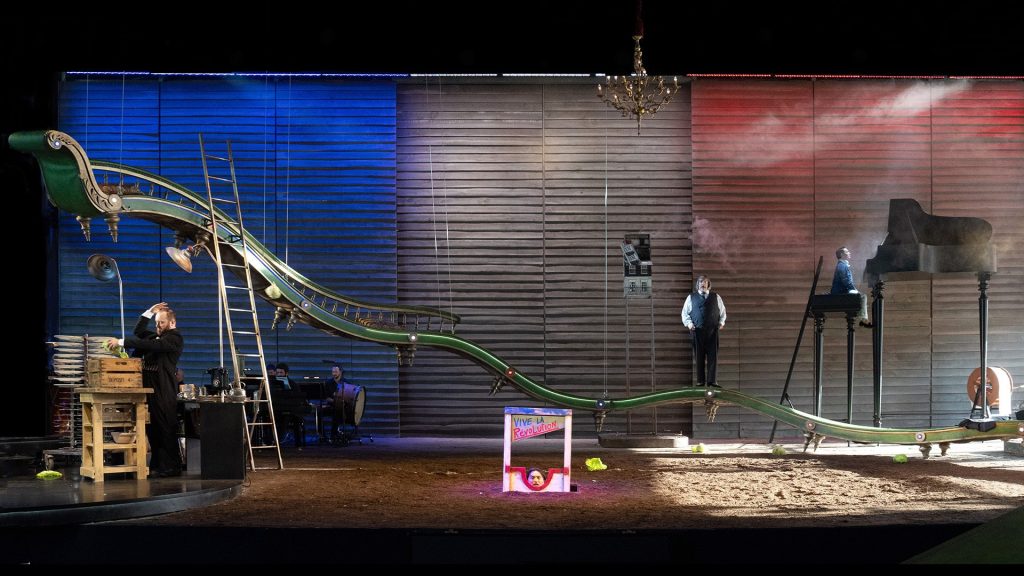
It always was a very wordy and complex play with the central mystery about the reasons for the 1941 meeting between the two former colleagues now on opposite sides in the war. As with a number of productions these days the Trumpian overtones were quite obvious and played up in Michael Longhurst’s direction. The real star of the evening was the set designed by Joanna Scotcher with a water-filled moat surrounding the central revolve and hanging light bulbs feeling like so many atomic particles. They also changed colour to suit the mood – in a series of clever lighting effects.

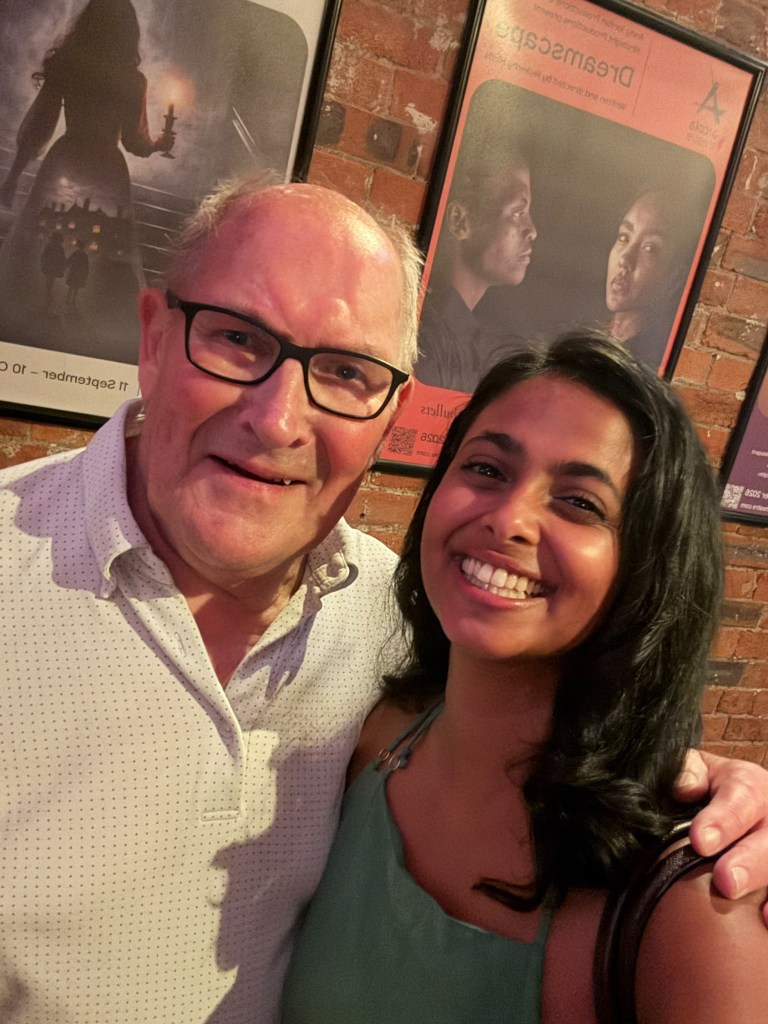
It was well done and thought-provoking but perhaps not the most enjoyable evening in the theatre. The after party more than made up for that with old friends and new chatting about everything under the sun – and drinking far too much. I was more restrained the next evening when I was able to catch up with my friend Rosa over dinner at the Union Club. Rosa is mostly based in a fabulous apartment in Girona nowadays but had to come back to get her car MOTed and various other chores and catch-ups. It was lovely to see her after quite a time and we put the arts world completely to rights during the evening.

The there was another nostalgia trip to see Teeth ‘n’ Smiles having a fiftieth anniversary revival. I saw the original with Helen Mirren as Maggie Frisby, the alcoholic fading rock star, played in the Duke of York’s Theatre by Rebecca Lucy Taylor who I have to say is a better singer and can act too. Coming from Rotherham her accent was spot on. David Hare’s play still feels very much of its time despite a few updating references. But it brought back happy memories of younger times of carefree excess and thoroughly irresponsible behaviour. The set was suitably shabby and the direction by Daniel Raggett (no relation that we’ve yet discovered) was pacy and engaging. I thoroughly enjoyed the depiction of a disintegrating band with its internecine rivalries and battles. And the original music by Nic and Tony Bicat was enhanced with some new songs from RLT or Self Esteem as she is known professionally.

For some mad reason I decided to go to see Watford play against Oxford United. It’s the dog end of the season where we can’t go up or down so there’s nothing to play for but pride and there was little of that on display as we lost 2-0. This lead to a truly toxic atmosphere at the end of the match with the players standing resolutely suffering piled on of abuse from certain members of the so-called support, who are clearly too young to remember what a state the club has been in at several periods of its existence.

I was pooh-poohed by some members of our party for my decision on arrival at Oxford Station to head off to the Ashmolean Museum rather than heading straight to the pub.

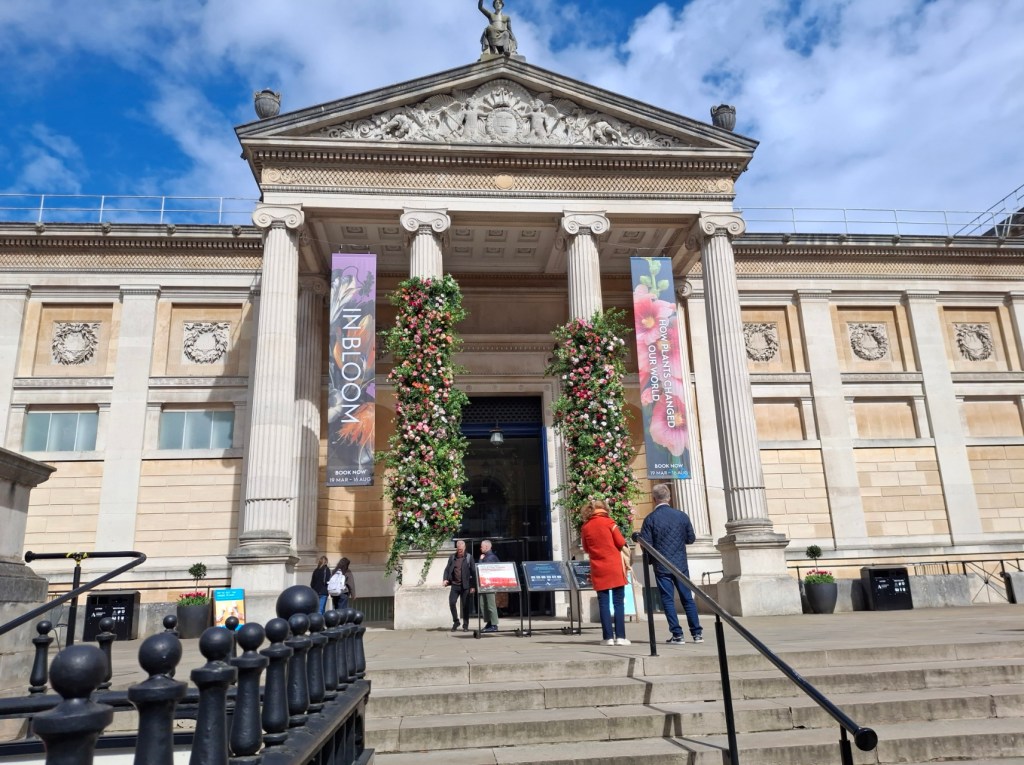
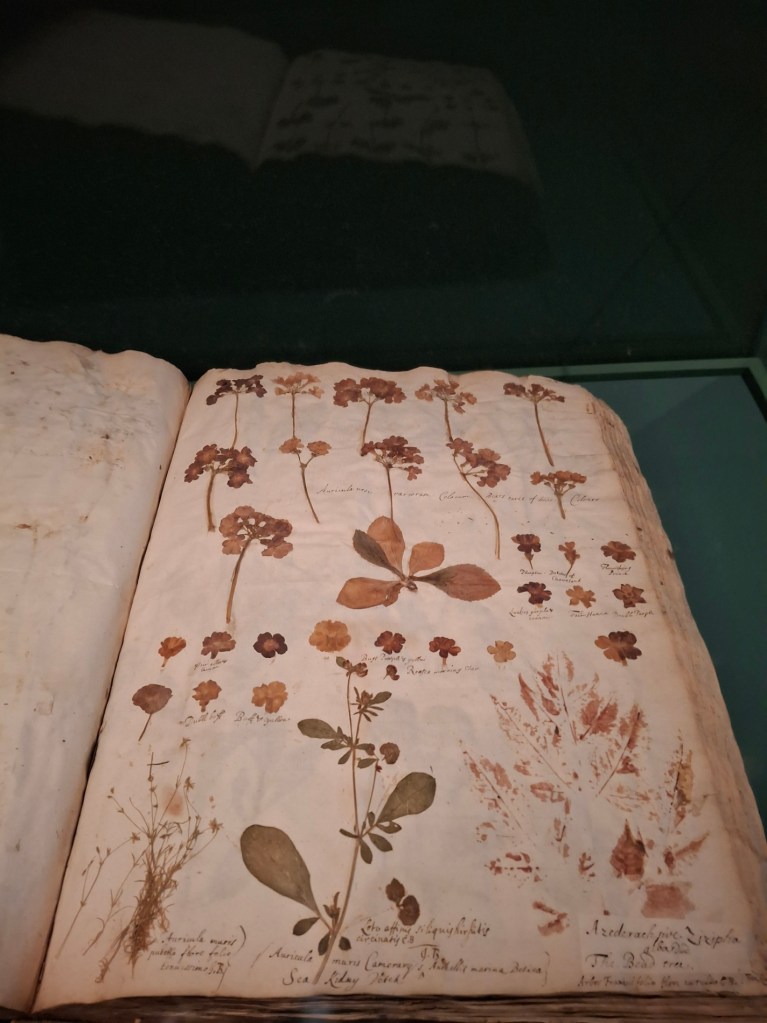
For once I made the right call – they waited 35 minutes for a bus, I was in the museum in 7 minutes. Flower displays adorned the portico presaging the exhibition called In Bloom about the history of gardening, plant hunters and the commercialisation of horticulture. It was excellent, small enough to be done in an hour or so but very informative and containing some beautiful and interesting images and objects.

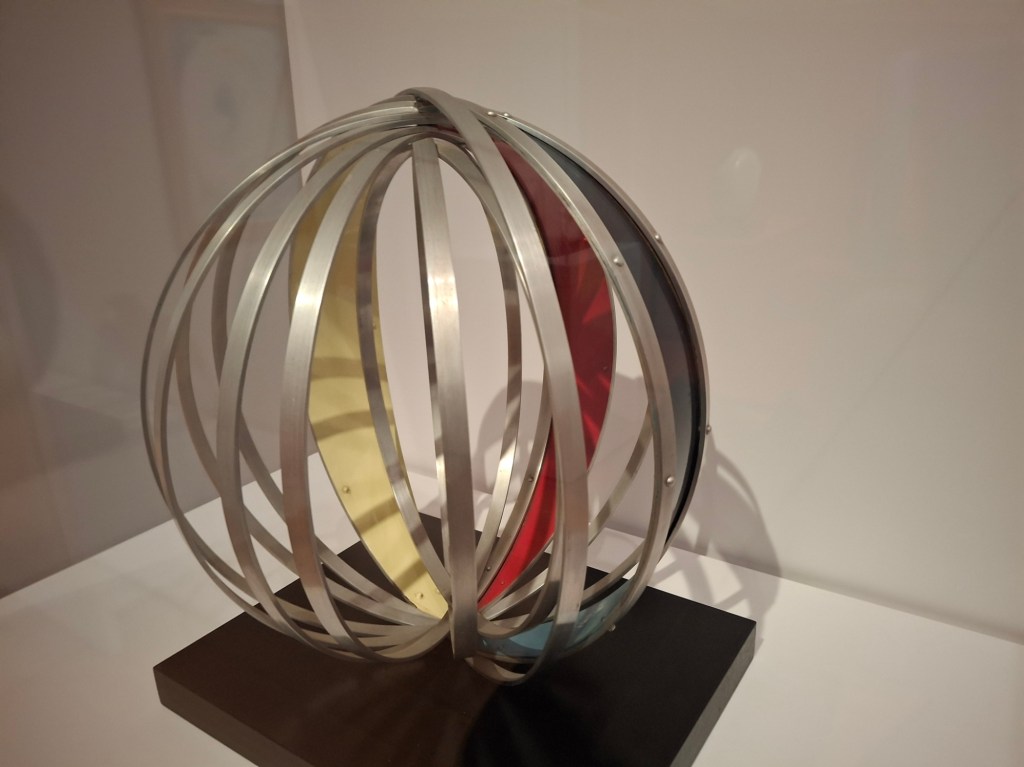
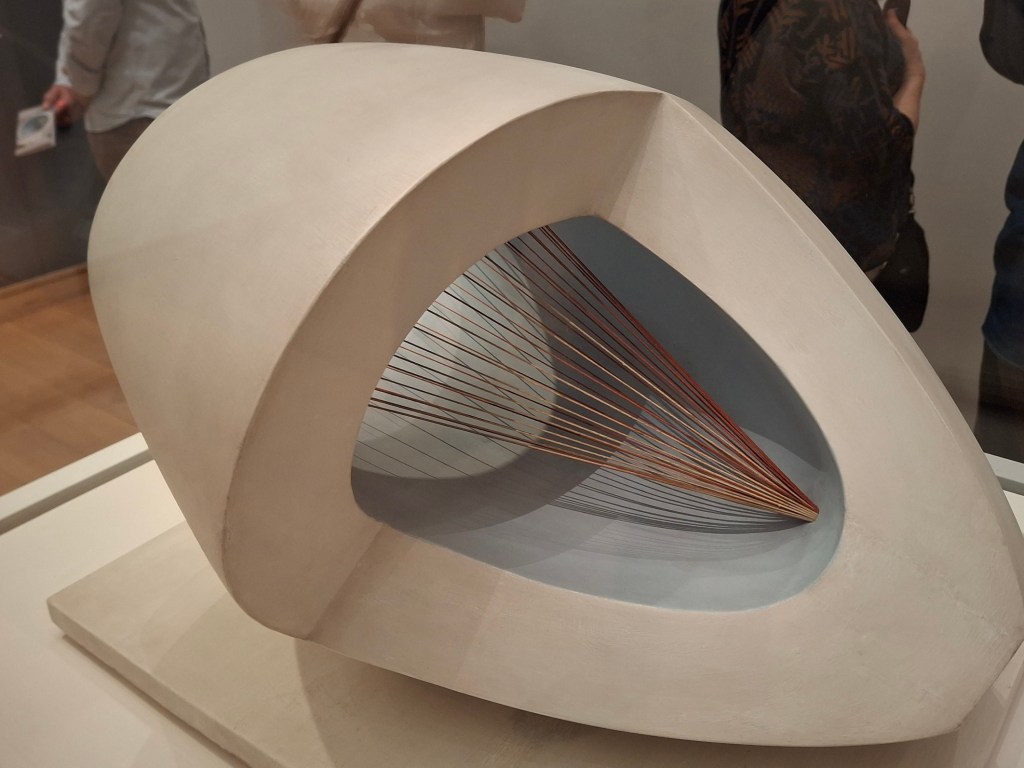
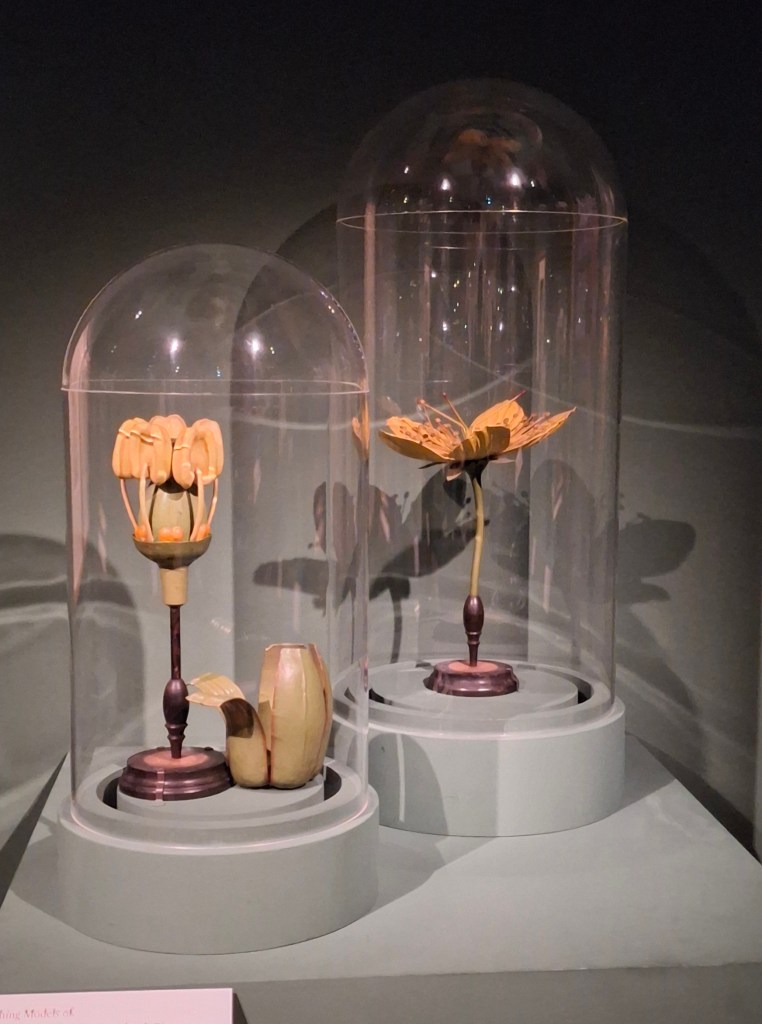
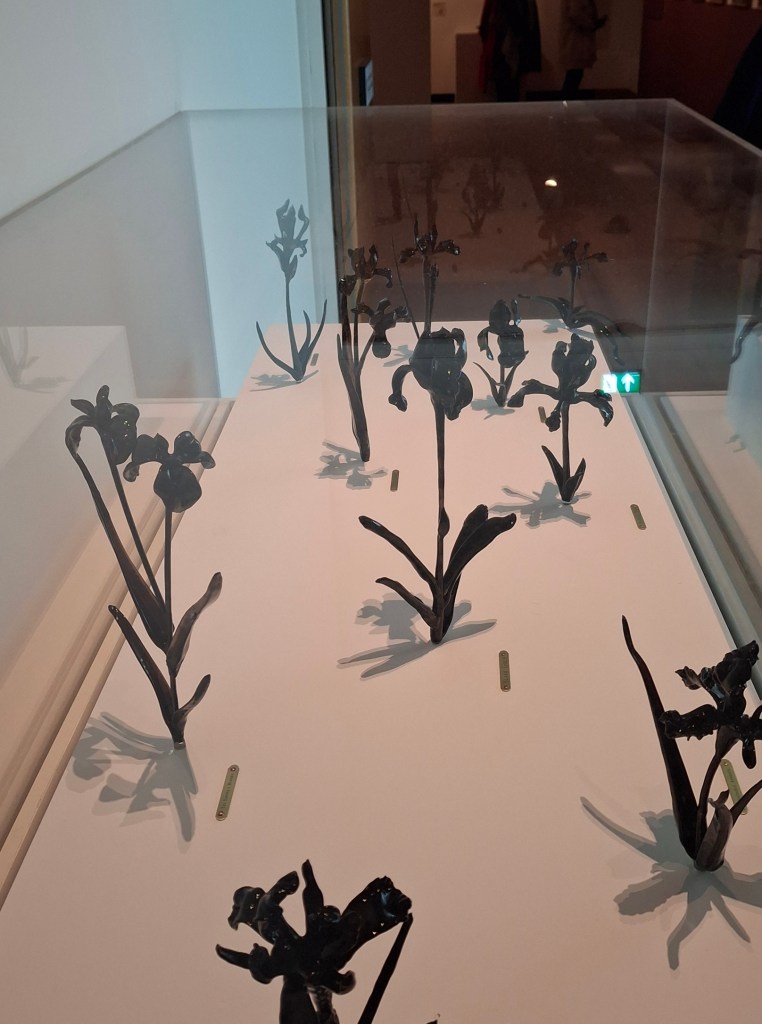
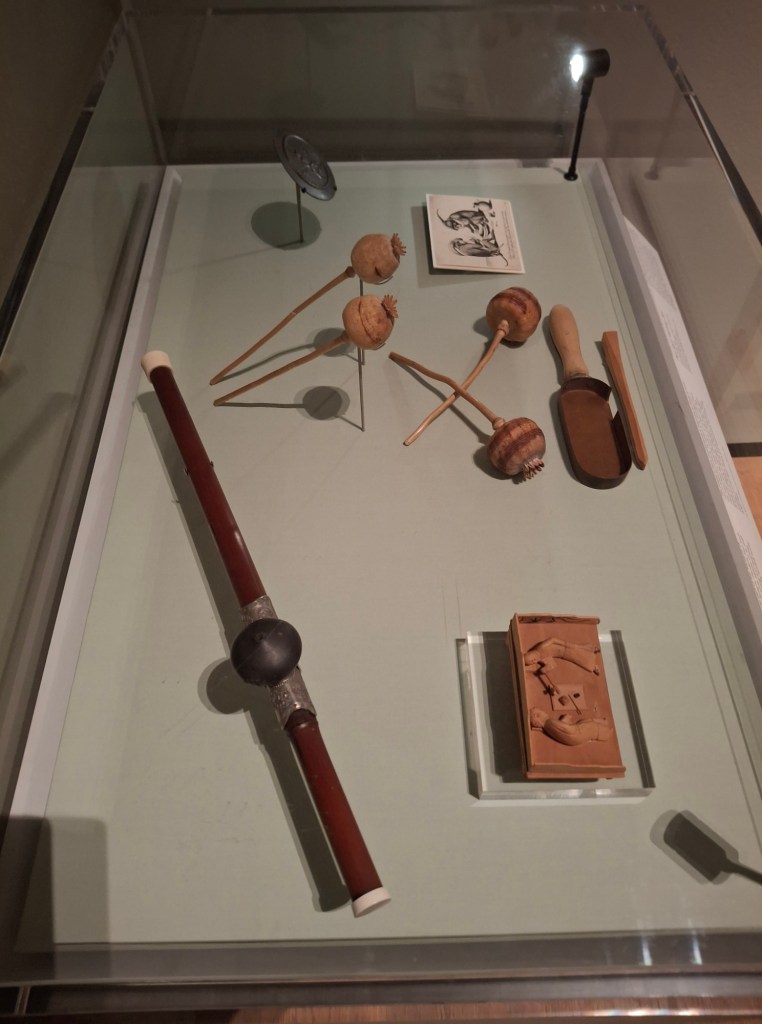
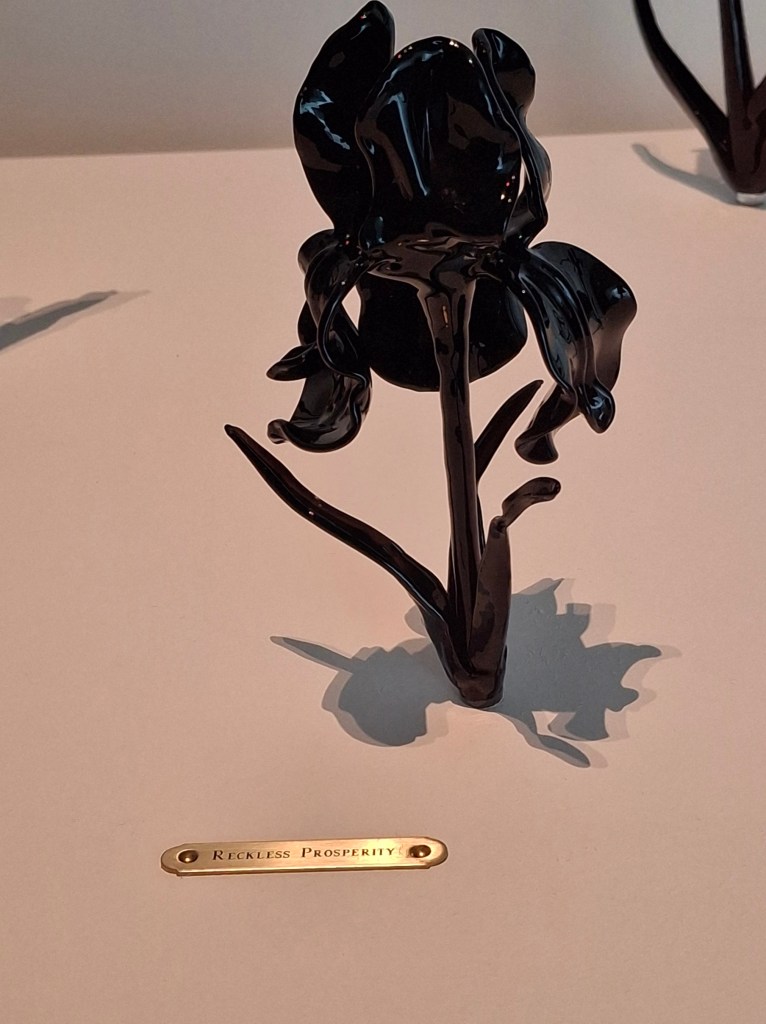
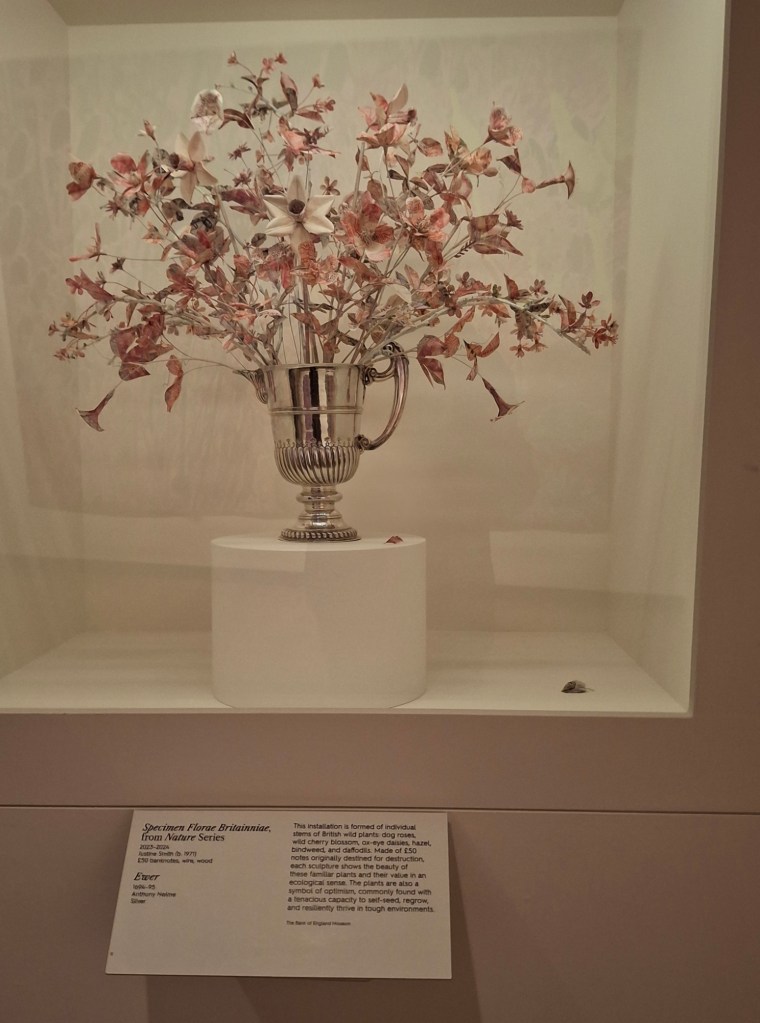
The exhibition featured early plant specimens lovingly pressed into folio volumes 400 years ago, botanical drawings, portraits of plant hunters and seed gatherers and some of the equipment they used. It didn’t shy away from the horrors brought about by the discovery of the powerful effects of the opium poppy, the mad vogue for the tulip that led to the bubble of 1634 retold in the Tom Stoppard and Deborah Moggach sceenplay for the film Tulip Fever in 2017. There were smell stations to distinguish between black and green tea and to smell burnt poppy seeds and bizarre botanical teaching models. Modern artists were invited to exhibit their reaction to the displays and there were paintings, tapestries and sculptures that extended the scope to the present. Flower displays by Justine Smith made from used banknotes epitomised the dangers of always seeking the new. The sculptures and prints of the Iranian artist Anahita Norouzi were especially striking. Her flower scultures bore significant titles focusing on the colonial exploitation and her prints made in crude oil were a timely reminder of the horrors currently unfolding in the Gulf. I’m very glad I went to see it, particularly as the football was awful and the pub had no real ale.

Romola Garai was nominated for two Oliver supporting actor roles – The Years at the Almeida (won) and Giant at the Royal Court. I reckon she’ll be up for another next time for her amazing performance (leading not supporting) as Nora in the new version of Ibsen’s A Doll’s House by Anya Reiss. It’s in a modern setting but with all the tensions of the original. The Italian rest cure is replaced by a rehab stint in a Portuguese Priory, there are maxed out credit cards and the expected higher levels of income come not from a promotion in the bank but the sale of a company which has nearly but not quite gone through. The stripped down cast leaves the children only heard through a sleep monitor but this probably helps speed up the action. I found it had a very strong link to the original while exploring more modern themes. The absence of children made Nora feel slightly less trapped in her domestic cage than the original and the conclusion was left up in the air with a quick cut to black with everyone on stage rather than a slammed door. Lots to ponder which is a good thing on leaving the theatre. Next year’s supporting actor nomination should go to Thalissa Teixeira who was the most sympathetic character as Kristine and gave a superb portrayal of the impoverished widow and former university friend.

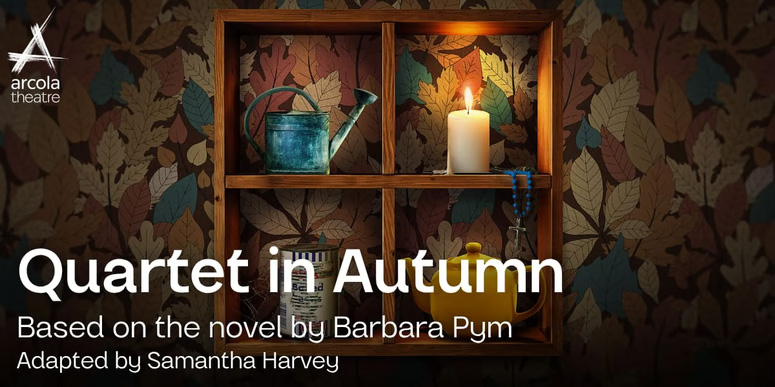
Iphigenia at the Arcola Theatre was again, a modern retelling of the familiar myth interspersed with live footage in various languages from people who had lost children through famine, refugee journeys and other misfortunes. These unwilling sacrifices made the dilemma faced by Agamemnon and Clytemnestra all the more poignant. It was an effective version with some fourth wall breaking moments and a haunting musical accompaniment. The backdrop of sails which turned into waves and the simple set framed some fine performances from Simon Kunz as Agamemnon, Mithra Malex as his daughter and Indra Ove. The modern political scene was never far from your thoughts as Agamemnon was prepared to kill his daughter in order to get wind for his fleet to sail into battle in a distant land in an unwinnable war – until a wooden horse tipped the balance after ten years of slaughter. We never learn anything myth or history it seems.

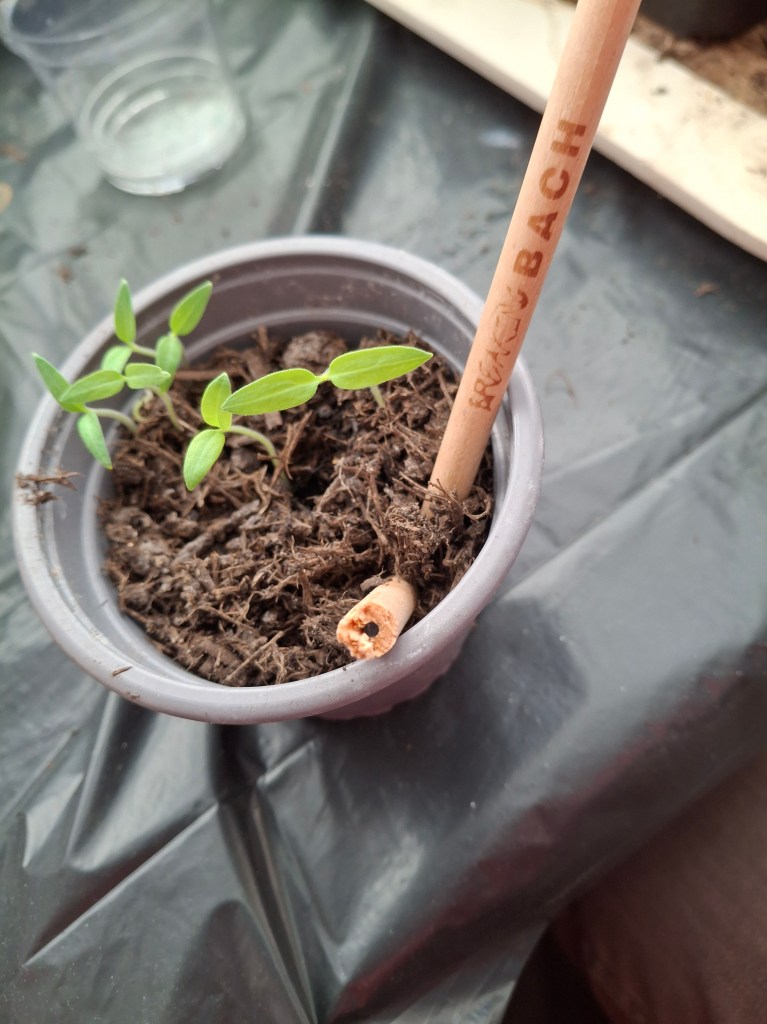
So it’s off to the Queen Elizabeth Hall for the latest in OAE’s experiments. One of the things I love about the organization is that they are always trying new ways of presenting music. Last year there was the amazing Breaking Bach promoted with among other things, plantable pencils. Mine says it’s sunflower seeds but the seedlings look very like tomatoes to me. At least they germinated! I shared this photo with some of the OAE team online and before the concert and we all eagerly await the next set of leaves and glorious sunflowers to plant out. I’ve promised to document progress.

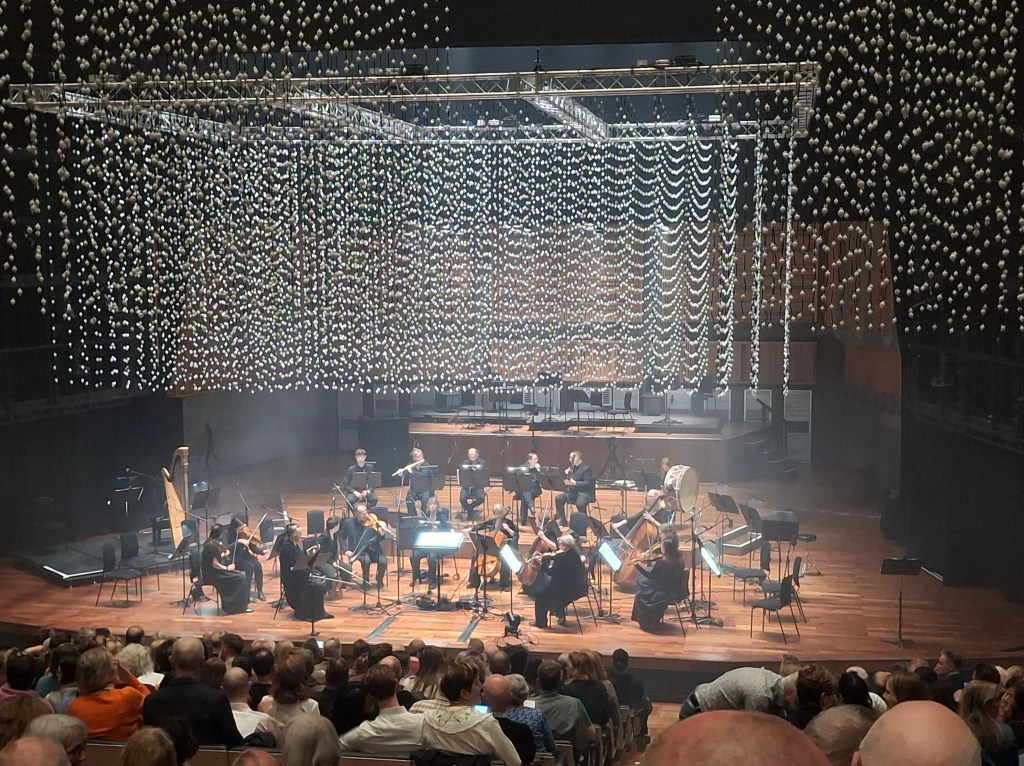
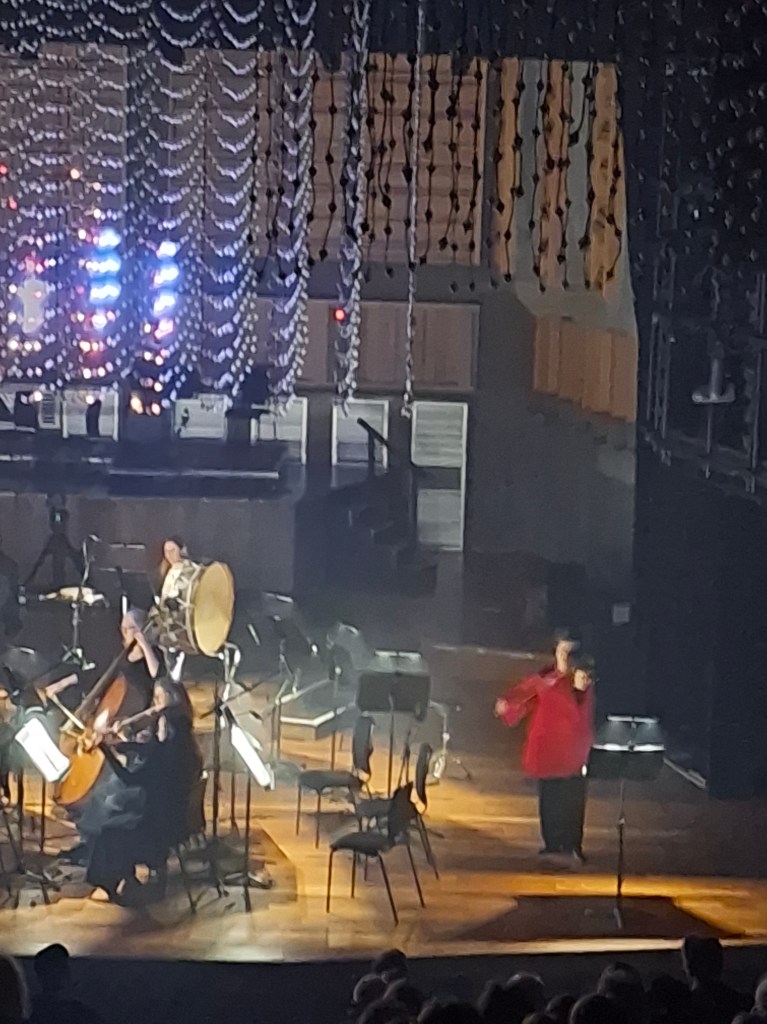
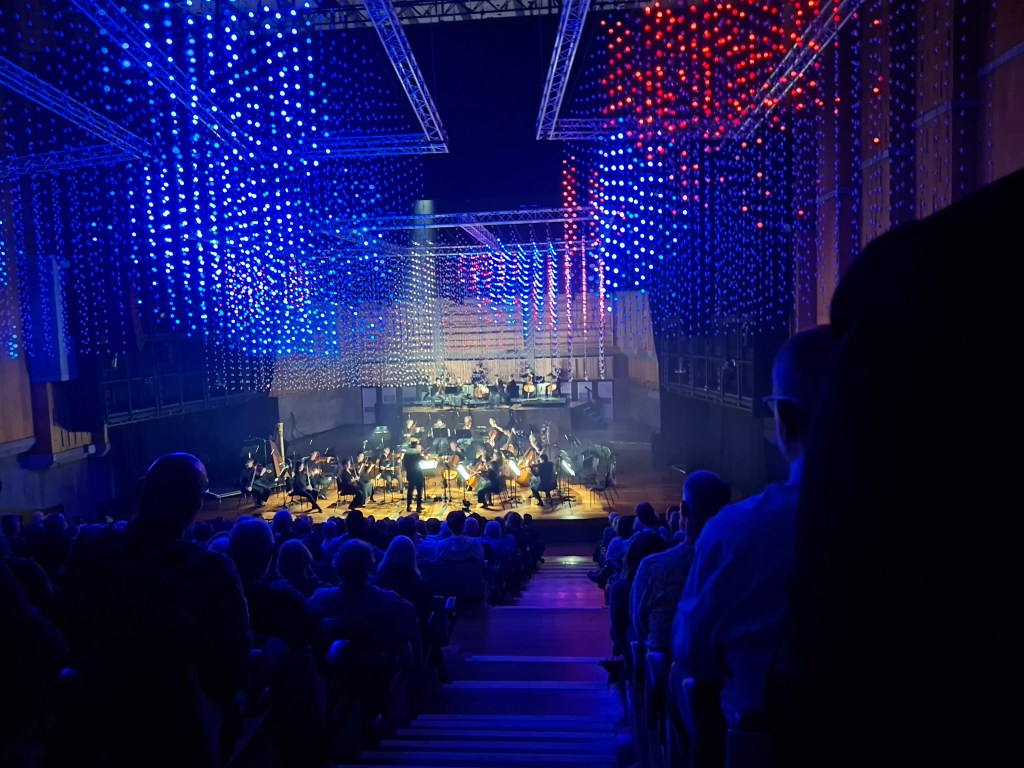
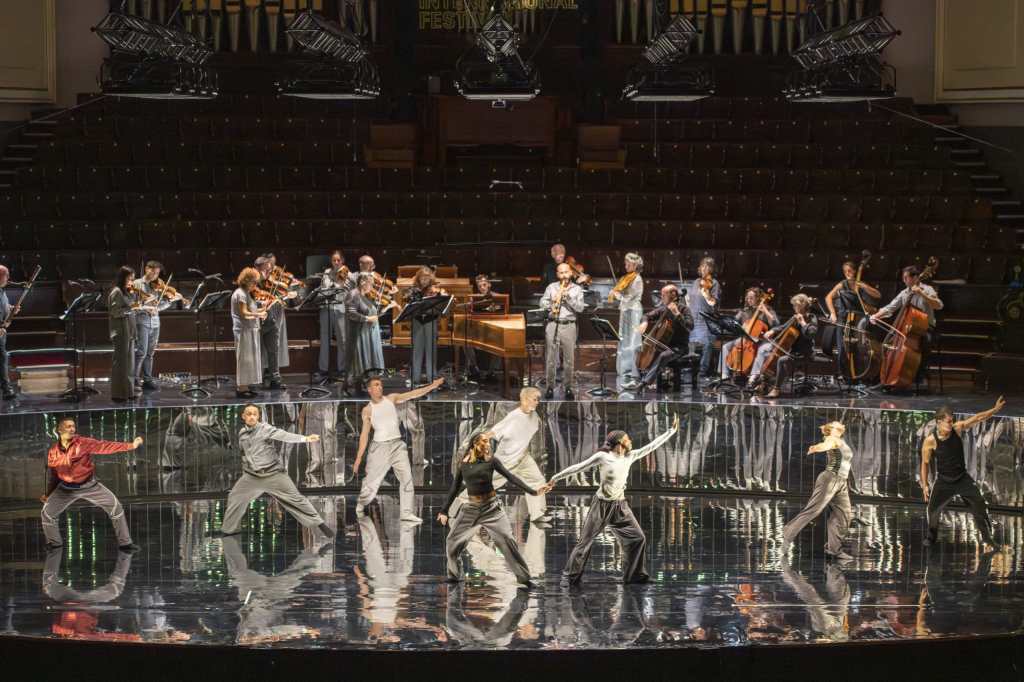
The concert tonight is Echoes of Hill and Horizon and present music outside OAE’s normal comfort zone. In collaboration with the Southbank Centre and Squidsoup – a specialist lighting company. The blurb promised “an immersive soundscape” and we were treated to bird calls in the foyer recorded at Leith Hill, Place Vaughan Williams’ home, to prepare us for his The Lark Ascending. What shocked on entering the hall was the massive grids with their arrays of tiny lightbulbs. I was glad I had chosen a rear stalls seat as there was one bank of lights above the central walkway behind front stalls punters’ eyelines. What was to come?

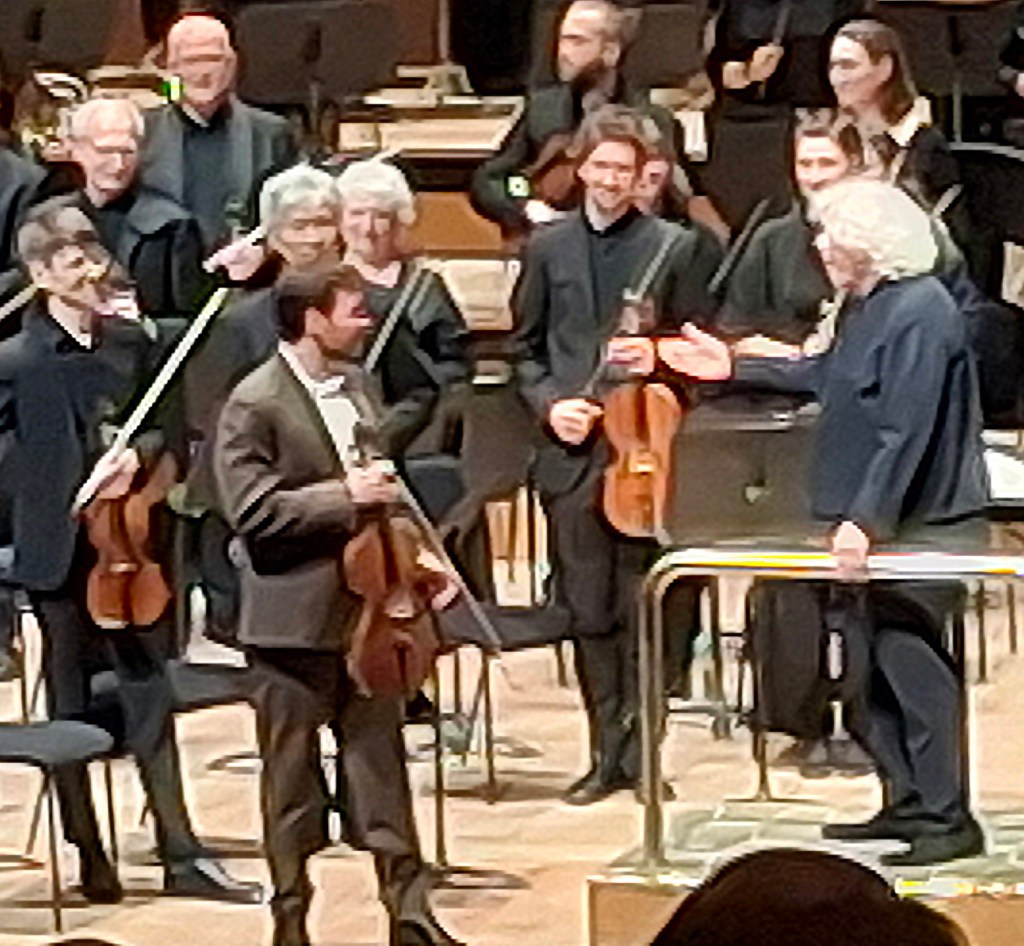
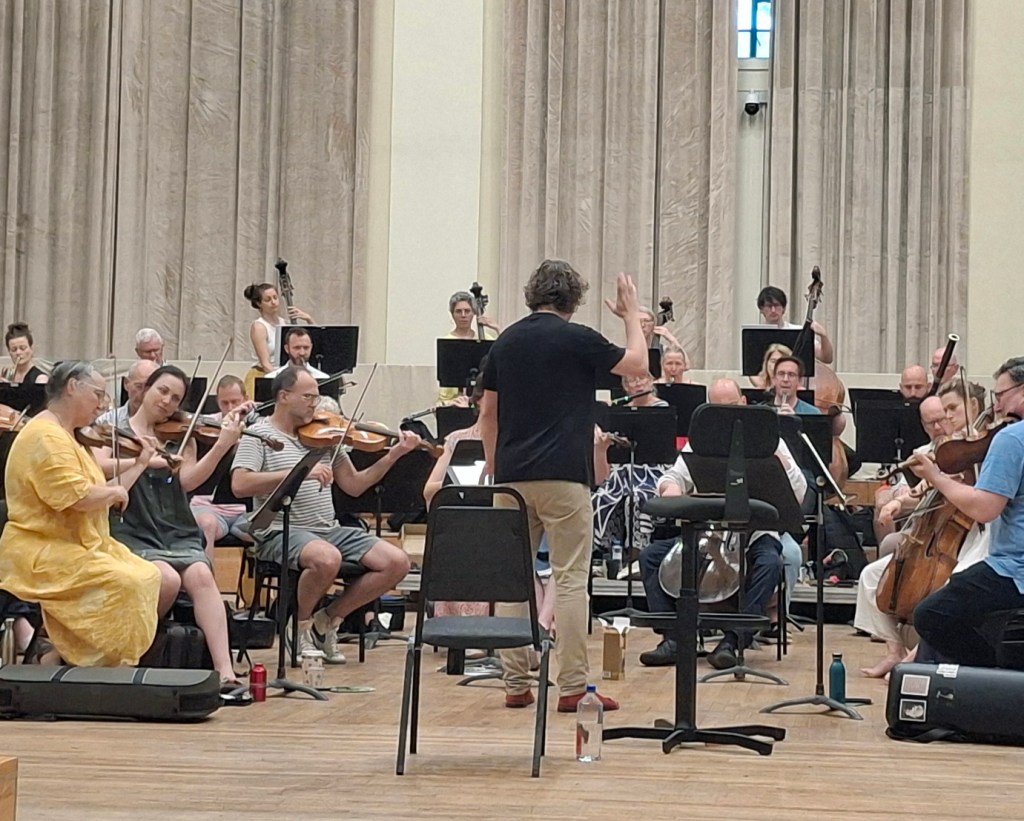
House lights dimmed, the orchestra played the opening bars and then Kati Debretzeni’s soaring violin was heard offstage. She emerged and continued to play from various points on the stage before disappearing again at the end. It was an inspired performance all the more effective because it’s the first time she’s ever played it. She explains her approach entertainingly here. The lighting streams showed said lark (oddly in red and white looking more like a Welsh dragon) flitting from side to side and back to front always rising with the thousands of bulbs able to change colour magically – it reminded me of the lights on the Copenhagen set last week. The lighting changes fitted well with the moods of the music – sometimes a bit obvious like the green swathes for Fantasia on Greensleeves – but often enhancing my appreciation of the music. For Vaughan Williams’ Fantasia on a theme of Thomas Tallis the orchestra split in two with some effective antiphonal layered playing in this familiar piece. What mattered most for me about the evening was the Southbank’s Concrete Voids sound system. Each musician had a stand mic beside them and the lightly amplified mix played into the auditorium was astounding. Every note was clear, as you’d expect from this band, but the enveloping effect of the surround sound was for me the highlight of the evening. To hear very familiar repertoire in such a new way was really satisfying and sent me from the hall with a real buzz of delight. Did the lights mean a lot? Probably a bit gimmicky and added only slightly to the pleasure of the music. But the Comncrete Voids system added a lot.

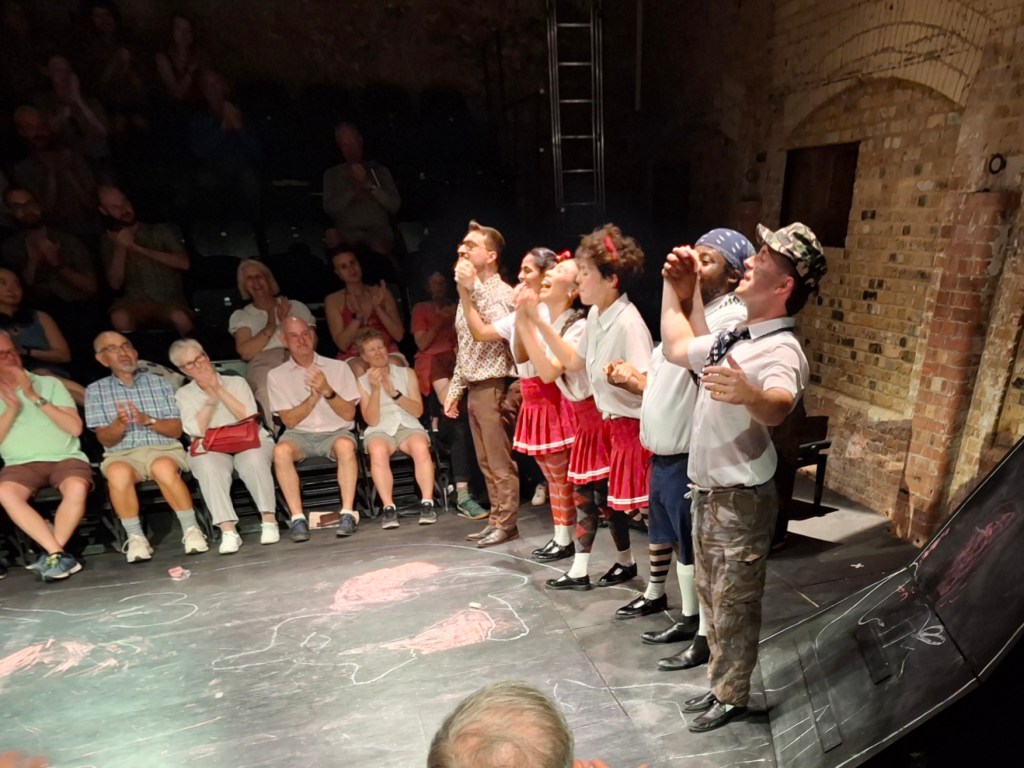
And the next evening there’s another stunning stage debut at the Kiln Theatre. And he’s only playing John Lennon! Noah Ritter was the debuntant alongside the chameleon that is Calam Lynch as Brian Epstein in Tom Wright’s play Please, Please Me. it was insightful, touching on Epstein’s discovery and subsequent management of the Beatles – none of their music was heard because of massive licencing fees, it seems. The one woman in the cast Eleanor Worthington-Cox plays John’s Aunt Mimi as well as Cyn/Cilla John’s first wife and Epstein’s other signing Cilla Black. She was excellent tin all three roles with subtle changes of headgear and wigs. The versatile set wheeled and danced across the stage with the outline of the Cavern Club providing a background. Amit Sharma’s direction allowed space for the play’s themes of Jewishness, illicit homosexuality, addiction and privacy stolen by beatlemania to unfurl in crisp dialogue with many moments of humour amongst the overall gloom thrown by Brian’s death aged 32 two years before homosexuality was made legal un the UK.

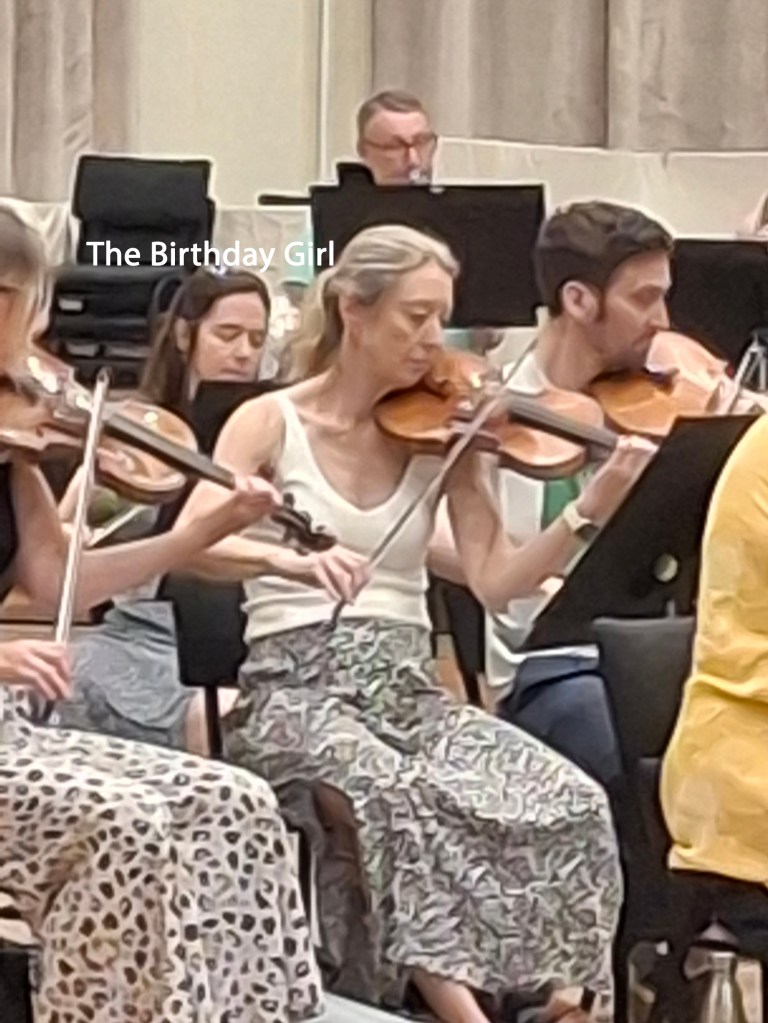
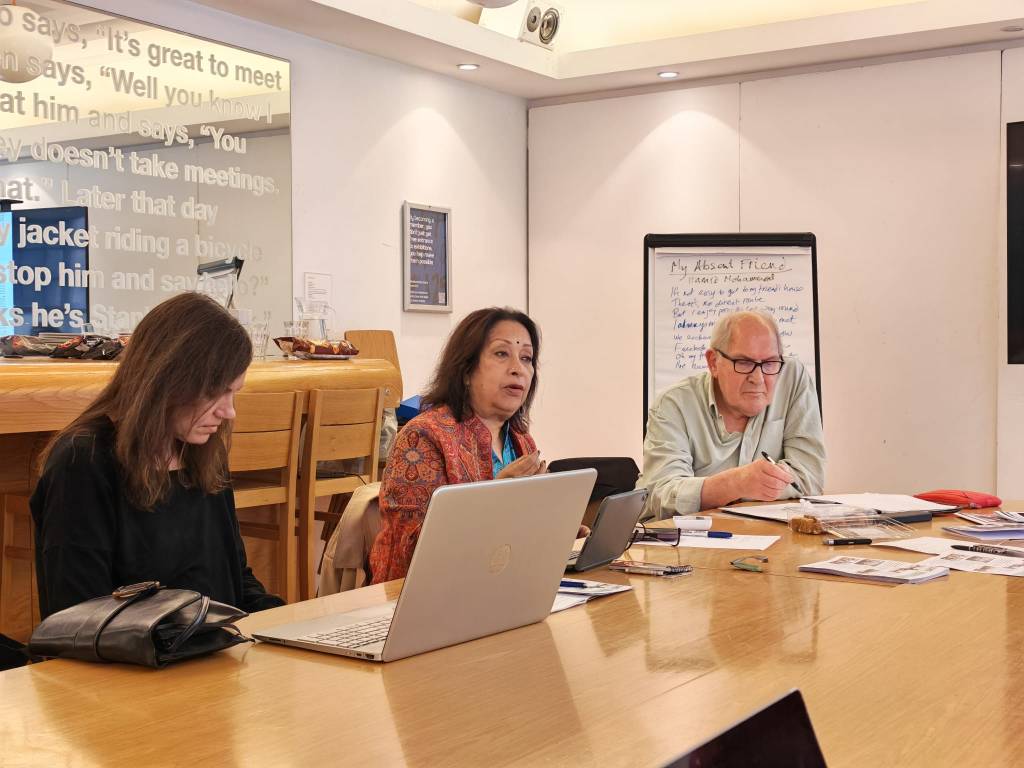
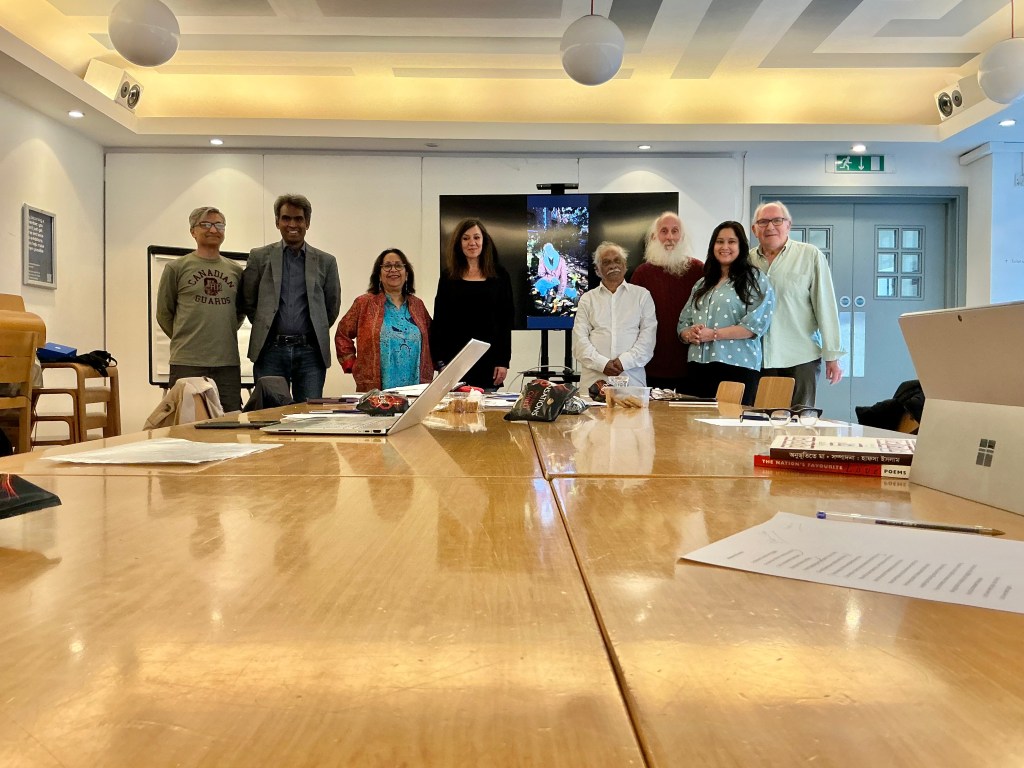
Bookending the blog neatly, the last Sunday of alternate months means it’s time to head back to the Whitechapel Gallery for the British Bilingual Poetry Collective’s Bi-monthly Meetup. At the last meeting we’d agreed a theme of Absent Friends as 26 April was the anniversary of one of our member’s father’s death and it was the week when my late wife Dee had her birthday so it seemed a good occasion to remember those no longer with for whatever reasons. Several poignant poems were read and lively discussion ensued as memories were exchanged.

‘Twas Valentine’s day in St Alban’s …

So after a busy start to February, its halfway point was marked with a trip to St Alban’s – the first for a long time for me. The occasion was the christening of the extended family’s newest addition Louisa Deeley. I was delighted to note that her middle names were Denise (my late wife) and her great grandmother Rosemary who was there and I was pleased to have a long chat with her over tea. The party decamped to a pub to watch Scotland demolish England in the rugby – large Scottish contingent present. I made my excuses and went to visit my composer friend Dani Howard who conveniently lives opposite the Mayflower pub in the city centre where we had a lovely few beers with her and her partner Sean chatting about all sorts of things musical and other. Dani has a busy schedule ahead with trips to Hong Kong for the premiere of her Cello Concerto to be played by her former mentor about which she’s a bit nervous, several performances of the Saxophone Concerto for Jess Gillam which I heard in Poole last year and concerts in Germany, the Netherlands and three weeks in Florida in October as a “Master-Artist” at the Atlantic Centre for the Arts Residency Programme working with composers, performers and poets.

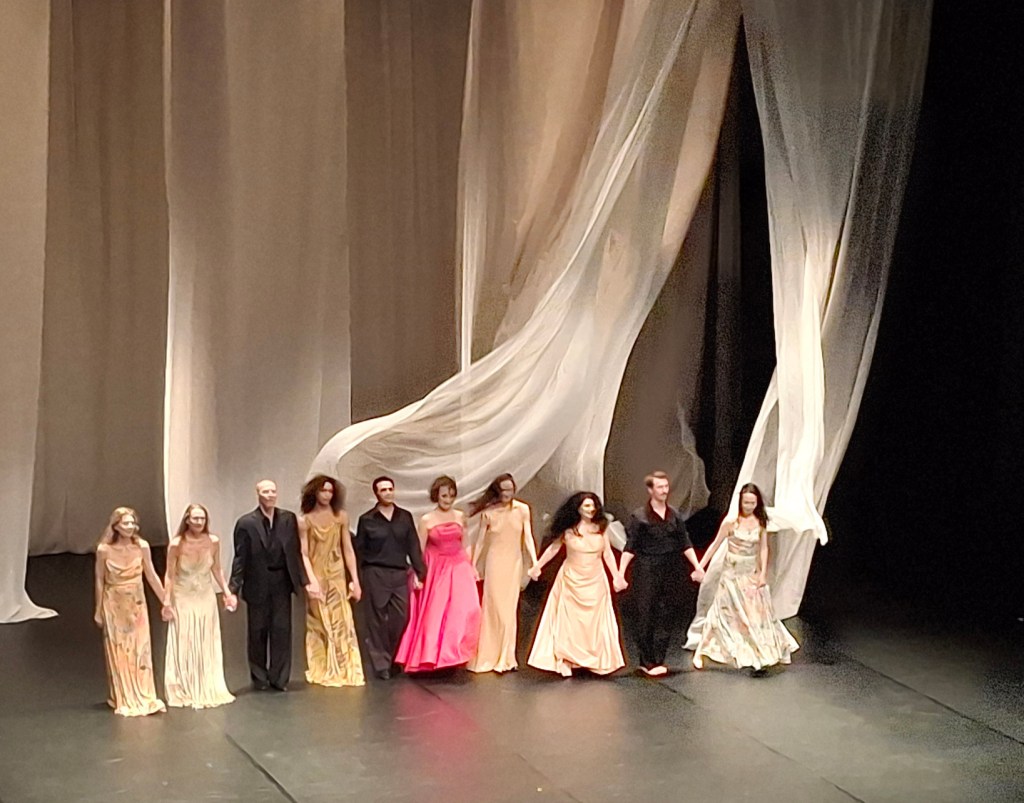
Then after a fairly quiet week a hectic weekend was upon us. On Friday I went with my friend Hattie to see Pina Bausch’s Tanztheater Wuppertal perform the amazing Sweet Mambo. With a flowing white drape background which sometimes billowed and was sometimes still and occasionally swallowed the dancers, the dance unfolded with a series of scenes in which women seduce and repel men, in which they find some common ground and other in which they have a laugh together. The fact that there are three men and six women probably indicates where Pina’s sympathies lie. The sound track is eclectic with classical, ambient, jazz and spoken words. As so often with her confections, it sounds like a mess but somehow it works with a mesmerising beauty. We left the theatre with big smiles on our faces.

Fabulous frocks and flowing drapes in Sweet Mambo

The next day promised to be a bit of a scramble with a trip to Watford for football followed by a cross London dash to the Arcola Theatre for a play in the evening. My initial journey was complicated by there being no Metropolitan Line trains to Watford – my usual route when not driving – as it deposits me much closer to the West Herts Sports Club, where we meet for pre-match drinks and chat, than Watford Junction. It was all worthwhile as our new manager – third of this season, 23rd since the Pozzo family bought the club in 2012 – coaxed the team to a 2-0 victory over Derby County. After the match two Overground trains took us via a highly complex platform change at Willesden Junction (thank goodness Fran was with me or I’d have got completely lost). We met up with Farzana in the Arcola bar before watching a highly entertaining one-man show with a Watford connection.

Monstering the Rocketman devised and performed by Henry Naylor was originally at the Edinburgh Festival but the excellent Arcola gave it a worthy London run. It featured the dreadful Kelvin Mckenzie’s vitriolic attack on Elton John, the total lack of facts and evidence for which resulted in the biggest libel suit in history with Elton taking on the might of The Sun and the power of the Murdoch empire. With video clips and garish headline displays Naylor told the full story in a variety of characters in a funny, terrifying and eloquent way. He was one of the lead writers for Spitting Image back in the day and his satirical skills enabled him to skewer McKenzie and cronies in a revealing and most enjoyable 75 minutes. As it was still early we three made our way to the excellent Five Fingers for a fine curry.

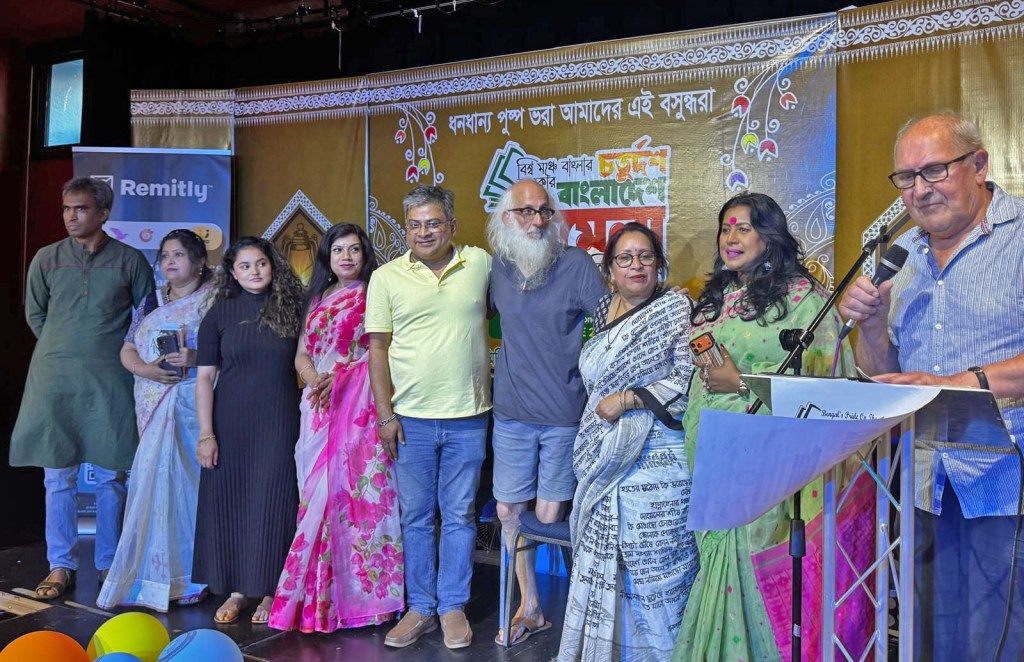
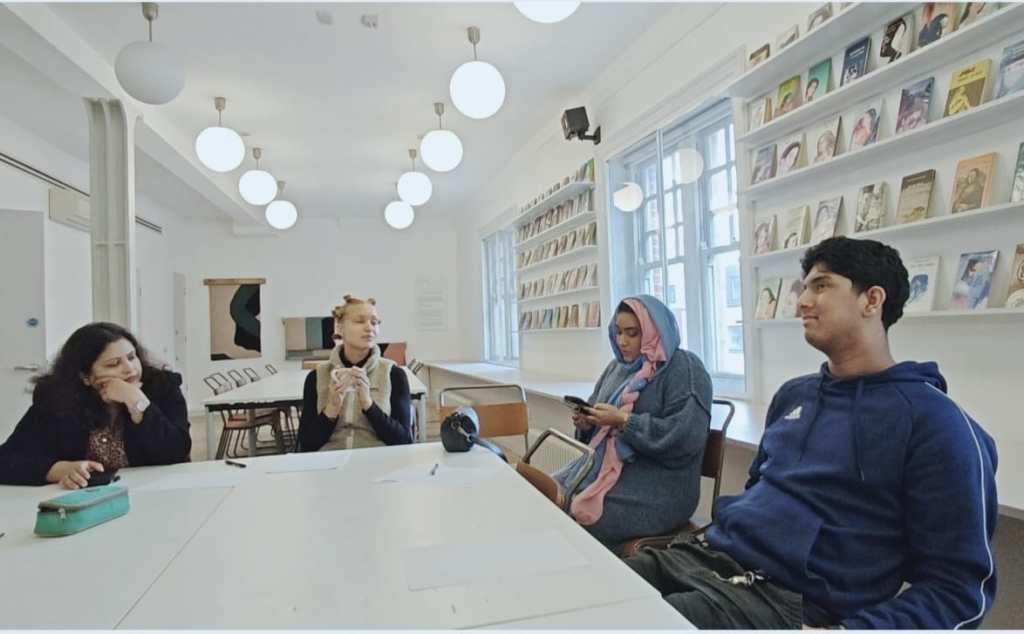
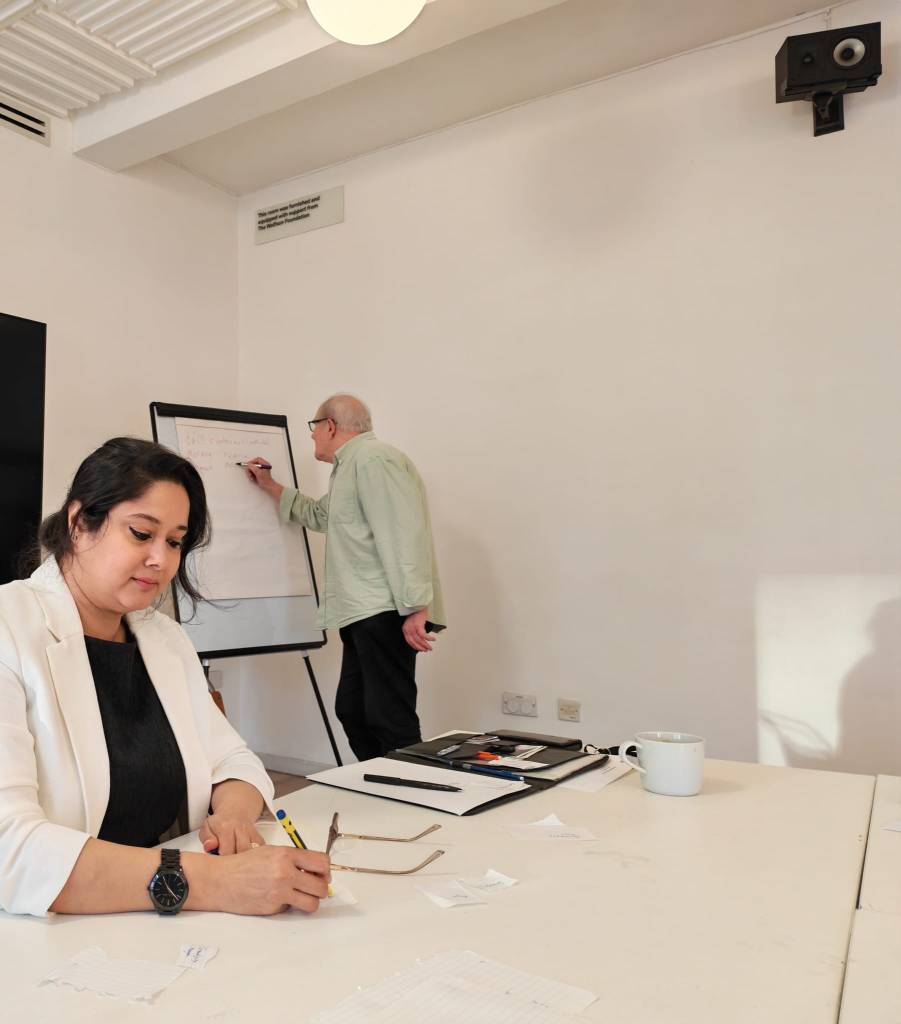
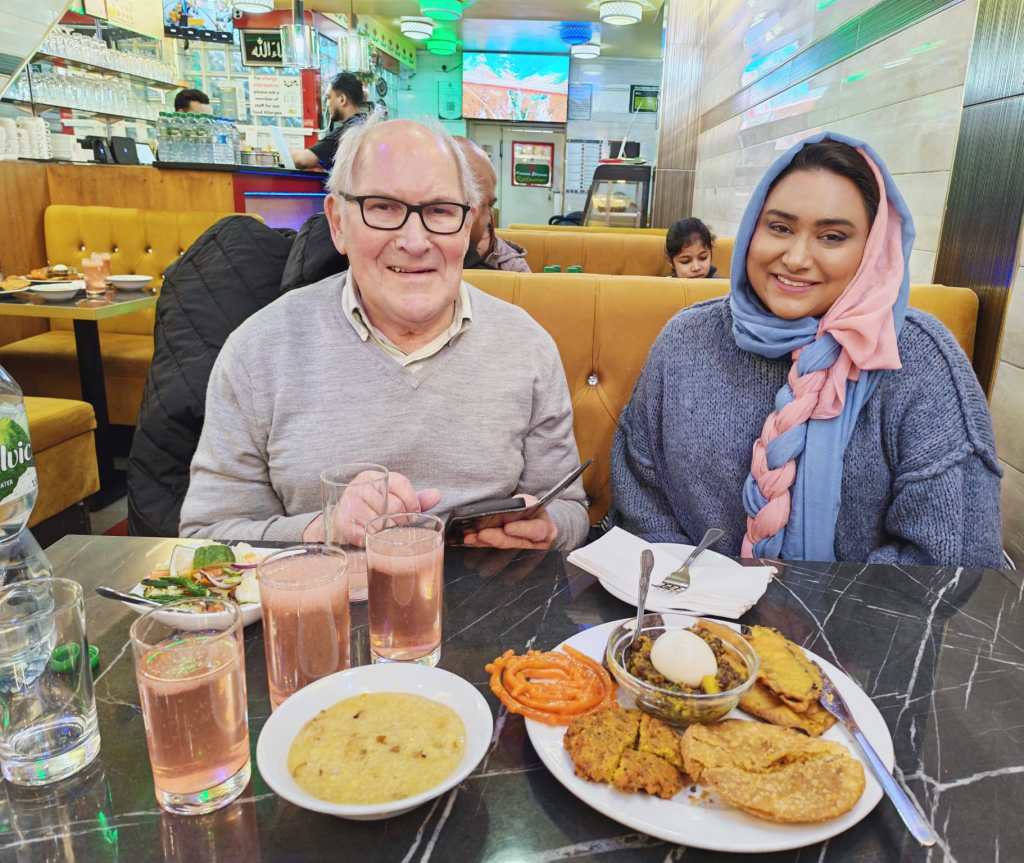
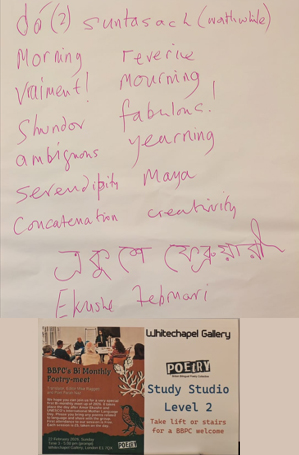
Saturday 21 was UNESCO International Mother Language Day so it was appropriate that our British Bilingual Poetry Collective (BBPC) group had our regular meeting on Sunday 22 and could focus on the topic with a group of regulars and two people joining us for the first time. I outlined the origin of the Day which started in Bangladesh when five students were executed for speaking Bengali rather tha Urdu and was observed there ever since. Then the government suggested to UNESCO that it should be global which it has been since 1999. I had asked my friend Shumi to bring her delightful poem Banglish about her experience of growing up bilingually in London, I had sourced a number of others I could read and a lively discussion ensued with contributions with many different experiences. We had a technical task to conclude in which all of us suggested two words which I then wrote up on the flip chart. The session’s ‘homework’ was to write a poem incorporating all the words. Three poems resulted which were not bad at all. If you want to give it a try the words are below. As some of the group were observing the Ramadan fast, we repaired to a local restaurant to enjoy iftar the moment the sun set. The chef did a count down for us and then promptly brought much-needed, by some, food.

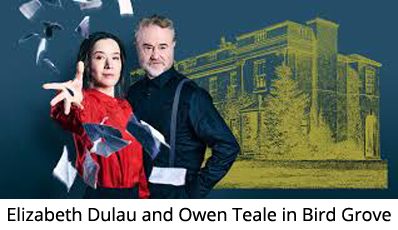
It doesn’t stop – Monday was off to Hampstead Theatre for the press night of Bird Grove by Alexi Kaye Campbell. It was a fascinating examination of the trials of a radical young woman Mary Ann Evans fighting a rigid father as well as contemporary mores. This radical young woman later still had to assume a male identity, George Eliot, in order to publish her seven novels and a number of short stories. Ironically she was allowed to publish translations under her own name. The play was rooted in the father daughter dispute and her association with some undesirably left wing friends.

A touch of near-slapstick was introduced through her would-be suitor needing a marriage to secure his inheritance. He was sent off with a flea in his ear. It was interesting with Mr Evans pouring guilt onto his daughter about overreaching their funds to put her in the titular grand house and her steadfast resolve to resist being bullied to church but it stirred up a wish for a play that reached further into her later life and success against the odds. Maybe that’s in the works.

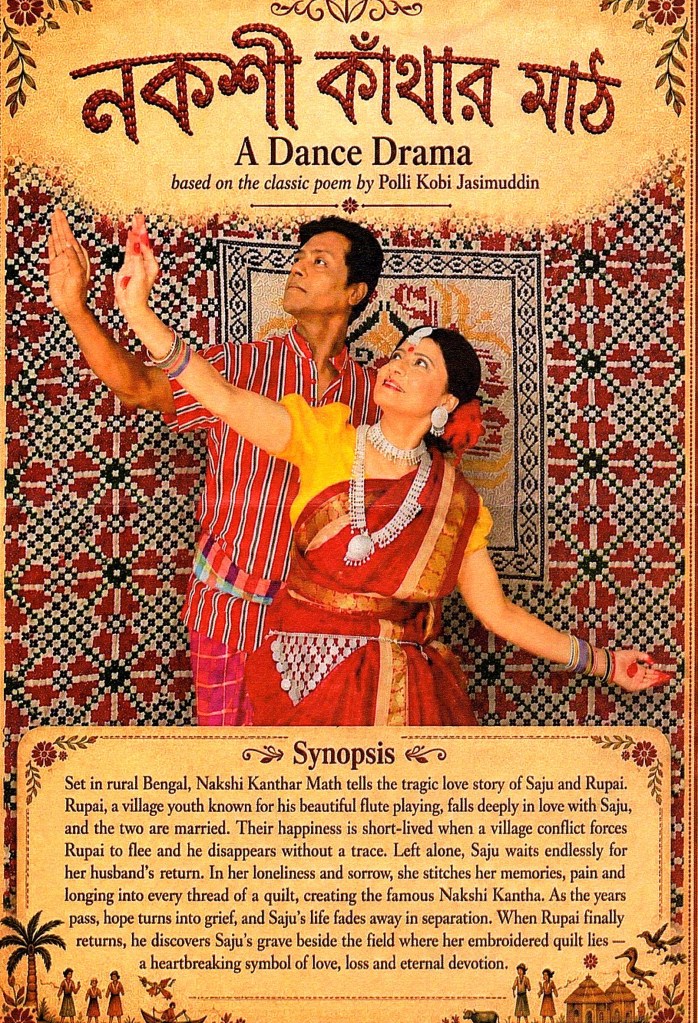
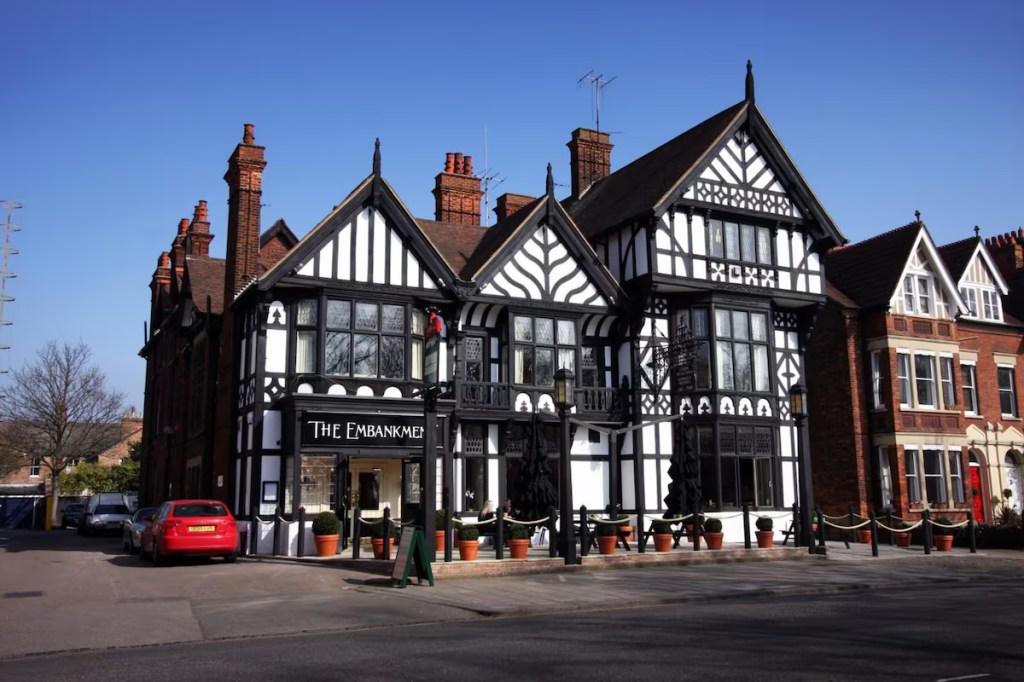
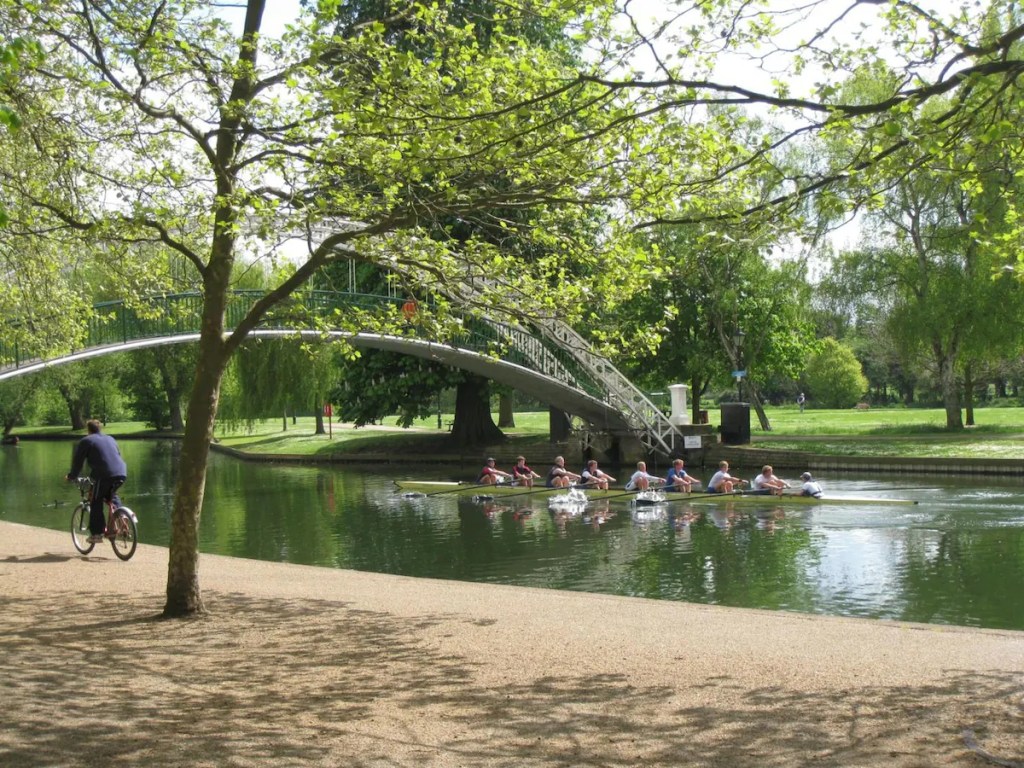
Tuesday was deadline day for BBPC to submit its proposals for the 2026 Season of Bangla Drama. We had discussed these as a group but it fell to me to get them in on time. Then on Wednesday I went to Bedford to have lunch with my friend Jossy who I hadn’t seen for a while. How lucky were we! After the murk and mizzle of the year to date we had a sunny day and could lunch in shirtsleeves on the patio of the Embankment pub (thanks to Pete and Julie Bradshaw for the local knowledge) overlooking the Great Ouse with its scullers, joggers, dog walkers and cyclists. The pub had good food and wine and apparently has rooms. We then strolled back to Bedford Station through a less beautiful part of the town but down by the river all was fine and we had a lively discussion on a wide variety of topics.

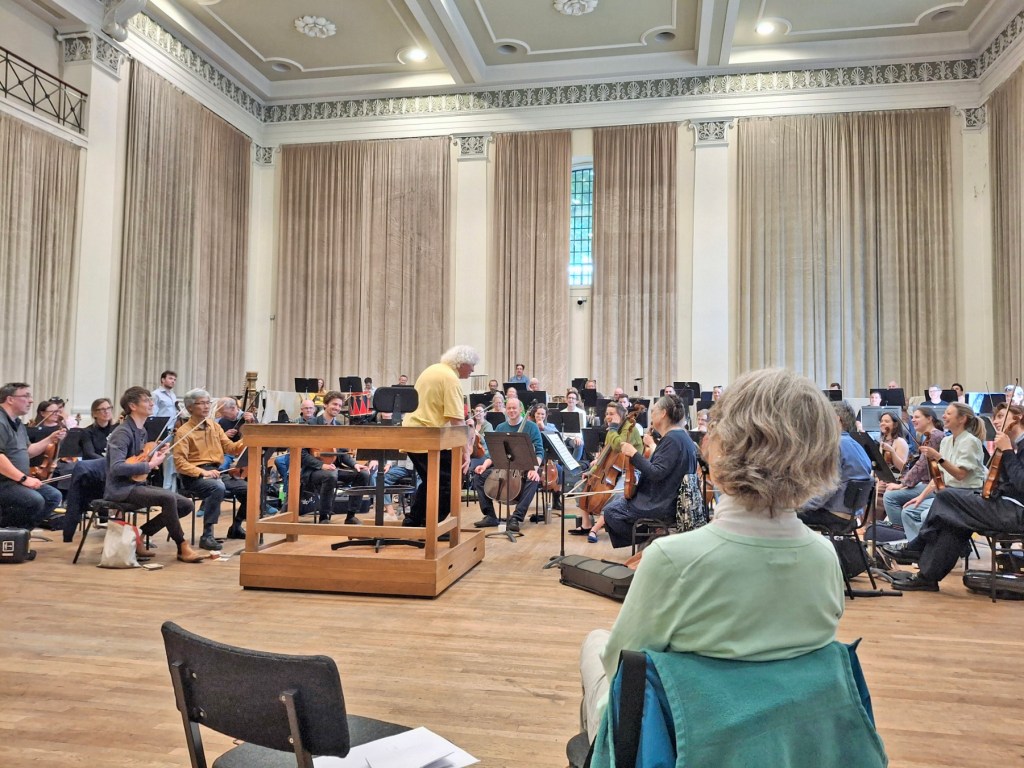
The Royal Festival Hall was full on Thursday for the OAE’s concert with Robin Ticciati – music director at Glyndebourne and familiar with the orchestra from its residency there. The programme was Mozart’s last three symphonies, 39, 40 and 41. These are pretty familiar items in the classical repertoire but are not often heard together, so a clever piece of programming. Once again, the conductor’s vision and energy, the orchestra’s use of period appropriate instruments made the works sound really fresh and new. The ‘Jupiter’, probably the most famous, occupied the second half and had atmospheric string playing in counterpoint with lush woodwind and powerful brass. A delight.

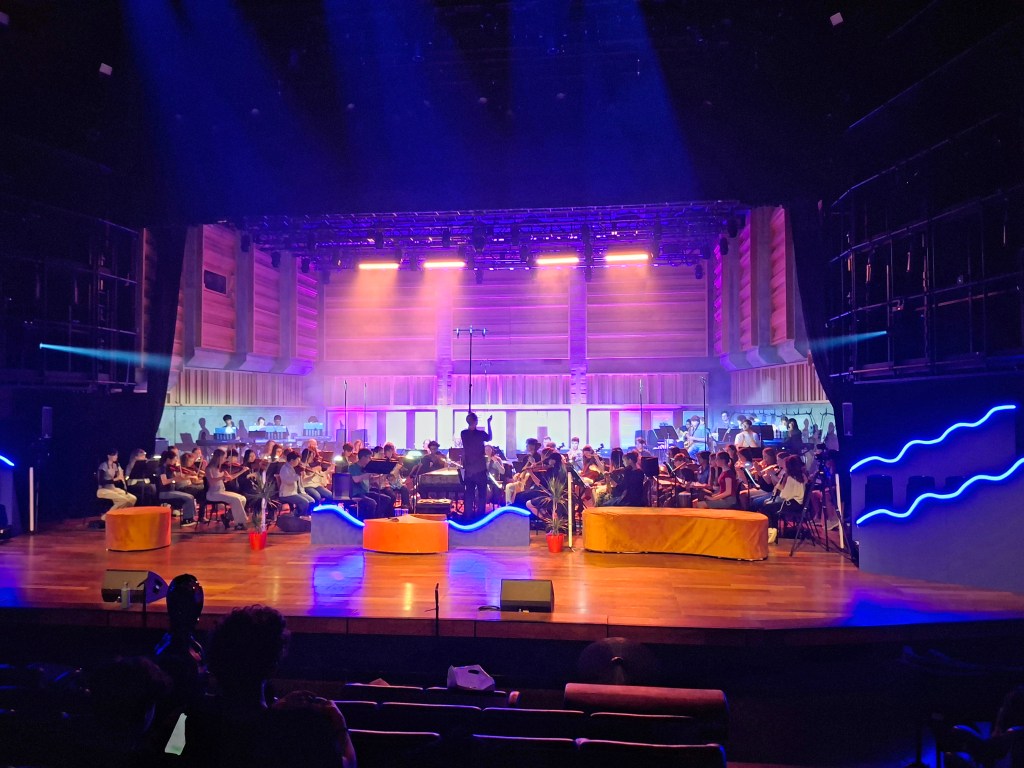
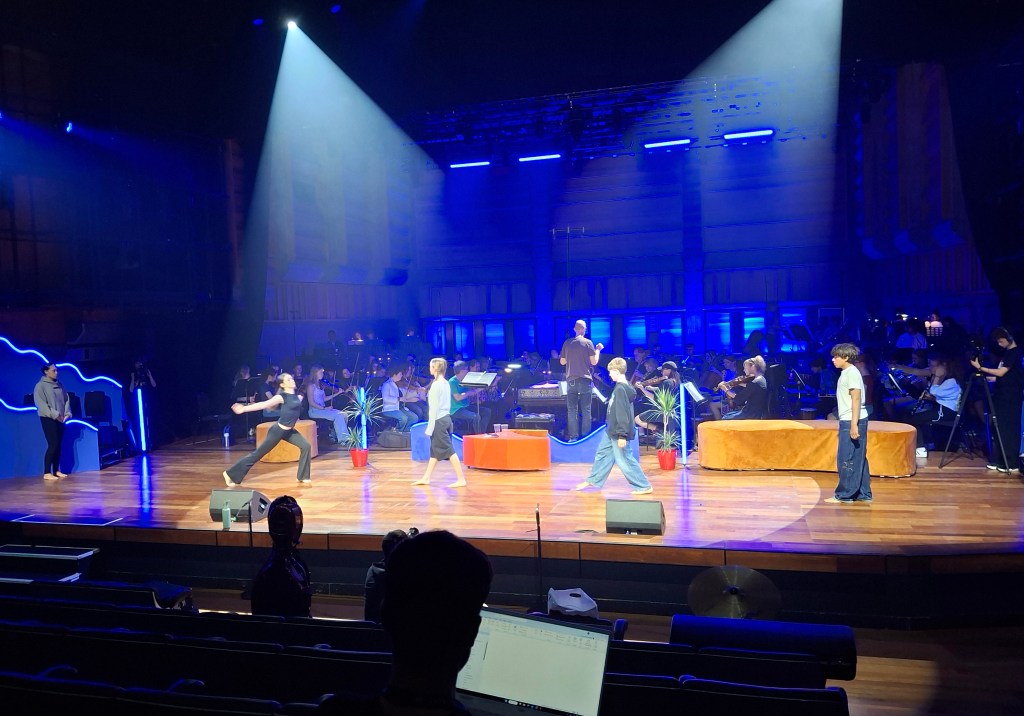
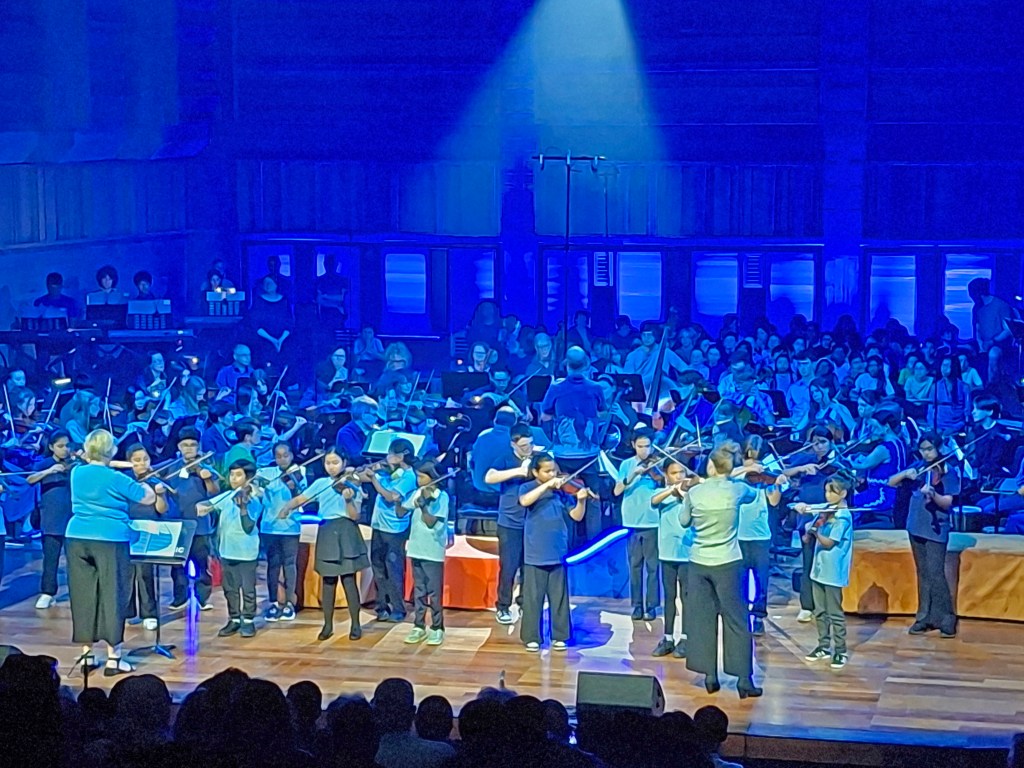
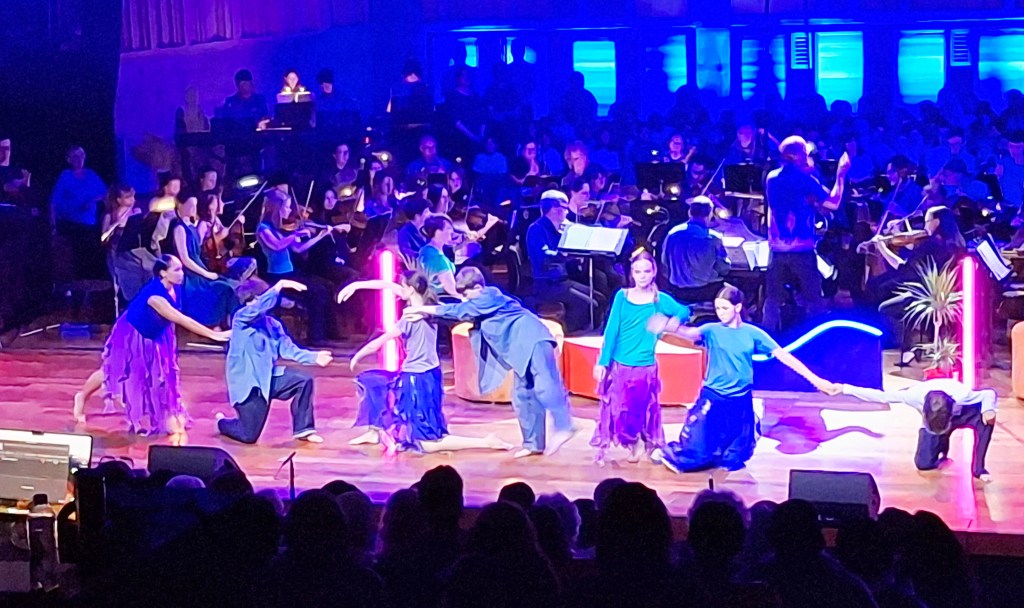
The evening was rounded off by the news from the Development Director telling me that the OAE’s sensational Breaking Bach project will have a series of performances in the UK next year and will be visiting the United States as well. Stemming from the orchestra being based in a school this ground breaking (sorry!) production deserves this exposure.

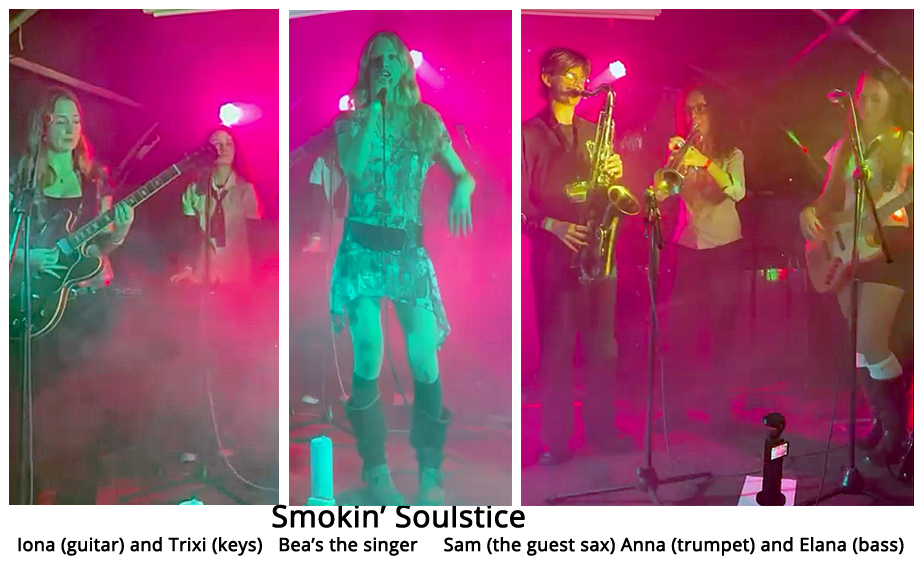
The next Sunday I had a music experience of a very different kind with a trip to an arch under Herne Hill Station to wear my SOULSTICE GRANDAD T-shirt with pride and see the group in which my granddaughter (Daisy but Trixi in the band) plays keyboard and flute and sings. Every time I see them they get better – different set list incorporating original material and covers, tighter arrangements and harmonies and tonight they had a guest saxophonist Sam to add to the exhilarating session amid the smoke machines and lighting of the Off The Cuff venue. (Image below contains stills from a video courtesy of Chris Addison as holding a pint in one hand and my coat in the other I couldn’t get my phone out.)

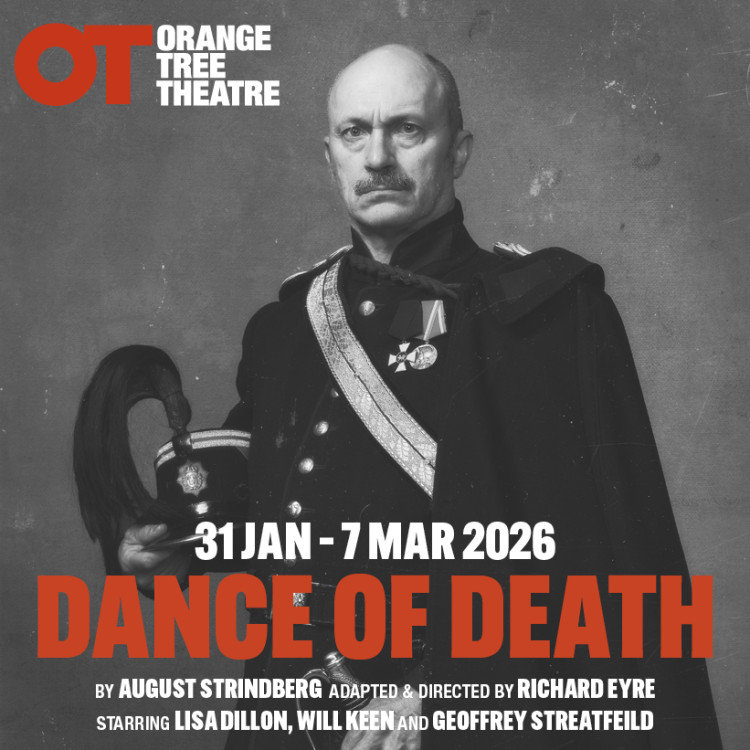
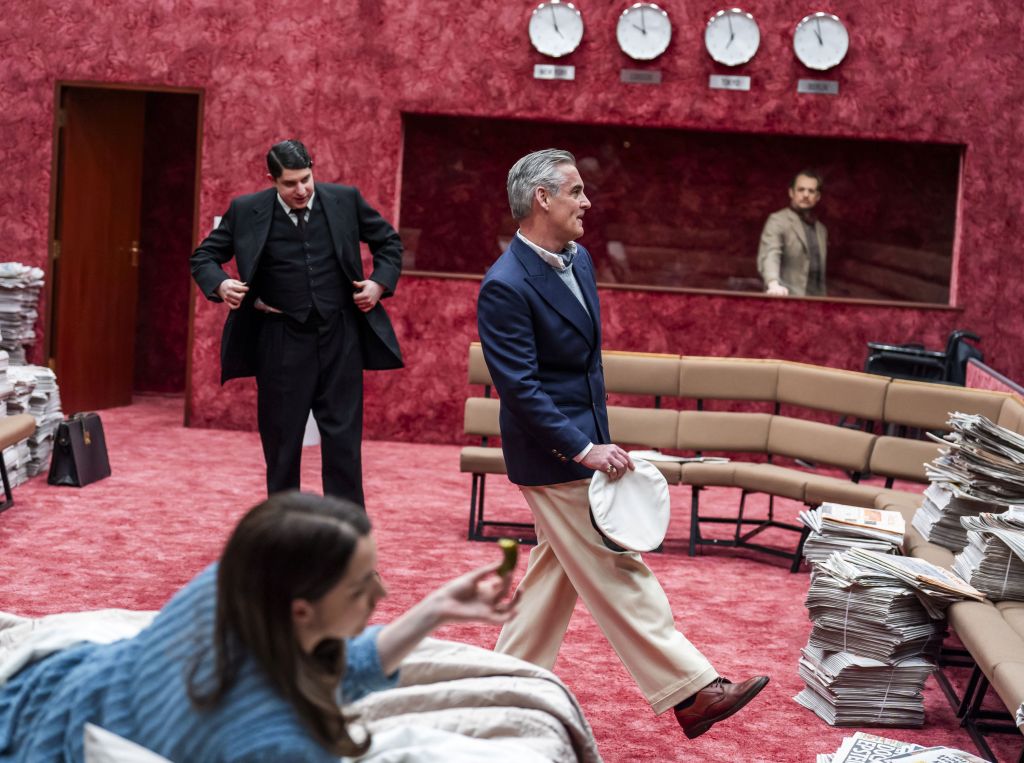
Two intense family dramas were next on the agenda. Richard Eyre’s adaptation of Strinberg’s Dance of Death at the Orange Tree was unremittingly bleak as a couple try to destroy each other. Updating it to the quarantine era of Spanish flu gave it an added claustrophobia as did the cluttered set. It was an evening to be admired for its production and acting rather than enjoyed. I knew a bit more what to expect the next night at the Young Vic as I had been to the Insight session last month. However the actual production came as quite a surprise. I’d seen the beige leather semi circle that forms a large part of the set previously but the red plush carpet on the floor and walls, the observation window and the fact that the audience reamined under the harshest of house lights as the action began were truly unexpected.

Arthur Miller is all over London at the moment, but Broken Glass is a late play and not often performed. The key element is the lower limb paralysis of Sylvia, played brilliantly by Pearl Chanda, a Brooklyn Jewish woman. After reading and hearing news of the Nazi Kristallnacht pogrom, suddenly her legs won’t work and she’s confined to bed. Attempting to explain this reveals all sorts of marital and family issues which see the characters unravelling before us, including a Dr Hyman played by Alex Waldman whose Freudian practices encourage Sylvia to imagine she’s sleeping with him. It was a demanding watch but made us think about current day issues of genocide to which many turn a blind eye – are we paralysed because there is nothing we can do? Leaving the lights on for much of the play was quite distracting as we were sitting opposite both Sir Lennie Henry and mostly significantly the Guardian theatre critic Arif Akbar. What would those hastily written notes revel in tomorrow’s paper? She’s usually quite a harsh reviewer but gave this four stars.

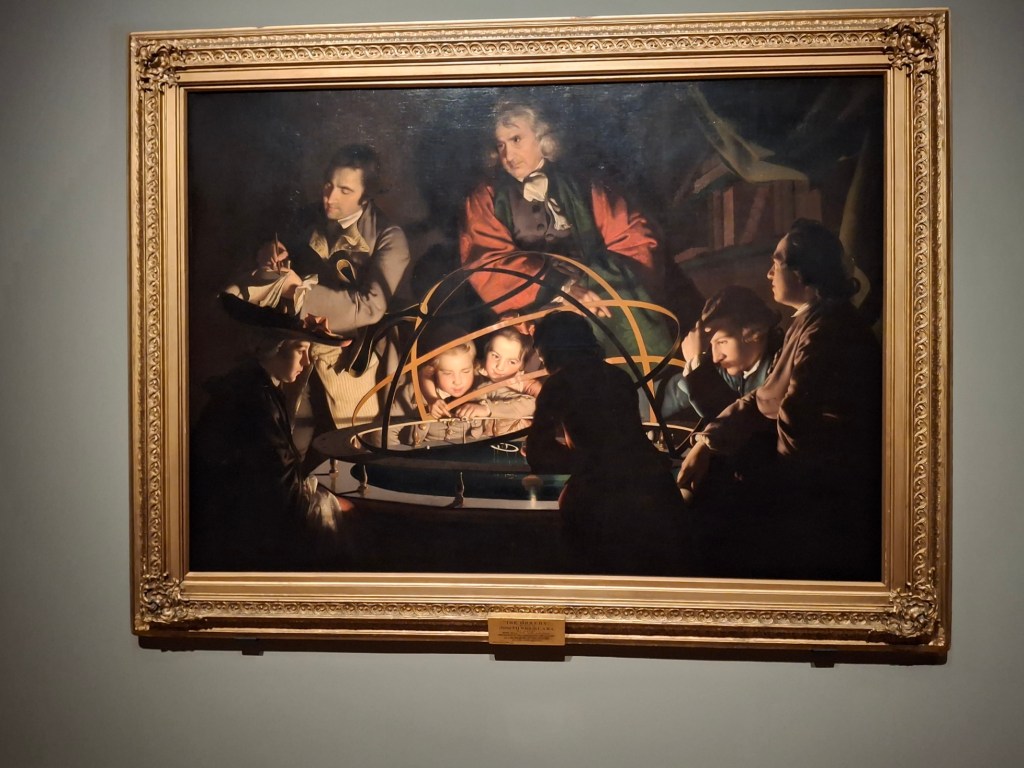
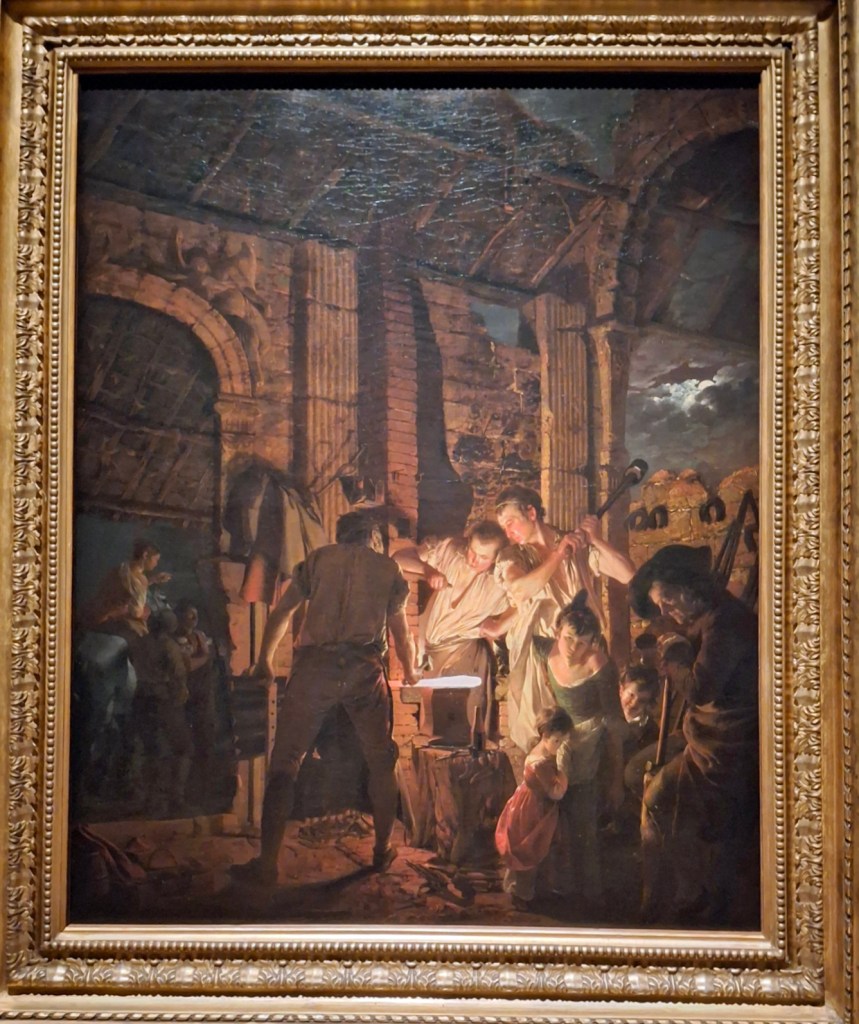
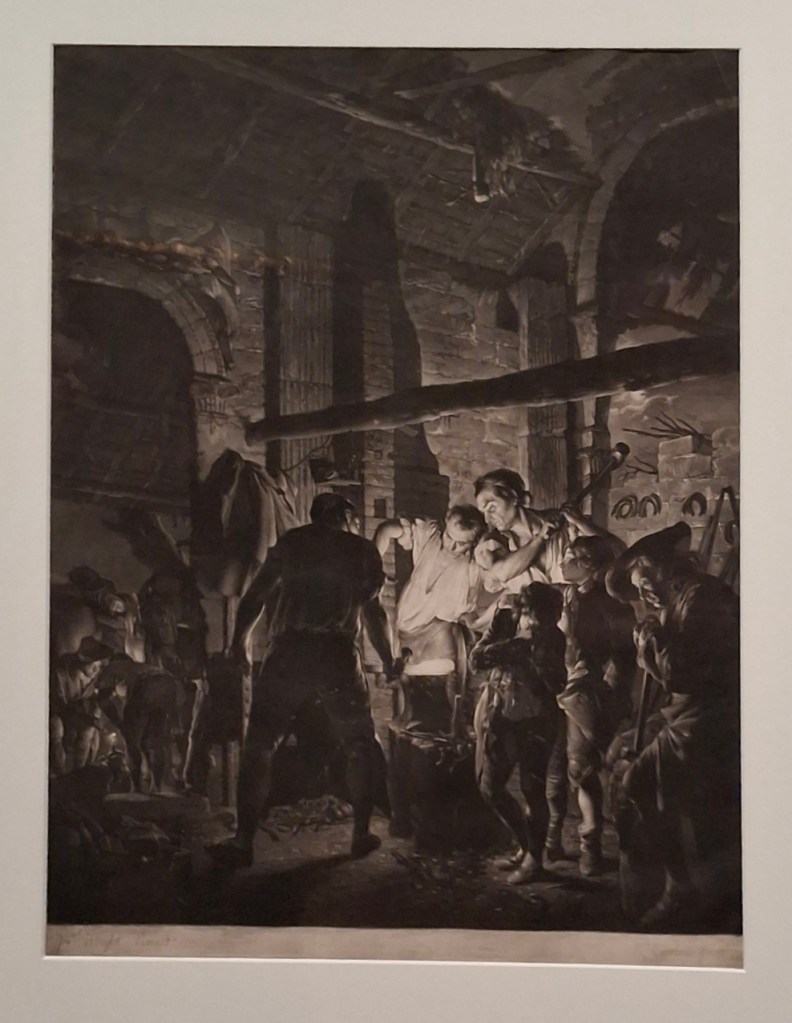
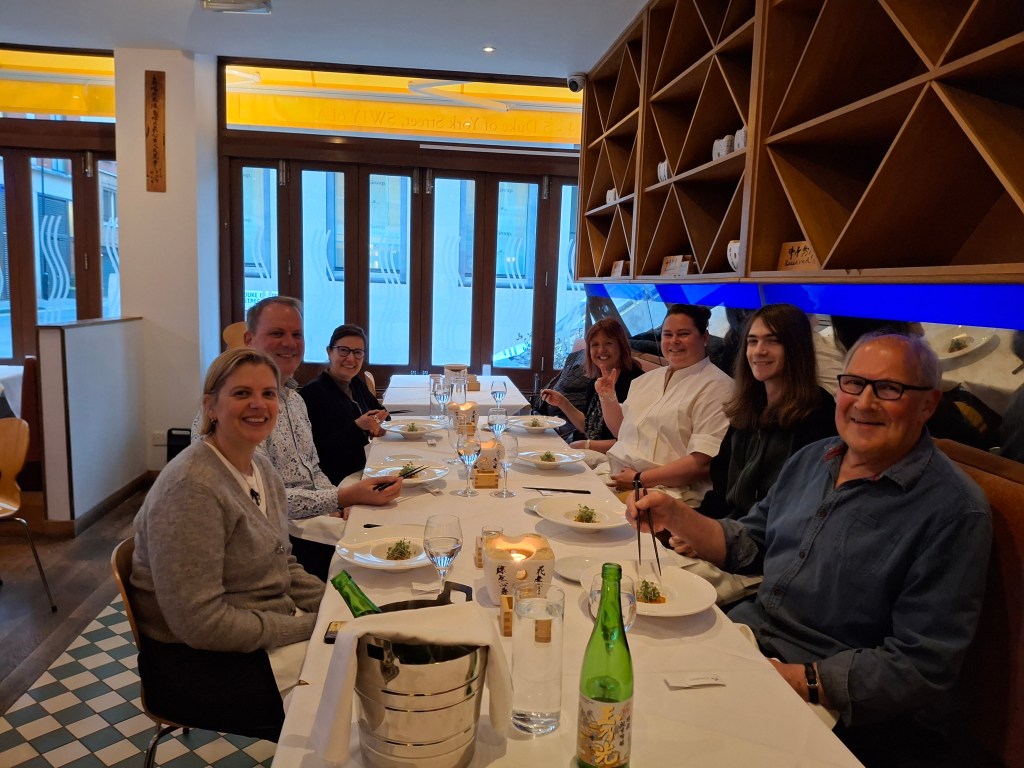
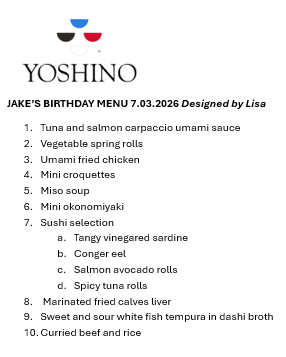
My grandson Jake, somehow turned 20 on Saturday and had decided that he’d like to go back to Yoshino for his annual birthday dinner. Ever happy to oblige I had words with Maitresse D’ Lisa and she came up with a really excellent menu for us. But before that, I decided to go to the National Gallery to see the Joseph Wright of Derby exhibition. I’d seen some of his paintings a few years ago in Norwich and was fascinated by his use of small and focused light sources. I gather his take on chiaroscuro is called ‘tenebrism’. In most of the paintings apart from the canndle or lamp light there was always a glint of moonlight in the background. As a big fan of printmaking as well as painting it was interesting to see mezzotint versions of his paintings which were obviously the main way of making money from your work at the time. Seeing them alongside each other was enlightening and the fact that one featured an orrery when I was about to meet my physics student Jake added another layer of interest. It’s a small show but well worth a visit. Walking through the other galleries it also remoinded me what a wealth of high class art is at our disposal for free still. I must go more often and revel in the Canalettos and Guardis and Turner v Constable without paying £24 for the privilege at the Tate. Oh and there are some favourite Goya, Velaquez and Murillo canvases I hadn’t seen for a long time – and as they say – so much more.

Then to the real business of the day. Anybody who has read previous blogs will know how important Yoshino is in my life. Dee and I first went to the old Yoshino in 2009 or 10 (I wasn’t blogging then or I’d know) when it was in Picadilly Place and came to know Lisa the Maitresse D’ quite well. Since then she’s been on a family outing to see My Neighbour Totoro at the Barbican and came to Glyndebourne with me in 2023 and we went as a family to the soft opening (right) of the new premises in Duke of York Street in April last year – minus Chris filming in Dublin and Daisy who didn’t fancy it, plus Rosa and Frances. So Lisa knows us all too.

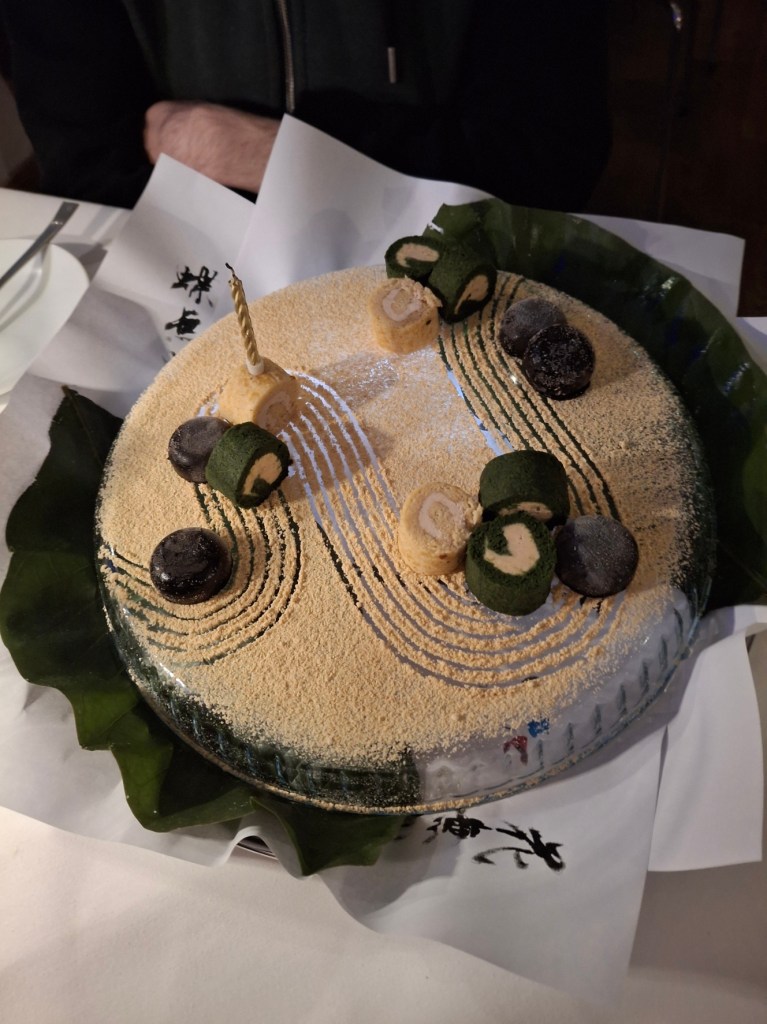
However when Jake said he’d like his birthday dinner at Yoshino there was rejoicing in lots of the family with a little trepidation on the part of a slightly picky Daisy. So I asked Lisa to book us in and design a menu for us with alternatives for Daisy. She pulled out all the stops and gave us an absolute feast of taste and texture sensations including making an alcohol free campari for non-drinker Jake. And as she had run out of my ‘usual’ sake – I wonder why – she offered me two options to taste before we settled on an excellent dry alternative. Daisy surprised herself and us by being really adventurous and enjoying things she wouldn’t have looked at – sake included. On a previous visit we’d tried a curry dish and had not been impressed. Lisa brought us a bowl of curry and rice saying it was spice combination number 47. Well this variety certainly hit the spot.This wonderful evening concluded with Lisa and her colleague Naomi bringing Jake a birthday cake of ice cream filled chocolates and soy and matcha mochi swiss roll slices all arranged on a raked zen garden. What a night! What service!

Rallentando – un poco

So after all those wonderful outings and stimulated by some excellent cultural offerings (see other recent blogs) it’s a week to slow down a bit. Sunday saw me take a train to Southend to attend a volunteers day at The Jazz Centre UK where I’d been invited because the management team thought I might be able to contribute something to their publicity, marketing and social media plans. I think this was based largely on the fact that I designed and maintain the website of legendary tenor saxophone player Alan Skidmore and posted about his recent gig at the Centre. It was a lively series of discussions with lots of ideas being put forward but, as with so many charities, their execution will depend on funding being sought and secured.

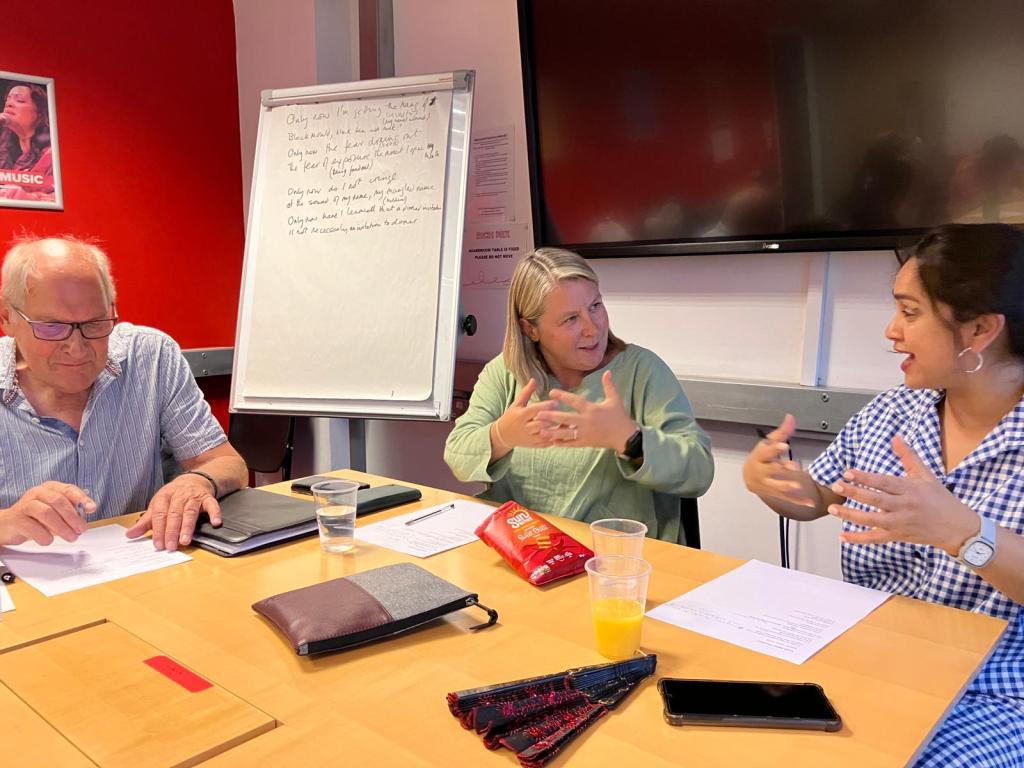
The midweek gave me the pleasure of welcoming my friend Anna Blasiak – a Polish writer and translator – to Raggett Towers. We worked together at one of the British Bilingual Poetry Collective’s Translation Circles a couple of years back and became firm friends. Here she is explaining a nuance to Eeshita while I’m looking for the right words to convey it in English. She is one of the twelve poets featured in our anthology Home and Belonging published by Palewell Press last year.

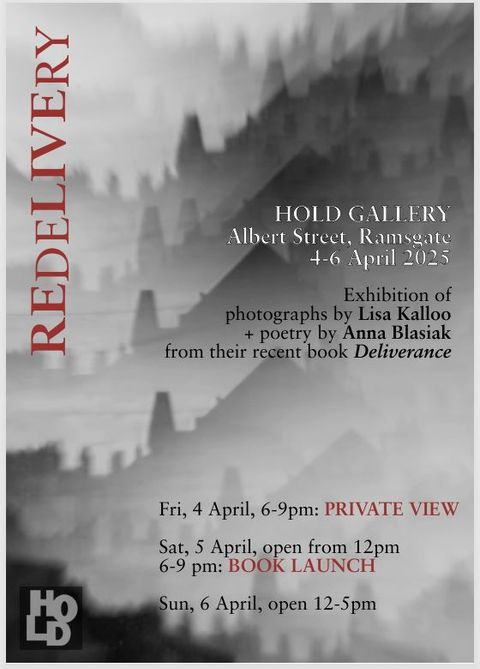
And as well as buying me an excellent thank you breakfast before she left on Thursday, I have an invitation to the launch in Ramsgate in April of the latest book she has written with photographs by her wife Lisa Kalloo. I’m looking forward to that trip and spending more time with this creative and lovely couple. I’ve stayed with them before and exploring this increasinly arty town on the Kent coast is a real delight.
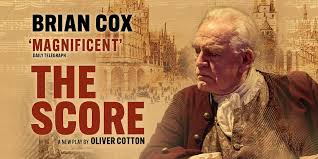
Thursday evening saw me joining Rosa and Hattie, Paola and Harry from the OAE at a Friends’ Outing to see The Score at the Theatre Royal Haymarket. I also met Nuria, a friend of Rosa, who was visiting London from Barcelona. She professed to have little English but we got by and she laughed in all the right places in the play.

And there were plenty of laughs in the story of deeply Christian J S Bach going to the court of deeply militarist Frederick the Great where JS’s son CPE is among the coterie of composers the king had collected around him. Cue high levels of competitiveness and entrenched positions.

Brian Cox’s performance was outstanding – grumpy, serene and authoritarian by turns – and it was good to see him on the stage with his wife, Nicole Ansari Cox ,for the first time since they did Tom Stoppard’s Rock and Roll together in 2006. As well as providing lots of camp melodrama, Oliver Cotton’s play led you to think about patronage, compromise, theology and materialism in a lively production by Trevor Nunn. The scenes where the Mr and Mrs Cox-Bachs were together were very touching.

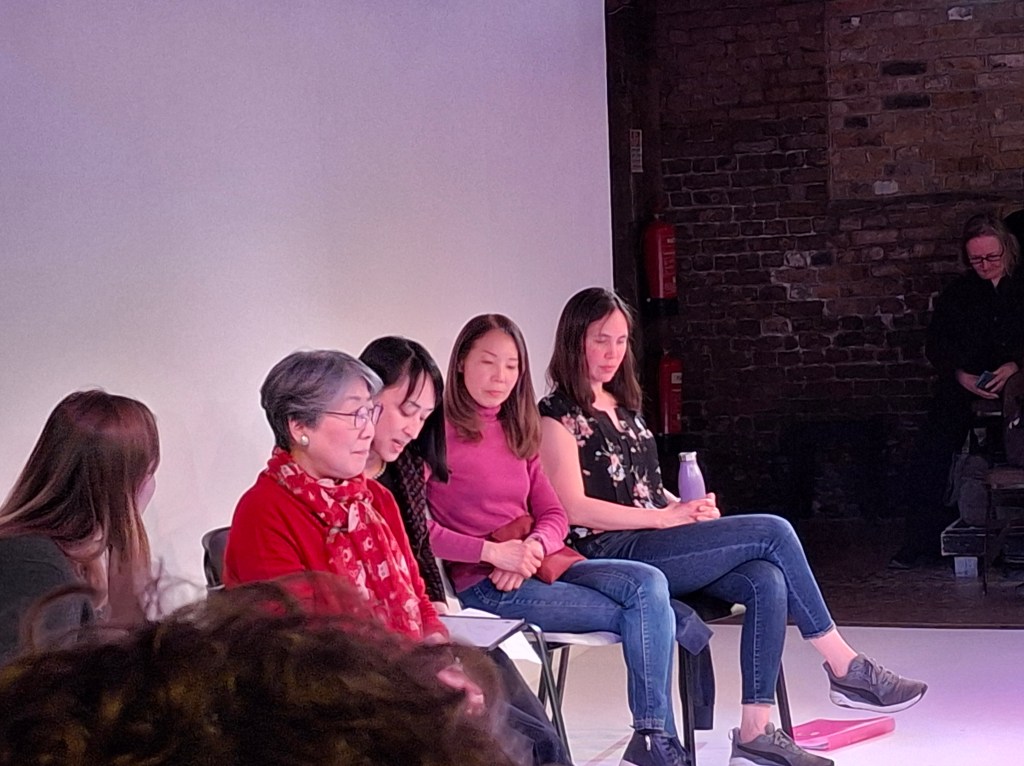
Friday lunchtime took me to the Arcola Theater in Dalston for a rehearsed reading of a famous modern Japanese play newly translated into English. Multiple award winning Ai Nagai is celebrated in Japan for her plays that focus on social issues and this one is no exception – menopause, relationship breakups, jealousy, ageing and memory all feature. Translated by one of the actors in this reading Meg Kubota, the English version had us all laughing out loud on numerous occasions an sucking our teeth in shock at others. It’s called Women Who Want to Tidy Up and features three schoolfriends who have kept loosely in touch through to their fifties where one of them, Tsunko, has broken up with her much younger boyfriend and is not answering her friends’ calls, So they arrive to find the apartment on which Tsunko had spent a lot of money in a complete hoarder’s mess. Although it was a reading, the stage in my mind’s eye was strewn with black bin bags, cardboard boxes, clothes, newspapers and magazines and half empty food containers. It’s a designer’s delight when it gets the full production which it richly deserves. I hope through the good work of the Japan Foundation it does secure a full London staging – it is very funny and very thought-provoking about stuff. Marie Kondo’s shadow looms over it.
A post-reading Q&A with Ai Nagai, her interpreter, translator/actor Meg Kubota and director Ria Parry.