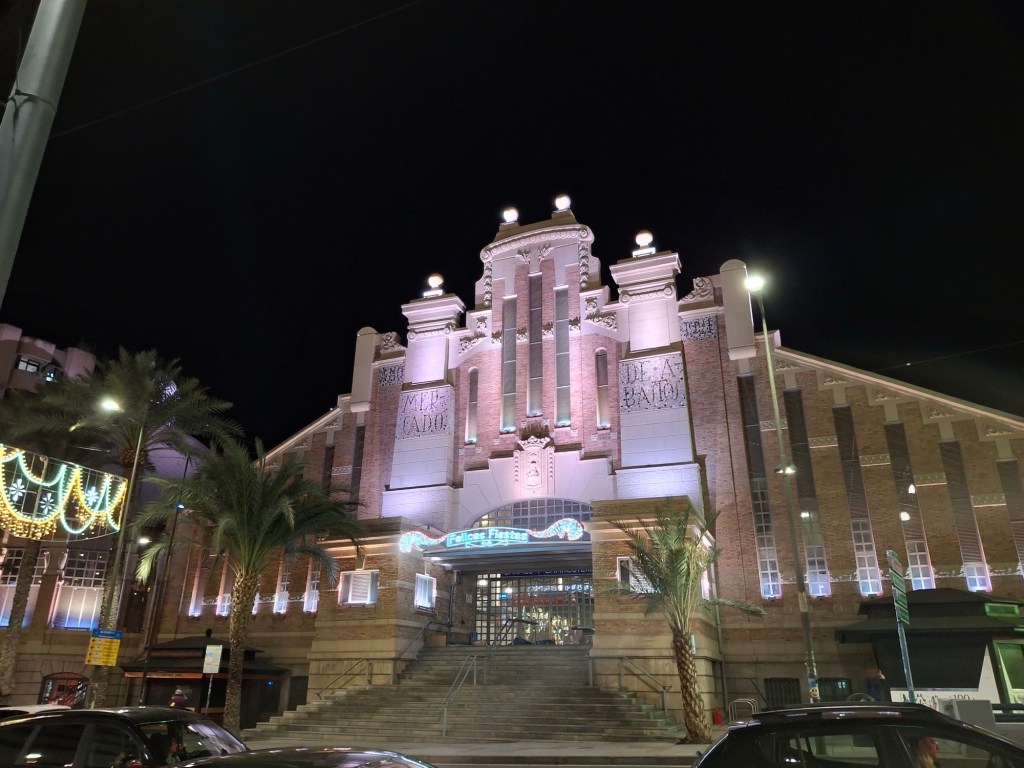
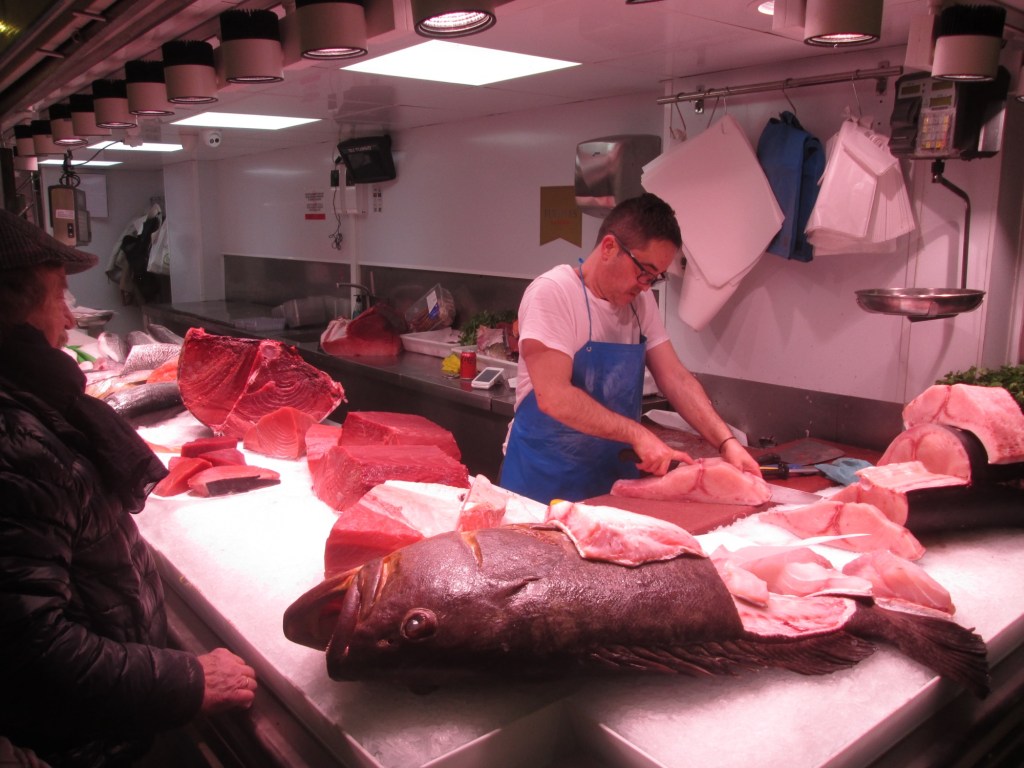
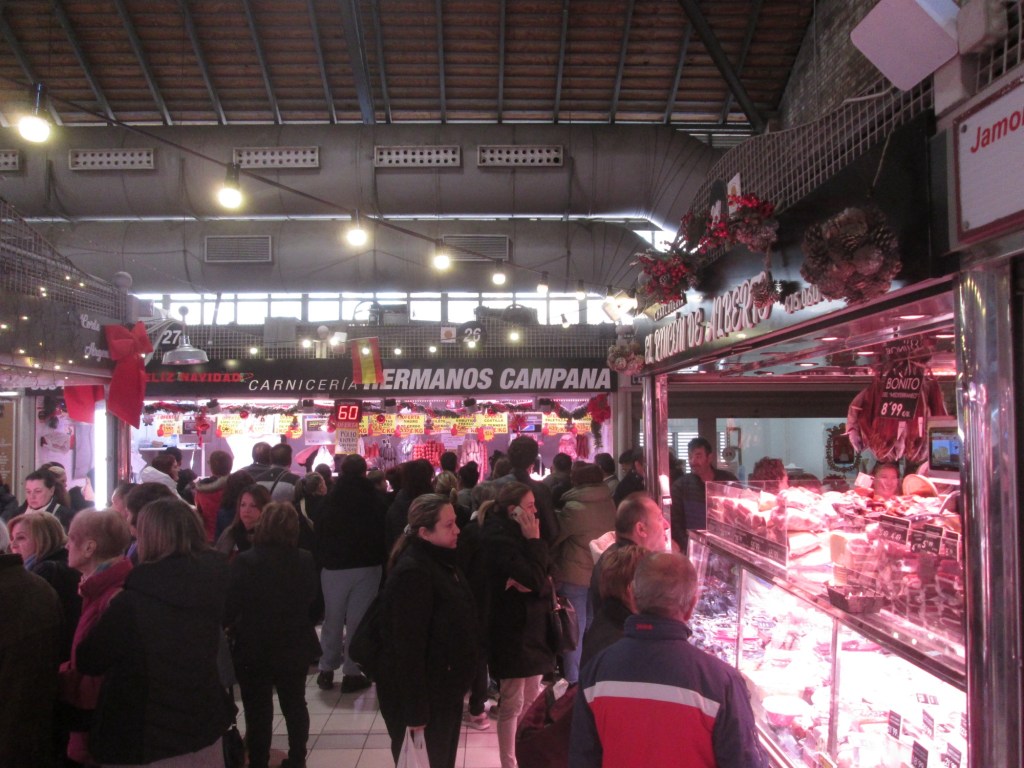
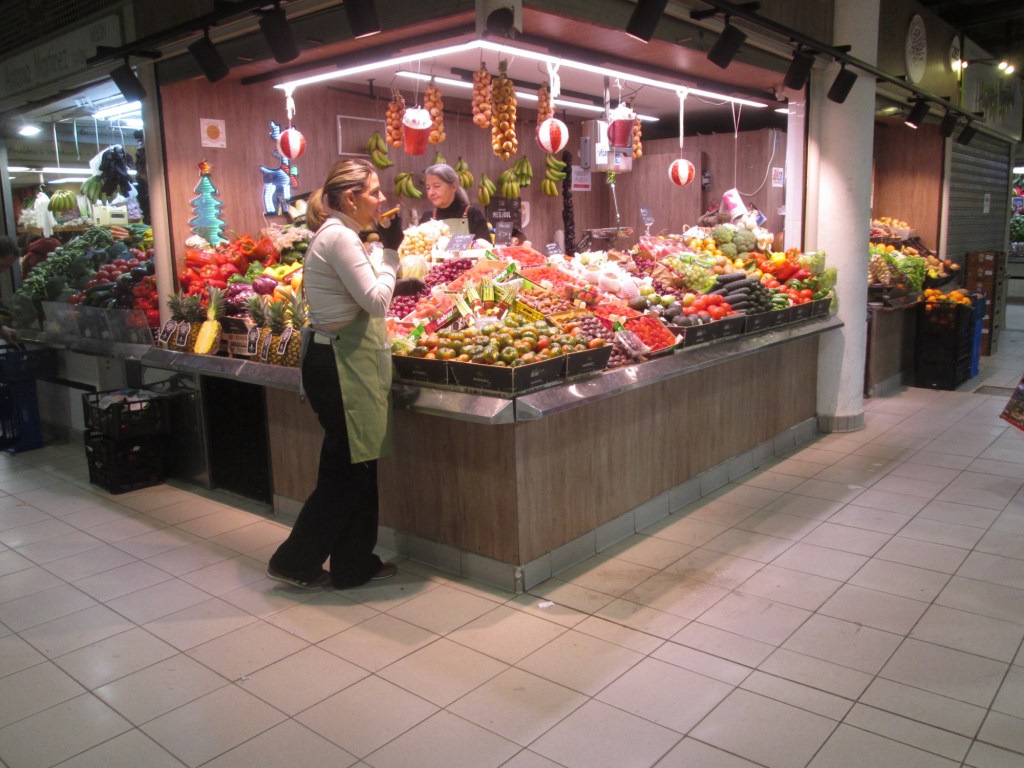
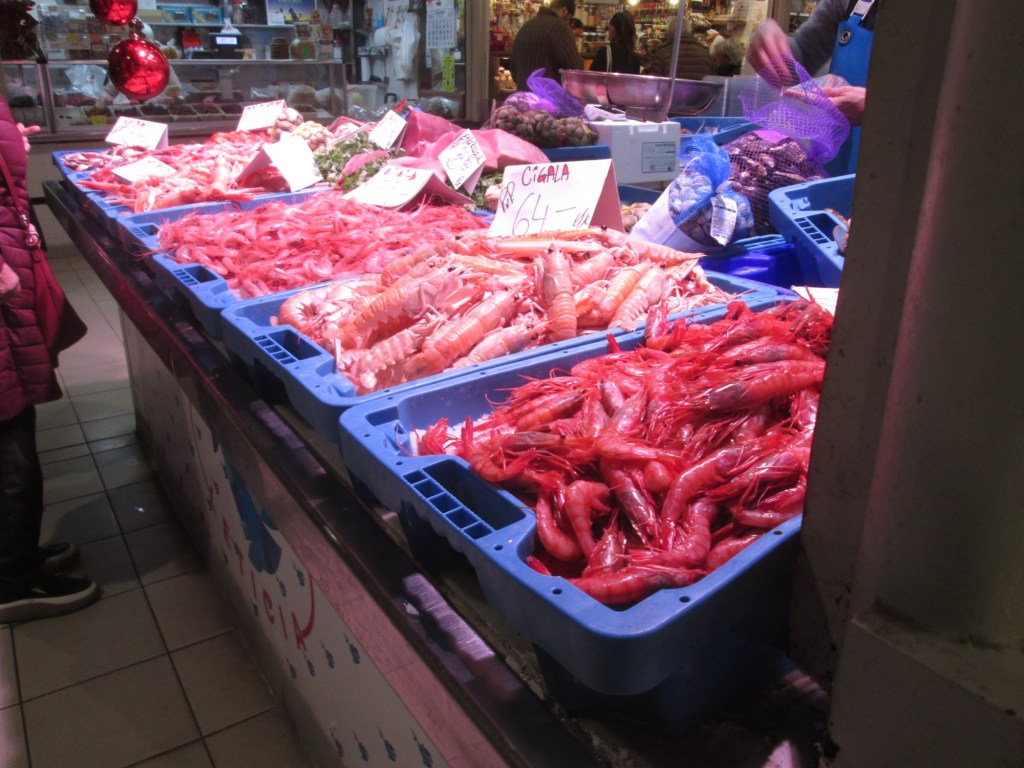
I don’t have a Fitbit or other step counter but I think I would have broken it today. I set off at 9.30 in quest of breakfast which I found quite close to the hotel and the central market which I’d shot last evening. As many will recall, I love a market and while the building couldn’t compete architecturally with many I’ve visited, the contents were well up to scratch. Fish, meat, fruit and vegetables, all local produce, were brilliantly displayed. Some counters were obviously more popular than others with lengthy queues waiting patiently after taking a ticket from the ‘Su Torno’ machine.
Mercado CentralCarving tuna Patience is a virtueArranging the stallSeafood aplenty
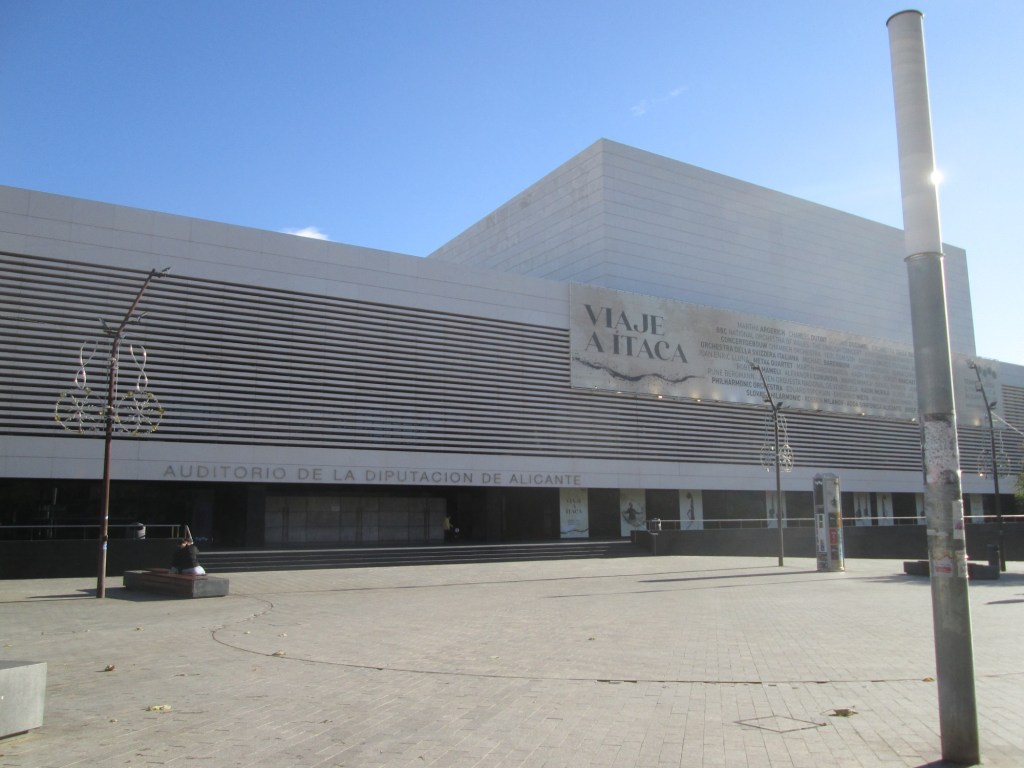
I then decided to walk to the Auditorio where I’m going to a concert this evening just to gauge what time to leave – 20 minutes is the answer. It also involved passing the Alicante bullring which has gigs now not fights which will be a relief to the bulls being driven towards it in the sculpture in the square outside.
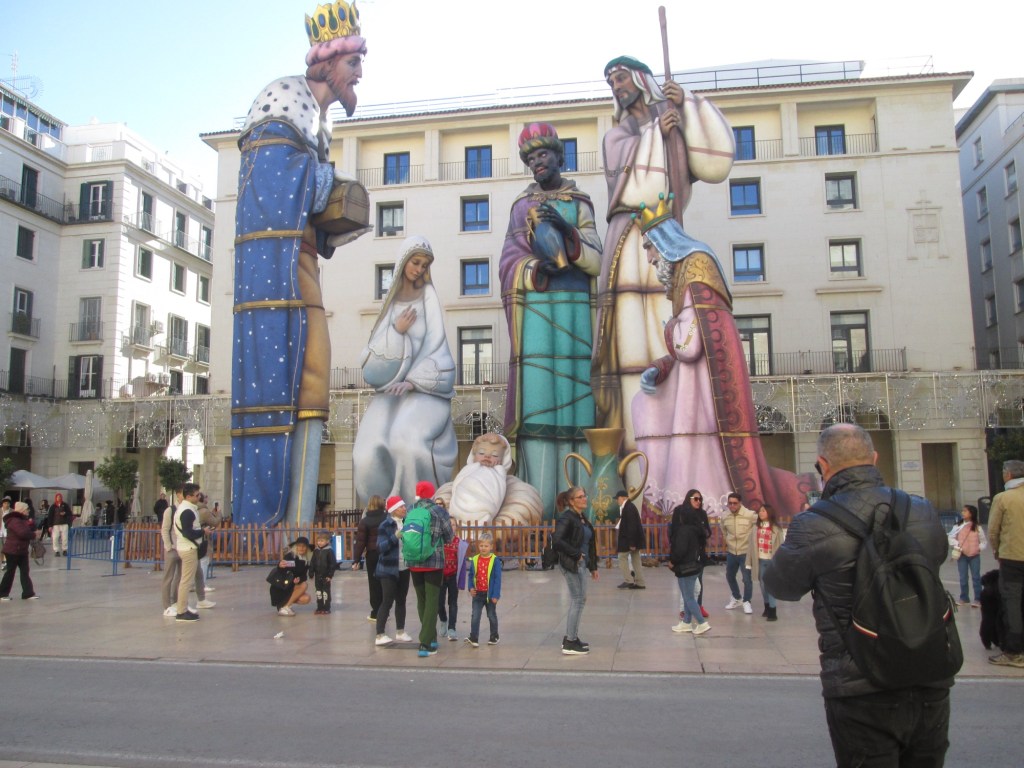
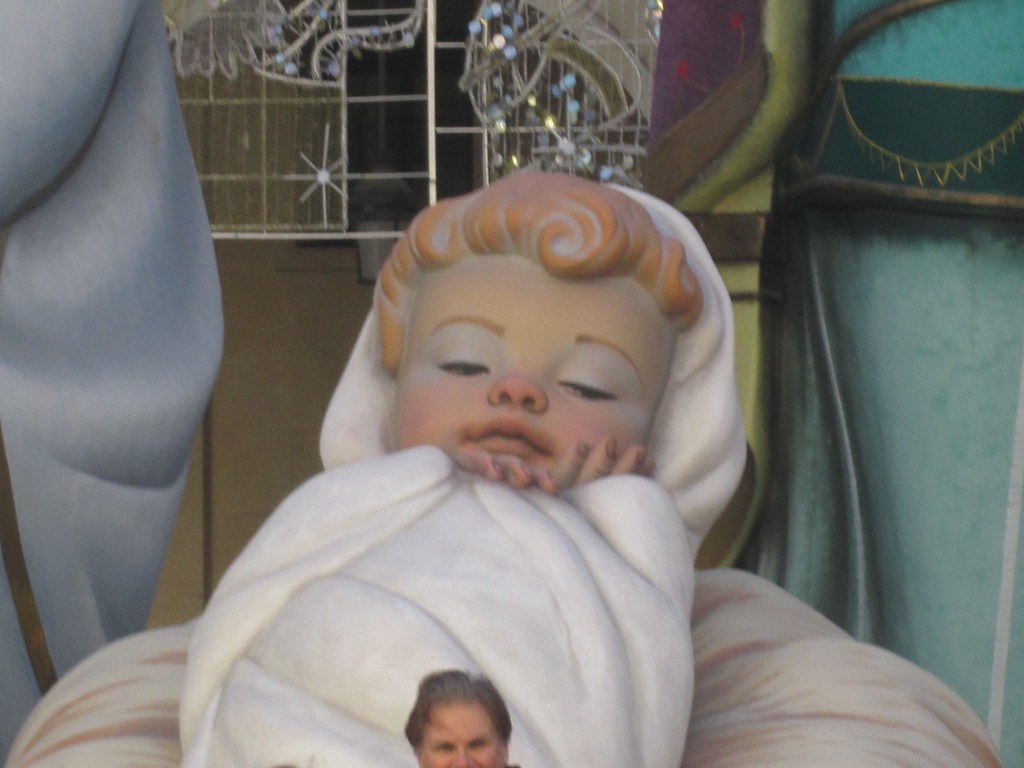
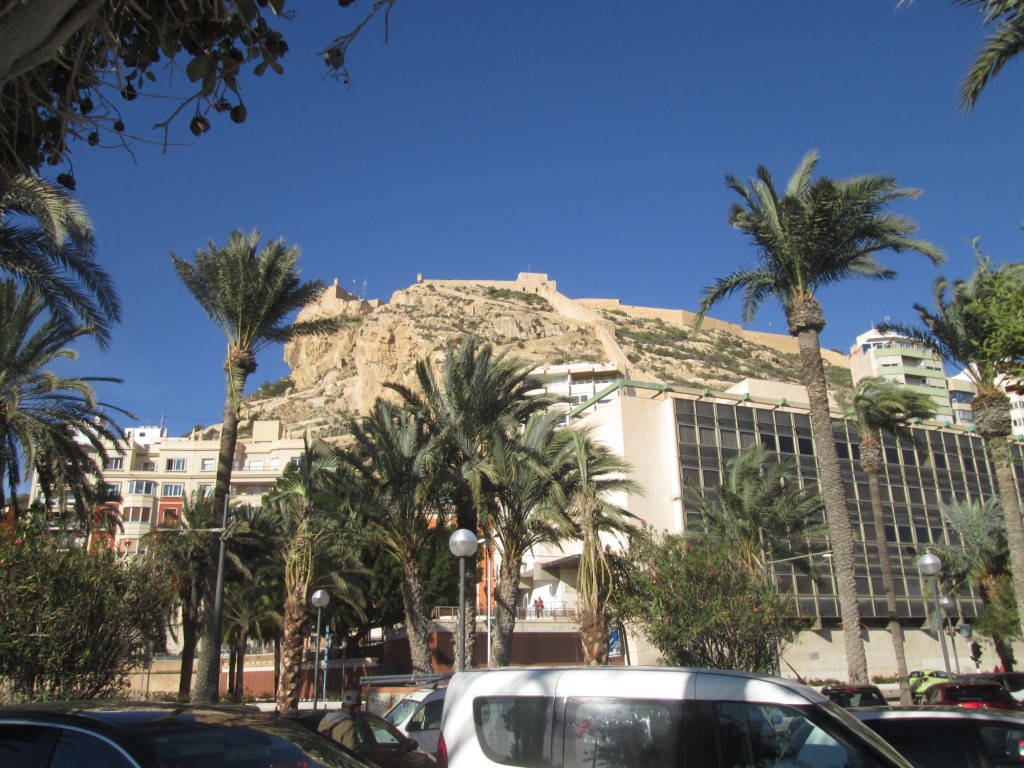
One of the major attractions of Alicante is the medieval Castillo de Santa Barbara and as cloud is threatened for Christmas Eve I thought I’d better do it today. On my way back down through the town I passed the Ayuntiamento which has a special Belen – the astonishing displays of the Christmas scene that are prevalent all over Spain. Outside was a giant version with a very strange looking newborn.
The castle sits quite a long way above the beach but fortunately there’s a lift, which by flashing my old farts’ pass I was able to use for free.
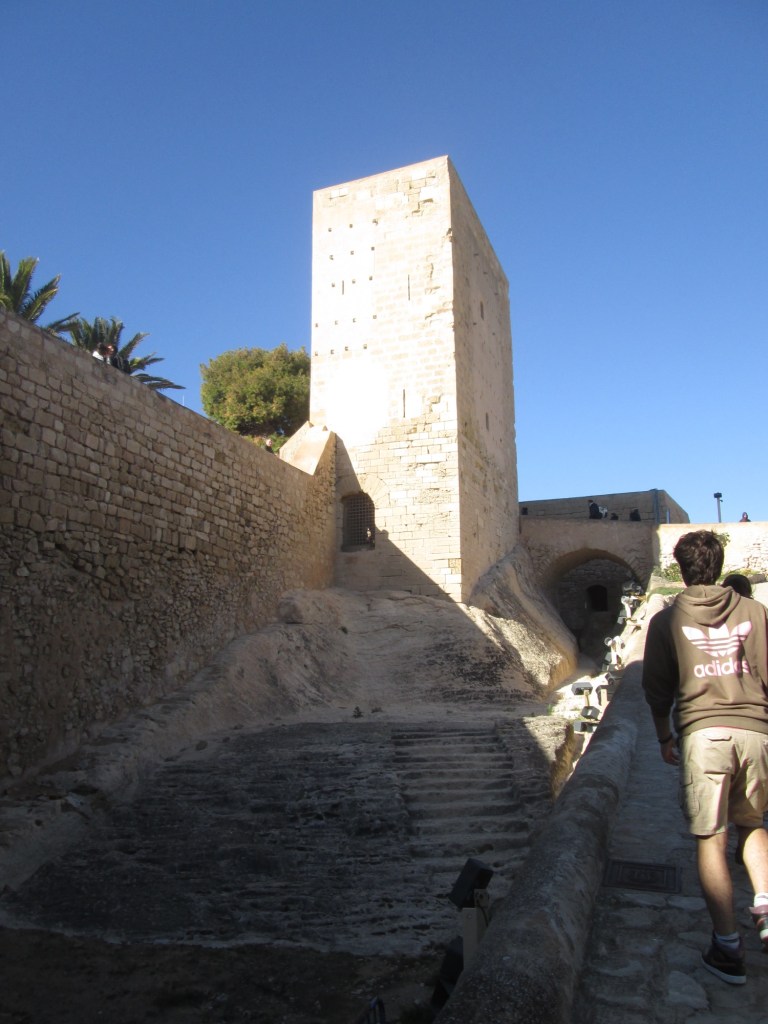
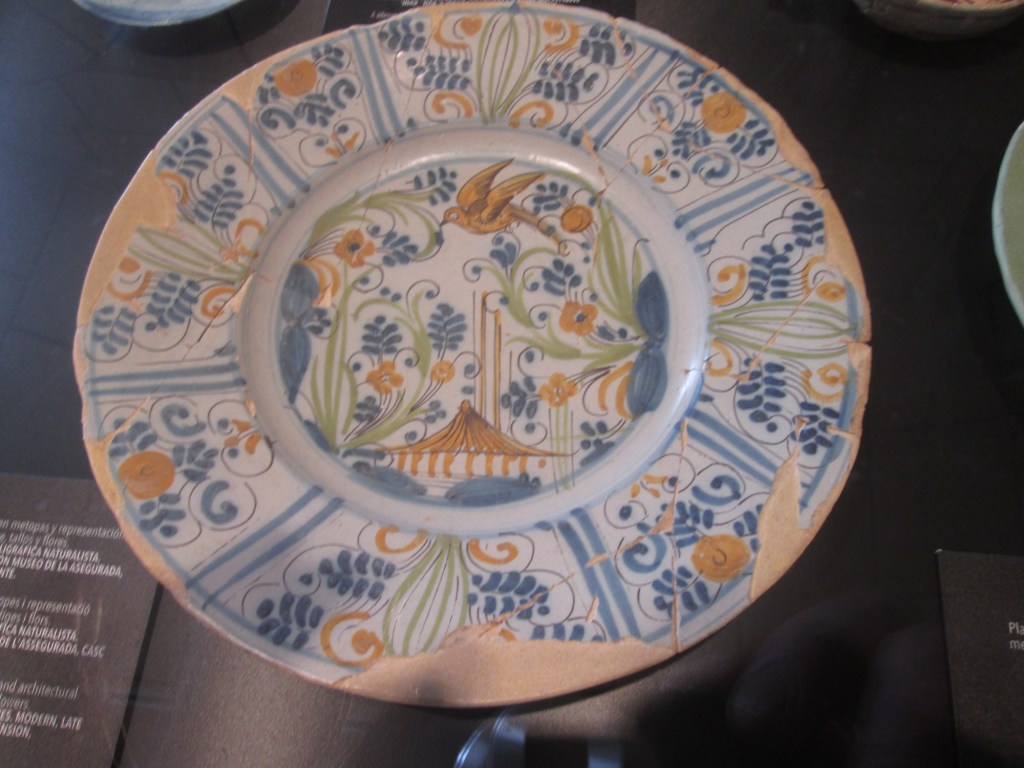
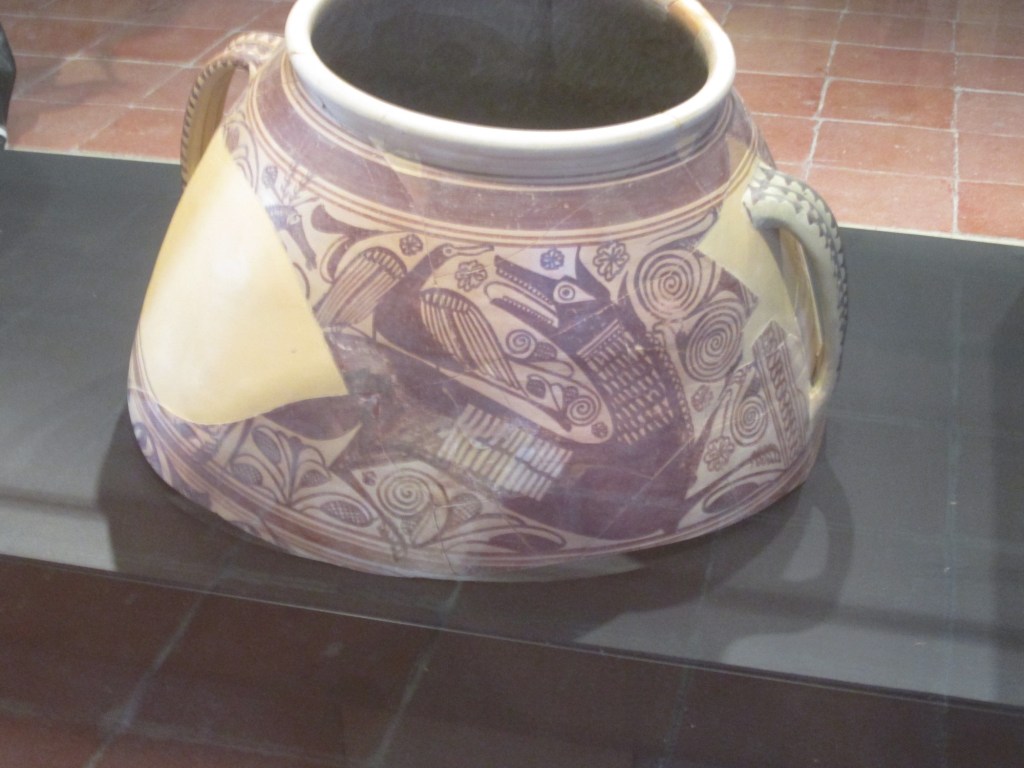
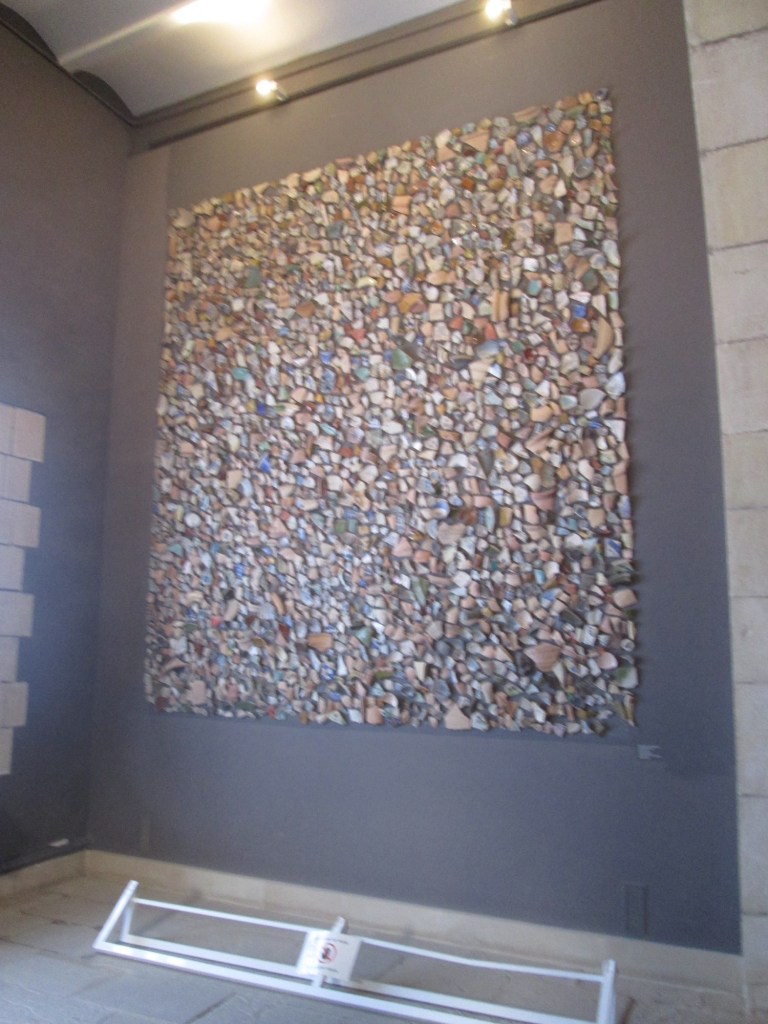
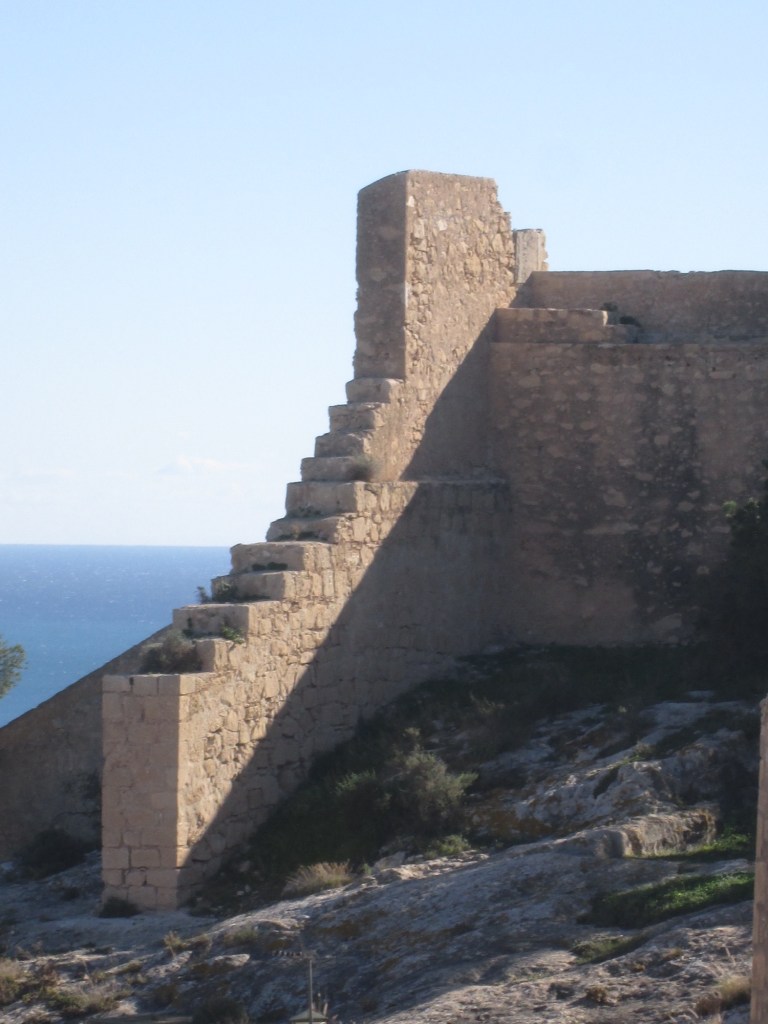
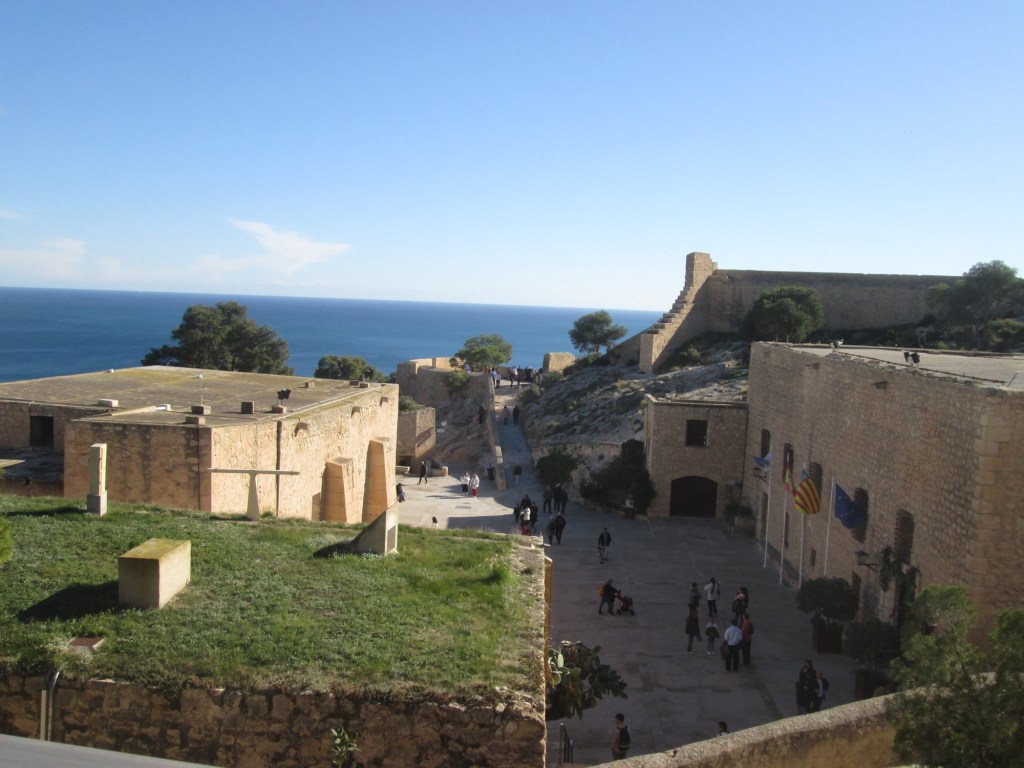
There’s still quite a long way to go when you alight from the elevator after a lengthy wait – be warned if you attempt it in high season; I had to wait about twenty minutes each way. There are lots of warnings about uneven surfaces and danger of falling so I mounted the steep slopes with great caution and frequent pauses. There’s not much left of the castle itself but the ultimate chamber has a great display of finds from the site over its history as a castle since the ninth century and from settlements on the site back to the Bronze Age. One of the main reasons for making the trek is for the views and they are spectacular.
Halfway upOne of the towersMoorish plateRoman vaseFragment mosaicFrom the top
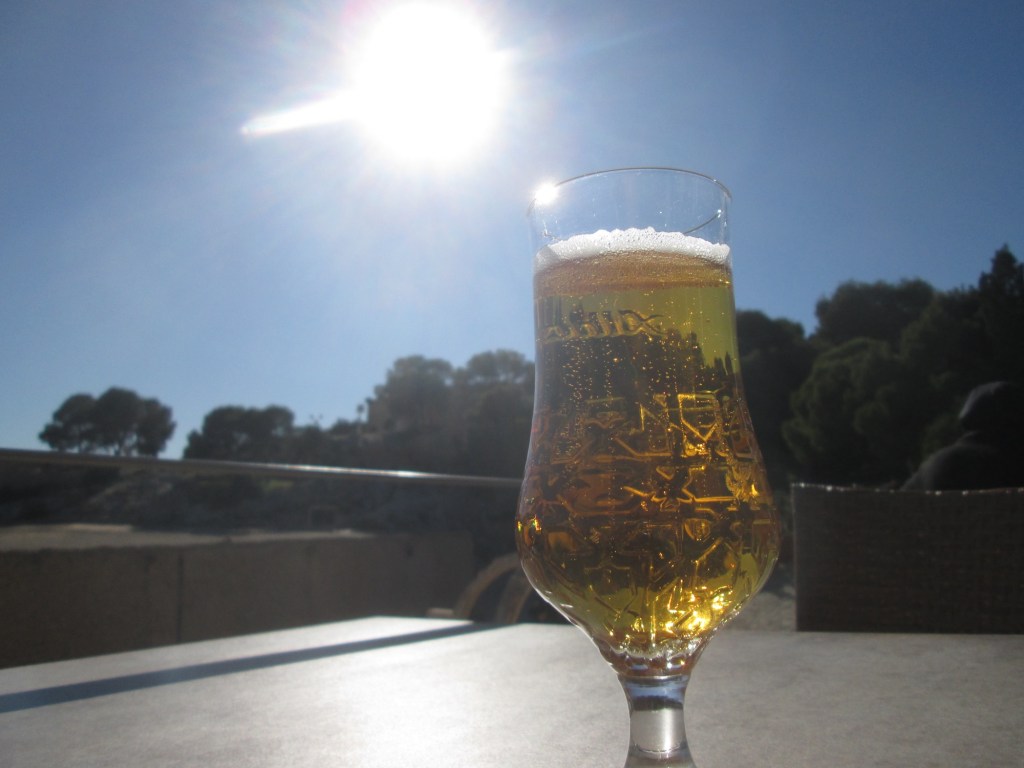
I made my way very slowly back down rewarding myself with a beer at one of the several bars the castle provides.
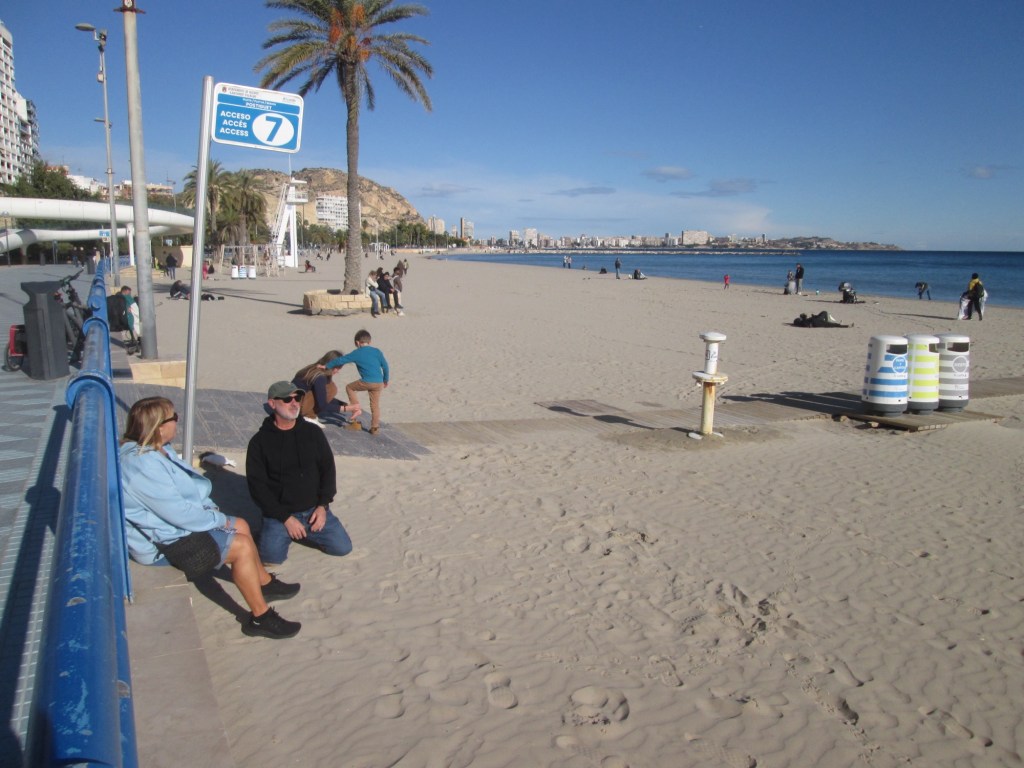
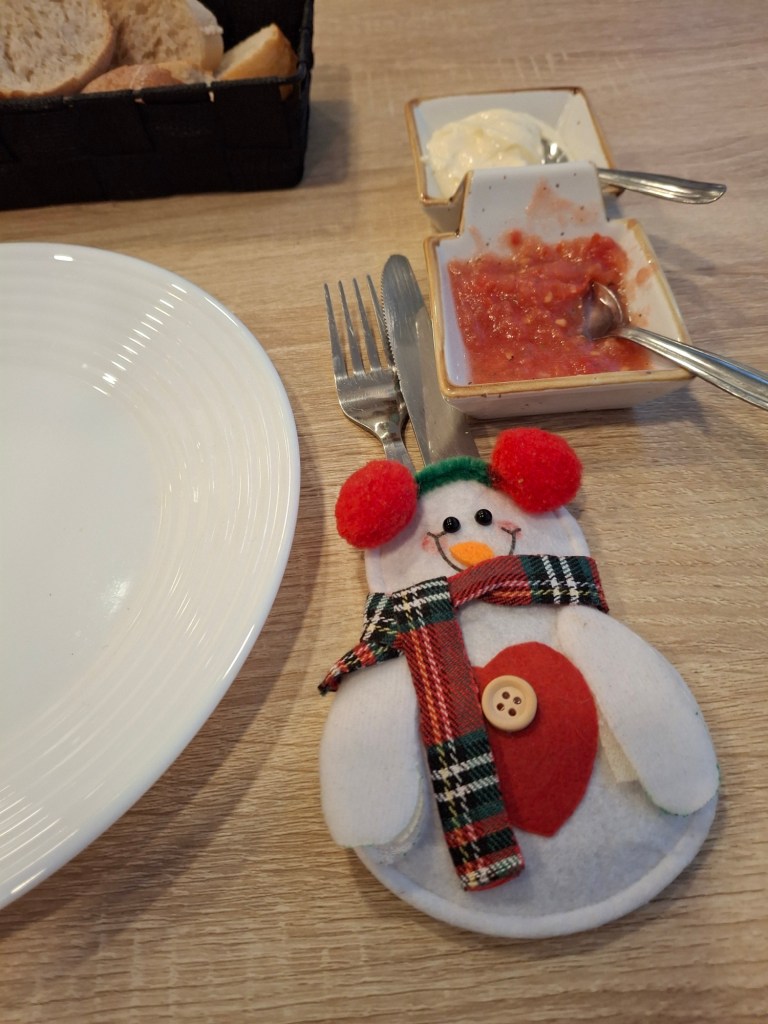
After a further wait for the lift – I’d done enough slithery downward slopes for my age – I went to the city’s central beach, El Postiguet, and wandered along the northern promenade in search of lunch. There were lots of beachfront places that looked both full and expensive. In the streets just behind I found a super little bar that had and excellent aubergine with mince and melted cheese – perfect. As further proof of Christmas madness my cutlery came in a snowman!
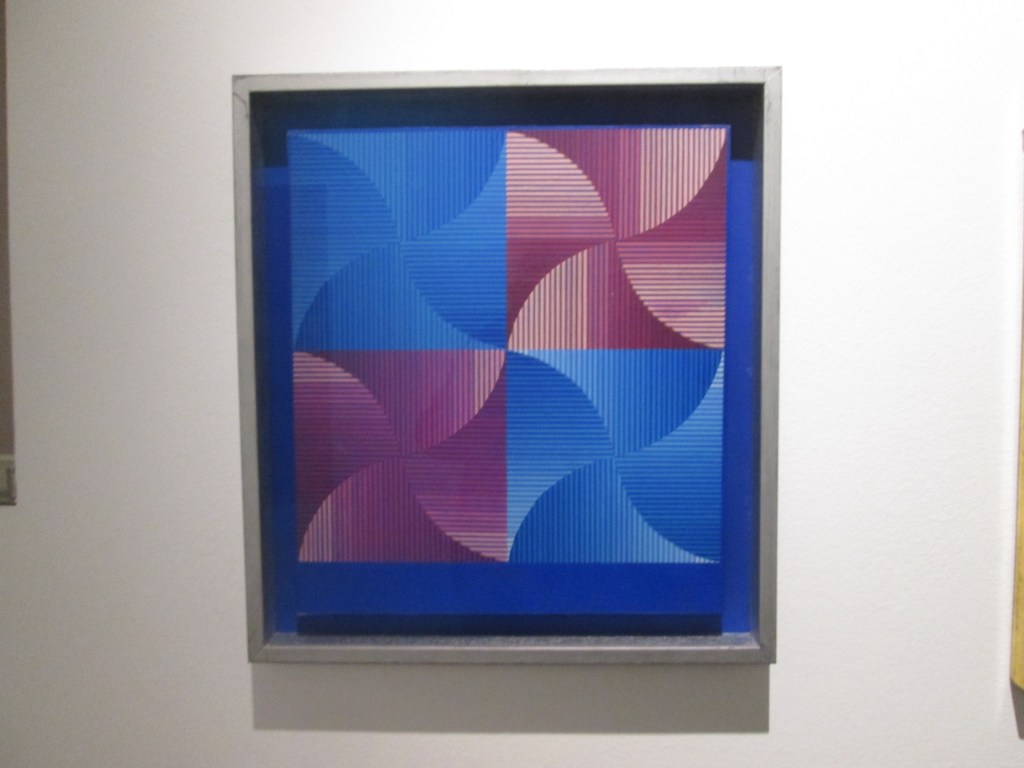
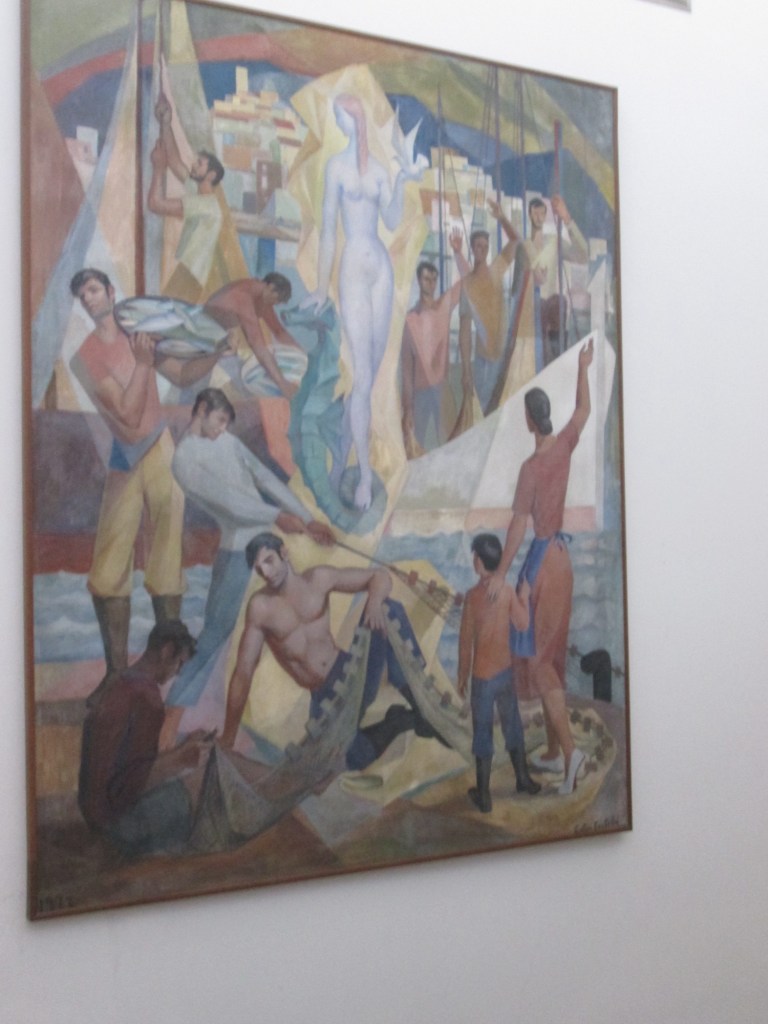
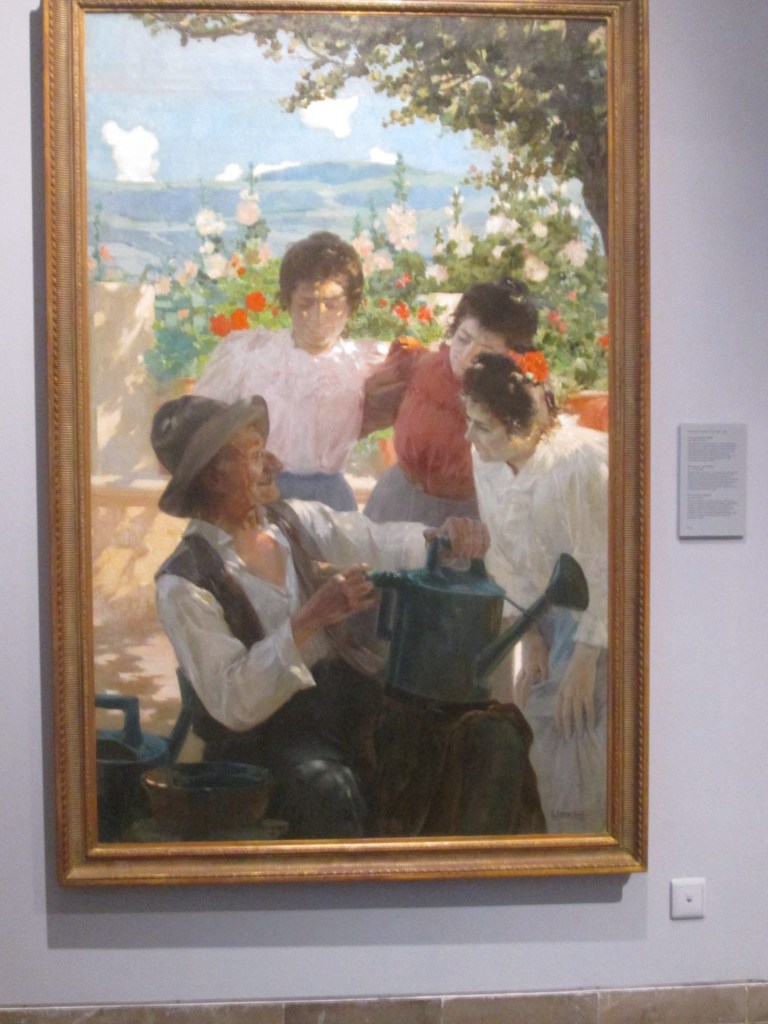
Right along the street was MUBAG the Museo de Belles Artes Gravina which had been on my list of places to visit. It had an exhibition of Spanish Romantic art and at my first entrance with a red corridor made me think I was in the Dulwich Picture Gallery. It had some interesting portraits and some more modern pieces, among them a couple by Eusebio Sempere of whom my neighbour Maria owns some originals. I like his abstracts with emotion.
SempereA staircase muralRealismDulwich?
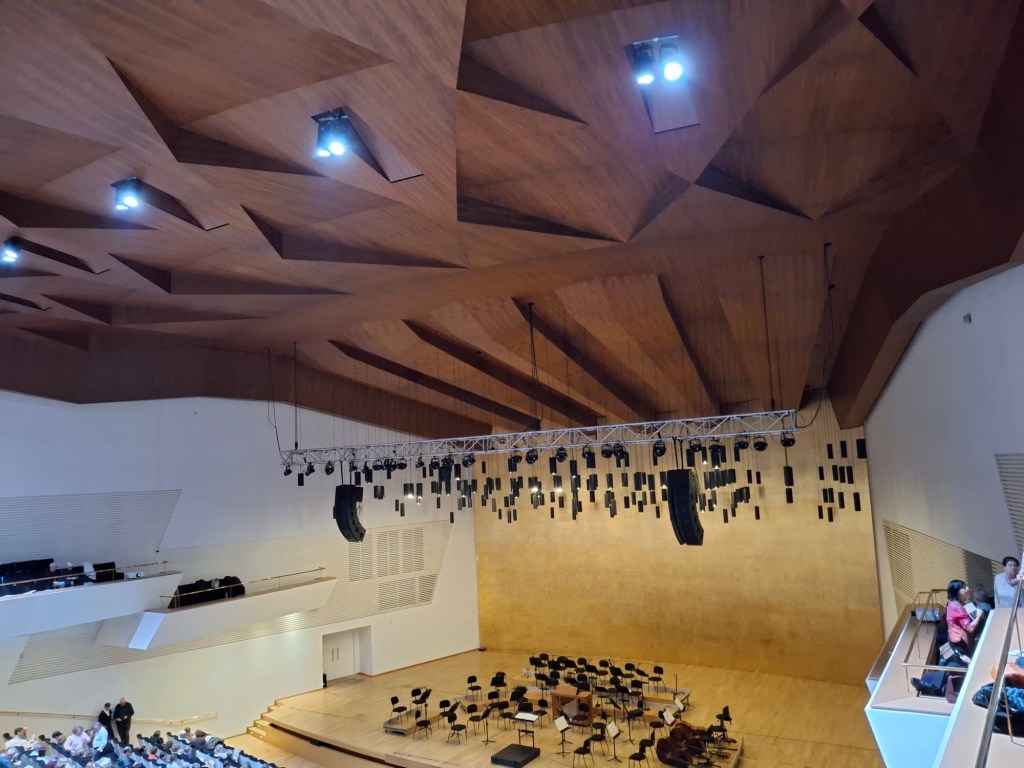
I decided to smarten up for the concert – trousers not jeans, a shirt not T and a jacket – so I called back at the hotel to change. Then more steps up to the Auditorio a rather splendid 2011 addition to Alicante’s cultural spaces. It’s a pleasant hall with a cedar wood ceiling that spoke triangles and coffins to me.
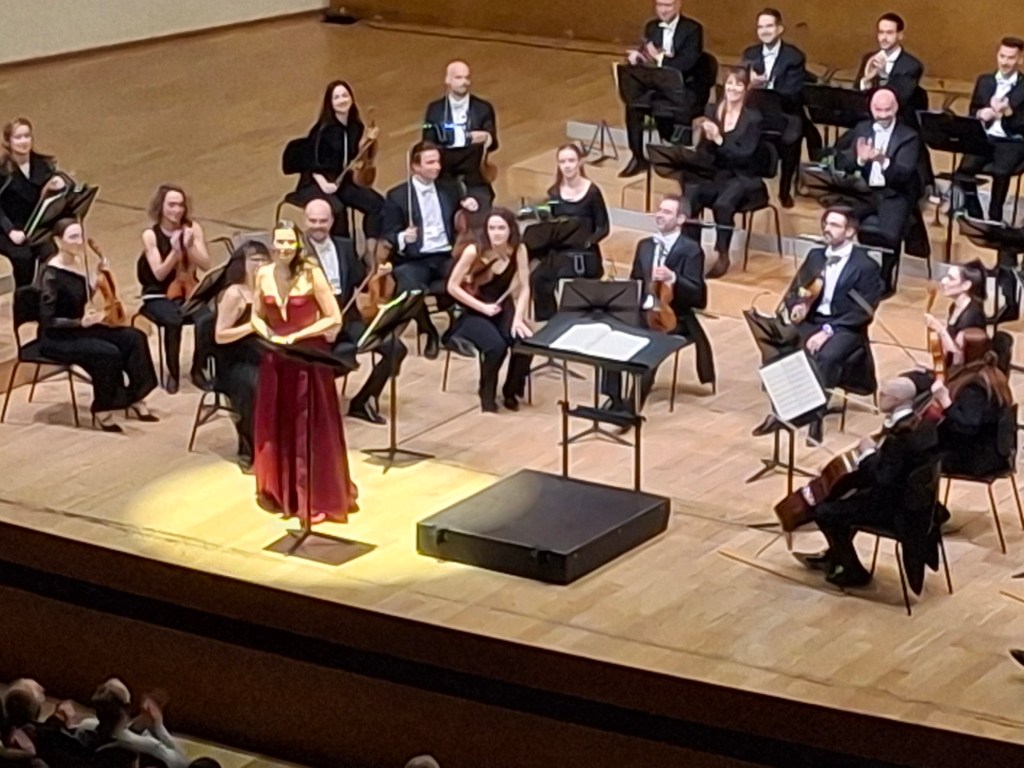
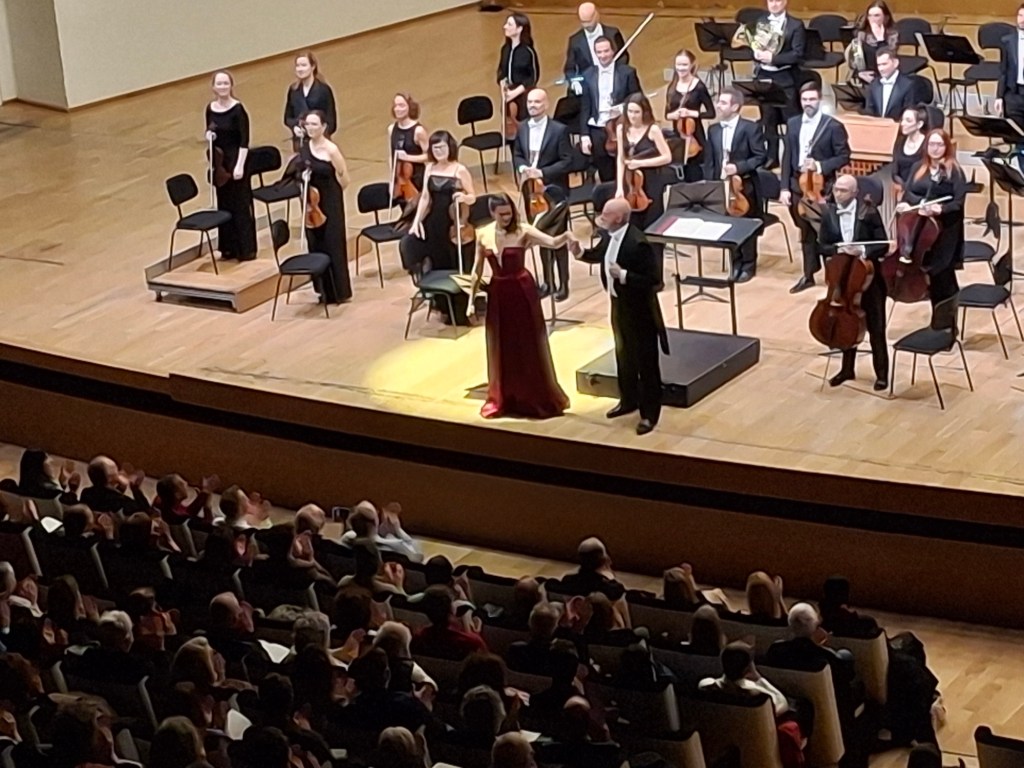
Then the concert began with Haydn’s Berenice cantata which featured the main reason I’d booked for this; Roberta Mameli an Italian soprano who I first came to love through a fusion album Round M – Monteverdi meets jazz which I heartily recommend. Claudio’s notes sung as written with a jazz accompaniment – brilliant! But she also has a superb voice with range and power which were further displayed in Mozart’s Exultate, Jubilate, the seventeen year old prodigy’s challenge to his favourite castrato. Roberta managed it with flourish and style and the orchestra under the baton of Ruben Jais supported her well and also did a symphony each from Haydn (49) and Mozart (25) with some panache.
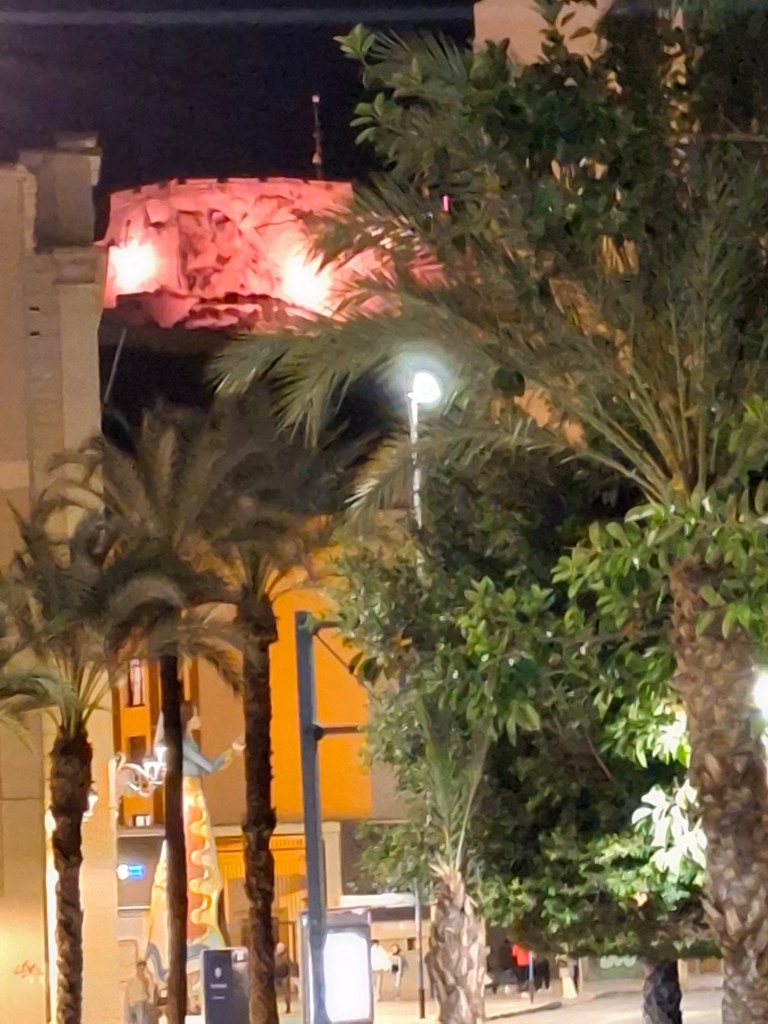
I left the concert very happy but concerned about finding somewhere to eat – we’re not in Madrid after all. The illuminated castle through the pines reminded me of a rather wild day. I needn’t have worried as the restaurant De Oliver about three doors from my hotel provided a rare and tasty steak, a good Rioja and a farewell whisky on the house. I may well be back!
Well the lawn didn’t quite escape the mower despite the warm weather and slow growth of grass but it had to have a tidy up. What did escape was the keyboard – too busy to type this month! It all started on Saturday 3rd with the last game of the season – unlucky draw – followed by a farewell to the season lunch at L’Artista and then Frances, Rose and myself whizzing off for a pre-concert Guinness in the Toucan with Ian Prowse (he didn’t have one) before he took to the stage at the 100 Club. It was as always with him a brilliant evening’s entertainment.
Then on Monday 5th Fran and I went to see the new Conor McPherson play The Brightening Air at the Old Vic. It’s a wonderful depiction of dysfunctional Irish rural family life with a standout performance from Rosie Sheehy as the disruptive Billie. The next day I had to record one of the English Language Teaching audiobooks that I do a couple of times a year. My voice over actor John Hasler (doing 16 different voices in Aussie accents around an RP narration – amazing) is about to rejoin the cast of Fawlty Towers at the Apollo Theatre with a bigger role than he had in the first run so I’ll probably catch that at some point in the run that starts late June.
Next up was a favourite ukiyo-e printmaker Hiroshige at the British Museum. I am familiar with most of the images displayed but seeing the vibrancy of the originals compared with reproductions was astonishing. The exhibition also included several indications of the complexity of making multi-coloured woodblock prints, inking them up and making sure paper is accurately registered. A technical triumph but also witty, emotional and dramatic scenes of love, life and landscape. It was interestingly curated too with prints fixed to scrolls which themselves were often the destination of woodblock prints.
An angry roosterMt Fuji and the Otomodome fallsThe scroll supportsMy favourite I think – so much emotion and movement battling through the snow
With my mind firmly back in Japan I spent the evening downstairs at the Hampstead Theatre in the midst of a video game. The play was Personal Values and combined characters’ real lives with their personae in the game they were endlessly playing. As a non-gamer it left me a bit confused but others enjoyed it very much.
Back at Hampstead the following Monday saw a very different set of games presented. This was an adaptation by Richard Bean of David Mamet’s 1987 film, Mamet’s debut as both writer and director. It was powerful, twisty, scary and shocking but immense fun. I hadn’t seen the film for ages but recall it being altogether darker and while there were some elements of that here, it was as you’d expect with Richard Bean rather more about the laughs. I’m looking forward to more card games and sleaze when we see Dealer’s Choice at the Donmar next month.
Music started the month and gave me a real highlight in the middle. Sunday 18th found me in the Temple of Art and Music in Mercato Metropolitano, the sprawling food fest at the Elephant and Castle. The group in which my granddaughter plays keyboard, flute and does backing vocals – elegantly called Soulstice – were asked to headline a Youth Open Mic session. There’s a clip here – not very well recorded and not by me! They are usually an all girl band but their drummer couldn’t make the gig so a brother kindly stepped in. I’m prejudiced of course but they are actually rather good with a soul-tinged mix of their own originals, Sade, Amy Winehouse and so on..
Different but no less enjoyable was the Orchestra of the Age of Enlightenment’s concert at the Royal Festival Hall with Sir Andras Schiff conducting from the piano in a Schumann programme with a little Mendelssohn in between. It started with the Konzertstück which is a very lively piece for piano and orchestra and was followed by familiar passages from Mendelssohn’s Midsummer Nights’ Dream and Schiff played Schumann’s only piano concerto after the interval. He had talked last year at an open rehearsal of his pleasure in having a brown Blüthner fortepiano rather than the shiny black Steinways that are usually provided.
He had it again tonight and did us proud, not only in the opening piece and the concerto, but gave us a solo encore of Brahms’ Albumblatt and then closed the piano lid very firmly and got the whole orchestra to play Mendelssohn’s Fingal’s Cave as a bonus encore. Coming at the end of an eight day tour to Vienna, Graz, Antwerp, Amsterdam and Munich the energy of Sir Andras and the orchestra was quite amazing. And with even more bonuses – a preconcert talk with Laura Tunbridge, professor of music at Oxford, and an interval drinks reception for friends – it was a night to remember.
Sir Andras Scxhiff leaves the stage, leaving behind his favourite instrument.
On my way to the OAE concert I went to the National Portrait Gallery to see the exhibition of Edvard Munch portraits. These were very impressive with clear characterisation of friends and family placed in relevant environments. He obviously didn’t like several of his subjects as these were not flattering portraits but reflected Munch’s relationship with them and indeed with himself. I couldn’t escape the musical theme of the month of May as my two favourites were The Brooch which is a lithograph of an English violinist who styled herself Eva Mudocci and a quick stetch of Edward Delius at a concert in Wiesbaden. I also liked his walking self-portrait and a double portrait of the lawyer Harald Norgaard and his wife Aase with whom he had a lengthy relationship. It’s an unusual composition and was quite striking. Munch knew Harald from his youth and painted Aase separately on a number of occasions.
I also made it to another British Museum exhibition after being a radiotherapy buddy to a friend who is going through the final stages of cancer treatment. She is great company despite the circumstances and we have spent some good times together. As I remember myself radiotherapy leaves you pretty wiped out so she declined the offer of accompanying me to the BM understandably preferring home and rest. The exhibition was mostly of objects from the museum’s own collections but shed a fascinating insight into the religions of India – Hindu, Jain and Buddhism through their artefacts and what they symbolised. The galleries also had birdsong, tolling bells and chanting played quietly to make it a multisensory visit.
Dancing Ganesha a fixture in all three religionsCan’t get away from music – a terra cotta lutenistSnake headed VishnuLakshmi Hindu goddess of fortune
My next adventure was into the world of words. The British Bilingual Poetry Collective resumed our Bi-monthly Poetry Meets at Bard Books on Roman Road in Bow. Shamim Azad and I led a session of poetry readings, discussion, translation and an open mic session which was much enjoyed by all present.
The late May bank holiday was spent having an early supper with Rosa and then a visit to the Wigmore Hall to hear the amazing percussionist Colin Currie. I wish they didn’t have a photo ban because the array of drums, marimba, vibraphones, glockenspiel and other thing you can bang to make music filled the entire stage. A varied programme showcased his ability to make exciting, moving, thoughtful and adventurous sounds emanate from this staggering collection of instrumental forces.
My main motivation for going was the world premiere of Vasa a Concerto for Solo Percussion by Dani Howard, a young composer I’ve been pleased to call a friend for a few years now. It was a complex piece featuring a series of different tempos, emotions and melodies. Dani had worked with Colin to devise the final form and told us later that she had to have a diagram of the stage layout of the marimba, two vibraphones, cymbals, drums and other devices, many of them foot-operated, so that she could ensure she was writing things Colin could physically move around the instruments to execute. It was a very rewarding evening concluding with some excellent conversation in the pub.
Bass drum and woodblocks were foot operated and 1-5 are various cymbalsColin and Dani after rehearsal
I had intended to give After the Act at the Royal Court a miss as I’m not a big fan of musicals. However the indisposition of Fran’s intended companion meant that she asked me to go. The content should have been – and was – of real interest. The ‘Act’ was the appalling 1985 Section 28 that forbade taechers in schools and colleges to mention homosexuality, Equally appallingly it was only repealed in 2003.
The play contained some verbatim quotes from individuals – teachers, parents and students – who had suffered from the act, recreations of protests including a daring 1988 abseil in the House of Lords and, for my taste, too many occasions when serious issues resulted in the cast of four bursting into song accompanied by onstage keyboardist and drummer.
The next evening was far more satisfactory. Because Terrance Rattigan’s The Deep Blue Sea was on at the Theatre Royal Haymarket we were able to pop into Yoshino for a quick pre-theatre sample of Lisa’s excellent cuisine and hosting. Some analysts feel that the doomed love affair represented in the play was Rattigan’s sublimation of his own homosexuality – still illegal when he wrote it in 1952.
Starring the wonderful Tamsin Greig with a fine supporting cast, this was a faithful period-set production that allowed the play’s veiled messages space to emerge from the context and the conversations around love and death, suicide and survival, protest and resignation, passion and comoanionship were brilliantly done, very moving and affecting.
Thursday saw Fran and I make our hat-trick of theatregoing with a trip to Islington to see Ava Pickett’s debut play 1536. The setting is sixteenth century Essex where three friends indulge in gossip – has Henry really ditched Anne Boleyn? – their own relationships with men and each other and the role of women in a patriarchal society. It’s bold, it’s funny. it’s sexy and it makes you wonder how much better things really are today. The rolling changes in friendships are brilliantly delivered in crisp dialogue and while history is all around, the play tells us a lot about today. As a writer on the brilliant The Great on Channel 4, Ava Pickett is clearly a name to watch out for.
The month’s finale was a trip with Frances to see Simon Russell Beale in Titus Andronicus at the Swan Theatre in Stratford-upon-Avon. After a pleasant drive up we had a late lunch, checked into the hotel and then made our way to the theatre. It was my first time in the Swan and we were a bit surprised that this production was in the smaller space, not the main hall. However the intimacy of the location made the horrors of Shakespeare’s most violent play (or is it Coriolanus?) very clear.
The production certainly didn’t stint on Kensington gore but used brilliant lighting and sound effects to protect us from witnessing the worst atrocities. SRB was his usual excellent self but was by no means outstanding. The whole cast under the direction of the versatile Max Webster was superb and brought the subtleties of the text into play as well as the torrid drama. And on reflection, yes this is the most violent of Shakespeare’s works.
We went out to Anne Hathaway’s house next morning for a walk around the orchards, had an enlightening tour of the house from excellent guides and then made our way back to London. A fine ending to a full and varied month of culture. As Shakespeare’s contemporary Thomas Dekker put it “O, the month of May, the merry month of May”.
The end of the short month didn’t bring any let up in activity as March started with me being out every night of the week. And what a week of contrasts. In brief: Monday Kyoto at Sohoplace after visiting the Goya to Impressionism exhibition at the Courtauld. Exhibition brilliant with paintings never seen outside Switzerland and collector parallels between Oskar Reinhart and Samuel Courtauld – good to have been a fly-on-the-wall at their meeting.
The play Kyoto was scarily excellent showing the lies and horse-trading of the climate change summit brilliantly performed by a large ensemble cast in which we the audience were very much involved with some actually sitting at the huge debating chamber table.
Tuesday couldn’t be more different but equally poignant and dramatic. At The Royal Court A Knock on the Roof was a nearly ninety-minute monologue by writer Khawla Ibraheem in which she portrayed the horror of a mother in Gaza with a young child and an ageing mother rehearsing how she would react when the ‘knock’ of a non-explosive or small bomb hit the apartment block as a five-minute warning before the real bombs drop.
What do you take, how far can you run, what if you’re on the loo or in the shower? It depicted the horror so much more effectively than all the photographs of the rubble by giving this intensely personal version of life as a Palestinian. A phenomenal piece of work all round.
Wednesday saw my second visit to Sadler’s Wells East, this time to see Jasmin Vardimon’s Now a 25-year retrospective of her contemporary choreography. I had planned to go with friends Rosa and Hattie and was pleasantly surprised to be joined in the bar by Pete and Julie, friends from the Watford FC family.
The auditorium proved a wonderful venue, the dance was superb mixing humour, drama and sophistication in the most brilliant amalgam of on stage and projected performances. Stunningly brilliant – a great first show at the new venue followed by a fascinating and insightful Q&A. And we made it back to the station without getting lost or having to go through the horror that is Westfield.
Thursday saw me head for the Almeida in Islington to see Otherland a play about transitions – one gender, one pregnancy by Chris Bush. While there were moments that moved me, I found the songs intrusive and not musically interesting and the whole structure a bit of a mess but then maybe that was the point – trans life is not easy or straightforward.
The highest quality artistic experience was restored on Friday with a lunch time recital of their album Battle Cry – She Speaks by Helen Charlston – what a treat twice in a week – and Toby Carr with his lute. The ease with which they jump from seventeenth century Strozzi and Purcell to the new song cycle written for them by Owain Park was mesmeric. The concert was given to a full one o’clock Wigmore Hall audience and was ecstatically recieved as was the Barbara Strozzi encore.
I then went for a light Spanish lunch with my friend Jadwiga and then strolled down Bond Street to the Halcyon Gallery which was showing stunning photorealistic oils by Mitch Griffiths, highly stylised photographs by David LaChapelle and across the street a surprisingly impressive (God you’re a snob Raggett!) exhibition of paintings and drawings by Bob Dylan – Grammys. Nobel, Turner next? Then I went for a fine dinner at the Union Club with our niece Kate to round off a fortnight of conversations, culture and fun.
I’ve managed to do a few things I wanted to experience while in Barcelona but a combination of occasional hip gyp (osteoarthritis quite advanced) and less breath from the lingering flu, I’ve not been roaring about the place as I maybe would have in the past. I love the fact that the city is so well supplied with benches so I can sit and take a rest when necessary. Isabel Allende has a fine quote in her book I just read A Long Petal of the Sea: ‘Pain is unavoidable, suffering is optional’. As I set out on Christmas Eve to enjoy the guided tour of the Palau de la Musica, I was able to have a coffee, perch on a bench and contemplate life at a slower pace.
Benches and cafes on the Rambla de Catalunya.
It also gives me a chance to look around and see elegant buildings like this. There have been some rather (imho) unsuitable replacements and refurbishments to the classy streets of the Eixample, the area into which the wealthy of the city expanded in the early twentieth century with its grid of vertical and horizontal streets so it’s hard to get lost. Enough rambling – on to the Palau.
At the Palau, I join a group of two Americans, one Hungarian and eight Chinese – probably statistically representative of relative populations. Our guide is Marta who is Catalan and a pianist with the organisation who also used to play cello but gave it up as too difficult. As often, the tour begins with a ten minute video of the history and diverse nature of music played at the hall – Montserrat Caballe and Pablo Casals of course but also Ute Lemper and Herbie Hancock. Marta returns and asks if any of us has ever been so I can show off with my attendance two nights ago. I can also answer her enquiry as to whether anyone knows the architect. I do – it was Lluis Domenech i Muntaner, another of the famous group of modernista artists, which included Gaudi. Together they designed the Catalan equivalent of art nouveau or Jugendstil elsewhere in Europe. What I couldn’t answer was how long it took to build – a staggering two and a half years. My guess would have been ten. There were obviously lots of wealthy merchants investing their profits from the Americas in a cultural centre of some magnificence in Barcelona.
A ticket window, roof detail and the main entrances wide and high enough for horse-drawn carriages to enter.
The interior is just breathtaking. Every surface is decorated with trencadis, there are thousands of plaster roses – the flower of Catalunya – and sculpture and plasterwork of great significance. There are lots of red and white cross flags which are familiar in England especially around football tournaments. St Jordi (George) is the patron saint of Catalunya too. Lluis certainly thought about what he was building. Alongside the name of the Palau are the words Orfeo Catalana reflecting the origins of the hall as a place for choirs to practice and sing – well they couldn’t watch Strictly or The Voice so they had – and still have – lots of local choirs. I’m hoping to see some of them at the special Sant Esteve (Boxing Day) concert which is said by some I’ve spoken to to rival New Year’s Day in Vienna. As with the exterior a few photos won’t do the venue justice but let’s just say a bust of Beethoven surmounted by horse-riding Valkyries on one side of the stage and sculptures of all the muses behind the performers on stage make this a very special place. The glass sunburst at the centre of the ceiling which allows natural light through is a masterpiece of both design and engineering.
The sunburst with Valkyries behind.
Some of the muses and another flying horse.
After a coffee in the cafeteria, I set off through the old city centre towards the cathedral – I’ve never seen it without works going on, maybe one day. Then I just have to stop for a beer in Plaza Reial a long-time favourite. One of the limited advantages of travelling alone is that I’m doing far more reading than usual. Instead of chatting over a beer, out comes the kindle. So far I’ve read William Boyd’s rambunctious The Romantic in which we meet Byron in Italy and discover the source of the Nile. This was followed by Kate Atkinson’s fabulous Shrines of Gaiety featuring the dodgy world of nightclubs in interwar London. And as mentioned before, Isabel Allende’s epic Long Petal of the Sea which begins with the horrors of the Spanish Civil War in Catalunya and escape to France and from there to new lives in Chile only to become involved in another coup there. And now I’m enjoying Hotel Iris by Yoko Ogawa – another tantalising excursion into the strange world of Japanese fiction. And the Mcs are lined up next Ian McEwan and two from Cormac McCarthy.
The cathedral and Plaza Reial.
From here it’s a short step along the Rambla to the Liceu opera house which sadly had nothing I wanted to see this trip and then for a walk through the fabulous Boqueria market. I’ve probably rambled on about my love of local markets and my regrets at living in a hotel – maybe an apartment next time. The colour, the noise, the camaraderie of the market is infectious. No room at the market bars though so I found a small bar in a side street for some gambas al ajillo and esparragos.
El Liceu, entrance to and interior of the Boqueria market.
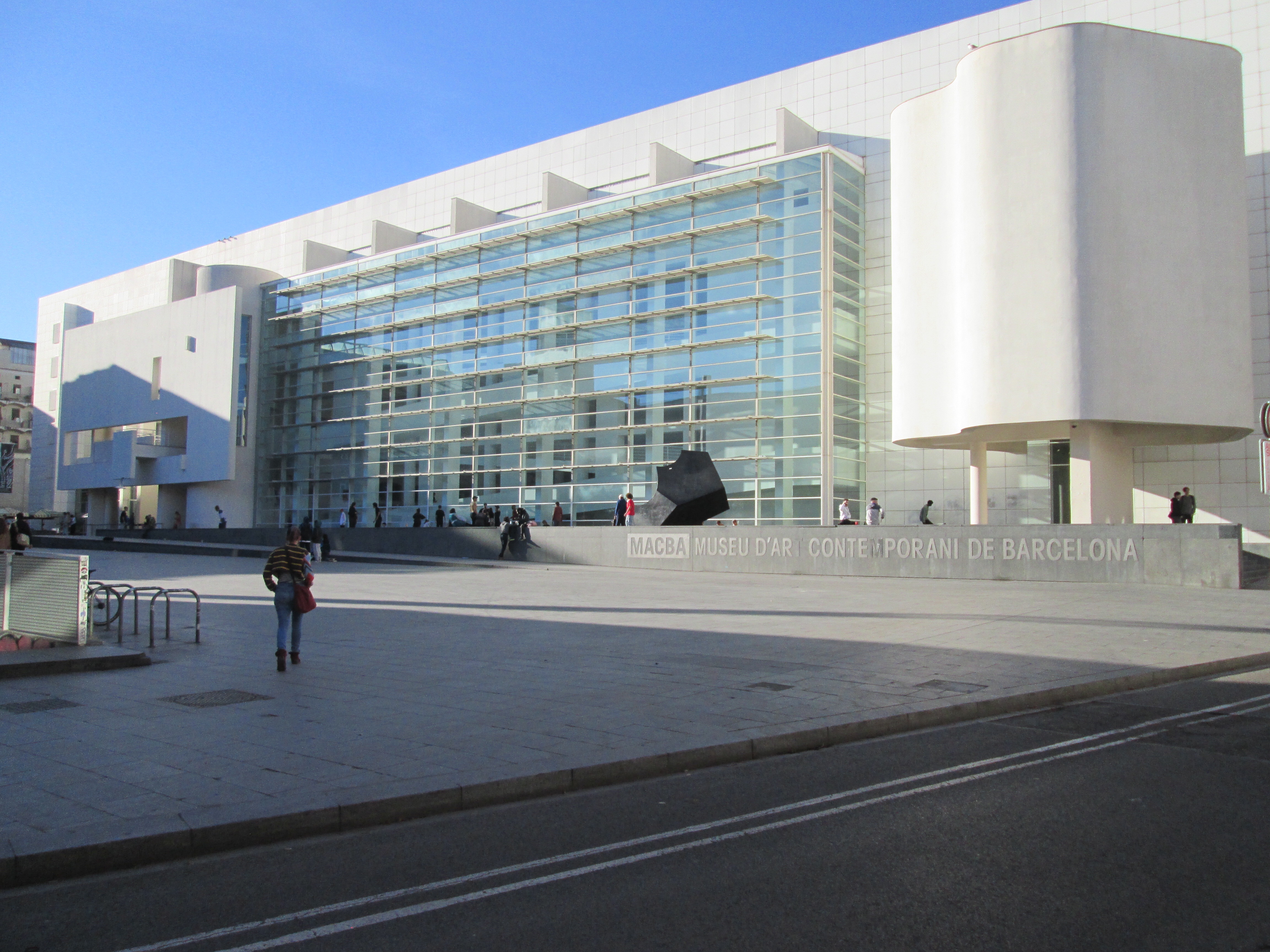
I have another short stroll to my next destination MACBA the museum of contemporary art in Barcelona. It’s new to me although it opened in 1995 so we must have missed it on previous trips. It’s a great white palace with a warning to watch out for skateboarders on the approach – what is it about art centres and skaters? One attractive aspect is that it has slopes not steps to link the various levels – reminding me a bit of the XXI gallery in Rome I visited in 2017. My appreciation of cutting-edge contemporary artwork is somewhat unrefined but I found two of the artists exhibiting here quite affecting. The Colombian Maria Teresa Hinchcapie which involved performance art, exploration of every day objects and photography gave me plenty to think about. Cynthia Marcelle is a Brazilian artist who had given a number of collaborators some materials to arrange as they wished. The result reminded me of a Cornelia Parker explosion of objects. There was another exhibit based on a Mexican Mixe myth which I found impressive in scale and impenetrable in meaning.
MACBA exterior, Hinchcapie video, Mixe myth and Marcelle room.
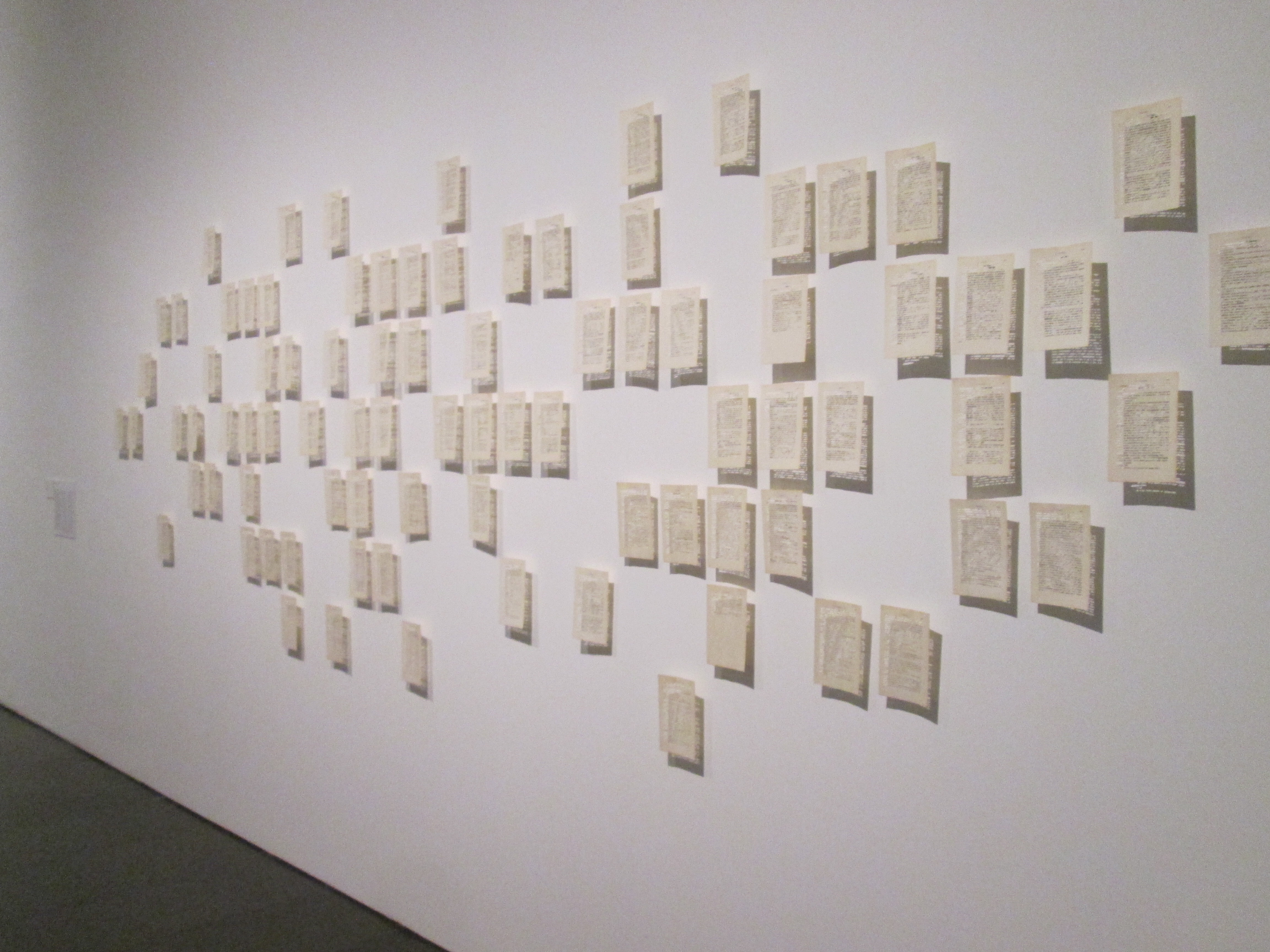
In the permanent collection were a number of pieces I really enjoyed – a Tapies bed and a series of pages taken from a book as if they had been typed without a ribbon so that light projected the text onto the wall. It’s by Mar Arza and is called Nada reiterada (nothing repeated). Most enjoyable for a bibliophile.
Sudden Awakening Antoni Tapies 1993.
The evening was rounded off in a convenient microbrewery Moritz opposite the hotel which was one of the few places open on Christmas Eve. It has a fine selection of house beers – lagers, IPAs a red IPA and a porter style Moritz Negra (black beer). Oh and it had a perfectly fine food menu too.
So Friday morning begins with a trip to El Corte Ingles to secure a USB to lightning cable. I don’t think I’ve ever been to Spain without at some point setting foot in the country’s prime department store. It delivered what I needed on the seventh floor – escalators all the way I’m pleased to say. Next on the agenda was to follow the advice given me on Wednesday evening and book a guided tour of the Palau de la Musica Catalana – all sorted for 11:30 tomorrow.
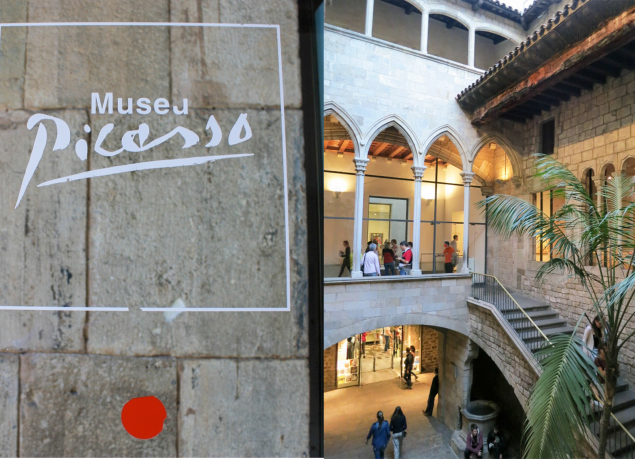
Next stop the Museu Picasso Barcelona – also free with Barca Card but they make you get a paper ticket from the box office as well. I’ve been here a couple of times before and while there’s always a good selection of Picasso’s paintings, prints and ceramics there is a major exhibition as well. This one is devoted to David-Henry Kahnweiler the German born dealer, collector and patron who did much to launch the careers of Picasso, Braque and Juan Gris.
Kahnweiler was quick to spot the movement that would become cubism and established a tiny gallery (four square metres) at the age of 23 where he exhibited early works by the then unknown Picasso, Braque, Leger, van Dongen and Vlaminck. He was friends with all of them and made good sales to kickstart their careers. As a German he had to go into exile in Switzerland during the First World War. He was considered an alien and his entire collection was sold by the French authorities in auctions at the Hotel Drouot. The sale catalogues make for interesting reading and a comprehensive listing of early twentieth century art.
Picasso sketching Kahnweiler, one of the photos in the exhibition.
There were works by many of his protégés and details of weekly soirées at Bourgogne-Billancourt where he entertained artists and potential purchasers. Picasso once wrote, ‘Where would we all be without Kahnweiler’s sense of business?’ I found it all fascinating, so much so that I took no photos – sorry. That is until I came to the huge room devoted to Picasso’s deconstruction of Velazquez’s Las Meninas. He made a series of over 50 paintings in which he analysed and recreated aspects of the famous work. This is my favourite. I love his self-portrait at the bottom right and the dog and the use of many images of his familiar iconography that find no place in the original.
After nearly three hours it’s time for some lunch. Everywhere in this area – the Born – will be expensive as it’s a major tourist attraction. However I find a corner in a popular venue and emerge refreshed. The Messi shirt shows that Argentina’s captain is still much loved in Barca. I was also surprised to find a flight of Japanese kites in an adjacent courtyard.
A few metres along Calle Moncada is a Museum new to me – MOCO. It has a branch in Amsterdam and opened in Barcelona in 2016 and I haven’t been here since before then. It’s devoted to MOdern/COntemporary artworks and features Keith Haring, Julien Opie, Damien Hirst, Dali and Banksy as well as less familiar local names. I did take a few photos here.
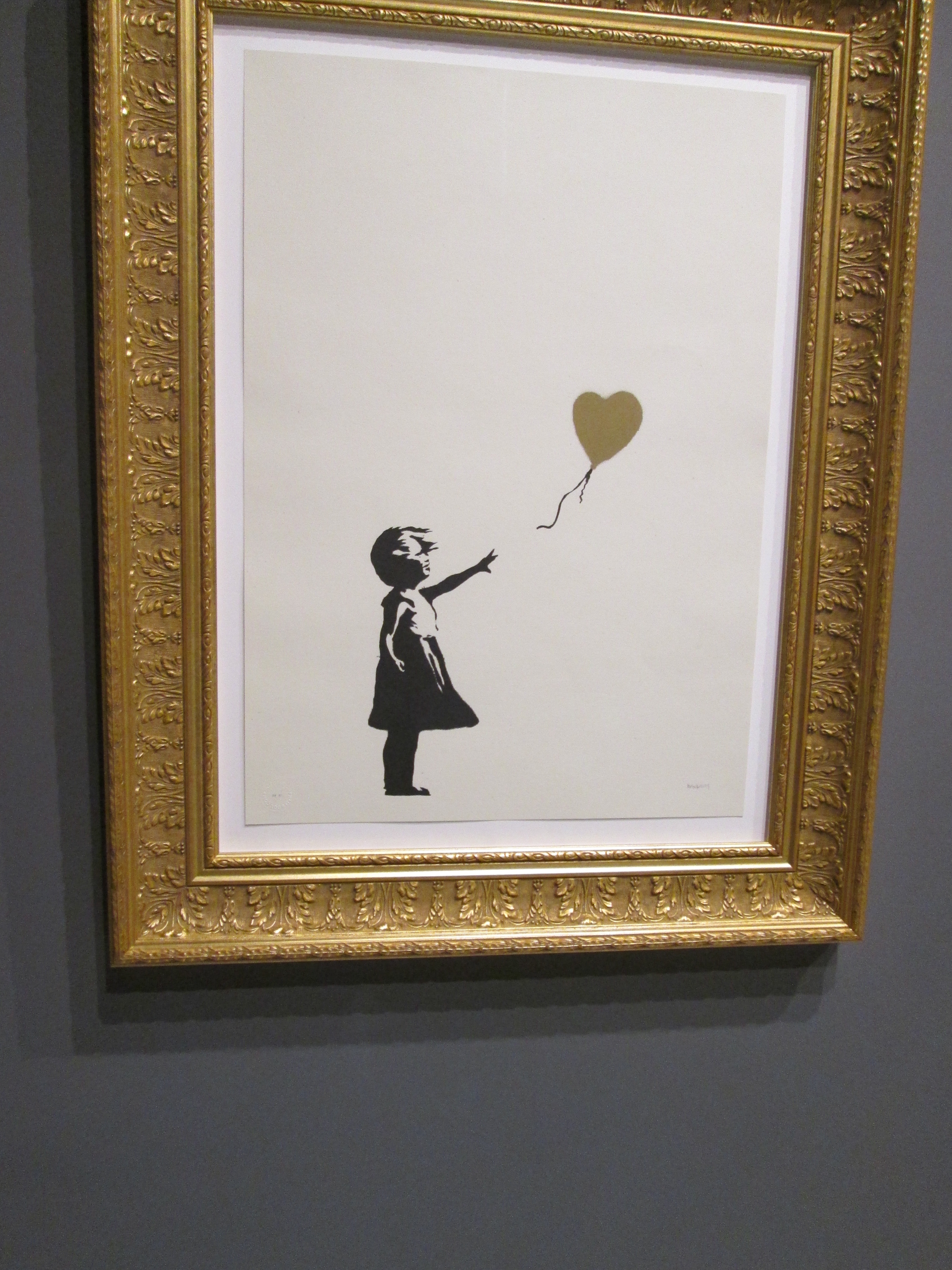
Dali, Banksy and a three layer asynchronous animated video wall that took my fancy.
As I’m quite a way down in the old part of the city I think it’s time to see the sea – well at least Barcelona harbour. As it’s Christmas time there are lots of tacky amusements on offer spoiling (for curmudgeonly me) a stroll along the waterfront. But there are some highlights. Graphics have always been wacky here since the Olympics, there’s always one seagull that won’t conform and I enjoyed the peace of the sun going down across the harbour looking out to the World Trade Centre where we filmed material for a promotional video for the Direct English franchise several years ago. All of course under the watchful gaze of Cristobal Colon.
So refreshed with my tapas in the Cerveseria Catalana and buzzing with my visit to Casa Battlo, I thought it was time for a bit more art exploration.
As I came from the station to the hotel on my arrival I had walked past this fine building with its wild bird’s nest hair. It’s the Antoni Tapies Foundation. I’ve seen Tapies’ work in other galleries but thought I’d take a look. Entry was free with my trusty Barcelona card so even more incentive. There were two exhibitions – one showing Tapies’ increasing use of varnish to affect the outcome, the other to Bruce Conner of whom I confess. I had not heard.
My first surprise was that although the building looked like it would be a gallery, I had to descend a flight of stairs to get to the subterranean exhibition space. Excavating basements may be popular in London now among the wealthy, but Barcelona has clearly been doing it for ages. As well as this space, I’ve walked past loads of Parkings with precipitous descents to way-below-street garages – glad I didn’t rent a car this trip as entrances are frighteningly narrow as well and I did recall wedging a Transit van on the way into a car park right beside the Callao metro station in Madrid while on a shoot there some years ago.
The Tapies space itself was light and airy with a suitably small number of paintings and objects displayed. They covered 30 years of his work from 1958 when he was awarded the Carnegie medal for painting, to 1988. I liked in particular his surrealistic deconstructed chair and several of the sinuous marks he’d made with painting and overlaid varnish. And of course there’s always the coarse one – he had a thing about the black letter X. Have a look.
Main gallery and some of the paintings
The other exhibit a further floor below was of work by Bruce Conner who’d escaped me but according to the descriptions on the wall was ‘the father of the video clip’. There were nine films in all ranging from three to fifteen minutes. The first was a horrific observation of the Bikini Atoll atomic bomb test, the next a sequence-shifting report on the assassination of JFK. Others were lighter – a piece called Looking for Mushrooms with music by Terry Riley,a noted consumer of same, so was all kaleidoscopic, psychedelic monochrome magic. Others used animation and effects considerably ahead of his time. I’m not always a big fan of video installations as art but these were eye-opening and thought-provoking. They also covered the period 1958 to 1976.
I stopped off at a supermarket on the way back to lay in beer, wine and brandy for the week ahead. Dee and I always liked a drink in our room to gather ourselves before going out to eat and old habits die hard. As I started writing the first blog I realised that I’d forgotten to bring the charger for the iPad mini on which I write, so scribbling would have to wait for tomorrow. So I got to my fine pigs’ cheeks a little earlier than might have been.
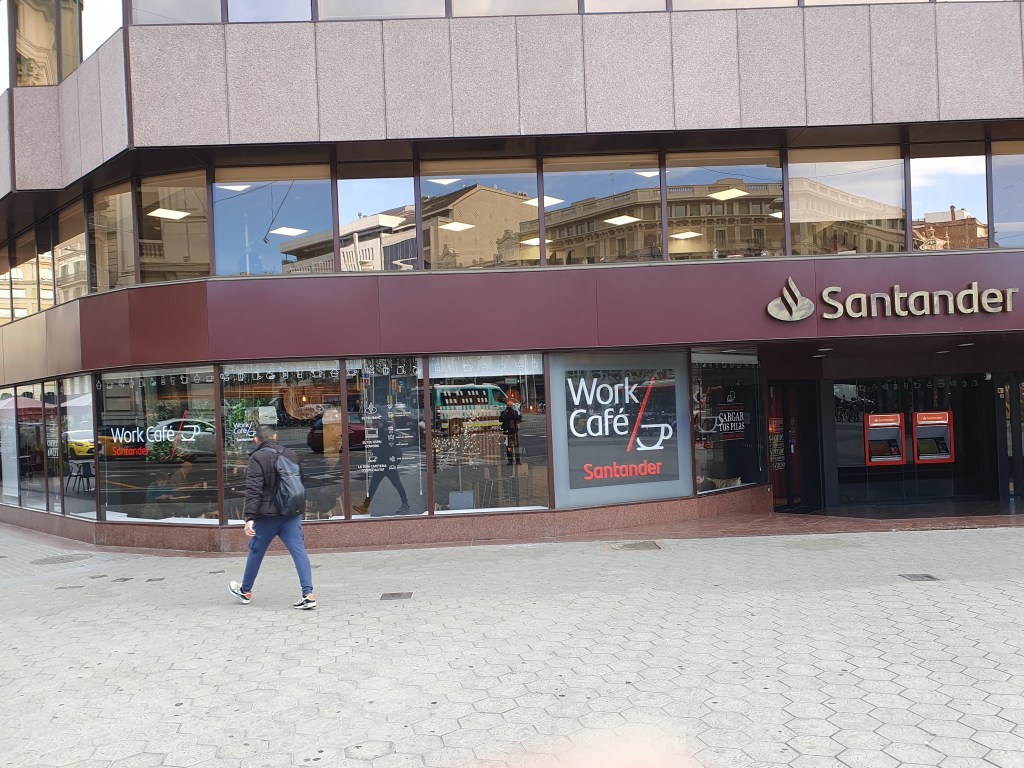
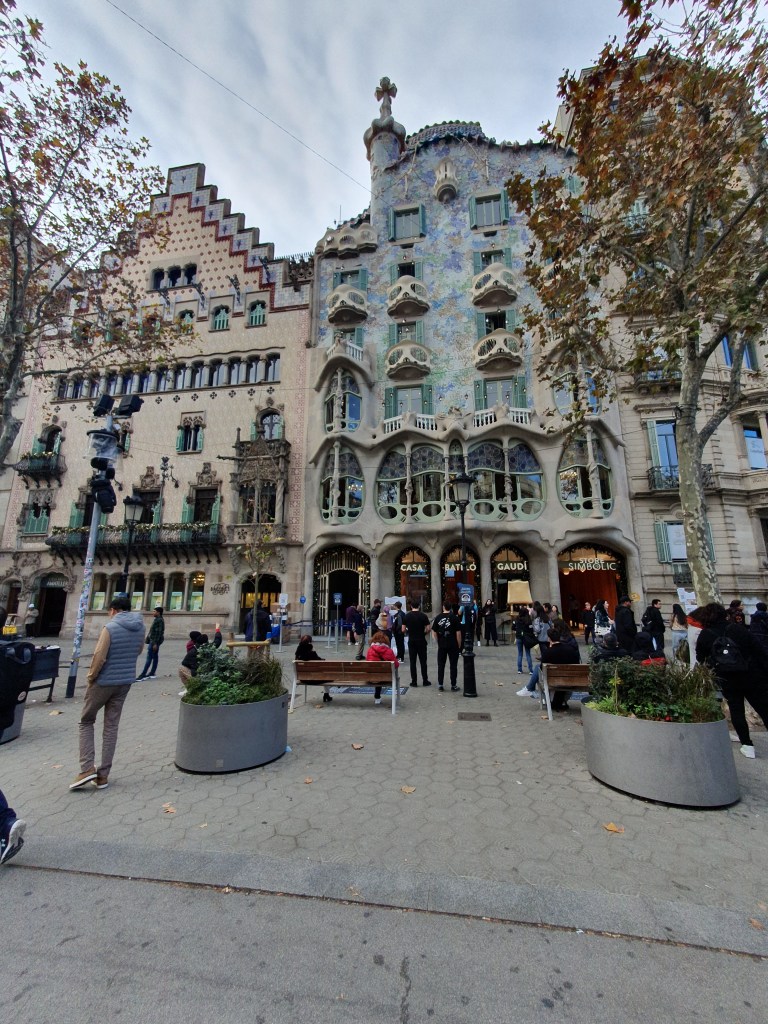
One of my reasons for choosing to come to Barcelona this year was to visit Gaudi’s famous Casa Battlo. I became friends during the year with a young composer Dani Howard who had composed the tracks for the guided audio tour of the house and I was keen to see inside the amazing building and hear how Dani had responded to her brief. The hotel has a breakfast buffet but I went in quest of something simpler. Opposite Casa Battlo was a Santander Bank work cafe which I thought I’d try. Result too, as Santander account holders get a 30% discount, so it was a very cheap juice, coffee and croissant. Loads of other industrious people were poring over laptops, negotiating on the phone and working hard. Interesting idea.
The Santander Work/Cafe and Casa Battlo exterior
The first part of the tour is in the basement in a Yayoi Kusama style mirror room. You step onto a moving metal platform and make a large circle through projections of the architect himself slumped exhausted among his drawings and the objects from nature that inspired his designs – fish, shells, mushrooms, rock formations. This is accompanied by a very watery track, whooshing waves mixed with orchestral sounds and set a theme for the tour which likens Gaudi’s structure to a section through an inverted ocean – I didn’t write the script!
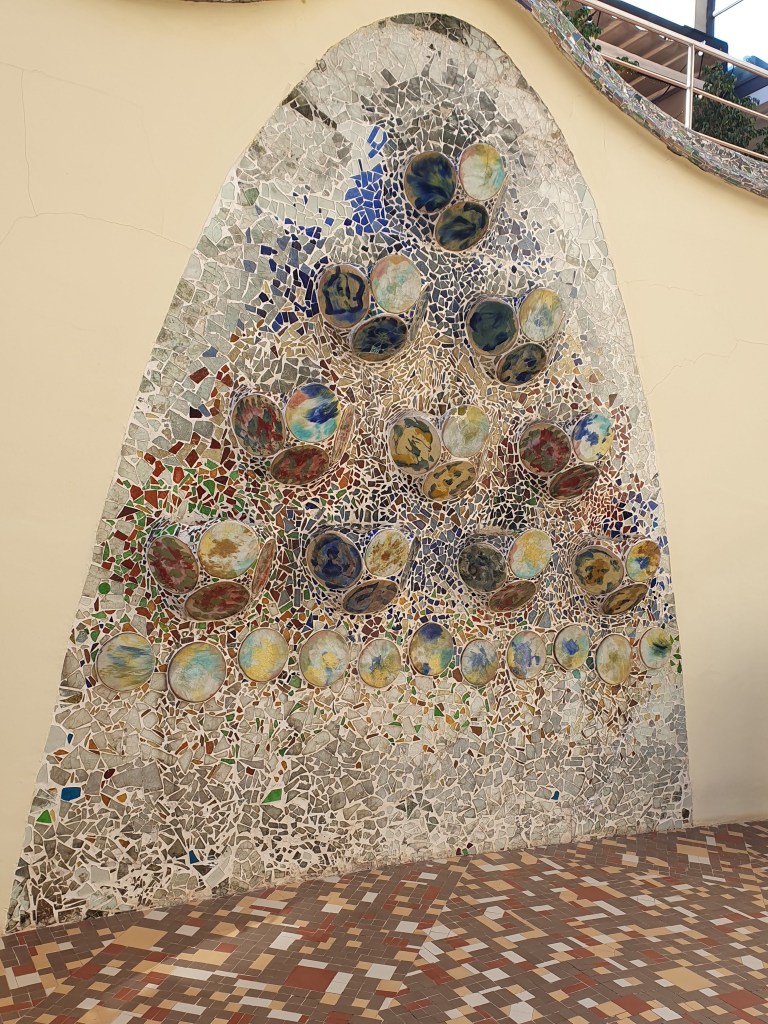
The tour proper is guided by a tablet with sixteen icons to select when you enter a room with that sign and commentary and music play. I absolutely love the building – the innovative elements, gorgeous woodwork, wrought iron balustrades and typical Gaudi trencadis – the patterned facades we usually call mosaics which combine broken tiles, glass and other materials making Gaudi the great recycler. I’ve added a few images from the house but it’s very tactile as well – you need to be there.
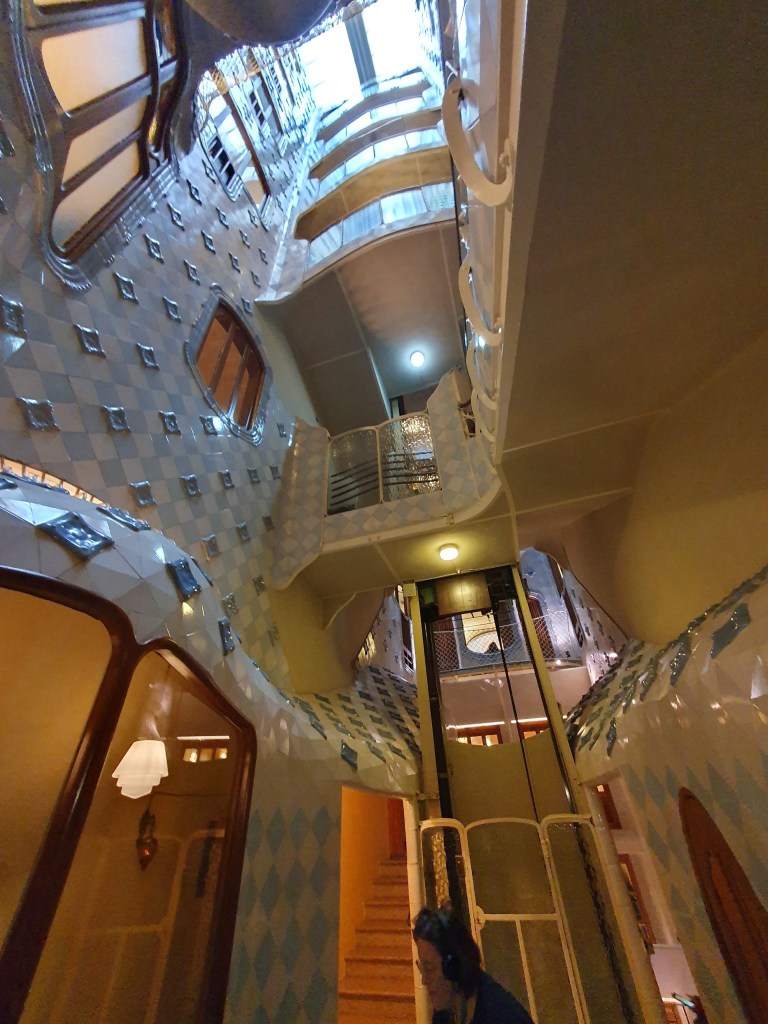
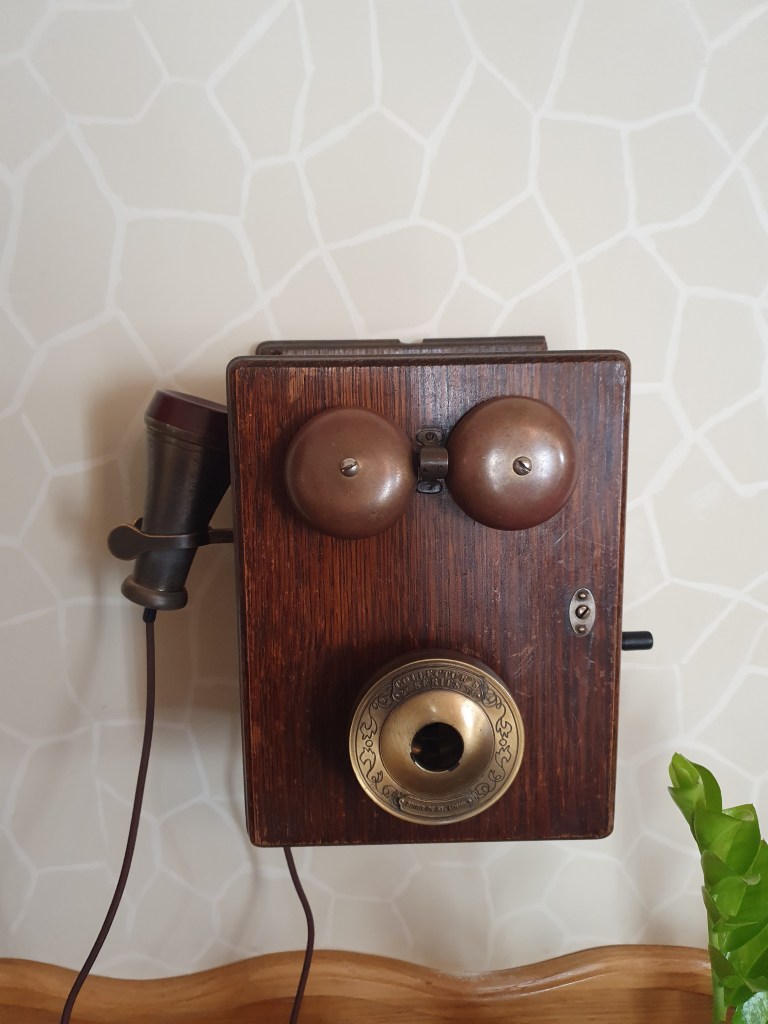
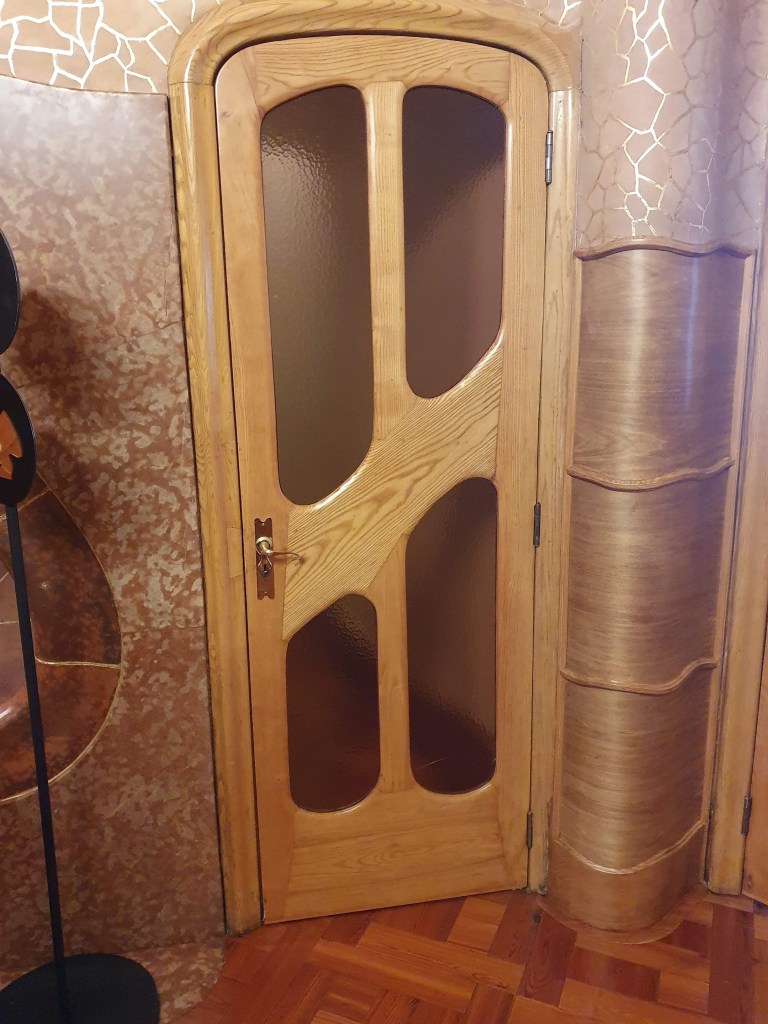
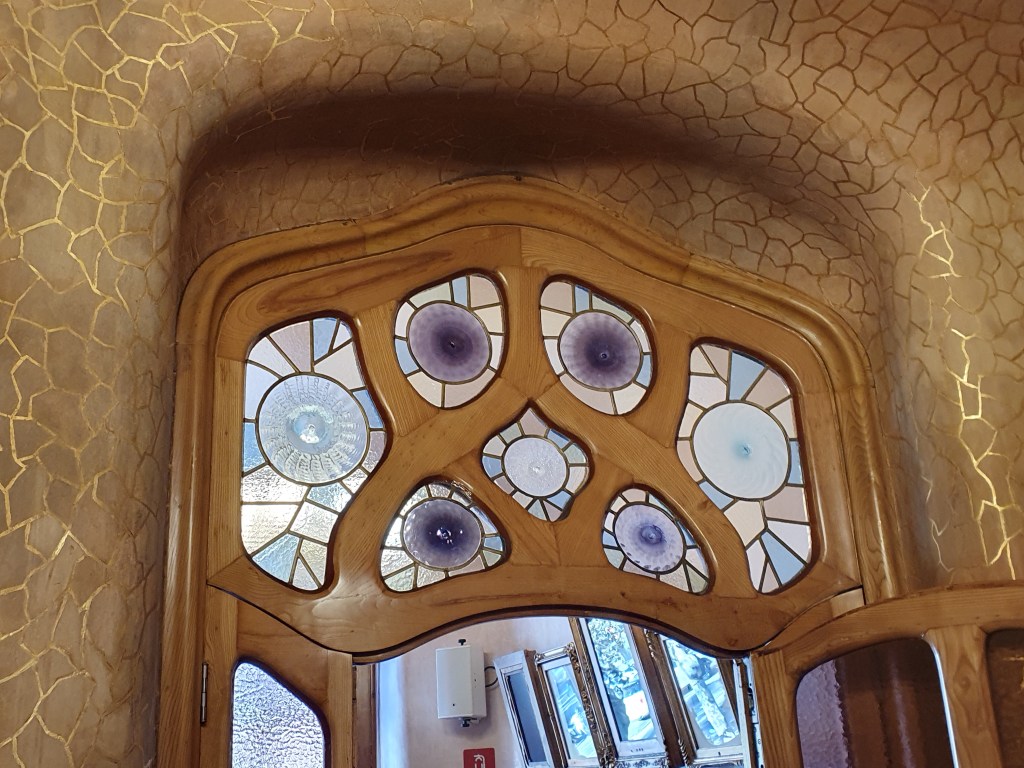
The atrium , wonderful early phone, lovely eccentric door and internal watery stained glass.
The house is tall and has this fabulous double atrium from floor to skylight flooding it with light – a very clever touch. So the the tour heads inexorably upwards until you reach the roof with great views over the city. As you mount each flight and select the next images so Dani’s music changes to fit the atmosphere and function of the room you’re in. It is wonderfully varied – simple piano pieces at times, what sounds like a marimba and cello rippling away for another but generally fully orchestral and often choral themes that work extremely well. The huge uplifting crescendo for the top of the stairs gave even my weary legs a jolt of energy. I think there’s a Battlo Suite for concert performance in there – rights permitting of course. And certainly there needs to be a CD or stream if this varied and atmospheric music wher a few recurring motifs are developed with creativity and technical skill to match the tone and function of each area of this amazing house. Great job Dani!
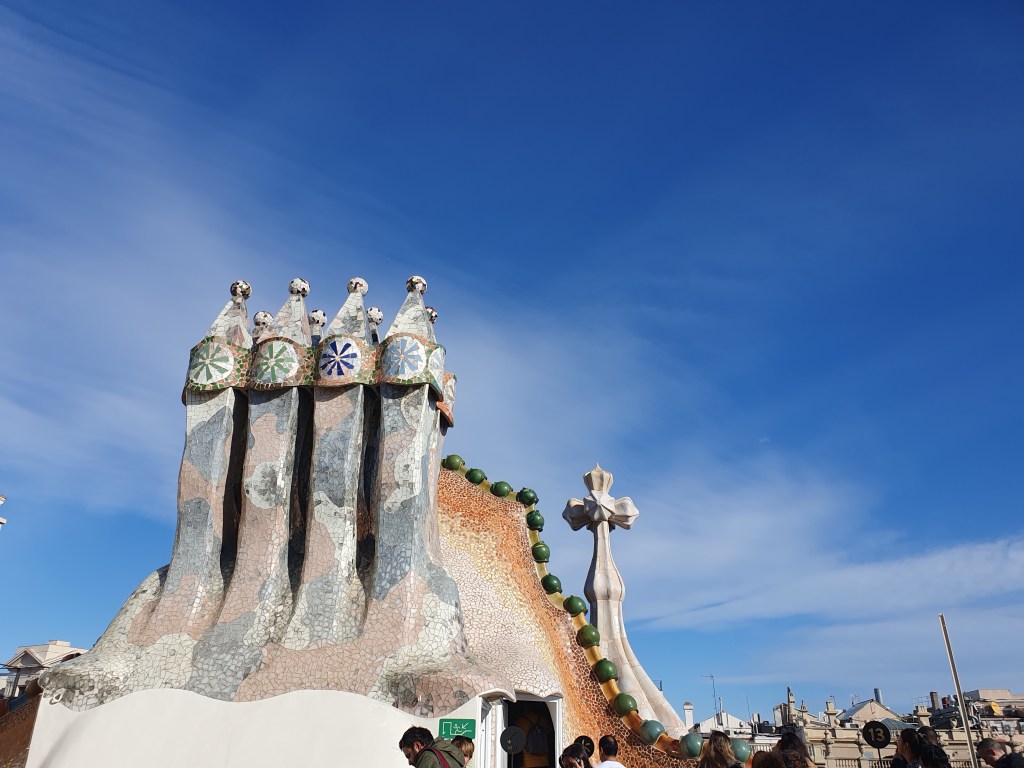
Water supply on the roof and trencadis flower pots on the patio
After a few moments contemplation on the roof marvelling that the large structures were in fact the house’s water supply we descend through another work of art. What was once the fire escape has been transformed by the Japanese sculptor Kendo Kuma who has draped the walls in swirls of aluminium links of chain mail which are aesthetically pleasing and highly tactile.
You exit through an immersive screen cube with projections of Gaudi icons and responses by artist Refik Anadol. The website suggests an hour and fifteen minutes – I went in at 11:00 and out at 13:30. House and music in utter harmony and I even made it up and back downstairs. I’d heard of the nearby Cerveseria Catalana and thought that would be a good option for lunch. Hah! Why I’d heard of it is that everybody else had, so I waited a little less than the threatened twenty minutes – it sometimes helps being just one – and enjoyed the amazing atmosphere and some great carved ham with a beer and then a glass of Verdejo with some anchovies and padron peppers a combination I’d not had before.
First things first – a trip at 10:00 to Clinica Belice for my two days before PCR test. Take 2 on that too as they needed to see my passport which was in the hotel – I’m really rubbish at this travelling lark. They were very efficient and friendly and I’m promised results tomorrow evening, [received Negativo at time of writing so if they have crew I might get home!].
Then later than usual to retrieve the car and set off. Well at least I know the way to Valldemossa and with the cloud much higher over the mountains I can appreciate the gorge that leads through the Sierra Tramuntana up to the town.
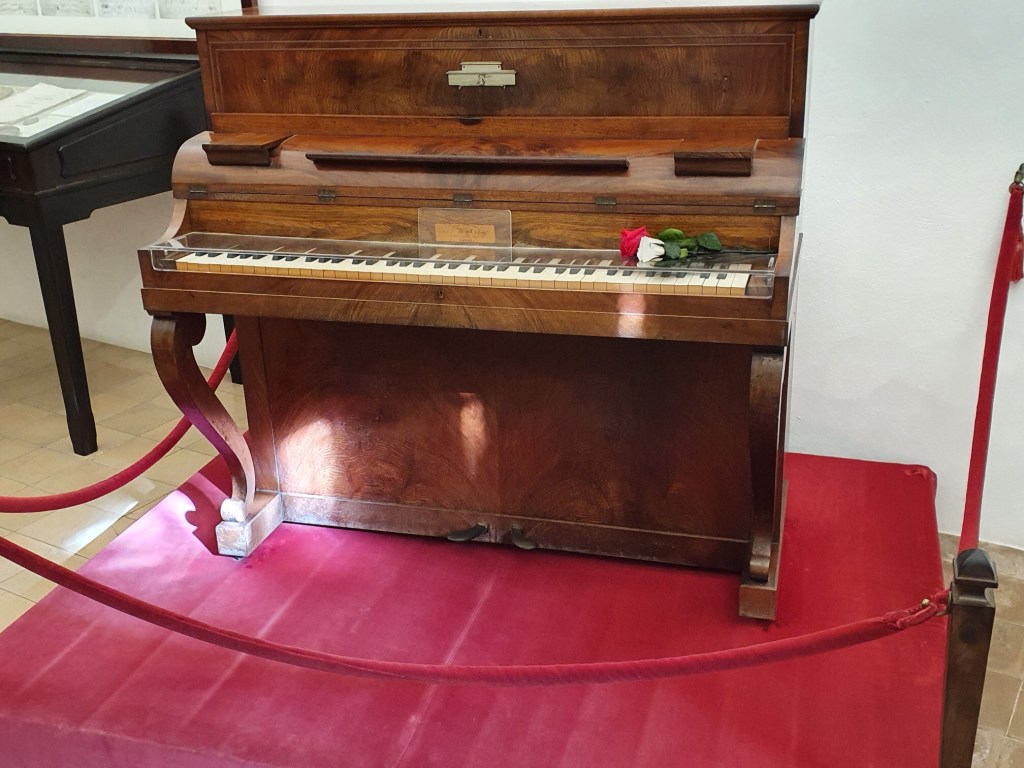
I know where to park so am soon in the Chopin/Sand cells inside the monastery. It is fascinating and reading George Sand’s disgust for the locals probably explains why they didn’t have a good time here. Her Un hiver en Majorque has some joyous descriptions of the landscape among the groaning about conditions and the impounding of a Pleyel piano for weeks by evil Spanish customs. When you read the copy you realise that they were only here for eight weeks and you wonder why all the fuss? She wrote about it and he composed some of his most famous works. Guess that worth some fuss – 24 Preludes Op28 are very highly regarded by Chopinistas.
The Cartuja cloister, entrance to Cell 4 and an interior view of the two rooms.
What is fascinating is to see the wall displays of facsimiles of his manuscripts with furious revisions. He hit the paper hard as well as the keys. And it is good to see his bust keeping a watchful eye on the piano they’d paid Pleyel 1200 francs for and from which he’d had so little use thanks to customs difficulties
To talk of them living in a monastery cell sounds like real deprivation and there were three adults (FC, GS and maid) and two children living there but they did have a garden of their own which Mme really enjoyed with its stunning views.
I’m not sure whether the trees had formed this circular shape in their day but the view this way hasn’t changed much.
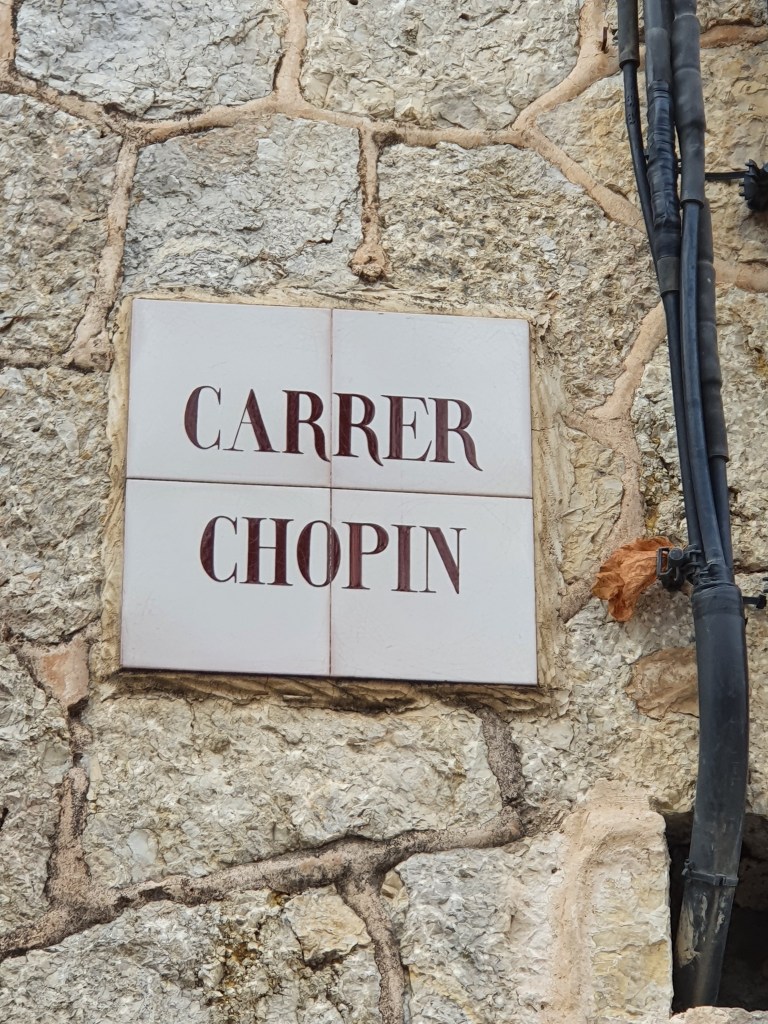
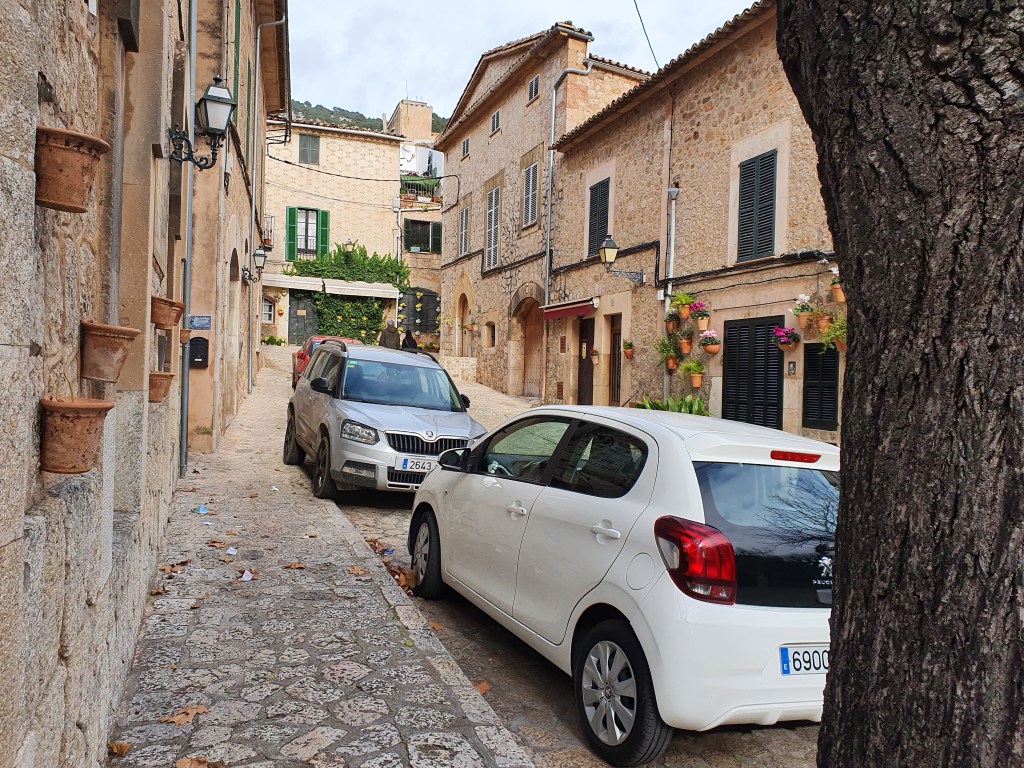
There’s not a huge amount to see and an hour and a bit sufficed. Valldemossa itself is too touristy for my taste, highly groomed streets, some interesting art but a whole lot of craftish tat. So i have a peremptory stroll, stopping of course to snap Chopin Street and WhatsApp it to my friend Jadwiga who is Polish and a Chopin groupie!
As I left the town I was struck by the large number of plane tree avenues leading to and from Mallorcan towns – there are some on the mainland but it feels rather French midi to me. I love them. Good now, but must be great in summer.
Having not eaten until four yesterday I thought ‘wouldn’t it be good if there’s a restaurant between here and Deia.’ There was and it is clearly very popular because while there were only a few diners when I arrived just before two, by the time I left it was full. I had some great sepia in a spicy pica-pica sauce and habanitas con baicon – an old favourite but here the very small broad beans had leeks, onions and peppers as well as bacon. Very tasty and timely – I thought.
Ca’n Costa filling up.
The short drive to Robert Graves’ house was familiar too and I much prefer the town to Valldemossa – sorry if that makes me a tasteless Brit. There was a convenient parking spot right opposite the house so I crossed the road full of hope.
The nicest ‘P off we’re closed’ sign ever!
Once again the lack of a planning companion struck – they close at 13:00 so I should have come here first. Doh! However the gate was not locked and I crept in to have a look at the garden at least. I was caught by the very friendly and fluent English speaking gardener who said he would have shown me round the house but had to leave at three-thirty. We chatted about the problems of gardening – it rained for the whole of November and everything is behind – but he’s doing his best, upon which I complemented him, explained I couldn’t come back again this trip but be sure not to miss it next time. He allowed me to take some photos and rewarded me with a couple of incredibly juicy tangerines.
Graves’-house, bust (by Epstein?) studio and tangerines.
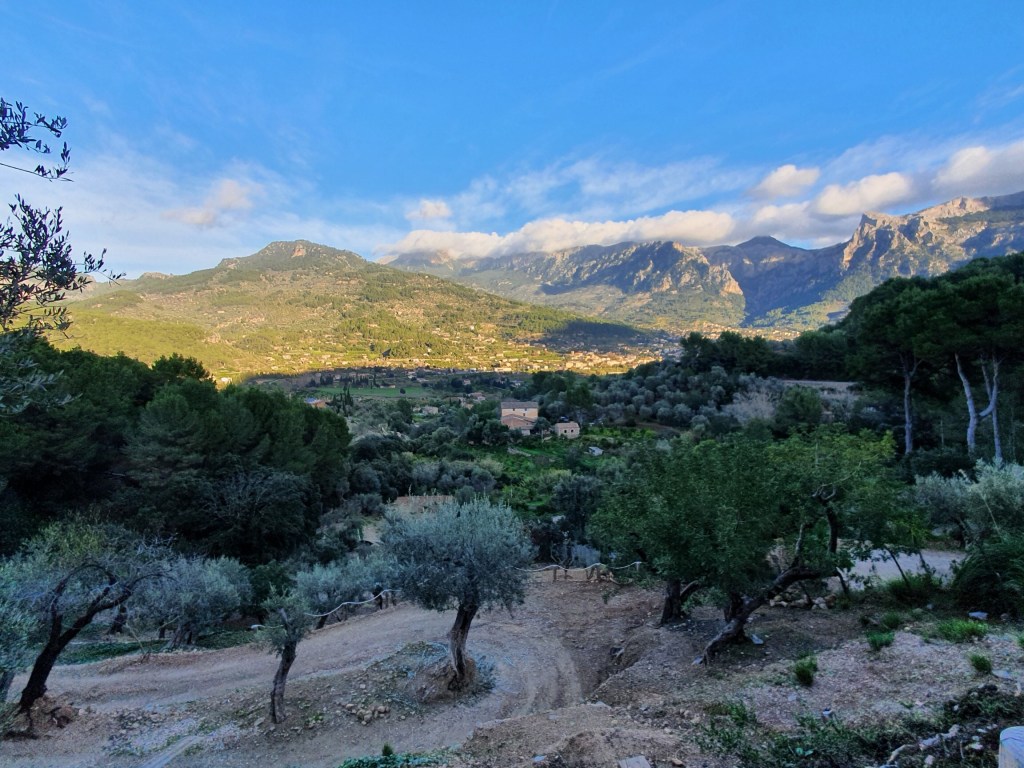
With little encouragement, I decided to carry on round the Ma10 to Soller and then head inland and back to Palma through the middle. With today’s better weather in the mountains their scale, variety and colours were amazing – just not enough safe stopping places for photography but I managed a few.
I passed through some interesting towns that would repay a visit: the Botanic Gardens at Alfaibia are closed until March, but look fun; Bunyola had some interesting buildings; and as I came to the end of the Ma2040 I found myself at the Mallorca Fashion Outlet – no point me stopping there! This is on the outskirts of the town of Inca which is linked to Palma by a near-motorway standard Ma13 so I headed on home or back to the hotel at least.
Christmas Eve has a special meal planned at the hotel but first there’s some boring admin to deal with. So after breakfast: Book a PCR test for Monday two days before flying home. Check 7 minutes walk from hotel, walk in service no appointment needed. Brilliant.
Christmas Day visit to Rosa and lunch out in the country will need a car. None available in the city but I can pick one up at the airport tomorrow and it’s on the way anyway. Check. So now to the real business of the day – a trip to the Fundacio Pilar i Joan Miro.
The location is out in the western suburbs of Palma in an area called Cala Major and it takes about fifteen minutes in a taxi from the hotel. One of the things I wanted after the grey of London was some blue sky. Not yet in Palma but today as I walk towards the entrance the cloud lifts and there is a good-sized patch of blue. And of course with Miro there will be more sun inside.
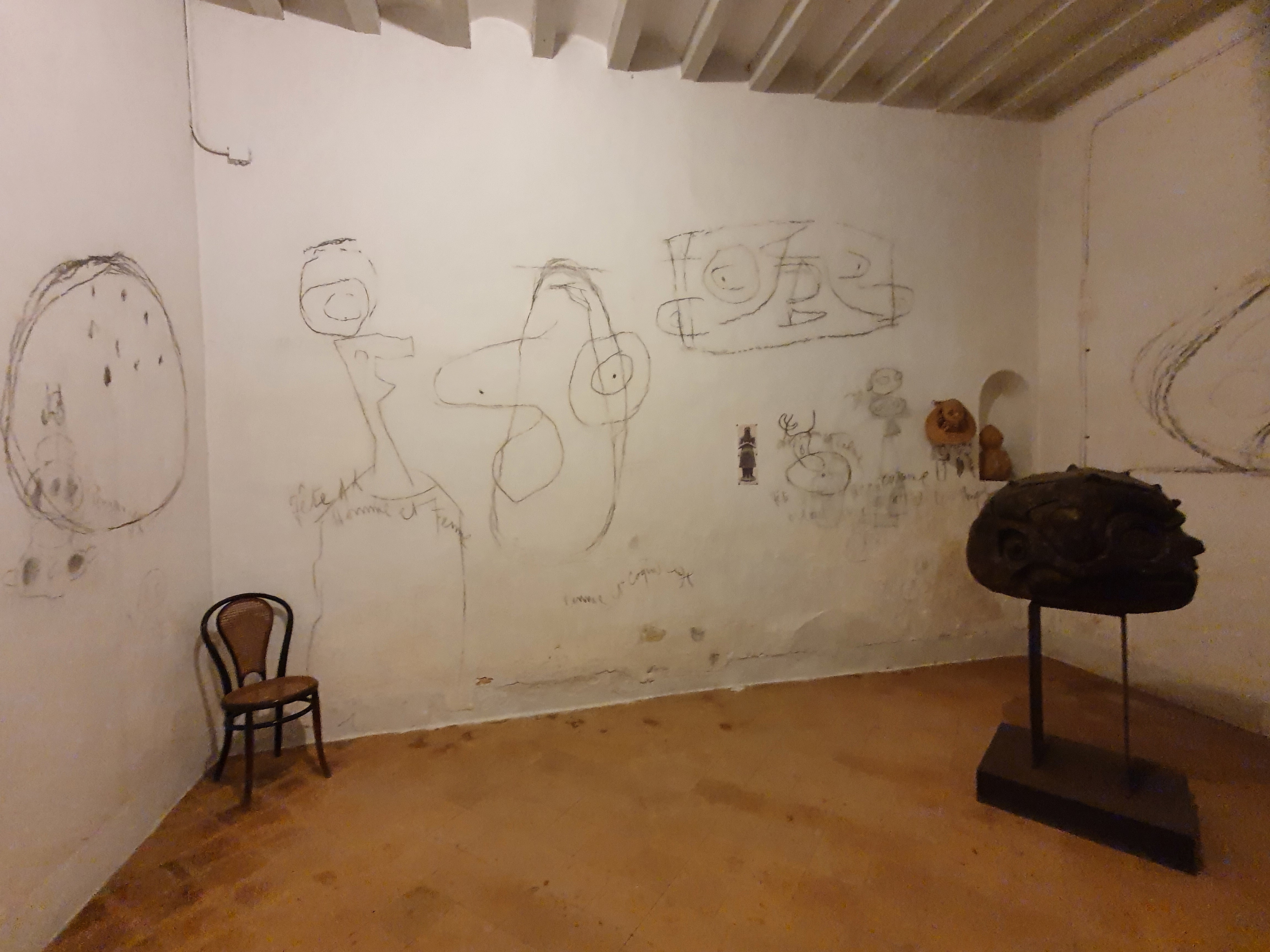
My visit was a little truncated as a large part of the building was closed for repairs and remodelling but both in the extensive gardens where big sculptures were displayed and in the studio where the stacked canvases there were ample testaments to the genius and prolixity of Joan Miro. He and his Mallorca wife Pilar, lived on Mallorca from 1956 until his death in 1983. He used a small building Finca San Boter while his friend Josep Sert was designing and building a purpose built studio, now known as the Sert Studio. Up in Boter it’s fun to see the remains of Miro’s sketching in charcoal directly onto the whitewashed walls and also to note the eclectic collection of everyday objects he took inspiration from.
Graffiti and inspiring trivia at Son Boter
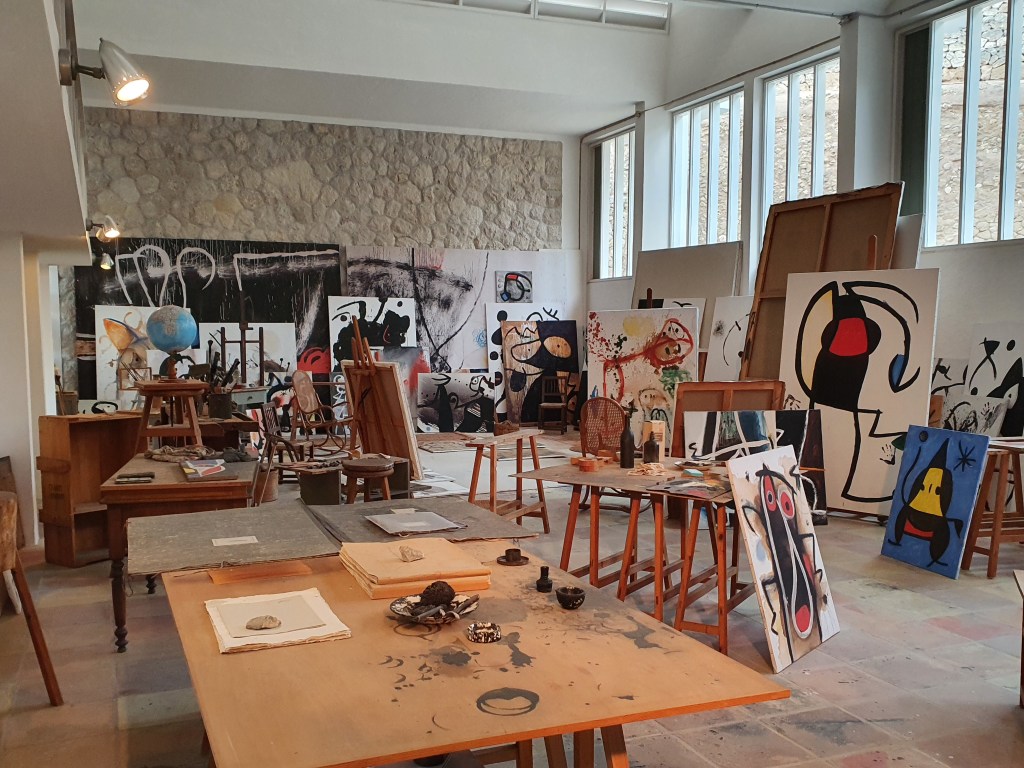
The Sert Studio is a fine building from the outside with a fluted roof either echoing waves or clouds and slanted tiles to allow filtered light and air into the capacious balconied studio. I was utterly gobsmacked by the sheer number of canvases leaning against each other and the walls. While there are strong similarities in Miro’s basic mark selection and palette, each canvas has a different atmosphere and you wonder what the finished articles would have looked like. It’s always fascinating to see artists’ work in progress and there’s plenty of it here.
The Sert Studio outside and in
There was also a rather good fifteen minute video about his life and work on Mallorca which after climbing and descending the many steps to Boter studio I was happy to sit for a while and watch. I was very pleased I’d made the trip out here and as I left wondering where I’d get a taxi, I came upon a bus stop that said Route 46 went up the Passeig de Mallorca which is very close to the hotel. It also had a QR code that informed me that a bus was due in ten minutes so I decided to wait. Well worth it! It headed off in totally the wrong direction according to my understanding of where Palma lay, but eventually came to a terminus in Genova, waited for a while and then returned me through bustling suburbs including one that must have been close to the more infamous areas of Mallorca as there were adult only entertainment bars, sex shops which I found a bit surprising next to supermarkets and pharmacies. However it did pitch up where I wanted and I had a stroll back to the hotel with a few stops for liquid, but little food refreshment as a six course meal was planned for nochebuena in the hotel. This began at nine o’clock began with cava, a delicious fish soup, crispy octopus and fillet of sea bass accompanied by frequently poured Verdejo and after a short pause and change of glass, a Rioja went nicely with the lamb stuffed with foie gras (apologies vegans!). I declined the tiramisu with red fruits but did have some home made turron (nougat) with my coffee. By now I was chatting to my neighbours Carl and Cristina, Swedish fiancés who were here for Christmas before heading to Andorra for skiing where they had become engaged this time last year. Sampling a copa or two of Mallorcan brandy, we got on well and I have an invitation to their wedding in Stockholm in August. I may just be too busy with centenary celebrations at Watford to attend however. But what a lovely Christmas Eve and one that didn’t end up in hospital!
Well, after careful consideration, I decided I would go away for Christmas and with a family recommendation I’m heading for Palma de Mallorca for a week and will rent a car to see a bit more of the island while I’m here. I’ve completely forgotten how to pack and found the new rules about cabin baggage confusing – for an extra 20 quid I can take a big and a small one – one for the locker, one under the seat. Hooray no waiting at the carousel!
As the flight is at 07:10, I’ve booked into the Premier Inn North Terminal at Gatwick with a week’s parking with Purple Parking. So out of practice, I go to the hotel first and check in only to be told that I should have parked first and come in on the shuttle bus. As I go to retrieve the car there’s a security guard on his walkie talkie summoning the bomb squad. He admonishes me “Never leave a car unattended in an airport”. I grovel and set off. It transpires that Purple Parking is halfway to Brighton and I have a vague recollection of using it under a different name once before when Dee, Jacque, Toddy and I set off for the Copa de Ibiza in 2004, my only other venture to the Illes Balears. A short wait and a bus takes three of us to a stop outside the terminal from which the only route to the hotel appears to involve dicing with death with drop-off traffic. I make it, have a beer and supper and retire fairly early with the prospect of a 05:00 alarm. I was concerned that extra security and health checks might make the security/check-in process even longer than usual. It was not too bad and soon I was at the gate where my bag option also conferred ‘speedy boarding’. a real bonus. The flight was busy but not full so distancing and masks were easily possible. As we took off and headed out across the channel the sunrise was amazing (and a bit sharper than the through the window phone shot).
A corner of Sussex as the sun comes up.
The flight was pleasant enough with solid cloud over most of France until the Auvergne and the eastern Pyrenees showed a light touch of snow. We even arrived ten minutes early – just as well as getting out of Palma airport is a task of IKEA-like proportions. A bus into town, walk to the Hotel Amudaina where, despite it being 11, they kindly allowed me to check in rather than just leave my bags which is what I had expected. Having declined EasyJet’s breakfast offerings, it was dump stuff in the very pleasant and spacious room and pop next door for my first orange juice, croissant and an excellent café solo doble. Refreshed I decide to go and explore. It’s not long before I get confirmation of where I am.
This sign is on the waterfront where there are lots of posh yachts and in the distance those apartment blocks of cruise liners that flock to the wonderfully curved harbour.
Next to this is the Lotja, the old stock exchange which with its barleytwist pillars and fine ceiling reminded me of the similar building in Valencia. That evening I was to say to a friend I met later on that much of Palma reminded me of Valencia – no bad thing in my book.
So I continued to walk around the city with occasional breaks for coffee and beer. I found the cathedral which I plan to visit tomorrow and the market – Mercat del Olivar – I love the colour, the smells and the constant babble of chat in Spanish markets and had some tapas in a bar inside it. The Plaza de Espana was a bit sprawly and dull, the Plaza Mayor very elegant but spoilt by Christmas market stalls – what have the Germans done to the worl.
The Olive Tree market and a fine modernisme house
The old town is filled with narrow streets and occasional delights of modernisme architecture. Feeling I’d had a good first orientation I went back to the hotel to change into more suitable garb for a concert at the Palacio de Congresos where I was to meet my friend Rosa Pascual and her mother. As it happened Rosa’s mum wasn’t feeling too well so I had the pleasure of Rosa’s company, and no need to confess to my lack of Catalan, for a concert in a fine new auditorium.
The auditorium and the huge orchestra with professionals in black and students in white, some of whom looked only about twelve or thirteen.
It was given by the massive forces of the Orquestra Simfonica dels Illes Balears. The programme opened with a festive overture by William Grant Still which was unknown to me and quite lively if a little rough at the edges as the band settled down. We then had Handel’s Water Music and a suite from the Nutcracker at which I kept wanting Matthew Bourne’s dancers projected on a screen behind them. It then went a bit poppy and Hollywood before concluding with a special arrangement of some Catalan carols which nearly had Rosa joining in and which we both really enjoyed. Rosa thought the conductor had made a very sensitive treatment of some old favourites. She then kindly dropped me off at the hotel but couldn’t stop for a drink as she had to drive back into the middle of Mallorca along dark and twisty roads to a villa she’s staying in. I went for a walk around the neighbourhood, was declined entry by one restaurant which said the kitchen had closed so ventured a little further and supped in La Bodeguilla with a great atmosphere, far too much food and my first taste of a local Mallorca wine OBAC de Binigrau which was a blend of several grapes, lightly oaked and most acceptable but I think they should leave off the subtitle if they want to export it. It had been long, varied, exciting and lovely day – and I’m abroad!




























 mikeandmurakami.com