When I met Jenna Raggett back in March at St George’s Hanover Square, we agreed to keep in touch. We did and so I set off with family and friends to the Royal Albert hall to see a BBC Prom given by the Irish Baroque Orchestra in which Jenna plays violin. So we had the delightful moment pre-concert in which Jenna could say “Michael Raggett meet Michael Raggett”. Her father is also a Michael and stayed and had a chat to me and two other Raggetts – Tom and Caroline – while Jenna went off to change and prepare. The Irish branch also have a cousin Michael who lives in Basingstoke! Also with us were my friend Jadwiga and her daughter Lucy and son-in-law Brian who were amused by this weird nominal encounter. We then went to our excellent seats and enjoyed a most magnificent performance of Handel’s Alexander’s Feast, a work I’d not heard before. We all enjoyed it thoroughly as did the critics (here’s just one of the reviews). In another coincidence the counter tenor Hugh Cutting was performing and we had seen him a Garsington back in June in Handel’s Rodelinda and singing with Tom’s choir Pegasus the next day at St John’s Smith Square . All the soloists were great as was the energetic conducting of Peter Whelan and of course the mellifluous playing of the violins!
Peter Whelan saluting the orchestra and soloists. And then we got the Hallelujah Chorus as an encore.
Behind Closed Doors …
That outing marked the end of August but September has started with some further treats. Thanks to my friend Frances’ patronage of several theatre companies, I get invited to some behind the scenes events as well as the plays themselves. We had the privilege of going into the rehearsal room at the Young Vic for a Q&A with the cast of Joe Orton’s Entertaining Mr Sloane.It was a fascinating discussion of how the outrage it caused in 1963 was in danger of being repeated in our time too in the case of people who don’t conform to some British ‘norm’.
Also it was interesting to hear how the actors ahd prepared for their roles, including a visit by Tamzin Outhwaite to Sheila Hancock who had played Kath in one of the earliest productions. It was also a special moment to be able to look at the maquette for the set and see the marks and props laid out for rehearsals. We also had a chance to chat to the new artistic director of the Young Vic and director of the play Nadia Fall.
A couple of days later Fran invited me to a patrons’ event at the Orange Tree Theatre in Richmond. Again it was a huge privilege to be present at a technical rehearsal – the moment when all the elements – lighting, sound, wardrobe – some easing needed of tight waistcoat and attention to a cravat – script assistant, technical crew and of course the actors and director put it all together in the actual theatre space. Once again it was the Orange Tree’s artistic director Tom Littler who was directing the play – August Strindberg’s Creditors in a new translation by Howard Brenton, whose brilliant Churchill in Moscow we saw here earlier in the year.
The cast was very impressive Charles Dance and Nicholas Farrell were working through a lengthy scene with references to the third cast member Geraldine James who was in the theatre but not involved on stage during our visit. Watching silently from the balcony it was interesting to look at the processes of blocking the scene, adjusting lighting and sound levels and to note the great difference in approach between directing for the stage and for television. An afternoon of real insight. Can’t wait to see the full play.
And out in the open …
My friend and colleague in the British Bilingual Poetry Collective, Shamim Azad had been asked to curate a family day at the Serpentine Pavilion in Kensington Gardens. This was very special as this year’s pavilion, the 25th, is the work of Marina Tabassum a renowned Bangladeshi archictect. There were sessions of storytelling, poetry performance and traditional Bengali song and dance throughout the day from 10 until 3 in the afternoon.
Our poets included our executive director Eeshita Azad originally from Bangladesh, Sara Kärpänen originally from Finland, Chiko Jones originally from Nigeria and Pip McDonald still from Sunderland. They each recited poems to an enthralled audience – in all cases mixing their original language with English.
Pip doing ‘Time’Chiko in Igbo and EnglishEeshita reading in BanglaSara in Finnish and EnglishSally the storyteller with ShamimThe poets invited me to join them for a group photo
As well as our own group Shamim had invited an experienced and engaging storyteller Sally Pomme Clayton who opened the proceedings and Mukto Arts who played and danced after our poets with some fine traditional Bengali tunes and encouraged the audience to come and join them which they did with ages ranging from, I would guess six months in a baby sling, to seniors like me.
Shamim takes a breakDancers from Mukto ArtsThe audience joins in the dance
I’ve been to many of the annual temporary Serpentine Pavilions over the years with memorable ones from Zaha Hadid, Frank Gehry, Sou Fujimoto, Theaster Gates and Ai Wei Wei with Herzog and de Meuron. It was wonderful to see Marina Tabassum’s pavilion which she calls A Capsule in Time filled with these performances and also with seed planting, weaving, character creation and role play sessions going on concurrently. A really fun day out and I was just there to support our team not to perform which was a great relief.
After the madness of May the new month starts at a somewhat gentler pace. First up on 2 June is a trip to Glyndebourne to see the Festival’s first ever production of Wagner’s last opera Parsifal. Having just driven to Stratford and back, I decided to do this one by train and the excellent £10 return Glyndebourne bus service from Lewes Station. It worked really well and I arrived on the most beautiful sunny day, took a walk around the lake, had a glass of wine and watched all the lovely people. I decided on a dark suit rather than the full DJ and it’s becoming clear that the dress code is much more relaxed than it used to be – there were even men in shorts! Oh and had a preview of dinner!
So, into the auditorium and during the wonderfully atmospheric overture a caption appears on the curtain referencing Cain and Abel. Now Wagner had already mashed up Arthurian legend with strict Roman Catholic Good Friday rituals. Could the story take another level of myth? Well in my opinion, no. The main charaters’ alter egos or older doppelgänger mooching around at the back of the set didn’t do it for me and the construct that Klingsor and Amfortas had been quarreling brothers also didn’t wash. All that said it was magnificently sung and the orchestra under Robin Ticciati was just sublime. And there were some great moments of theatre in Jetske Mijnssen’s production too. I loved the gang of Kundry clones whooshing down on poor Parsifal and I liked the procession of Titurel’s coffin round and round the altar before laying him to rest. On the coach back to Lewes one visitor complained that this went on a bit too long to which I replied “Well, there is a lot of music to get through before the next aria and at least there was some action.” Despite some reservations about the over-concepty production it was a great evening and I’m very glad I saw, but especially, heard it.
The Kundry clones take a bowParsifal takes his applause
The next evening (Tuesday) saw me join a friend from 50 years ago, Alison Dunn, at her retirement party in the splendid Humble Grape wine bar off Fleet Street – a great choice as that’s where we first knew each other when she worked on Education and Training magazine with Barry Turner a long-standing writer and editor friend who did some consultancy work for me in my guise as an educational publisher back in the 70s. Tasked with speaking to everyone in the room – I only knew Ali – I did about 70% and what some fine famaily, friends and former colleagues she has.
Each year in November the British Bilingual Poetry Collective, of which I’m a trustee, runs an interactive poetry event as part of Tower Hamlets’ Season of Bangla Drama. So on Wednesday Shamim Azad, the founder, and I head off to see the coordinator of the festival Kazi Ruksana Begum to discuss plans schedules and the broad outline of this year’s event. The theme for 2025 is ‘Kindness’ and we’ll be switching our focus from Rabindranath Tagore to the national poet of Bangladesh Kazi Nazrul Islam in a session with the title Kindness with Kazi.
< Last years’ poster
The evening brings the last concert I’ll see in the Orchestra of the Age of Enlightenment’s Southbank season. It’s an old favourite but like you’ve never heard it before. Elgar’s Enigma Variations must be one of the most played pieces in the repertoire with ‘Nimrod’ known in many different forms. However, the OAE presents ‘ historically informed’ performances so to hear the music played on gut strings, wooden not metal flutes, French not German bassoons made it sound completely fresh. Quite possibly how Elgar himself would have heard it. The variations formed the second half of the concert. Before the interval we heard his lively concert overture In the South written while he was in southern Italy and reflecting the sounds and landscape of the country. The mezzo Frances Gregory then performed five of Elgar’s Sea Pictures with great sensitivity and bursts of power to soar above the rich orchestral tones. the Portuguese conducter Dinis Sousa made his debut with the OAE and clearly developed a great rapport with them. He’s the principal conducter of the Royal Northern Sinfonia based a the Glasshouse in Gateshead and looks a fine prospect.
I remember a lot of excitement around Patrick Marber’s Dealer’s Choice back in 1997 in the confines of the Cottesloe theatre at the National and I enjoyed it very much at the time. I was looking forward to this revival in the similarly contrained arena of the Donmar and it didn’t disappoint, mainly thanks to a brilliant performance from Hammed Animashaun as Mugsy. The banter between the boys, the knowledge that he’s going to lose and his dream of opening a restaurant in a disused toilet in Bow infuse the whole play which has a spectacular set transformation that’s worth the ticket alone. As with House of Games, I’m more than ever convinced I’m not cut out to be a gambler.
I should have gone to Garsington to see Tchaikovsky’s Queen of Spades on Friday. However my frequent opera comapnion Jadwiga was unwell and I couldn’t find a replacement at short notice. The brilliant box office have moved my booking to 21 June and we’ll be seeing Handel’s Rodelinda instead.
My next musical outing was on Sunday 8 June when I went to a new venue for me – Charterhouse. It was a concert organised by the Barbican as part of the European Concert Hall Organisation’s (ECHO) rising stars programme. It was a recital for trumpet and piano and featured a premiere piece Continuum by my friend Dani Howard. Dani had worked with the trumpet player Matilda Lloyd to create the piece. As Matilda said in her intro “It started with an icecream on the beach”. Knowing Dani’s large orchestral works, her opera and hearing her percussion composition for Colin Currie last month, it confirmed – if it needed it – her versatility and gift for melody and creating atmospheres. Matilda and her pianist Jonathan Ware had played this piece 18 times as they toured the European concert halls who form the ECHO with this one being the last. They all kindly invited me to join them for tea and cake or a beer after the concert so it was altogether a super Sunday afternoon.
CharterhouseThe composer takes a bowDani, Matilda and Jonathan
As a special offer if you’d booked a Barbican ticket you could see the Encounters exhibition for a fiver, so I did. This was in a small gallery on floor 2 and featured the contrasting works of Giacometti, with whom I was familiar, and Huma Bhabha who I didn’t know at all. Huma was born in Pakaistan but is now based in upstate New York. Her monumental works which incorporate found materials contrast with the elegant skinny figures of Giacometti. I know which ones i’d like to own but it was an interesting hour contemplating differeing approaches to making sculptures.
The Encounters exhibition at the Barbican
Continuing with our catholic cultural chase, my next visit was to Sadler’s Wells with my daughter Jo to see Mathew Bourne’s The Midnight Bell . This was a belated birthday outing for Jo and we had a fine early supper in Moro before making our way through the heaving Exmouth Market up Rosebery Avenue. What are all these people doing out on a Tuesday? The ballet is set in sleazy Soho in the 30 where the eponymus pub is host to prostitutes, closeted illegal gays, a lovestruck barman and various other denizens of nighttime London. There were duets, larger ensemble pieces, the most amazing and fluent set changes and original music blended with ballads from the era sung with original vinyl hiss and crackle, endless style and commitment by booming baritones. We both enjoyed it a lot and chatted about it as we made our way back to Farringdon for trains back home. It’s good to enjoy your daughter’s birthday treat too!
Yoshitomo Nara is an artist I’d seen a little of and so off I went to the Hayward Gallery to see what must be one of his biggest ever shows outside Japan with over 150 works displayed. He’s the epitome of Japanese kawaii kitsch but with a twist – those sweet faced Hello Kitty style children’s faces contain messages of disquiet, protest and fear. Nara is very political in his work and repeats themes throughout his long career which the exhibition spans. There are installation – a ramshackle shed, a teacup fountain, paintings, drawings and sculptures spread over the whole expanse of the Hayward. It was fascinating to start with but there’s just too much to see and too much repetition of the themes that are dear to him. I’m glad I went however and got to have a chat with a film crew shooting it for The Sunday Times.
There was a double challenge getting from the gallery to my dinner with friends in Soho. First I had to navigate the waterfall and fountains on the walkway. They were fun – a cascade from the level above, water pouring from a waist and a green figure with a fountain for a head. Then I had to make my way across the Hungerford footbridge the scene of my disastrous fall last May. I managed both and had a great evening. I’ve been a fan of Nubya Garcia the young British saxophonist for a long time and managed to pop into the Queen Elizabeth Hall to get one of the last few tickets for her gig there next Thursday. It’s part of Little Simz’ Meltdown Festival which sounded a bit youth for me but I do like Nubya’s music so I bought one
The warm up band, Oreglo were a quartet of keyboard, drums, guitar and tuba – the latter becoming an instrument of choice it seems since Theon Cross in Sons of Kemet and other of the new groups that have arisen from Tomorrow’s Warriors – also a training ground for Nubya which she graciously acknowledged in her concert introductions. Oreglo were full of life and energy in a field that spanned jazz and prog rock and were an adequate preparation for the main event.
I was very surprised to see the band walk on stage Sam Jones headed for the drum kit but that doesn’t look like Daniel Casimir and that is certainly not Joe Armon jones at the keyboards. Nubya then followed in a huge-skirted off the shoulder gown and later introduced Lyle Barton at the keys and Max Luthert on bass. It’s a tribute to the quality of musicianship that you didn’t notice the personnel changes – yes the solos might have been a bit different but they fitted the music, mostly from the latest album Odyssey. She proudly announced that she had done all the arrangements for the strings that are on the album herself – taking her out of her comfort zone to make the sounds she wanted to hear. She also apologized for the lack of a string section tonight but had rearranged the songs for this concert. I am so glad I bought that ticket. The album is great and different but her live performances and those of these superb players were electrifying. She even did a walkabout through the audience with the final song from the album ‘Triumphance’ with its spoken word lyrics of life enhancing advice about resilience, tolerance and collective power. Nubya is true talent at the height of her own powers who received a standing ovation from the packed QEH audience which did include a few other people of my generation as well as all the meltdown youth.
After another visit to the Union Club, this time for lunch with a friend, we set off in the evening to enjoy The Taming of the Shrew in Tredegar Square in Mile End performed by a group called Shakespeare in the Squares. They perform an adapted version of one of the bard’s plays – different each year – in squares across London. I think it was 18 this year. The production includes songs for the audience to sing along with, some high quality acting and projection against traffic and aircraft and other ambient noise. And not only do they speak Shakespeare’s words eloquently they also play instruments and sing. We were lucky that it was a beautiful sunny pre-solstice evening and it was hugely enjoyable. I’ll try another venue next year.
The Taming of the Shrew in Tredegar SquareOur close up viewThe cast take a bow
More music on Sunday when my son was singing with the choir Pegasus and the Outcry Ensemble at St John’s Smith Square. Two fanfares opened the evening the familiar Copland’s Common Man and Joan Tower’s Uncommon Woman which I didn’t know and then a Britten choral work which I’d never heard ‘Ad Majorem Dei Gloriam’ which was, I’m told, very hard to sing but was a great listen with six differently styled sections setting the words of Gerard Manley Hopkins for unaccompanied voices. I had a good catch up with Tom in the interval and then enjoyed Britten’s Variations on a theme of Frank Bridge and Leonard Bernstein’s Chichester Psalms where the countertenor soloist was none other than Hugh Cutting who had been at Garsington the night before. I was able to tell him how much we’d enjoyed Rodelinda and his performance tonight. He too enjoyed the production at Garsington and thought it worked well, especially the dancers.
The Outcry Ensemble and Pegasus Choir at St John’s Smith Square
Well the lawn didn’t quite escape the mower despite the warm weather and slow growth of grass but it had to have a tidy up. What did escape was the keyboard – too busy to type this month! It all started on Saturday 3rd with the last game of the season – unlucky draw – followed by a farewell to the season lunch at L’Artista and then Frances, Rose and myself whizzing off for a pre-concert Guinness in the Toucan with Ian Prowse (he didn’t have one) before he took to the stage at the 100 Club. It was as always with him a brilliant evening’s entertainment.
Then on Monday 5th Fran and I went to see the new Conor McPherson play The Brightening Air at the Old Vic. It’s a wonderful depiction of dysfunctional Irish rural family life with a standout performance from Rosie Sheehy as the disruptive Billie. The next day I had to record one of the English Language Teaching audiobooks that I do a couple of times a year. My voice over actor John Hasler (doing 16 different voices in Aussie accents around an RP narration – amazing) is about to rejoin the cast of Fawlty Towers at the Apollo Theatre with a bigger role than he had in the first run so I’ll probably catch that at some point in the run that starts late June.
Next up was a favourite ukiyo-e printmaker Hiroshige at the British Museum. I am familiar with most of the images displayed but seeing the vibrancy of the originals compared with reproductions was astonishing. The exhibition also included several indications of the complexity of making multi-coloured woodblock prints, inking them up and making sure paper is accurately registered. A technical triumph but also witty, emotional and dramatic scenes of love, life and landscape. It was interestingly curated too with prints fixed to scrolls which themselves were often the destination of woodblock prints.
An angry roosterMt Fuji and the Otomodome fallsThe scroll supportsMy favourite I think – so much emotion and movement battling through the snow
With my mind firmly back in Japan I spent the evening downstairs at the Hampstead Theatre in the midst of a video game. The play was Personal Values and combined characters’ real lives with their personae in the game they were endlessly playing. As a non-gamer it left me a bit confused but others enjoyed it very much.
Back at Hampstead the following Monday saw a very different set of games presented. This was an adaptation by Richard Bean of David Mamet’s 1987 film, Mamet’s debut as both writer and director. It was powerful, twisty, scary and shocking but immense fun. I hadn’t seen the film for ages but recall it being altogether darker and while there were some elements of that here, it was as you’d expect with Richard Bean rather more about the laughs. I’m looking forward to more card games and sleaze when we see Dealer’s Choice at the Donmar next month.
Music started the month and gave me a real highlight in the middle. Sunday 18th found me in the Temple of Art and Music in Mercato Metropolitano, the sprawling food fest at the Elephant and Castle. The group in which my granddaughter plays keyboard, flute and does backing vocals – elegantly called Soulstice – were asked to headline a Youth Open Mic session. There’s a clip here – not very well recorded and not by me! They are usually an all girl band but their drummer couldn’t make the gig so a brother kindly stepped in. I’m prejudiced of course but they are actually rather good with a soul-tinged mix of their own originals, Sade, Amy Winehouse and so on..
Different but no less enjoyable was the Orchestra of the Age of Enlightenment’s concert at the Royal Festival Hall with Sir Andras Schiff conducting from the piano in a Schumann programme with a little Mendelssohn in between. It started with the Konzertstück which is a very lively piece for piano and orchestra and was followed by familiar passages from Mendelssohn’s Midsummer Nights’ Dream and Schiff played Schumann’s only piano concerto after the interval. He had talked last year at an open rehearsal of his pleasure in having a brown Blüthner fortepiano rather than the shiny black Steinways that are usually provided.
He had it again tonight and did us proud, not only in the opening piece and the concerto, but gave us a solo encore of Brahms’ Albumblatt and then closed the piano lid very firmly and got the whole orchestra to play Mendelssohn’s Fingal’s Cave as a bonus encore. Coming at the end of an eight day tour to Vienna, Graz, Antwerp, Amsterdam and Munich the energy of Sir Andras and the orchestra was quite amazing. And with even more bonuses – a preconcert talk with Laura Tunbridge, professor of music at Oxford, and an interval drinks reception for friends – it was a night to remember.
Sir Andras Scxhiff leaves the stage, leaving behind his favourite instrument.
On my way to the OAE concert I went to the National Portrait Gallery to see the exhibition of Edvard Munch portraits. These were very impressive with clear characterisation of friends and family placed in relevant environments. He obviously didn’t like several of his subjects as these were not flattering portraits but reflected Munch’s relationship with them and indeed with himself. I couldn’t escape the musical theme of the month of May as my two favourites were The Brooch which is a lithograph of an English violinist who styled herself Eva Mudocci and a quick stetch of Edward Delius at a concert in Wiesbaden. I also liked his walking self-portrait and a double portrait of the lawyer Harald Norgaard and his wife Aase with whom he had a lengthy relationship. It’s an unusual composition and was quite striking. Munch knew Harald from his youth and painted Aase separately on a number of occasions.
I also made it to another British Museum exhibition after being a radiotherapy buddy to a friend who is going through the final stages of cancer treatment. She is great company despite the circumstances and we have spent some good times together. As I remember myself radiotherapy leaves you pretty wiped out so she declined the offer of accompanying me to the BM understandably preferring home and rest. The exhibition was mostly of objects from the museum’s own collections but shed a fascinating insight into the religions of India – Hindu, Jain and Buddhism through their artefacts and what they symbolised. The galleries also had birdsong, tolling bells and chanting played quietly to make it a multisensory visit.
Dancing Ganesha a fixture in all three religionsCan’t get away from music – a terra cotta lutenistSnake headed VishnuLakshmi Hindu goddess of fortune
My next adventure was into the world of words. The British Bilingual Poetry Collective resumed our Bi-monthly Poetry Meets at Bard Books on Roman Road in Bow. Shamim Azad and I led a session of poetry readings, discussion, translation and an open mic session which was much enjoyed by all present.
The late May bank holiday was spent having an early supper with Rosa and then a visit to the Wigmore Hall to hear the amazing percussionist Colin Currie. I wish they didn’t have a photo ban because the array of drums, marimba, vibraphones, glockenspiel and other thing you can bang to make music filled the entire stage. A varied programme showcased his ability to make exciting, moving, thoughtful and adventurous sounds emanate from this staggering collection of instrumental forces.
My main motivation for going was the world premiere of Vasa a Concerto for Solo Percussion by Dani Howard, a young composer I’ve been pleased to call a friend for a few years now. It was a complex piece featuring a series of different tempos, emotions and melodies. Dani had worked with Colin to devise the final form and told us later that she had to have a diagram of the stage layout of the marimba, two vibraphones, cymbals, drums and other devices, many of them foot-operated, so that she could ensure she was writing things Colin could physically move around the instruments to execute. It was a very rewarding evening concluding with some excellent conversation in the pub.
Bass drum and woodblocks were foot operated and 1-5 are various cymbalsColin and Dani after rehearsal
I had intended to give After the Act at the Royal Court a miss as I’m not a big fan of musicals. However the indisposition of Fran’s intended companion meant that she asked me to go. The content should have been – and was – of real interest. The ‘Act’ was the appalling 1985 Section 28 that forbade taechers in schools and colleges to mention homosexuality, Equally appallingly it was only repealed in 2003.
The play contained some verbatim quotes from individuals – teachers, parents and students – who had suffered from the act, recreations of protests including a daring 1988 abseil in the House of Lords and, for my taste, too many occasions when serious issues resulted in the cast of four bursting into song accompanied by onstage keyboardist and drummer.
The next evening was far more satisfactory. Because Terrance Rattigan’s The Deep Blue Sea was on at the Theatre Royal Haymarket we were able to pop into Yoshino for a quick pre-theatre sample of Lisa’s excellent cuisine and hosting. Some analysts feel that the doomed love affair represented in the play was Rattigan’s sublimation of his own homosexuality – still illegal when he wrote it in 1952.
Starring the wonderful Tamsin Greig with a fine supporting cast, this was a faithful period-set production that allowed the play’s veiled messages space to emerge from the context and the conversations around love and death, suicide and survival, protest and resignation, passion and comoanionship were brilliantly done, very moving and affecting.
Thursday saw Fran and I make our hat-trick of theatregoing with a trip to Islington to see Ava Pickett’s debut play 1536. The setting is sixteenth century Essex where three friends indulge in gossip – has Henry really ditched Anne Boleyn? – their own relationships with men and each other and the role of women in a patriarchal society. It’s bold, it’s funny. it’s sexy and it makes you wonder how much better things really are today. The rolling changes in friendships are brilliantly delivered in crisp dialogue and while history is all around, the play tells us a lot about today. As a writer on the brilliant The Great on Channel 4, Ava Pickett is clearly a name to watch out for.
The month’s finale was a trip with Frances to see Simon Russell Beale in Titus Andronicus at the Swan Theatre in Stratford-upon-Avon. After a pleasant drive up we had a late lunch, checked into the hotel and then made our way to the theatre. It was my first time in the Swan and we were a bit surprised that this production was in the smaller space, not the main hall. However the intimacy of the location made the horrors of Shakespeare’s most violent play (or is it Coriolanus?) very clear.
The production certainly didn’t stint on Kensington gore but used brilliant lighting and sound effects to protect us from witnessing the worst atrocities. SRB was his usual excellent self but was by no means outstanding. The whole cast under the direction of the versatile Max Webster was superb and brought the subtleties of the text into play as well as the torrid drama. And on reflection, yes this is the most violent of Shakespeare’s works.
We went out to Anne Hathaway’s house next morning for a walk around the orchards, had an enlightening tour of the house from excellent guides and then made our way back to London. A fine ending to a full and varied month of culture. As Shakespeare’s contemporary Thomas Dekker put it “O, the month of May, the merry month of May”.
Three plays this week featured real life events dramatised by outstanding writers. At the Royal Court Manhunt written and directed by Robert Icke recreated the events of 2010 which saw the nation’s longest search for the fugitive murderer Roaul Moat. The play examined Moat’s mental state, childhood, failed relationship and his conviction that Northumberland Police had it in for him. The dramatic opening with an overhead camera projecting Moat’s pacing in his prison cell set the tone for a psychological and emotional thriller. In the lead role Samuel Edward-Cook was all muscle, repressed violence and angst in an outstanding piece of acting. Multiple-character supporting roles made for a fascinating examination of the factors contributing to his undoubted guilt. I remember the events clearly as I was held up on the way to a shoot by closed roads around Rothbury where he was finally caught. There was a post show talk in which an interesting aspect discussed was whether there was at the time a north south divide where, in the south, he was regarded as something of a hero for evading arrest for so long – seven days, in contrast to the north where he posed a real threat. Lots of food for thought.
Manhunt at the Royal CourtThe Punch at the Young Vic
Another favourite playwright, James Graham, featured an event from his native Nottingham. His The Punch at the Young Vic dramatised the cause and effects of a notorious one-punch death in 2011. Convicted of manslaughter and having served his sentence, Jacob Dunne was one of the first to experience restorative justice on his release from prison and it was the series of meetings between him and the victim’s parents that formed the core of this moving and enlightening evening. Directed by Adam Penfold the play was originally seen in Nottingham and transferred to the Young Vic with the same outstanding cast with once again a truly memorable central performance from David Shields as Jacob supported by a fine group of multi-character actors among whom I would single out the wonderful Julie Hesmondhalgh as, among others, the victim’s mother and campaigner for restorative justice. Her dancing is worth the modest ticket price.
I went to a completely new venue on Saturday – the Morocco Bound Bookshop and Café in Bermondsey – it’s name alone took me back to my early career in publishing where I knew about, but sadly never had the opportunity, to lavish a Morocco Binding on any of the books I produced. It looks to be a lively place with poetry open mic nights, jazz gigs, a book club and more. My visit was for the launch of a poetry anthology which contained a poem by my friend and British Bilingual Poetry Collective founder Shamim Azad. Published by a magazine ‘The Other Side of Hope‘ Other Tongue Mother Tongue contains twenty poems on themes of immigration in eighteen languages. Given BBPC’s experience with Translation Circles, this was obviously an event not to be missed. Shamim read her poem to open the event and then closed it with a rhythmical Bengali poem that had the audience all clapping along.
Monday morning had a musical start with a trip to the Orchestra of the Age of Enlightenment’s base in Acland Burghley School in Tufnell Park. This was a Friends’ opportunity to observe 100 teenagers from ABS and Swiss Cottage School rehearsing for a performance at the Albert Hall on Wednesday as part of Camden Schools Music Festival. The OAE’s education director Cherry Forbes was at the heart of proceedings with music director James Redwood. It was fun, engaging and again encouraging to see so many young people enjoying the opportunity to sing and make music together. And it’s always a delight to be in the fabulous hexagonal Brutalist hall.
Tuesday saw me set off to the Romanian Cultural Institute in Belgravia for an evening of music performed by Romanian soprano Madalena Stan and pianist Lidia Butnariu. It’s in one of those magnificent houses in Belgrave Square. I went with my friend Daniela Tifui, who is of course Romanian, and she enjoyed her first visit to the Cultural Institute, the music and the chance to meet new people and speak in her first language. The concert had a number of popular opera arias, some Gershwin and a world premiere of a song specially compsed by Calin Huma who has been an envoy to the UK but is now about to transfer to Italy, combing music composition with his consular responsibilities to very good effect. There was a glass of wine afterwards and an opportunity to chat with Madalena and Lidia and other interesting people who regularly attend these events. And if Saturday gave me a throwback to my publishing days, today was back to my early days of filming as the piano was lit by a redhead – a rarity these days when most lighting is done with LED panels.
Madalena with a rose for Gershwin’s The Man i love (and the redhead)Celan the composer and LidiaDaniela and me after the concertLidia and Madalena taking a bow
A third play based on real life completes my week. Ben and Imo by Mark Ravenhill was first seen at the Royal Shakespeare Company in Stratford but is now relocated and adapted to the intimate space of the Orange Tree in Richmond. Directed by Erica Whyman, It covers the fiery, feisty, often fraught relationship between Imogen Holst and Benjamin Britten in the period before his opera Gloriana was to be staged in a gala performance to celebrate the coronation of Elizabeth II in 1953. The powerful two-hander with Samuel Barnett and Victoria Yeates covers immense issues like the creative process, ownership of ideas, state funding of the arts and personal relationships during a period of intense work in which Imo’s role and remuneration were never adequately discussed, so trust, credit, job description and accountability were always tiptoeing or slipping on the shifting pebbles of the beach at Aldeburgh.
Imo’s dance demonstrations were a highlight as indeed were the musical elements woven into the script – Britten, Dowland, Wagner et al – all played by Connor Fogel. The evening was enhanced by a Q&A with Mark Ravenhill and Orange Tree’s Creative Director Tom Littler. Mark was delighted to have approval of his version of events from two singers in the audience who had worked with both Ben and Imo on his operas and her community projects.
One key element for me was how the very talented Imogen Holst subjugated her own creativity to serve first her father Gustav, and then Britten. I was impressed by the archive of her papers at the Red House where Britten lived with Peter Pears which is well worth a visit. Dee and I went in 2016. Writer Leah Broad who has pioneered the restoration of female composers in her book Quartet commented elsewhere on Imo: ‘few musicians have had such a wide-ranging impact on music in the UK as Imogen Holst, having turned her hand to everything from composition to conducting, teaching, public speaking, musicology, concert organising and musical administration. The full legacy of her work has yet to fully be understood – but as a composer, at least, new recordings and publications are paving the way for her to emerge from the combined shadows of Britten and Gustav Holst, and to receive the acclaim that her own modesty never allowed her to pursue.’
I normally only write this blog when travelling and usually when travelling abroad. But I haven’t done that since Christmas in Cadiz in 2019 so it’s been a while. However the last week has involved travel and events that hint at some sort of normal life again. The week began with me getting unexpected praise for writing something completely outside my comfort zone so I posted it on my Verbalists blog. It was a piece of music criticism as homework for a short series of webinars from the Orchestra of the Age of Enlightenment.
So last Saturday I ventured to the wilds of east London (Gants Hill) for a delicious lunch and stimulating discussion with one member of the group BBPC (British Bangladeshi Poetry Collective) of which I am honoured to be a trustee. I was invited by Shamim and Eeshita Azad who I worked with in Bangladesh way back in 2009. My poet and artist friend and I are working on a translation project where she finds my editing experience a help. As I told her she mines the jewels; I just give them a bit of a polish. We made good progress and had a fun time. So why was the day spoiled by taking me nearly an hour to get back through the Blackwall Tunnel? What were all these people doing on a Saturday evening?
Sunday and Monday were consumed by domestic and gardening duties which proved fun in the sun and both flowers, fruit and vegetables are coming on nicely and I have a neat front hedge.
On Tuesday morning the four of us who are the executives and trustees of BBPC were subjected to a 90 minute grilling – not she wasn’t that fierce, a gentle toasting – by a bank manager, making sure we were who we said we were, what we planned to do and I suppose to make sure that we weren’t a front for a money-laundering operation. We survived and hope to have a bank account to go with our newly acquired status as a Community Interest Company. We had a splendid picnic that evening to celebrate becoming a real company. More excellent Bangladeshi food and the company of friends, oh how we’ve missed that!
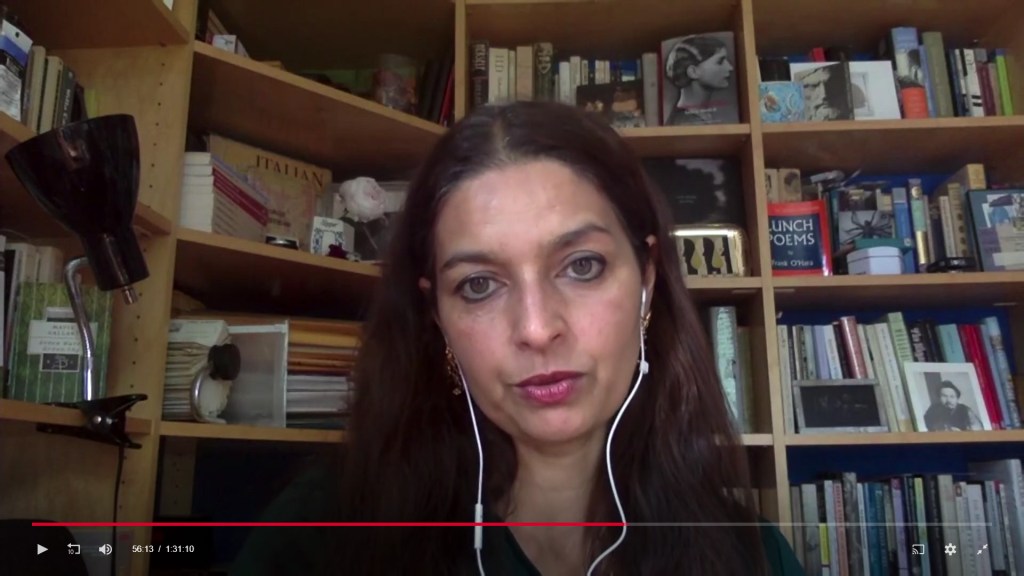
On Wednesday Eeshita and I attended an excellent British Library streamed lecture by Jhumpa Lahiri about the art of translation something we will be featuring in BBPC workshops. She is Bangladeshi but now an American citizen teaching at Princeton and has just published Thresholds in English which is a translation she made herself from the novel she originally wrote in Italian after moving to Rome a decade ago to steep herself in Italian language and culture. Thought-provoking, informative and stimulating words from a fierce intellect who shared her thoughts with great clarity.
And as that wasn’t enough excitement, in the evening I conducted a Zoom interview for TheWatford Treasury a magazine I help to edit. Talking to a Watford striker hero always gives me a buzz but Tom Smith as he is now, Tommy when playing, was charming, thoughtful, generous of time and gave me just what I required for an article I’m writing.
Then the real fun started on Thursday. I actually drove to Putney to pick up my friend Jadwiga and headed off for Glyndebourne to see Janacek’s Kat’a Kabanova. It’s the first time since 2019 and we were blessed with a glorious sunny day and had booked a hotel in Lewes so as not to have to rush back to London after the performance. We arrive in time to change and book a cab. Mad Mike panic – I normally keep cufflinks in the pocket of my DJ jacket, but after its last use it went to the dry cleaners. Taxi imminent, no time to go shopping so quick improvisation required. Has reception got a stapler? Of course and duly sterilised it provided a new way with shirt cuffs as we made our way the Glyndebourne, passed through the temperature checks and venue log in and went to pick up our picnic which we’d booked in the marquee for the interval. Glyndebourne is doing a big thing with local winery Nytimber and, well local businesses need support so drink was taken.
The opera was beautifully sung and played and is a heartening tale of disastrous marital infidelity leading to death – well it is opera. The score is dynamic and exciting and made for a fabulous evening and if you would like to you can read my review here.
It had been such a delight that on returning to the hotel in Lewes we decided a glass of wine would be a suitable accompaniment to discussing our views of the production. So we did that for a while and both agreed that while visual and direction aspects of the production were naff, the music and the experience were wonderful. As we were thinking about retiring two young ladies entered the bar, got themselves a drink and asked if they could join us. They were police officers due to give evidence in court on Friday and proved chatty and delightful companions as bottles rather than glasses were consumed and four people who should have known better struggled off to bed around 1.30 am.
The last time we visited Glyndebourne together it was glorious weather for the opera and biblical, monsoon rain next day, I might have been back in Dhaka. History repeated itself with one significant difference. Last time I’d left my car’s lights on by accident all night and had to call the AA who, after getting it started, advised driving solidly for two hours to recharge the battery. We zigzagged across Sussex and Kent before deciding it was safe to stop for lunch in Penshurst. The car was fine this year and took us through the deluge to Chichester where we had tickets at the Pallant House Gallery to see an exhibition From Degas to Picasso which was very impressive. But it did raise a question of access to art. All the paintings and prints were from the gallery’s own collection and was the exhibit was put together rather hastily once opening dates were known. There were more etchings, lithographs and screen prints than oils, but also a healthy selection of watercolours. We feasted our eyes but were saddened that all these images are normally hidden from view in a vault or storeroom. Here are two lithographs by Salvador Dali that showed a different side of his work – albeit with a few characteristics tics here and there.
Lunch in the café was pleasant and we were ready for a mercifully rain-free drive through the fabulously varied scenery of Sussex and Surrey via Midhurst and Haslemere marvelling that we were out of our homes and having a fine time with a friend. What a great end to a busy week!
Thanks to Farah Naz and Jadwiga Adey for some of the photographs.




 mikeandmurakami.com