
It’s funny how random acts of kindness often beget others. I took in a package for Maria our neighbour opposite. It was quite heavy so I carried it over the road into her hall. As we were talking I mentioned I was going to Spain and ending up in Madrid and she said she would contact her friend Jose who worked at the Reina Sofia certainly on my visit list. So this morning I walked through the El Retiro Gardens and eventually made it – sorry Jose a few minutes late – to the fabulous Nouvel Building which didn’t exist when we last visited, I think there was scaffolding and cranes.


 We chat over a coffee – Jose doing that thing I’ve seen lots of Spanish people do – get a regular coffee and a glass with some ice cubes and then pour the coffee into the glass of ice – cafe con hielo. I guess it’s a DIY iced coffee. We got on very well – he works in the exhibitions department arranging the changing calendar of temporary exhibitions. I think I’d quite enjoy the challenge of deciding who to feature and then finding willing sources to lend works for the exhibition – forensics and persuasion in equal measure. Jose has kindly arranged a free ticket for me and provided me with a guide to one of the two exhibitions in the building Eusebio Sempere where we went first and then Jose went off to do his day’s work. He was most generous with his time and I hope to repay it in London on his next visit. On our way I couldn’t help but admire the magnificent library created as part of the extension.
I had noted in Cuenca on Sunday that one of Sempere’s works was missing from the museum on loan to the Reina Sofia so I did get to see it after all. Sempere is an interesting artist with a love of precise lines, geometrical forms but also innovated with illuminated cutouts and computer generated images. Then he made massive mobiles in chromed steel where the juxtaposition of two or three planes mean that the image ‘moves’ as the viewer walks past the object. Happy bunny – small scale intricate drawing, experimentation and massive sculptures with powerful effects. Equally happy bunny downstairs at the Russian Dada exhibition – who knew? I’ve just read A Gentleman in Moscow on this trip so there were lots of resonances in the works of anti-art produced by the Dadaists of Moscow and St Petersburg. There was a hilarious first film from Eisenstein and lots of other highly graphical works attempting to change the nature of art at the same time that Russia tried to change the nature of government. Eye-opening stuff that exposed another huge level of my ignorance.
While in the Reina Sofia I couldn’t not go to see Picasso’s Guernica again and I also enjoyed a lot of other works from the time of the Spanish Civil War. In another room was a Richard Serra installation called Equal Parallel – Guernica Bengazi inspired by the US bombing of Libya. It’s a room filled with cleverly spaced blocks of rust coloured Corten steel and as you weave your way between them you have time to think above motive, action and consequences – poignant after visiting Hiroshima earlier this year. Art and politics are hard to separate aren’t they?
With imminent eye glaze it was time for a museum break and a trip to the Atocha station which when Dee and I were last in Madrid together had just had its equivalent of the Kew Gardens temperate house installed and I was interested to see how it had gone. This is a sub-tropical forest inside a railway station approach. Some of the trees we saw just planted – already quite sizeable – are now trying to escape through the roof. It’s a green oasis to walk through on your commute into the city but inevitably time, millions of passengers, fag ends and gum have taken their toll. Can we ban chewing in public as well as smoking? Or at least better disposal?

 I fancied a quick beer but there was a football team occupying most of the nearby traditional café and I’m afraid I don’t do Burger King or Macdonald’s, I did find a suitable bar a short distance away and sat and looked at a booklet about Open Madrid I’d been handed by a tourist office lady. This is about places not normally visitable like the Open Gardens and Open Offices in London and I now presume other cities. Might have to come back – it sounds fun. However the booklet also informed me that at the Teatro Pavan this evening was a performance of Yerma to mark 80 years since Lorca’s death. I know the play from reading it, the Juliet Stevenson performance in the Cottesloe in the 1980s and of course the recent Billie Piper vehicle although I’m not sure many of Lorca’s actual words were in that version exciting though it was. So I got the phone out, booked one of the last four tickets – is there a bot that tells you that whatever you’re after there’s only so much or so many left? I find it annoying on hotel sites, slightly less so here – it might even be true.
My trusty sandals have become a bit squelchy and are emitting rude sounds as I walk so I take a cab back to the hotel for a change of feet – I wish! Birkenstocks applied, I pop round to a local bar for a bite, They have, they tell me, an excellent ceviche with cod, sea bass and prawns so I am persuaded and have a beer and then a crisp young Rueda when the food arrives. Then it’s back through the Retiro Gardens to the Prado which is such a fabulous museum that I can’t be here and not enter. I decide against the special exhibition of Lorenzo Lotto and head for the main galleries.
 There are brilliant Bosch and Bruegel rooms but I decide to restrict myself to El Greco – they have lots more here than in Toledo and some of even better quality, Velazquez and Goya. What I like about El Greco’s big set pieces is that each portrait in the crowd is of someone you’ve just seen or might meet in a bar. Christ carrying the cross with tears welling up is amazing. Moving on seeing Las Meninas again made me think of Laura Cumming’s excellent book The Vanishing Man which features a whodunnit art world adventure tracing a missing Velazquez – must read it again. He again pushed painting forward in many ways with some of the brushwork almost akin to Van Gogh. The Prado has lots of Velazquez but I recall being told on an Art Fund visit to Apsley House that they have even more as they were given as tribute to Wellington for ridding Spain of the French. I save Goya till last and end up with the two majas and then the awful, awesome 3rd of May which does actually make me cry.
Time now to leave and get those feet moving across the city to the theatre which is not marked on my map but is in Calle Embajadores which leads off from the Plaza Mayor. Appropriately I pass a statue of Lorca on the way – a good omen?

 It’s quite a schlepp and my dreams of a pre-performance drink have to be passed up. They scan my ticket on my phone and send me past a main auditorium to a tiny space that was exactly like the old Bush theatre in the early 70s. Four rows of folding chairs in rows of 20 and mind the props as you cross the stage to your seat. No numbered seating meant I should have got there earlier but with a bit of craning and sliding I managed to see most of it. Oh and there was only one empty seat. It was a mixed version with modern dress, a refusing-to-turn-blue pregnancy test taken on the centre stage WC to emphasise Yerma’s longing for a child and some updating of the language. It was well acted with a good ensemble cast and a brilliant Yerma who is of course virtually on stage throughout. This actress is Alba José who looked vaguely familiar and when I got home I realised that she had been in the excellent Spanish TV series shown on BBC 4 last year I know who you are. A very happy couple of hours to round off a day of culture. So I take a post-performance glass of wine and haltingly discuss my impressions with a couple whose English is on a par with my Spanish but we have another round and all enjoyed the play and a chance to chat about it.
On my way back through Sol, there was a demonstration – well it’s Madrid, there will be won’t there? This one was calling for no indemnity for the perpetrators of Franco’s crimes and compensation for the victims. The dictator may have been gone for 40 years but what with plans to move his remains from his dreadful mausoleum and retribution for those who suffered he’s certainly not forgotten. Art and politics, people and politics and still several people I spoke to don’t (or can’t) believe Brexit will happen. I stop for some tapas – prawns in garlic and albondigas meatballs in a tomato sauce on this occasion in a great bar-restaurant called the Cathedral.

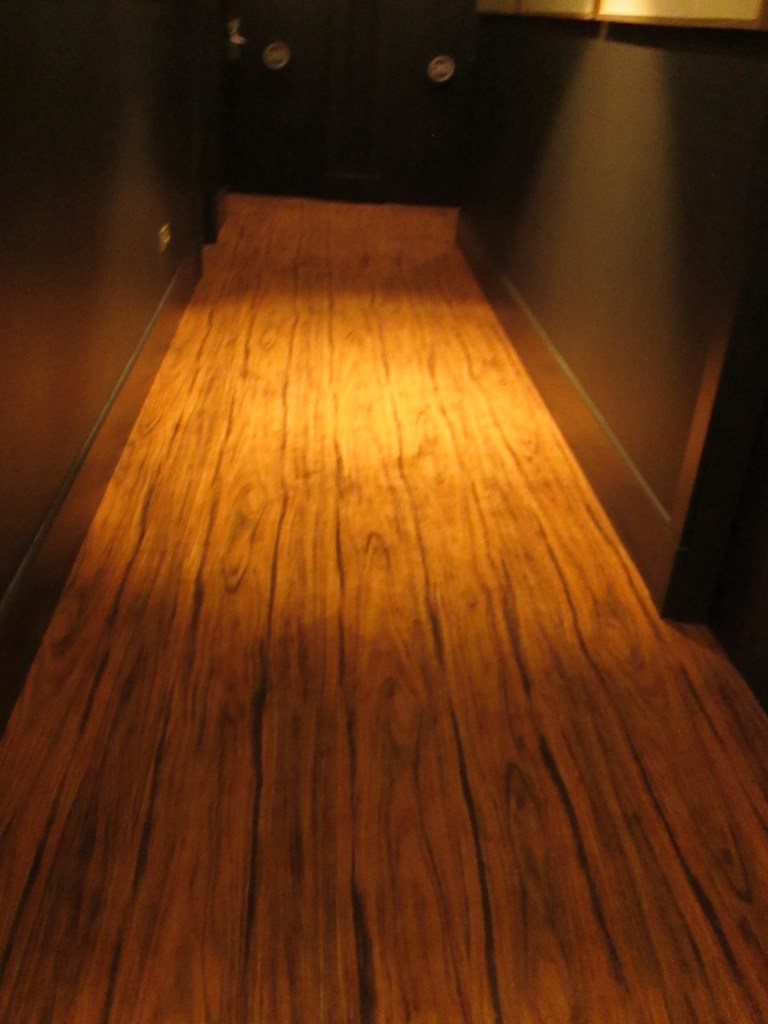
 Another pit stop for a café y copa well it is my last night in Spain and back to the hotel – so different from my others but fun with its black and white décor and strange wood grain woven carpet in the corridors, Why? Actual wood strips in the rooms.

 I spend Friday morning getting a few last minute items around the Salamanca area which was as I said in an earlier piece was new to me and very impressive. Plenty of places to eat and drink well but also little food shops, fruit and veg stalls and lots of antique shops – if I was driving home I might be in trouble. Check out is at noon and flight check in at four so I decide to drive straight on down Calle Alcala in the car. It goes on for ever and ends up in the town of Alcala de Henares of which I made a circuit but failed to find a parking spot. It’s an important musical and university town and has some impressive buildings housing those pursuits. Looked definitely worthy of another visit – maybe by train next time I’m in Madrid (if).
I took a circuitous country route back and found myself in Paracuellos de Jarama I’d read about this place in books on the Spanish Civil War as it was the location for many of the early mass shootings of the war with estimates of between 2000 and 10,000 massacred by Fascist forces. It does have a staggering view across the airport and away to the city of Madrid. Like so many of the places I passed through there are huge swathes of new build dormitory towns to serve the capital. But it still had a pleasant little square with a tall tower and a few bars. Down a zigzag route and into Barajas town where I had a couple of false starts including going into the taxis’ stacking compound before finding the tiny entrance to the rental car return zone. All sorted in good time, checked in by machine again – although a person did print the baggage tag – and then to the lounge to enjoy light refreshments and watch the aircraft manoeuvre. I stayed in the comfort of the lounge too long and had my hand luggage removed at the aircraft steps. Had put iPad in camera bag so able to blog during the flight. As we went for take off I snapped the village where I’d been two hours earlier – you can just make out the tower I think – the brick one not the airport Control Tower. Machines away now as on descent.


Swift flight, straight to an empty passport reader and only ten minutes to wait for my two bags followed by a struggle to meet with my Data Cars driver but eventually home after a very fine two weeks in the sun and it’s shining here although less warmly as I set off for the West Herts Sports Club for a beer with friends before Watford v Manchester United at 17:30.

 The northern river Jucar had a bit more water than the Huecar on the parador side and there was a pleasant park and another incredibly modern church the cross of which probably doubles as a cellphone mast, impressive university buildings and a likely looking theatre.
 Do I walk back up or get a cab? Seems daft to not walk but it does prove quite steep and there’s more to come later. However the legs make it up beside the Huecar with its little weirs gurgling encouragement to the ancient limbs and I do get a different angle on the hanging houses and the bridge which on my way down I’d heard someone refusing to cross – I guess if you have a height phobia it would be very scary.


 I had of course to go through Sol the very heart of Madrid and our favourite plaza Santa Ana before heading through the Retiro Gardens and back to the hotel on Alcala. My feet said enough and there’s a Mexican-Spanish fusion group playing live on the roof terrace tonight so it would be rude not to attend. Besides as I entered my room after an urgent beer in the bar I found this. Salud!


 Well on this stretch there had been a rock fall within the last couple of days given the freshness of the markings on the road. There were still yellow road works signs for the guys clearing the rocks off the road.
 I drove through the gorge of the river Jucar passing literally gorgeous scenery (sorry) and an extensive reservoir.
 Finally after a section marked as ‘Mountain road – no markings’ – great fun and only one vehicle to negotiate in 20 km – the road emerged in the village of Cañete which had some staggering Moorish walls, a market and a bar/restaurant that looked good for lunch. I sat with a beer and some local very strong manchego cheese and homemade chorizo when the heavens opened and the town came rushing in.
 It was clear that I was occupying a difficult spot for la padrona to accommodate everyone so I moved to great thanks from the incoming group. As you do, I became involved in conversation thereafter and enquired as to what their tee shirts signified. The women were wearing tops with the slogan ‘La peña de pantocha’. I knew that peña meant an association, society or interest group but I had to enquire what the word pantocha meant – should have learnt more slang in my youth. The ladies burst into laughter and indicated that it was a part of the feminine anatomy where as they put it ‘Entran las pollas, salen los niños’. My conclusion that in English they’d be called the C*** Club had them in complete hysterics with gleeful delight in the matched alliteration. The menfolk were all bearing tee shirts with the legend WILLYS with which I was familiar from a souvenir/craft shop in Palamos a while ago where as a winter gift they had a series of beautifully knitted ‘willy warmers’ ranging from thimble size to truncheon – you decide which to take home. I tried to explain that grammatically their slogans were wrong in that they should either be WILLY’S if they were celebrating one particular member or WILLIES if they were all involved. I spared them the Wilis in Giselle. We were deep into dangerous territory here as I couldn’t accept the free-flowing booze with my car parked opposite under the walls. It transpired that while the fiesta always had a religious element, a few years ago some of them had decided to sex it up a bit with some gender related fun and games so they had a number of contests between the sexes. I hate to think how the evening would have finished – it was quite rowdy when I left at 4.30. But my new friends did pose for a photo as I left. Spike in June babies in Cañete?


 What I hadn’t checked was that Belmonte was celebrating its fiesta patronal which involved a lots of singing, dancing and drinking on Saturday and on Sunday a procession for the Virgin of Grace. So I watched England beaten by Spain to the delight of the locals – I had to admit Spain were the better team although ‘we was robbed’ at the end. I then joined the revellers at the local brass band’s recital and then at a series of sets by a band I can only describe as Latino heavy rock. They were fun, people dressed up and danced but they did go on until 04:30.
 I had retired by then but not to much sleep! On the way east the weather had changed and once the music stopped I was woken by thunder. It rumbled around but produced no rain which is good as two days ago in a town near Toledo I saw on the news cars being swept down the street in flash floods. It was called Cebolla = Onion Town.


 It has some very impressive examples: Chillida, Tapies, Miro among them and some fine works by artists I didn’t know. Being inside the building was great too as some of the original features remain and the view from the balconies is vertiginous.

 I might not have fetched up where I did in a previous visit (!) but found a bar in the main square near the cathedral with some local craft beer I thought I’d try – the bottle came and it was 7%, serious beer, but as so often with high alcohol content too sweet for my tooth so I stuck at the one there and had a more refreshing Alhambra on the way back to check in.
 However this wasn’t going to be a stay in the hotel all day stay so no real problem. On arrival after my Don Quixote day I walked the twenty minutes into the centre. To be fair it’s a fairly dull town with a few good buildings – theatre very deco, church one very modern and some very ancient as well as a good plaza.

 However this part of the trip was for swimming (tick), writing (tick) chilling (semi-tick) and exploring the local ecology, archeology and oenology (two and a half ticks).


 It provided a good lunch stop in the shade as the temperature reached 41 Celsius.
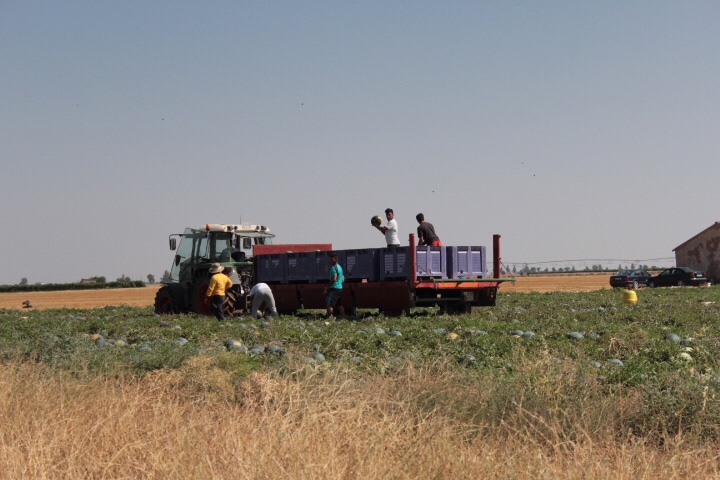


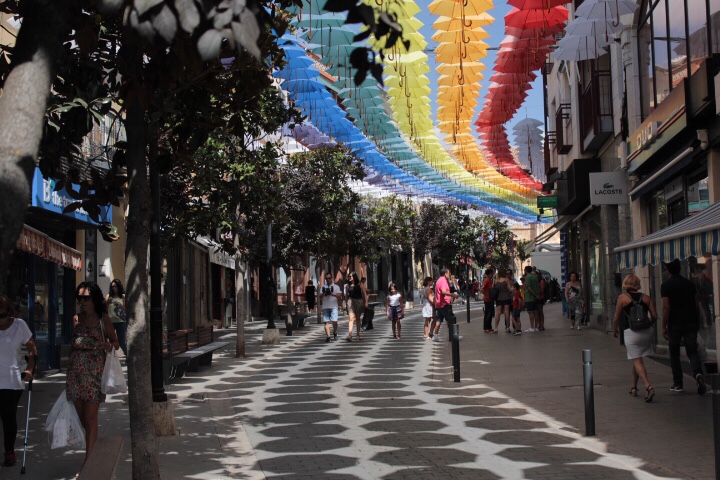
 The town has a fine plaza and church, a ducal palace now the town hall, a cinema themed bar and is famous for growing saffron without which no paella would be complete.


 It also has an octagonal library – complete with youngster on the net – and a little way away a famous 18th century casa de postas which from its original use as a place for message carriers to stay has been a barracks, a hostel and is noted as a building of interest. But as you can see it’s all a facade.
 Made me think again about spending money restoring old things, funding prestigious projects that no one really needs and using scarce resources on real need and halting the slide into poverty of so many. It’s a hard one as heritage is important. How come Spain already has a brilliant high speed train network AVE that connects all the major cities at more than 300 Kph? Crossrail, HS2 really? Are the amazing infrastructure projects what took Spain into the dodgy PIGS group a few years back?
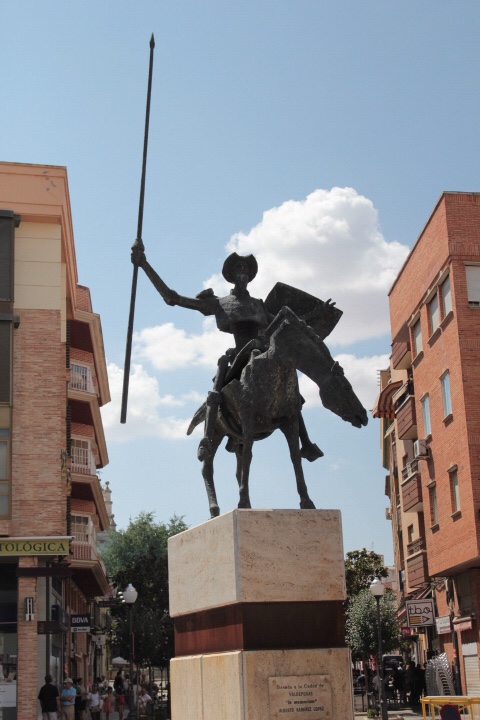
 It’s enough to make a nag like Dulcinea sweat going up all those hills and forgetting that you can drive to the top! Since we were there one of the mills has been restored to function on a few days a week actually grinding grains to make flour – but not today. We had visited here from the parador at Almagro a bit to the south so I thought a nostalgic trip there was in order.
 We had seen its galleried plaza mayor with Christmas lights and a tree. It brought back very happy memories but the square where we had lunched and shopped was exhibiting end of seasonitis today – it was midweek and school’s just gone back. In one restaurant the chef had presented us with a book about the aubergine (eggplant, berenjena) for which the town is famous.
 So I had to have one for lunch. It was delicious and Almagro remains an attractive town and I couldn’t help thinking that Dee should have been with me as I passed this bar.


 From San Tome to the high gothic Game of Thrones-worthy cathedral was not too bad but it was another steep schlepp up to the Alcazar, that huge fortress at the eastern end of the city. Worth it though as each facade is different, the views down to the Tajo are excellent and there are bars nearby.

 I concluded that unlike many cities it has no real centre but a number of quite small areas where shops and restaurants congregate. It’s quite hard to get a grip of which is probably why there were so many raised umbrellas escorting tour groups. Maybe I should have done the city tour bus. Beer and tapas downed I walked blissfully down to retrieve the car and go back to the parador for a swim and a read.
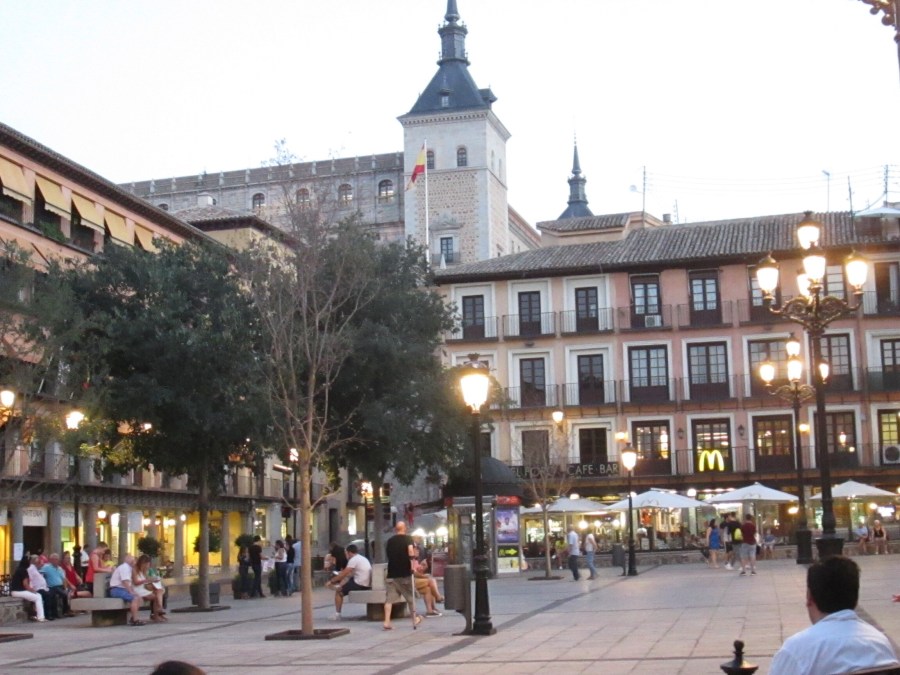 They of course were open but I persevered and found a little local bar where I thought I’d take a tapa before finding a restaurant. There was a quarter of a tortilla left and a big dish of wild mushrooms after which I made a joke that actually worked in Spanish along the lines of ‘I asked for a snack and got a meal’. Great hilarity and a glass of wine on the house as we watched the US Open tennis on the TV – a change from the very popular bullfight channel that plays in most bars – and had a bit of a conversation about the effects of Brexit – hard to avoid when you say you come from the UK. In one bar someone did actually say ‘If you don’t like us why are you here?’ My remain vote sort of placated him but there’s a degree of rancour. A copa in another bar and a walk back, up of course, to Zocodover to find a cab and complete Toledo Day 2.

 Outside the museum was a Corten steel sculpture of the apostles that El Greco was so famous for. As a Richard Serra fan I was quite taken by this work by Paco Rojas and by the steel letters dotted around the museum itself. There was also a well placed restaurant with a 12 euro menu so why not? On the menu were carcamusas which I’d never encountered despite extensive travels in Spain. It’s a dish of lean pork fillet with tomatoes, garlic, pimiento and wine, I think, anyway it was good. Next was a trip to another synagogue, mosque cum church in this eminently three faith city: San Juan de Los Reyes which had a great cloister, fabulous ceilings and bizarre stone work.

 It was fine but I felt I’d never really got to grips with Toledo, It’s this odd mix of reverance for the three religions history and an attempt to become a tourist destination. The parador and its inviting skinny dipping pool was great, the city did not add itself to my must rush back list.


 The Fullerton is converted out of one of Singapore’s historic buildings the Post Office which also at times housed the Ministry of Finance. It’s a fabulous neo-classical structure with extensive lounges and eateries on the lobby floor. It was again stressed to me that I’d be paying the rate agreed which when I reached my room looked like a real bargain. I’ve been fortunate enough to stay in some very good hotels over the years but this room was amazing. OK the view was down into the internal courtyard not out over the Singapore River but it probably had the same floor area as my house. A bathroom with a massive bath and a separate drench shower were to my left, fitted wardrobes to the right and then in the main room a massive bed, easy seating area and a desk. The yukata I’d become accustomed to was replaced by a long towelling robe and a fully-stocked minbar and snack counter completed the picture. As it was late and wet I decided to grab food in the hotel and to make a swift move as everything closed at 10 pm. The fifth floor bar with a view stayed open longer and to look out over Marina Bay with its manic lighting displays. We’d seen the Hong Kong waterfront light show but this goes on all the time.


 There were some good colonial and vernacular buildings hidden among the glass palaces of commercialism with all the usual suspect brand names abounding – I think there were three Lois Vuitton and four Chanel shops in a mile. One outlet that did take me by surprise was a Crate and Barrel an old Heal’s style favourite from Boston that I’ve not seen overseas before.

 However I had work to do in sorting out packing for tomorrow’s trip home for which I need to leave the hotel a 06:30. So I pop into 7Eleven for a couple of cans to ease the sorting of clean and dirty clothes and cramming them into suitcases. Mission complete I set off for Duxton Hill an area of eateries recommended by my son. It’s pleasant area with about twenty eating options in a short space. Seduced by a real Spanish leg of bellota ham on the counter I entered a tapas bar and my first glass of wine for ages = it’s been beer and sake all the way.


 Then suddenly in another room were grotesque succumbs-like figures engaged in scenes of bloody torture and horror such that I even checked with an attendant that they were by the same artist.
 I think even Bosch and Brueghel would have been shocked. I guess too many pretty children with their favourite toys can only go so far and your inner vision of hell needs an outlet. I can’t say I was moved to bring any prints home but I was glad I’d been. As I left a large school party was being lined up to enter the aquarium. Health and safety here has kids wearing hard hats.




 mikeandmurakami.com