
I had a bit of a lie in this morning and decided to take the car since I was going to visit the Automobile Museum which I thought would be interesting after seeing Cars at the V&A earlier this month. By a miracle my worst fears about parking the car on arrival were swept away by the fact that it has free parking in front – well I suppose they are all about cars. But first I went to see the other collection on the same site in a disused tobacco factory – an even more impressive building than Carmen’s in Seville. This was the Russian Museum which had three exhibitions. The first was devoted to the depiction of women in Russian art over the last two centuries and was more interesting for the social observation of costumes and customs than for the intrinsic merit of the canvases displayed – far too many in my humble opinion. Eyes started glazing over by room 5, beautifully displayed and labelled though they were. Given some of the obvious disparities between the have and have not classes it was pretty obvious why the Revolution happened. The next exhibit was the work of Nicholas Roehrich of whom I’d never heard. There were some amazing landscapes and allegorical paintings in alternately sombre and vibrant colours. He travelled a lot and ended his life in India where a wall full of square oils showed the Himalayas in all the variety of lighting stages that mountains pass through. He was a revelation but cars called so I’m afraid I skipped the third show featuring the life and works of the poet Anna Akhmatova.

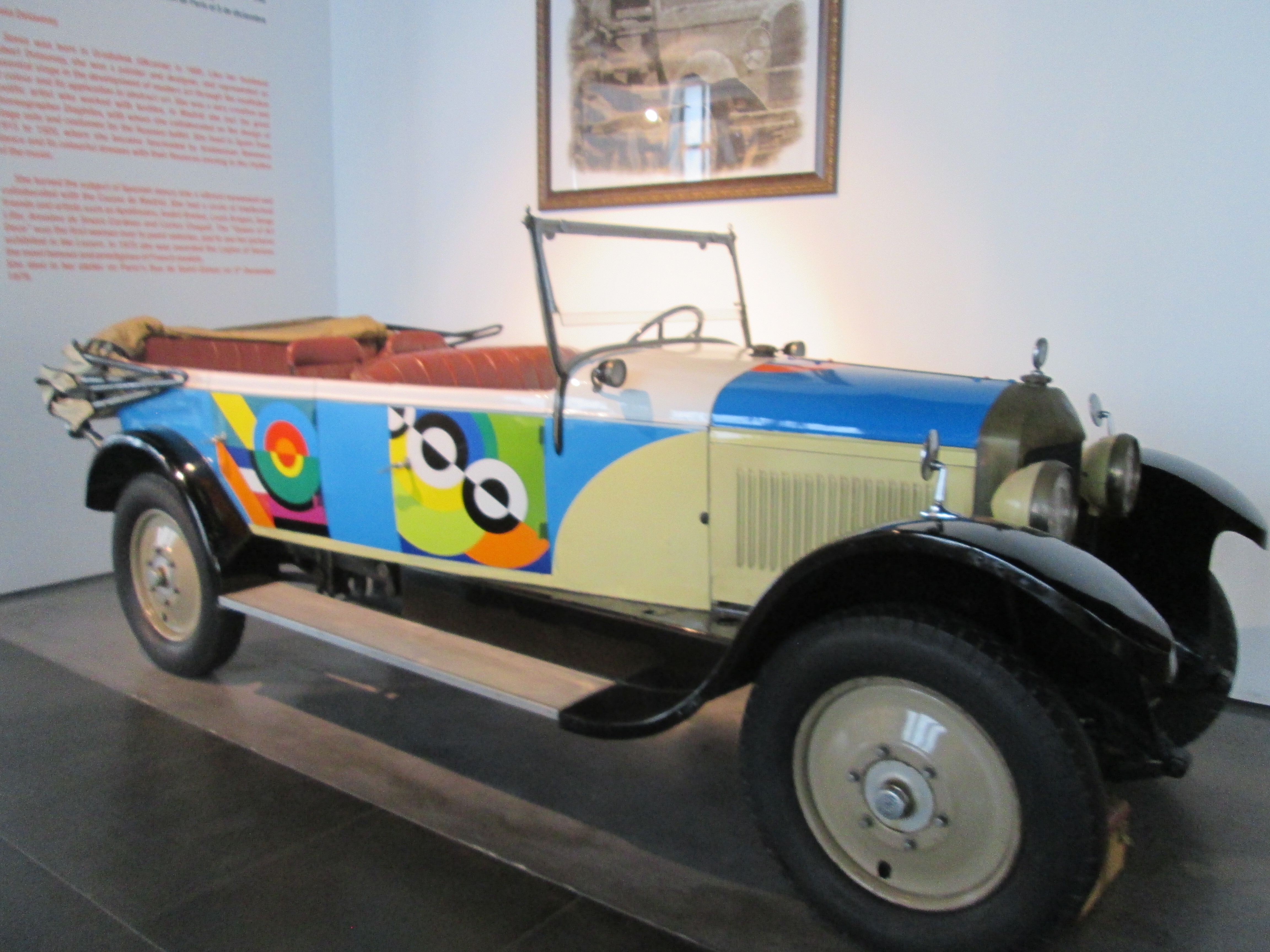
The Automobile Museum was just fabulous, charting the history of vehicles from earliest steam driven carriages through the vintage cars from the USA and Europe to future concept studies. It’s massive but very engaging as the official title is Museum of Automobiles and Fashion and beside each vehicle was a designer dress or outfit from the era so you could imagine these elegant folk installed behind their chauffeurs or later taking the wheel themselves. One car reminded me of Peter Blake’s painted Mersey Ferry, Everybody Razzle Dazzle, that I’d seen last week only to discover that it was painted by Sonia Delaunay in 1928.
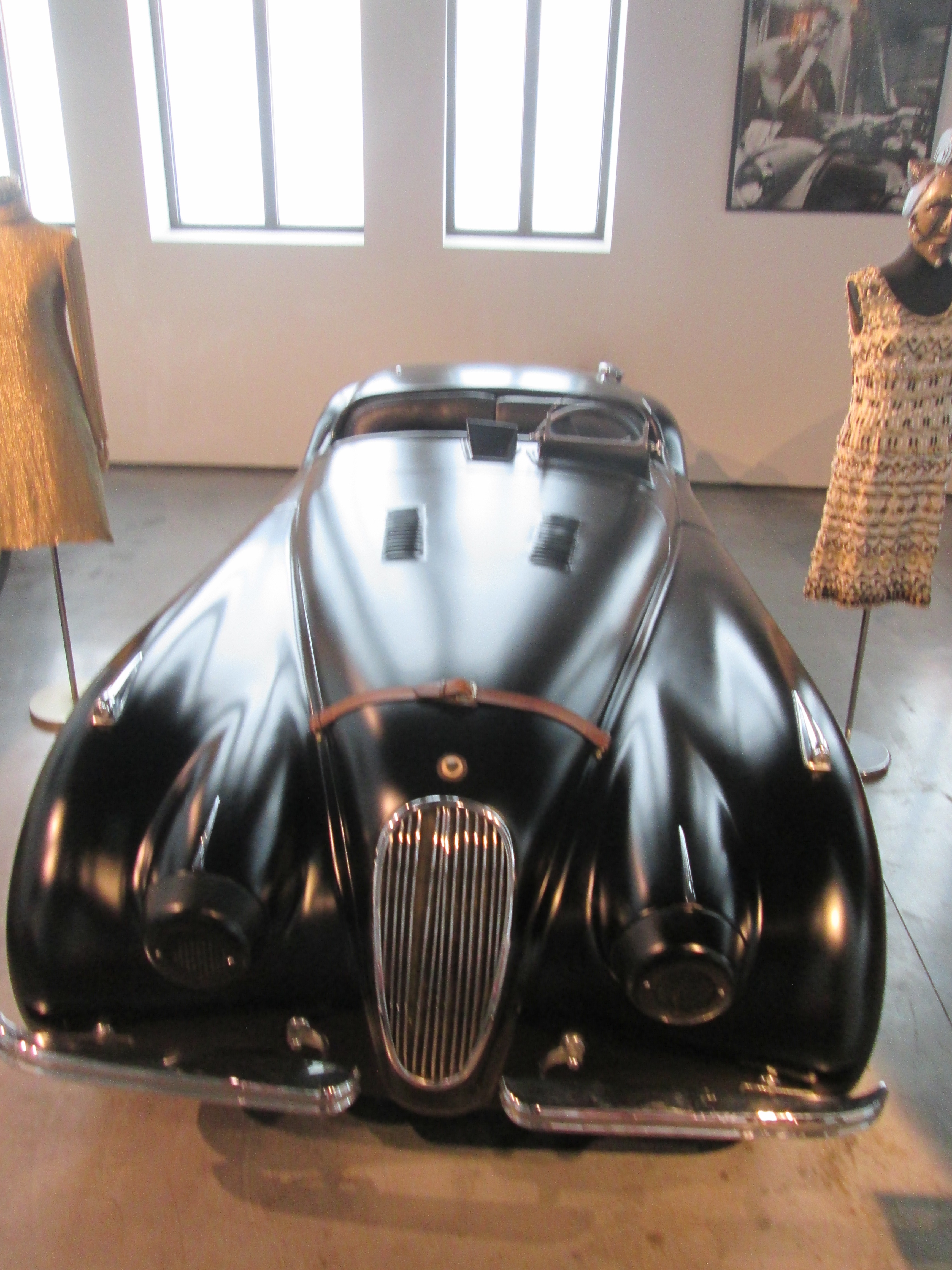
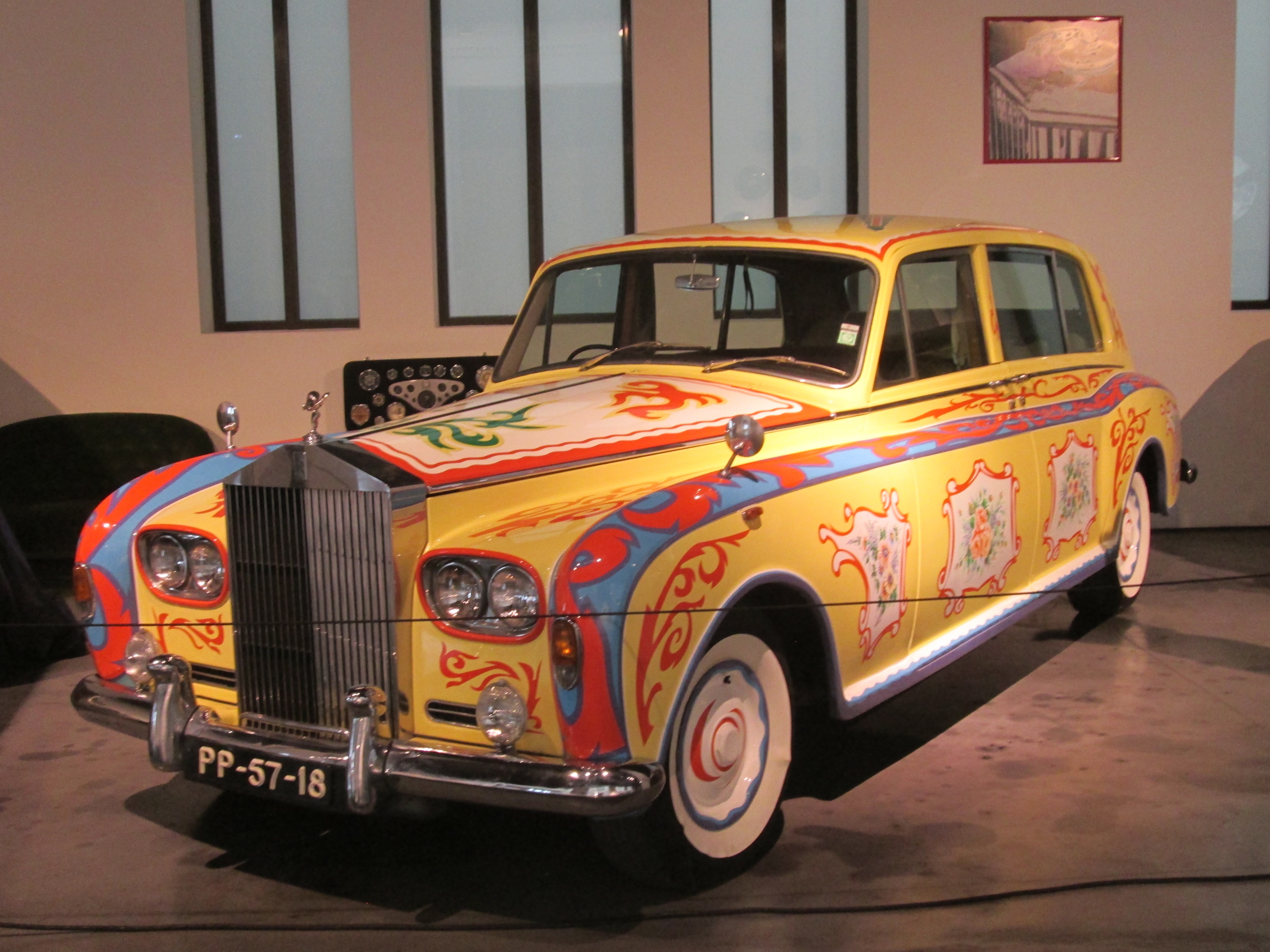
There were a lot of very sleek and beautiful beasts on show but I was left feeling very proud of Jaguar’s contribution to motor car design. And they had some funny ideas at Rolls-Royce too!
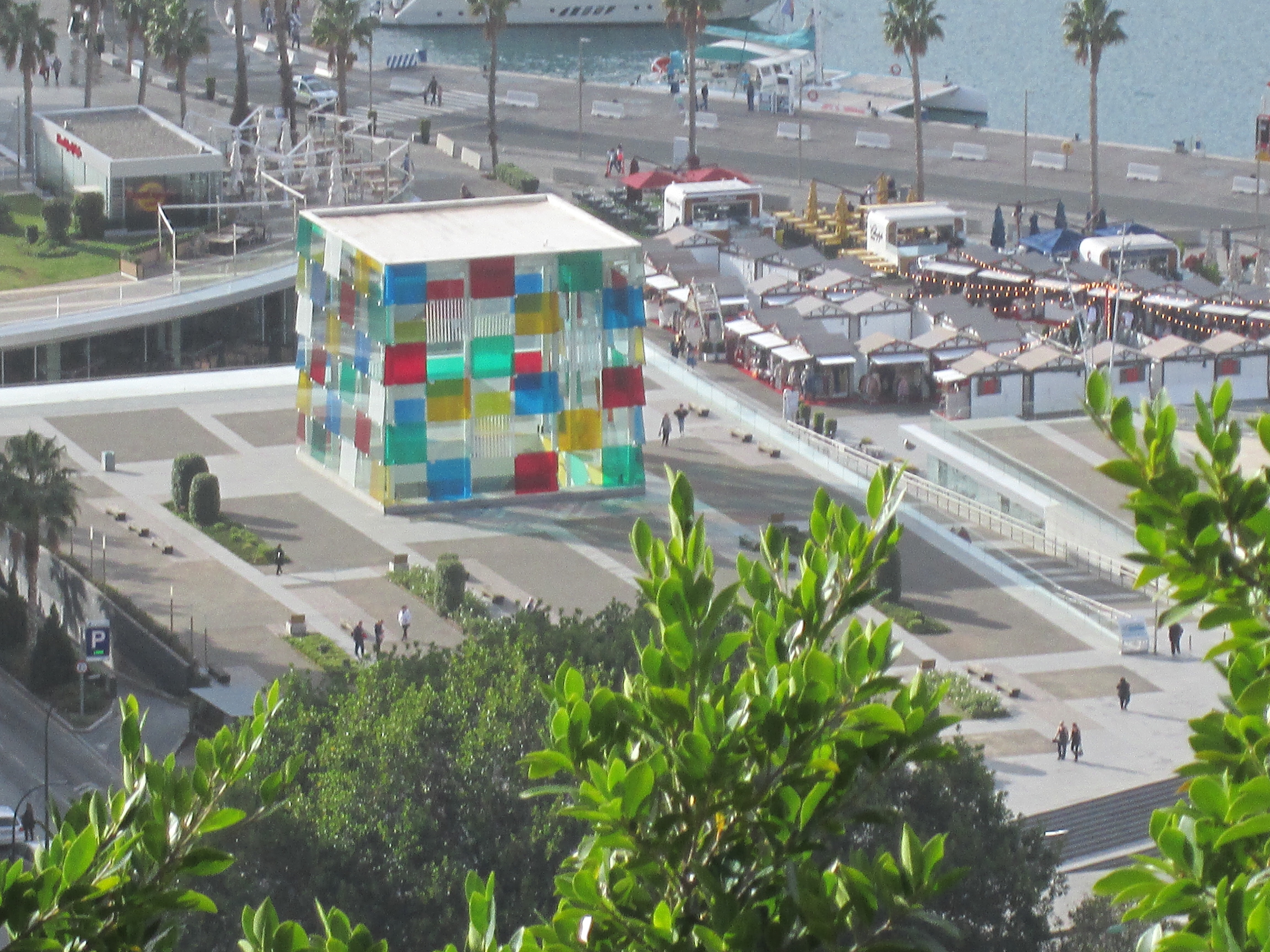
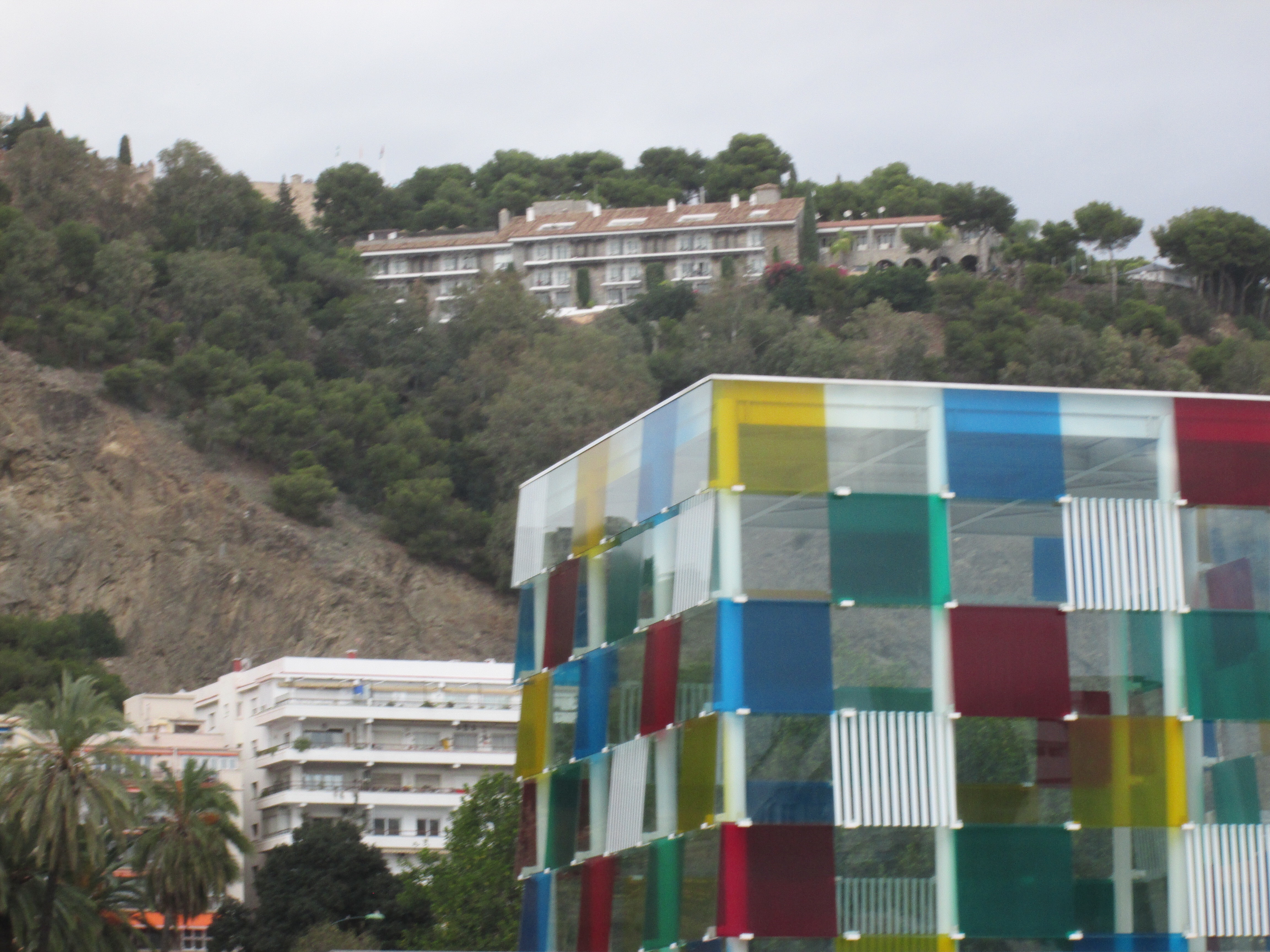
I then stopped off at the bus station to get a ticket for tomorrow’s planned trip to Torrox to share the Fiesta de Migas and watch Watford v Man United with an expat Watford friend. Sadly the first bus on a Sunday was at one and takes an hour and a half which would leave no time for fiesta and the last one back was at five which would leave no time after football so after a WhatsApp exchange I concluded that I’d do abstemious fiesta-ing and drive for convenience. Thence to my next port of call which was the outpost of the Paris Centre Pompidou which opened here last March. It’s an underground structure with a glitzy glazed Rubik’s cube on top. I can see it clearly from my balcony and thought it would be worth a visit.
Inside it’s a vast space with equally vast canvases and installations which appealed in varying measure. The highlights for me were a massive Miro and an equally large scale Peter Doig but I was also amused by the sheep installation that filled the first room. Sadly they wouldn’t let us sit on them despite their destiny as stools.

When I got back outside I could see my balcony up on the Gibralfaro Hill, providing a nice symmetry. The Centre is on a newish (2011) development of the waterfront in Malaga called Muelle Uno. It has trendy shops and restaurants – chain and individual and I decided it was time for some seafood and a glass of Verdejo a favourite white from next to La Rioja (will that count Les?).
I retrieved the car from the parking under Centre Pompidou with some distress. As I descended in the lift I saw no pay station and assumed it would be near the exit. It wasn’t so I had a stream of three needing to reverse so that I could go back to the machine – hidden behind the lift – and then emerge. Much tooting and muttering about Los Ingleses – expect more in future. I returned to the hotel and parked up and then started the walk back down when a convenient bus arrived to save me the trouble. However I very nearly had to arm wrestle a huge French woman to get on board. She was determined to be first despite her lowly rank in the queue and had the bulk to determine the outcome. At the city centre bus stop I walked to the Museo Carmen Thyssen to admire the work of Spain’s eighteenth and nineteenth century painters. I recognised two or three from the recent Sorolla exhibition in London now back home and was struck by how art movements seemed to move across countries with similar preoccupations in Russia and Spain in the same periods. I was warned on entry that there was to be a concert at 19.00 so my visit was enhanced by the sound check for the orchestra and warm up exercises of the choir. I didn’t stay as there were few tickets left.
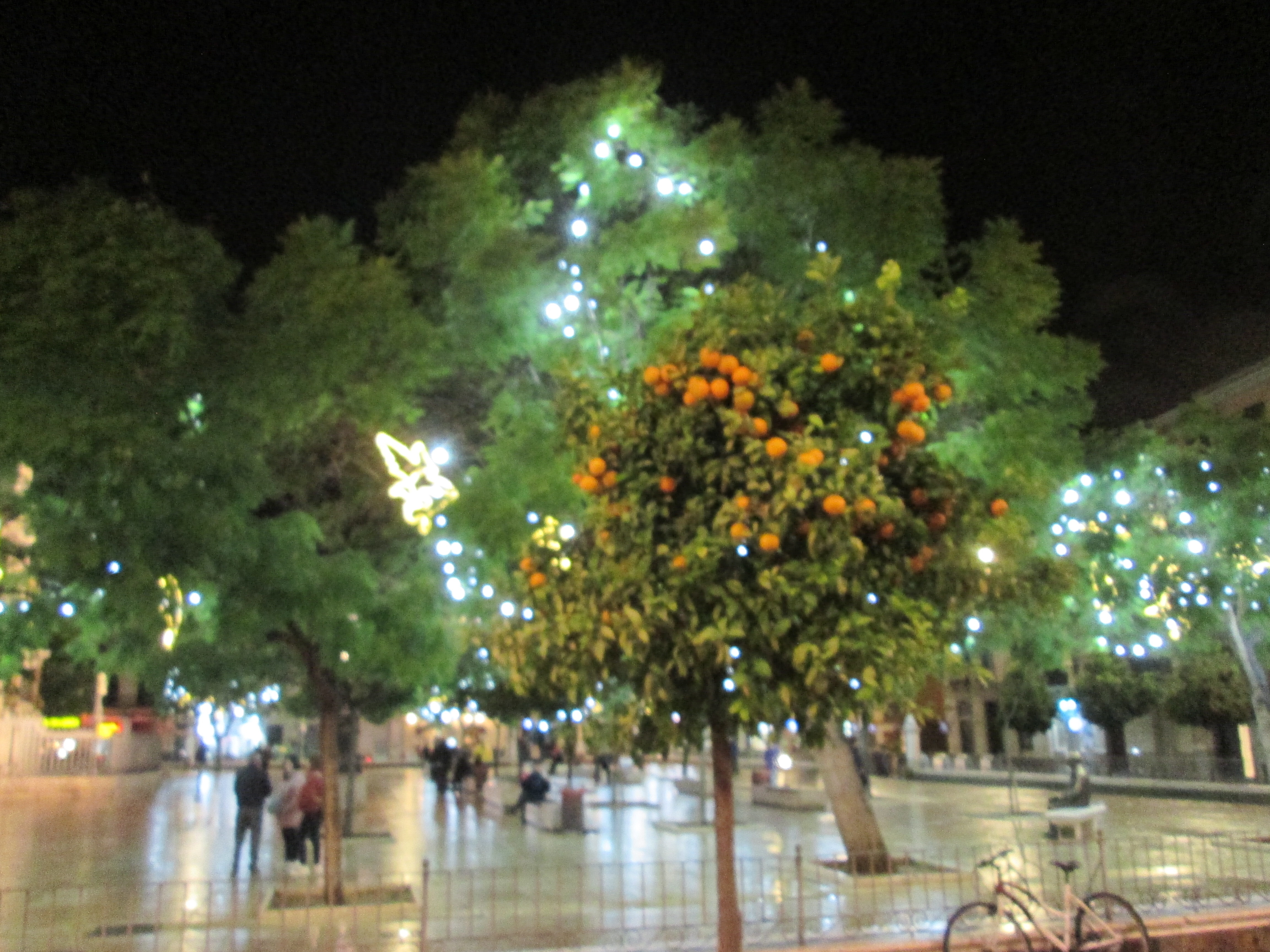
My friend Graham was in Malaga a few weeks ago and had recommended the restaurant Batik – if I could find it. I wandered through a few streets, stopping for the occasional beer in the odd neighbourhood bar and discovered that Batik was close to the Plaza de la Merced and the Teatro Romano. It was great recommendation with super carpaccio de jurado and tuna tatziki all washed down by a good Marques de Riscal. While I was there a couple of young ladies asked me to take their photo and we then got chatting. One of them worked in PR for Malaga Tourism so I offered my services should they need English copywriting or proofing. While we were conversing (pitching?) the most spectacular light show took place against the backdrop of the Alcazaba which in one sequence appeared to be self-destructing stone by stone. Something similar happens every year it seems. My homeward saunter was enlivened by superb temporary Christmas light displays:
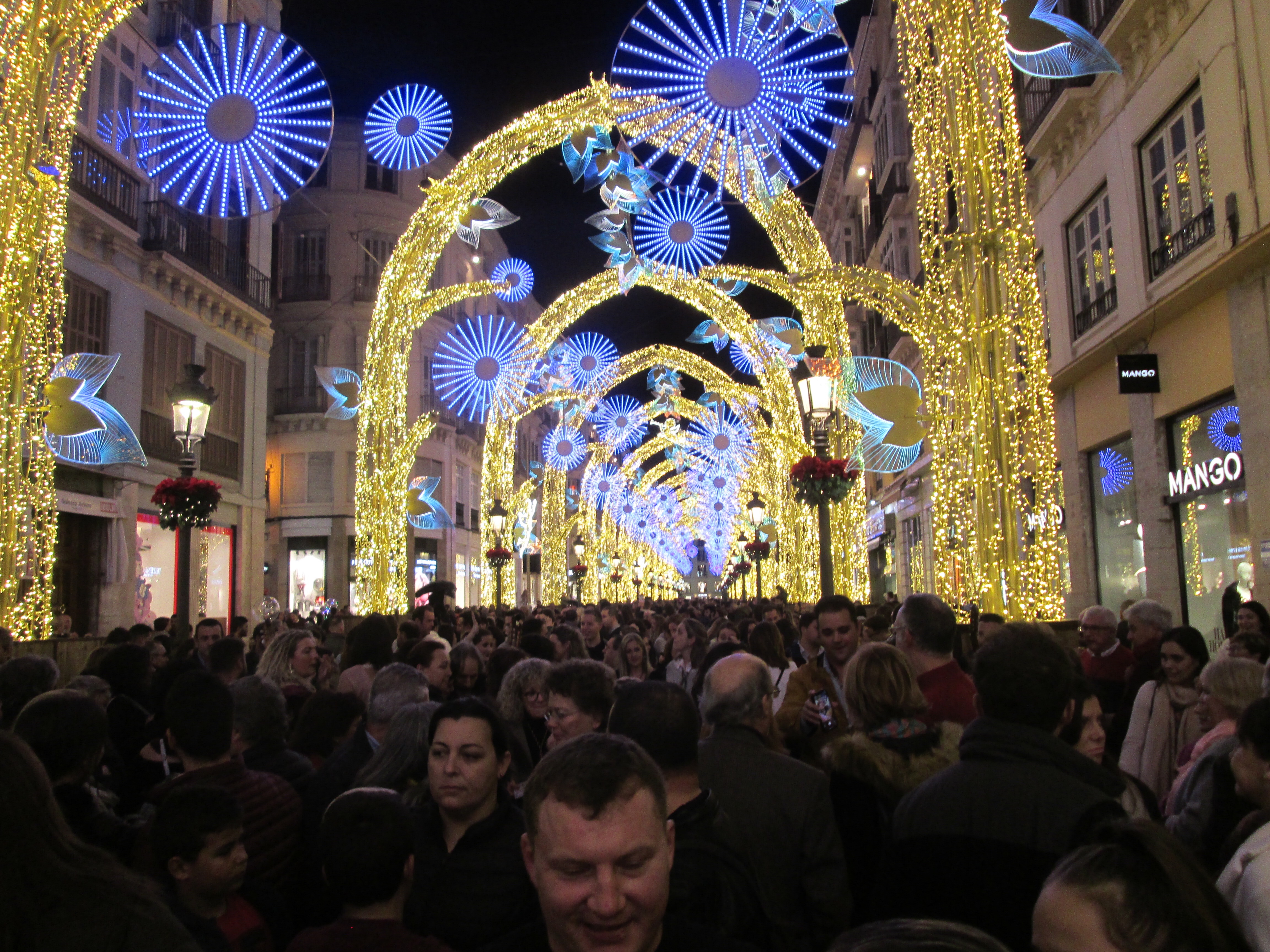
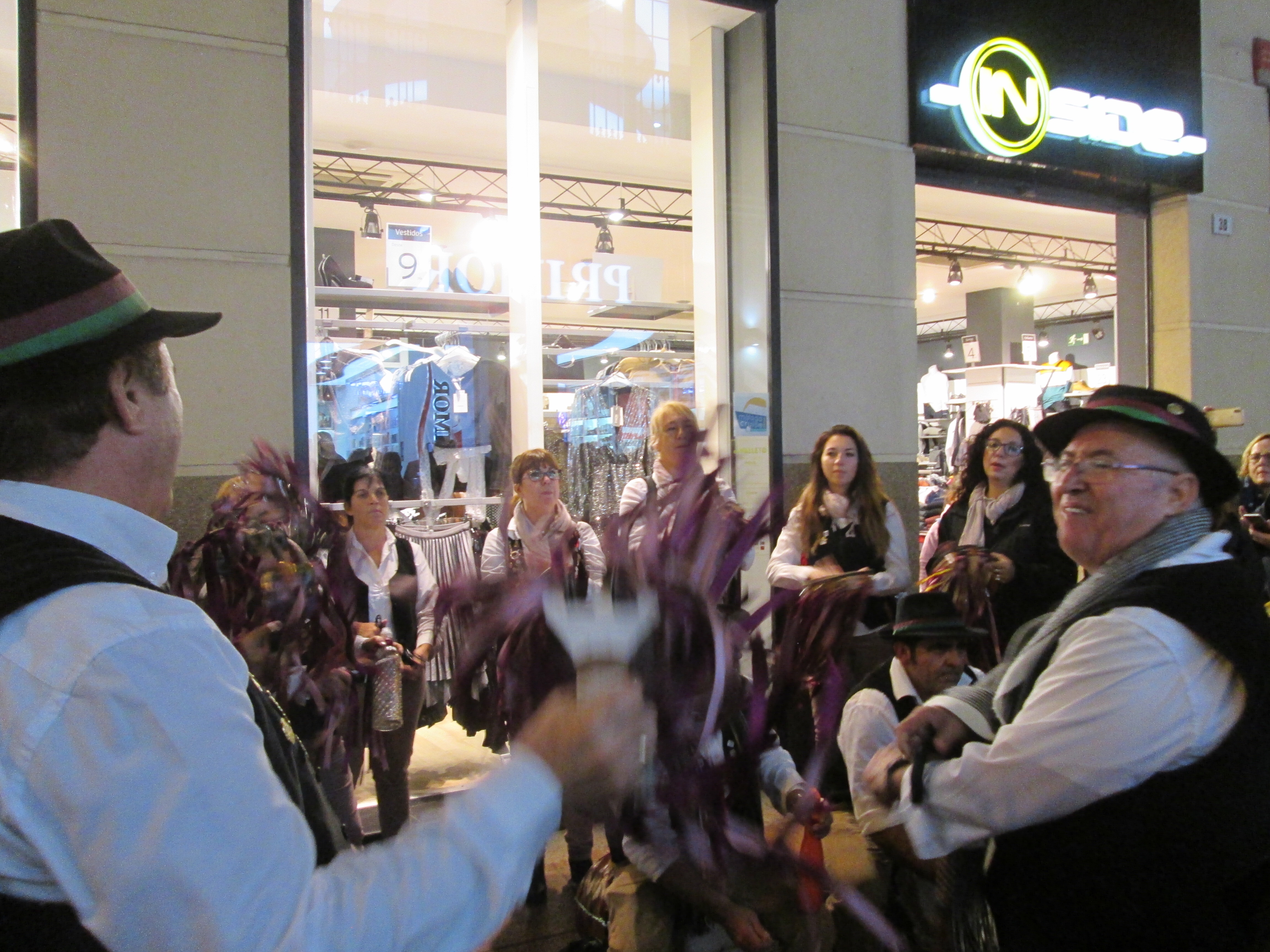
and groups of musicians at seemingly every corner. One of them appeared to me to be the Andaluz equivalent of Morris (pace Pete and Richard) while another was an energetic jazz group none of whom could have been more than twenty five, a promising sign for live music in the south. Then it was a taxi up the hill, a glass of brandy and some light blogging.




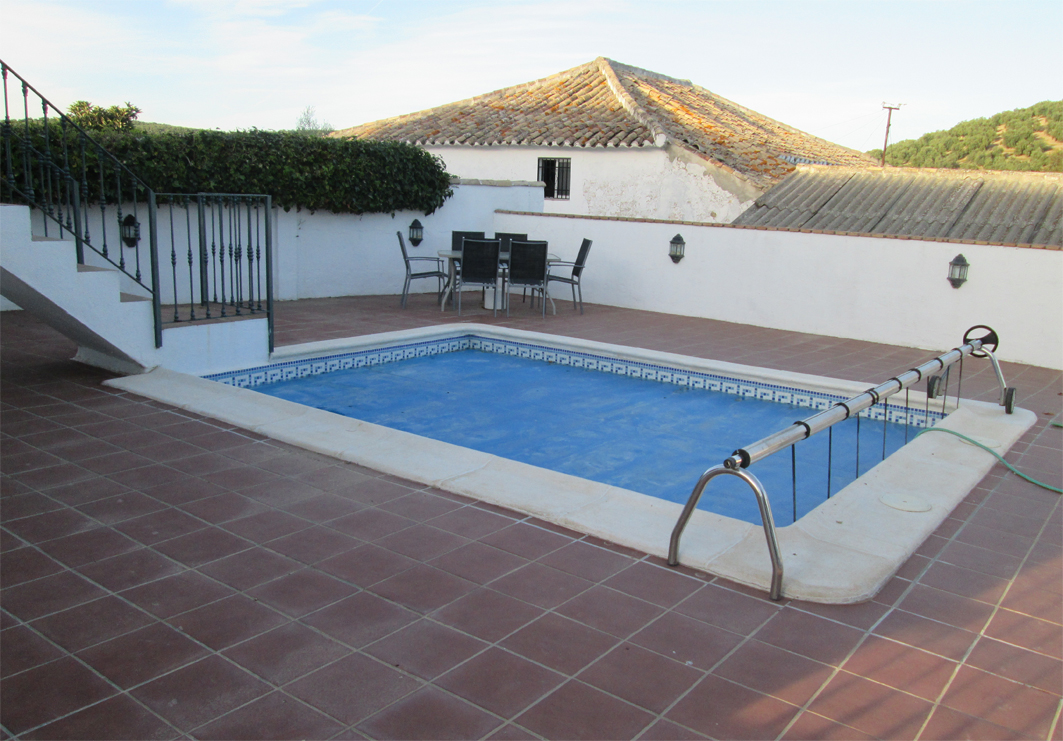
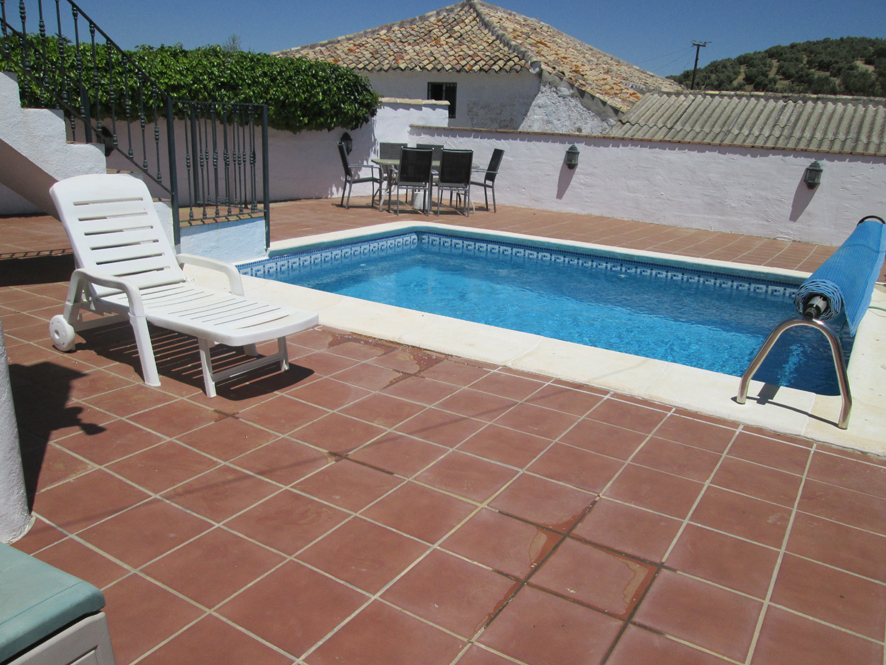 It was a splendid warm week with a few visits to the pool purely to stimulate the thought processes of course. I sat diligently in writer’s corner in the shade and have achieved what I hoped for – enough written down that it has its own momentum now and writing a chapter now and then among other commitments will be OK. If any of it is any good that is,
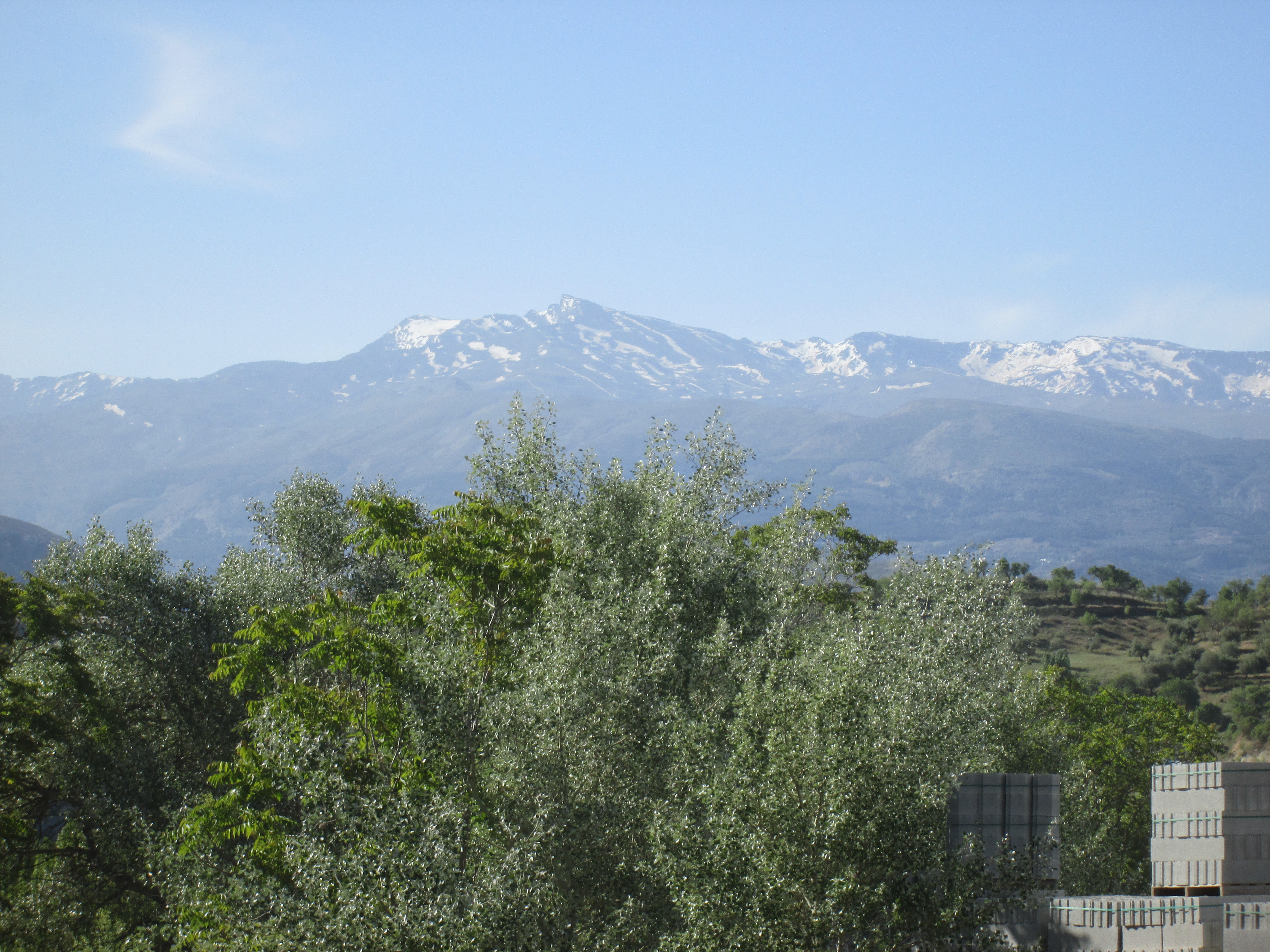 I left the house and set off eastwards along the A92 autovia, pausing for breakfast near Granada with a fine view of the Sierra Nevada, still living up to their name. I came off at a junction signed Huercal-Overa, the town nearest to my tree but SatNav was not happy as we did some N roads with a few trucks making progress a little slower. I soon arrived and found the original San Francisco deep in the heart of Almeria. We had agreed I’d find my way to
 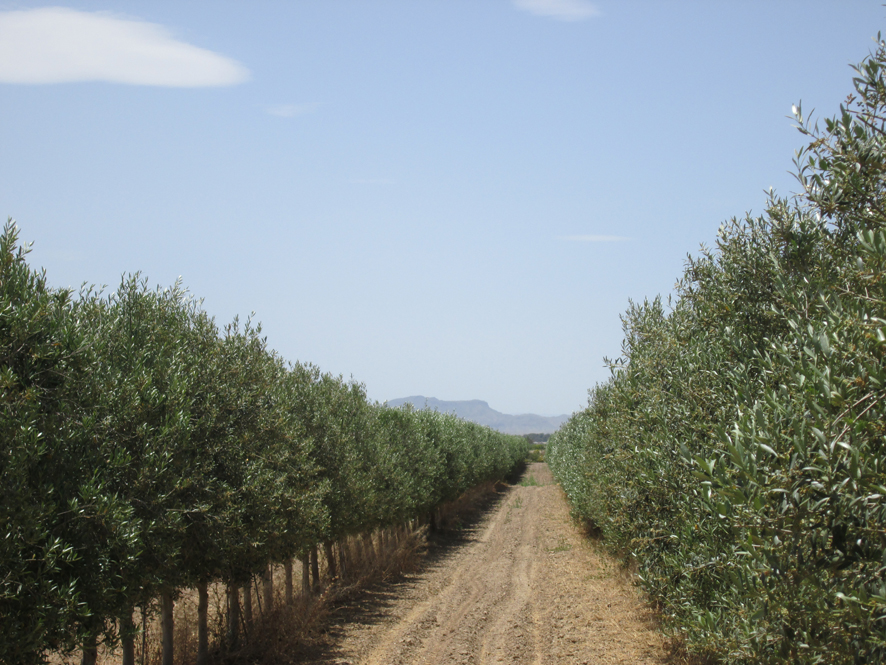 They’ve made a brilliant fist of sorting the place out and have achieved coveted status as first cold press virgin olive oil with International Olive Council approval which means a lot of tasting by people in Jaen, the capital of olive oil – one might say the Vatican of olive oil such is the mystery that surrounds it. Oh and it’s pretty tasty too like less fatty butter with added sunshine. And of course you’ll live longer.


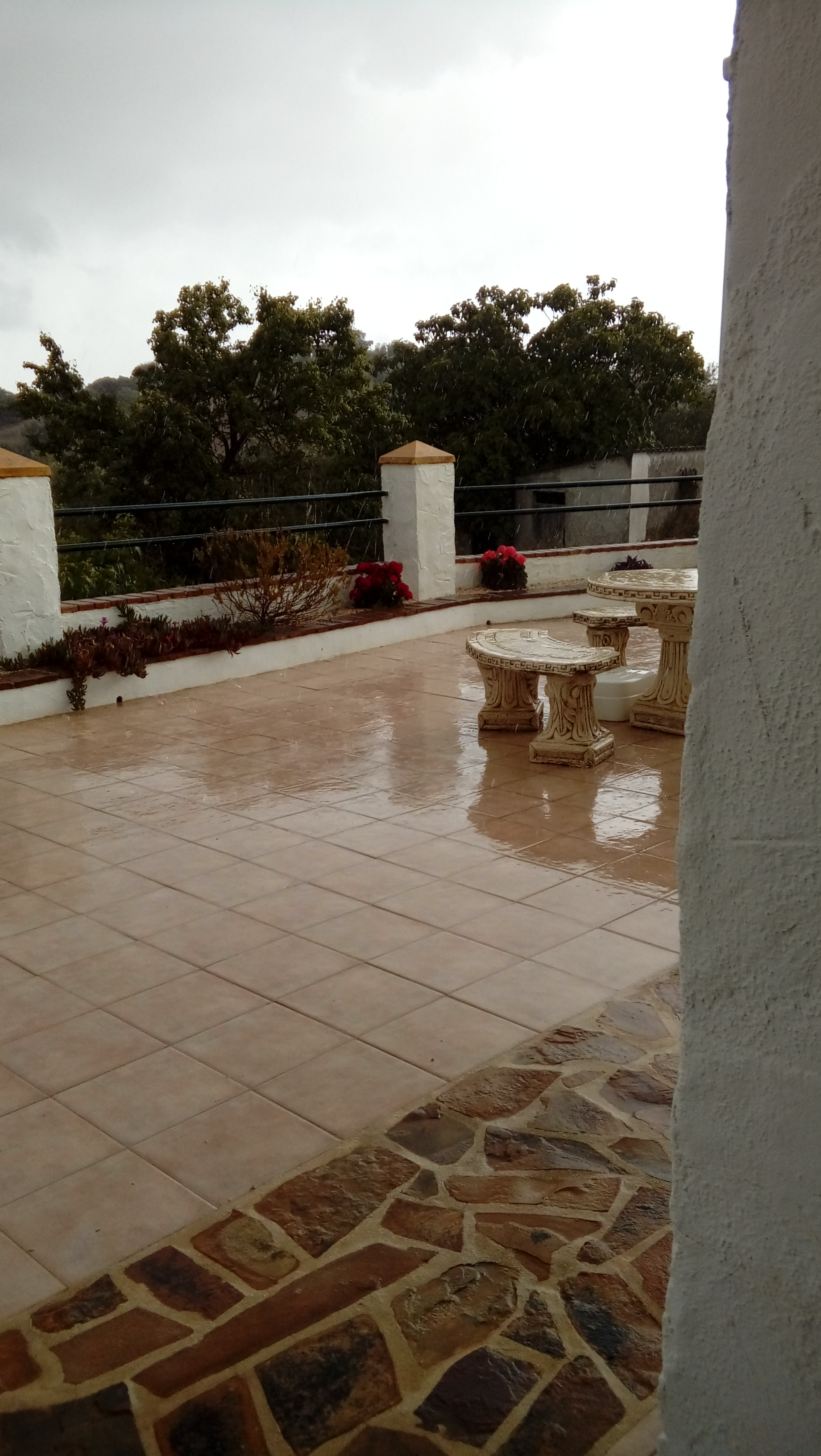 Thursday brought an absolute downpour and the forecast for Friday was dodgy so I sent a message asking if they want to postpone but we decided to risk it anyway. So I set off in blinding rain with the wipers the only things going fast along the windy road through Villanueva de Algaidas to reach the A45 autovia to Cordoba. All was well and I made it to the very modern station with a huge plaza in front of it in good time. But it seems there’s no short-stay, pick up and drop off parking. However two cars were waiting in a slip road in front of the station which had bollards to stop you entering from the obvious direction. No one seemed to be about so I failed to see a No Entry sign, went in did a three-point turn and was ready to receive Natalie and Graham when their train arrived just five minutes late.

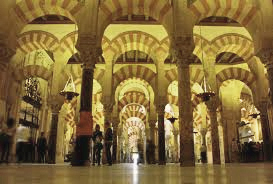


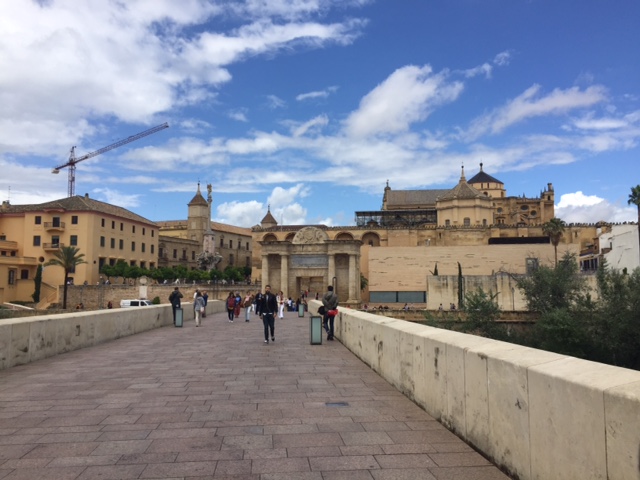 To the south, the banks of the Quadalquivir have been opened up and developed and we took the opportunity of a sunny spell to walk across the Roman bridge, even earlier than the mosque dating from the first century BC and rather spoilt by some later concrete balustrades. Time for a visit to a favourite which Natalie had recommended to Dee and me on our visit in 2010


![20170508_152136[1]](https://mikeandmurakami.com/wp-content/uploads/2017/05/20170508_1521361.jpg) So I arrive in Rute just after three which seems like a good time for lunch before shopping. I recall that nice restaurant and bar we used to go to –
So I arrive in Rute just after three which seems like a good time for lunch before shopping. I recall that nice restaurant and bar we used to go to – 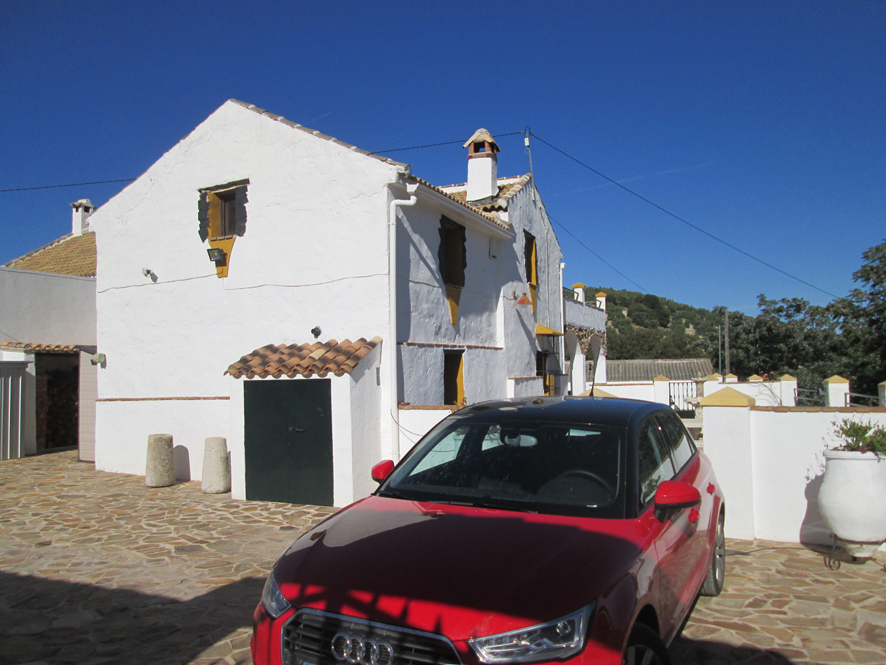




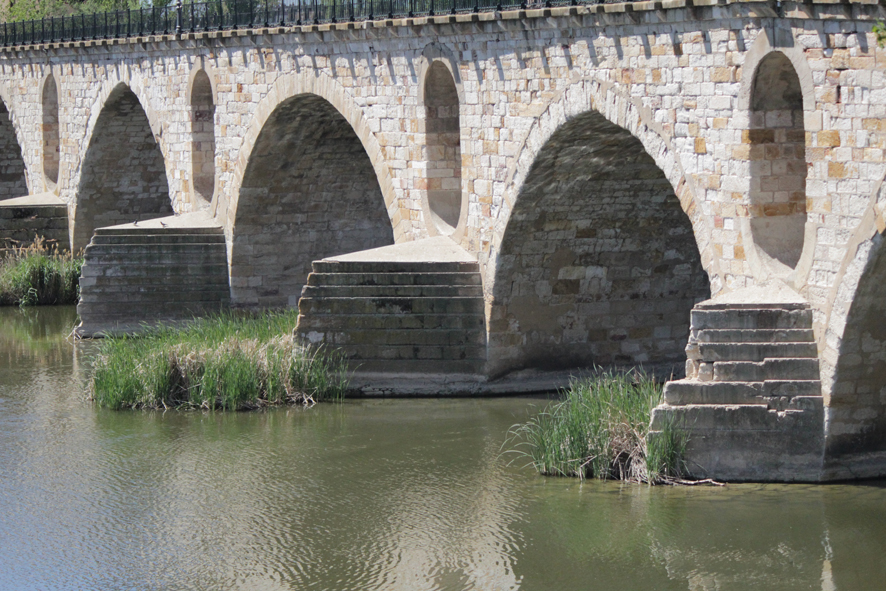 I then decided it was time to pay the Duero a visit and fortunately you can walk across the stone bridge, along the gardens and children’s playgrounds on the left bank with great views of the weir (!) and then back over the new road bridge and back to town along the right bank through a splendid avenue. It was a lovely reflective stroll for about two and a half kilometres reminding me a little of Boston’s esplanade on a Sunday with cyclist, joggers and rollerbladers but all on grass and sand.


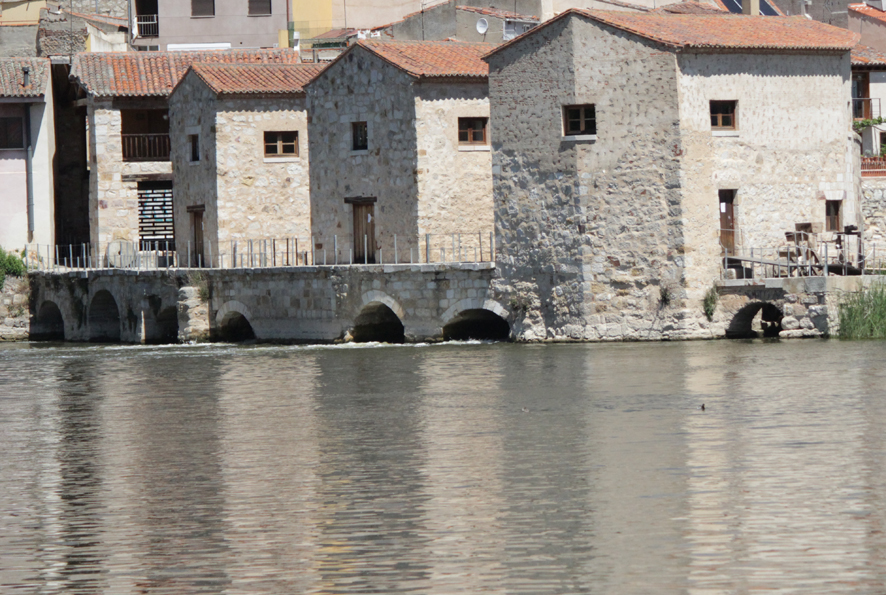
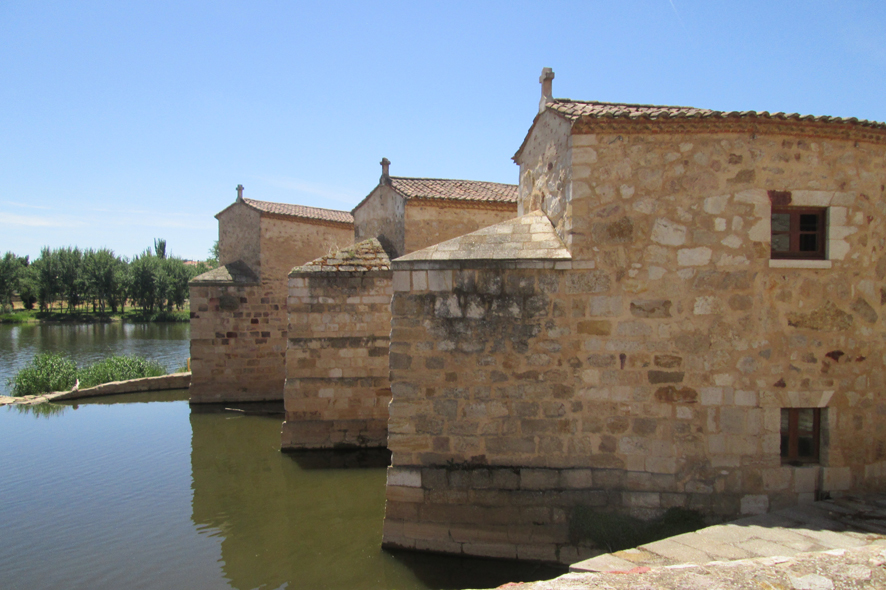


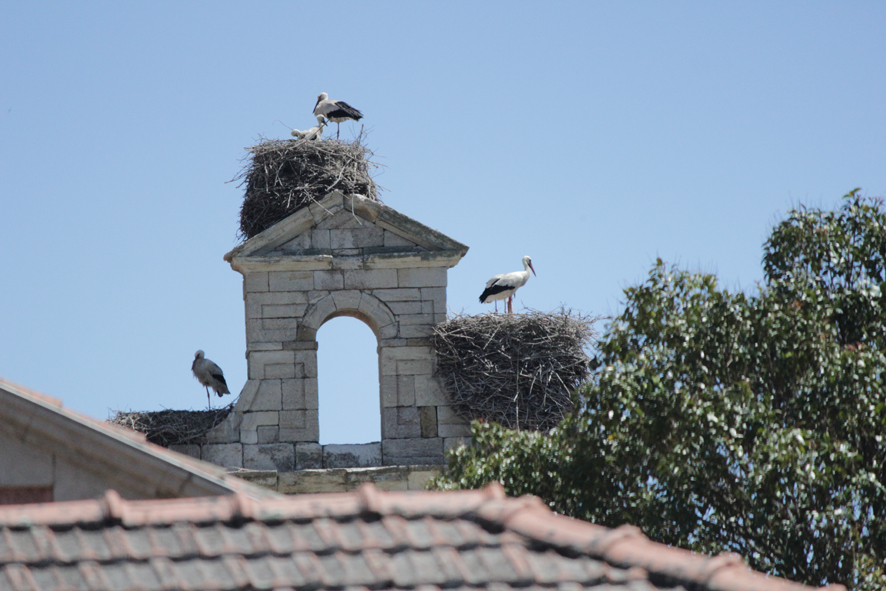 I continued my stroll through the medieval old town passing a super triple stork site through to the newer area where I got confirmation that yesterday’s weather prediction was very close if not there – it was 26° as I passed by so it might have got hotter. It’s fairly typical of Spanish towns with elegant avenues, parks and not-too-ugly apartment blocks and some interesting designs for children’s play objects.


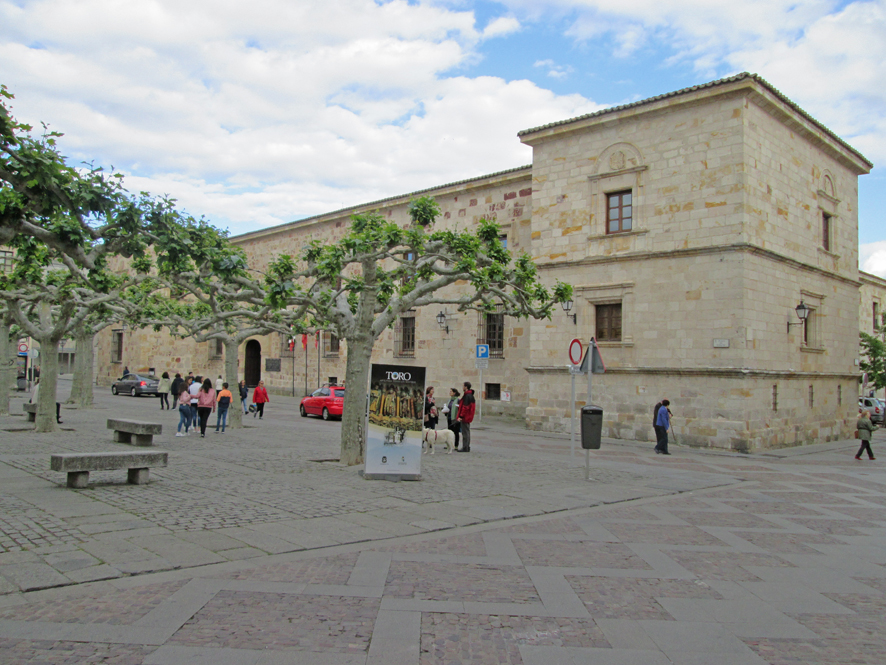
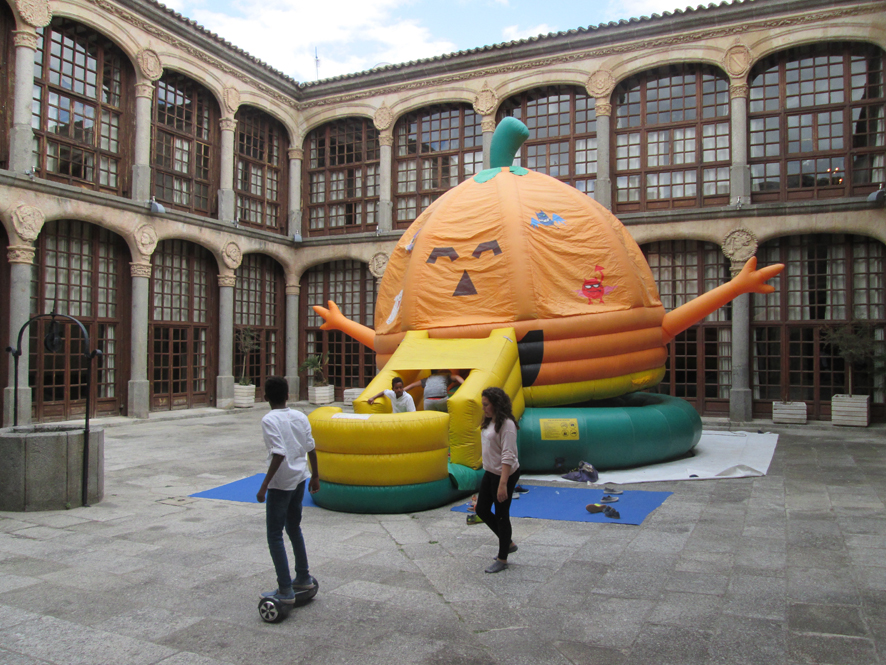 There’s a massive wedding on today so the normally elegant courtyard has an inflatable gonk bouncy castle. Well it keeps the kids out of the bar! Fortunately our favourite resident is still in place and I might take him for a ride around the ramparts tomorrow.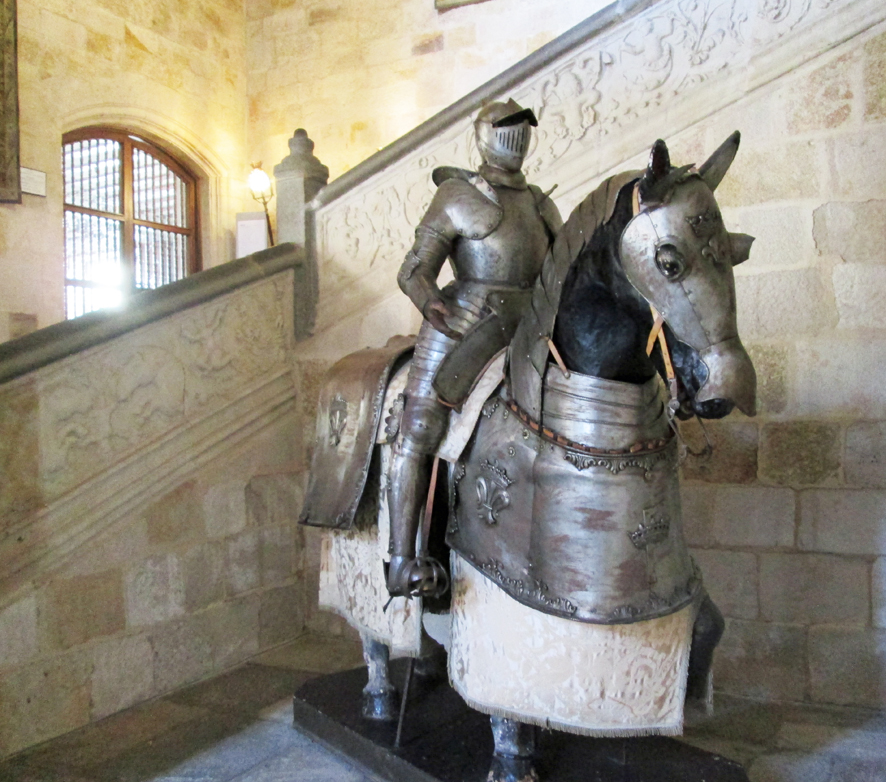
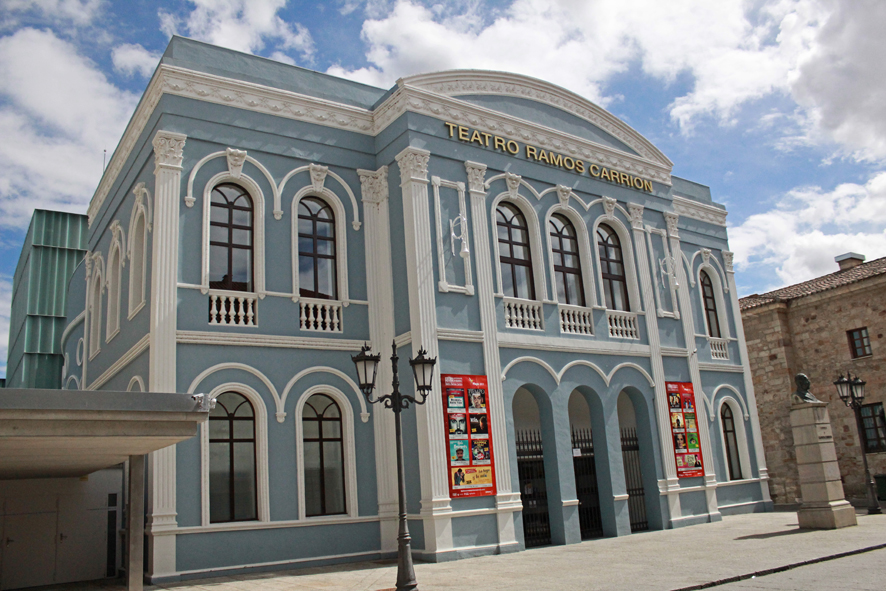 Right next to the parador is the Teatro Ramos Carrion which was a ruined hulk last time we were here. It’s been restored, had a modern extension added and created a new square with views over the Duero. It reopened to the public last year. There’s also another theme of these blogs that followed me to Zamora – the modernisme (oops that’s Catalan – modernismo) trail.


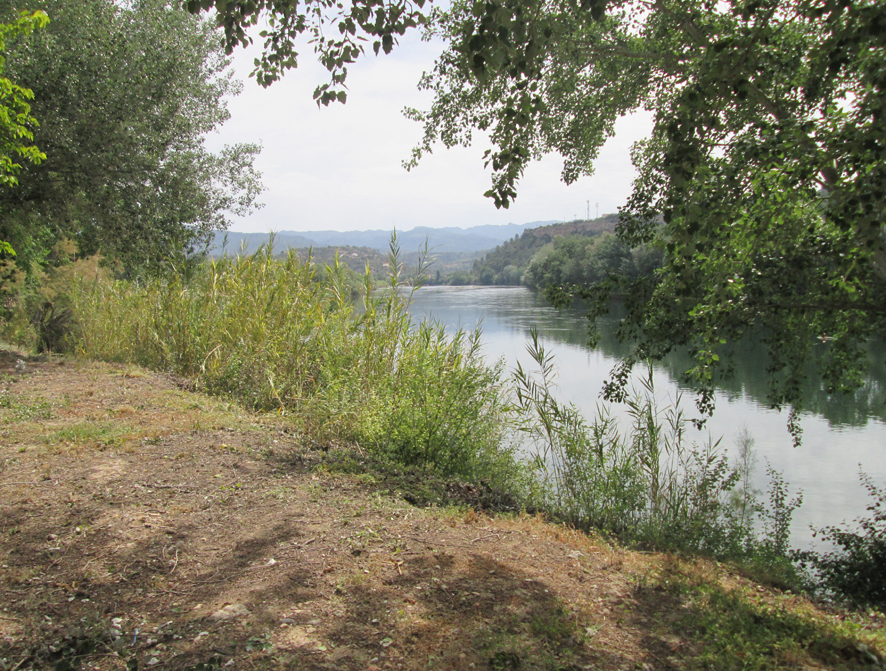 The river bank walk reminded me very much of a similar stroll also beside the Ebro but way west in Haro in the Rioja. Elegant wooden fences, plenty of places to sit and picnic and the interesting contrast of the slow-moving Ebro and the rushing canal.
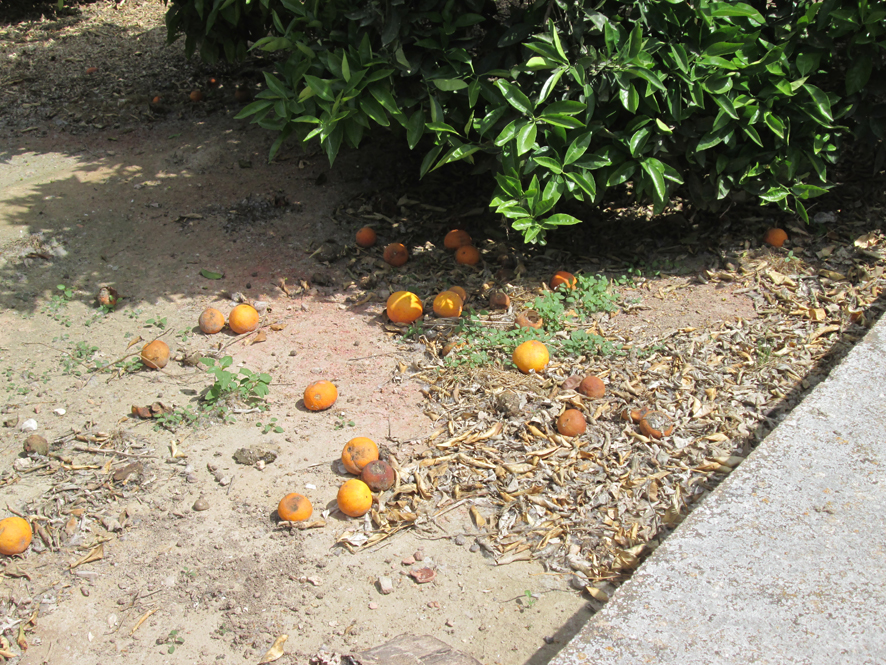 As I walked back through the village there was evidence that the citrus season is all but over although I did see another septuagenarian scrumping a few remaining oranges – to be fair he may have been legit. I didn’t like to ask. On my perambulations through the narrow streets I concluded that a third of the population was over 70, a third pregnant and the other third at work or in school. Back in the main square I discovered the reasons for the canal.
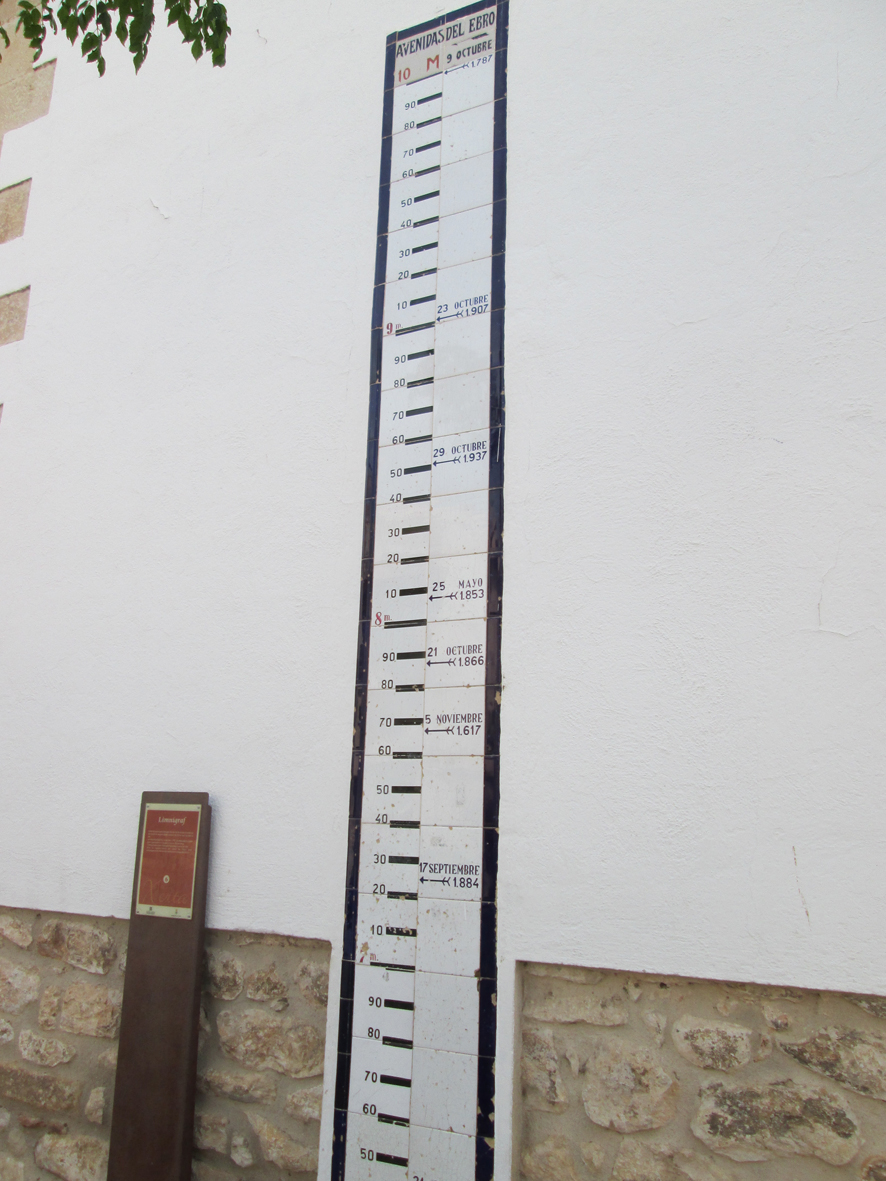 This marker up the side of the church shows the level of the floods – it’s ten metres at the top – that used to devastate the whole area because of the unpredictability of the flow in different seasons. So in 1857 they built a diagonal dam across the river – some evidence points to a much earlier Moorish effort to control the river – which siphoned large amounts into the canal which is used to supply towns and villages and irrigate the fertile lands of the area. A hydroelectric plant followed in 2002 so the waters of the Ebro are put to good effect.
 That’s my history quota for the day so I set off for culture. The town of Horta de San Joan has a


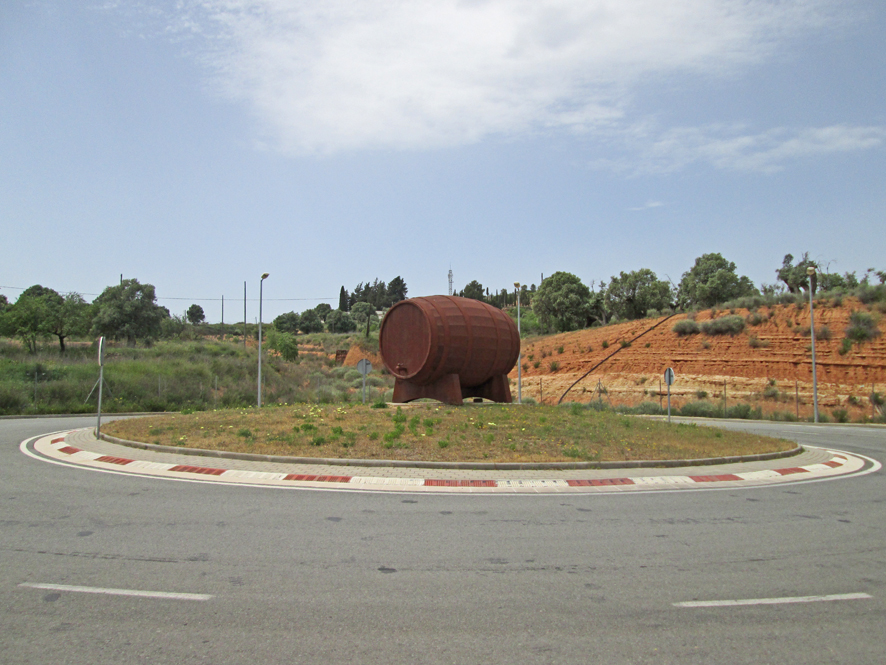 On the way I have an opportunity to snap one of the roundabouts I obsessed about the other day and a sign that I thought would amuse any of the IT buffs out there with its nifty digitalism.
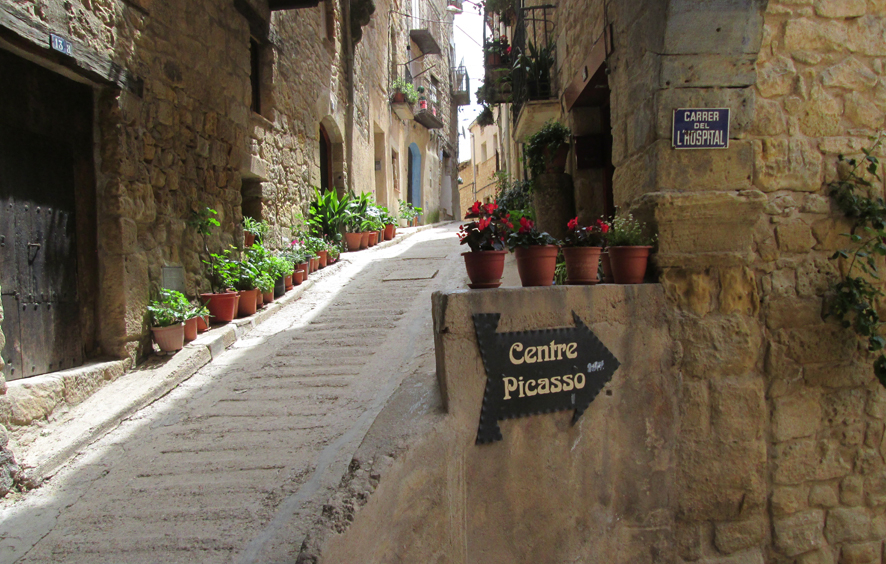 Of course after parking up and mounting the steps and steeps to Horta de San Joan I discover that the Picasso place only opens on Saturdays and Sundays – rubbish planning again. It also seems only to have reproductions and photographs of the mates he spent time with in Horta – might have been quite interesting but not essential, I think. After all that effort there was an attractive square with a bar with a beer with my name on. It was lunch time for the workers who are destroying the town centre before rebuilding it and they are all playing cards – quite competitively I would say.
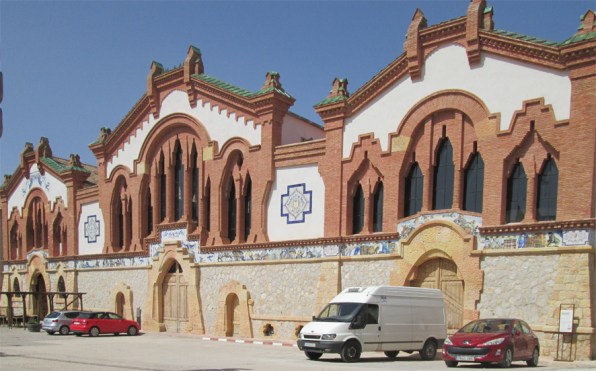
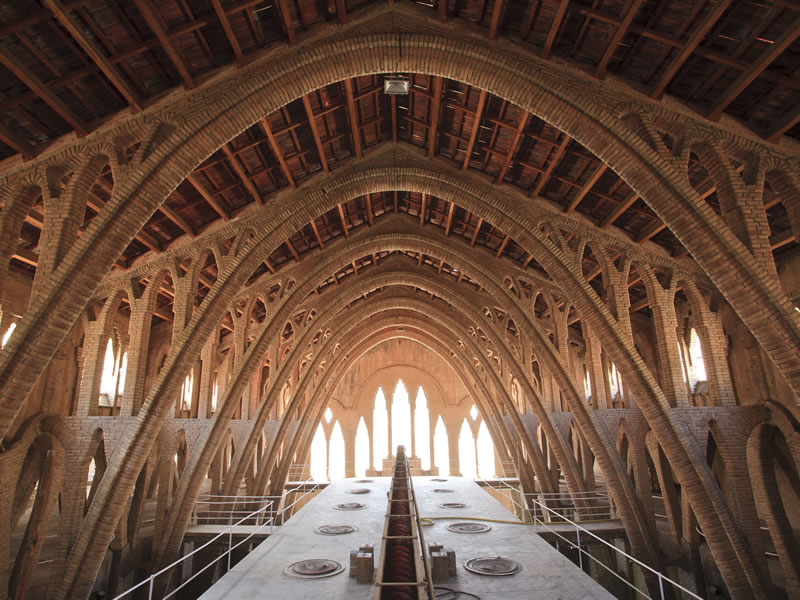


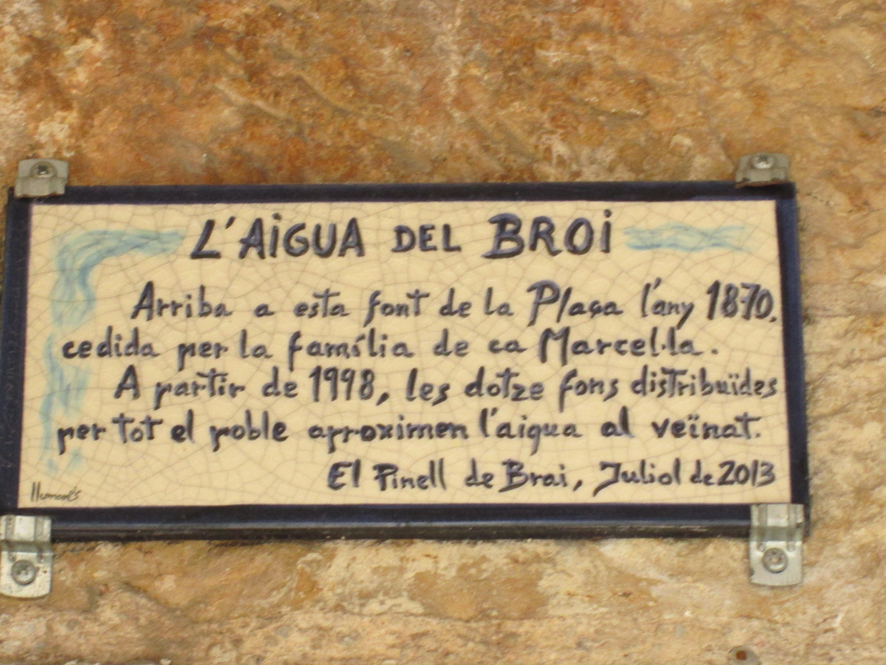


 Its Roman nature explained an odd bifurcation of a twin track section round a stone archway the Arc de Bera – I couldn’t stop but, thanks to Wikimedia Commons, I can show you what I saw. It was a sunny day, progress was good until a saw a signpost for San Sadurni d’Anoia. I don’t know how many of you are familiar with the town but I’ve read it on lots of bottles of cava. San Sadurni is the capital of cava so a diversion seems essential.


 I was tempted to continue my journey in this but security wouldn’t let me near it.


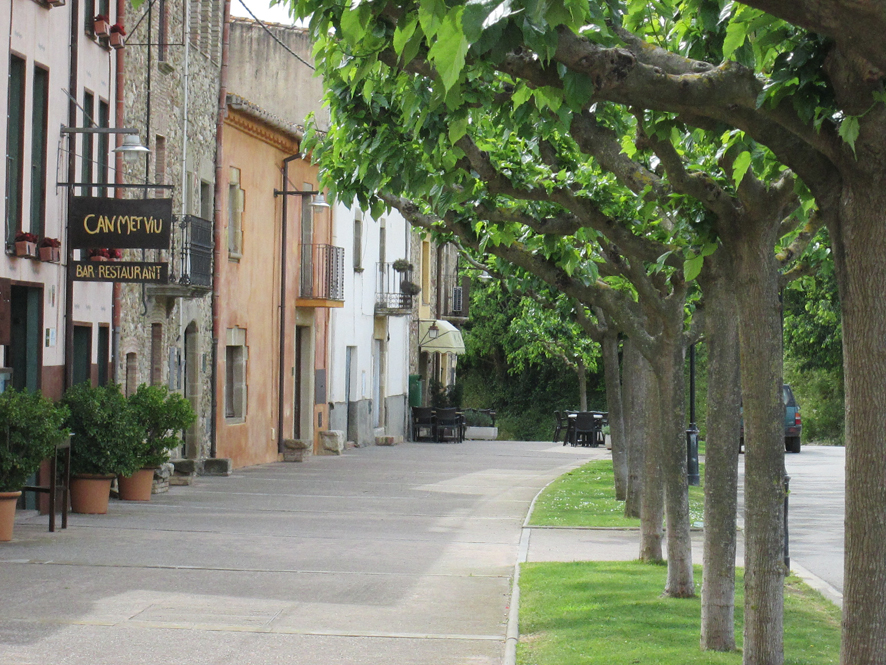 Eventually it flattens out and I arrive at San Sadurni de L’Heura a totally unspoilt old village in which I saw no one on my perambulation – they were all out working in the fields or the chicken coops or indoors cooking and mending although I heard no sounds either.


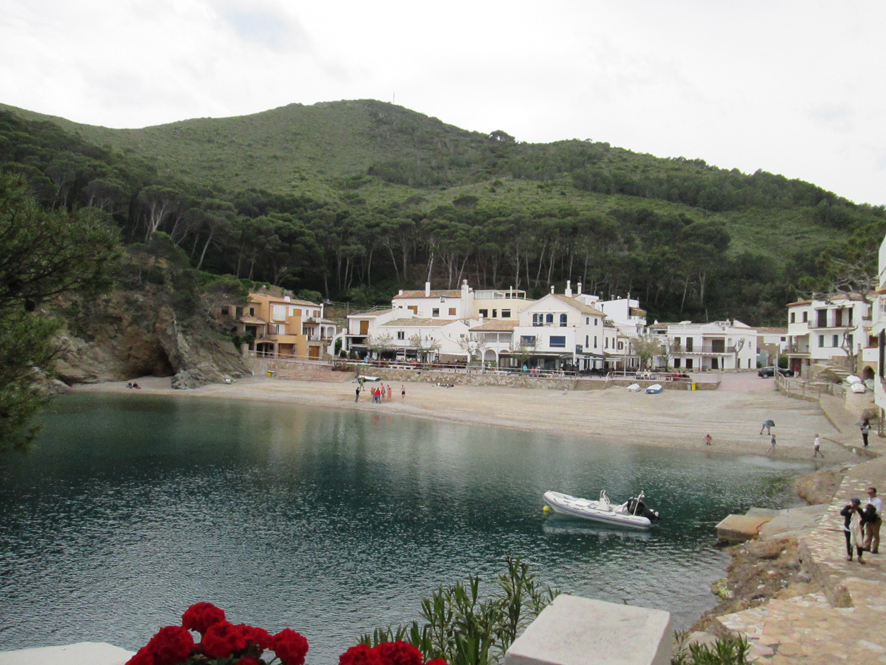
 Memories of Dee’s mum hit me then and I made for Sa Tuna where we took Eileen for a break after she’d lost Dee’s dad John. I began then to understand grief. Eileen was good company, very demanding of post boxes to send postcards, but had moments when she didn’t want to talk. This is the house we stayed in for a week.


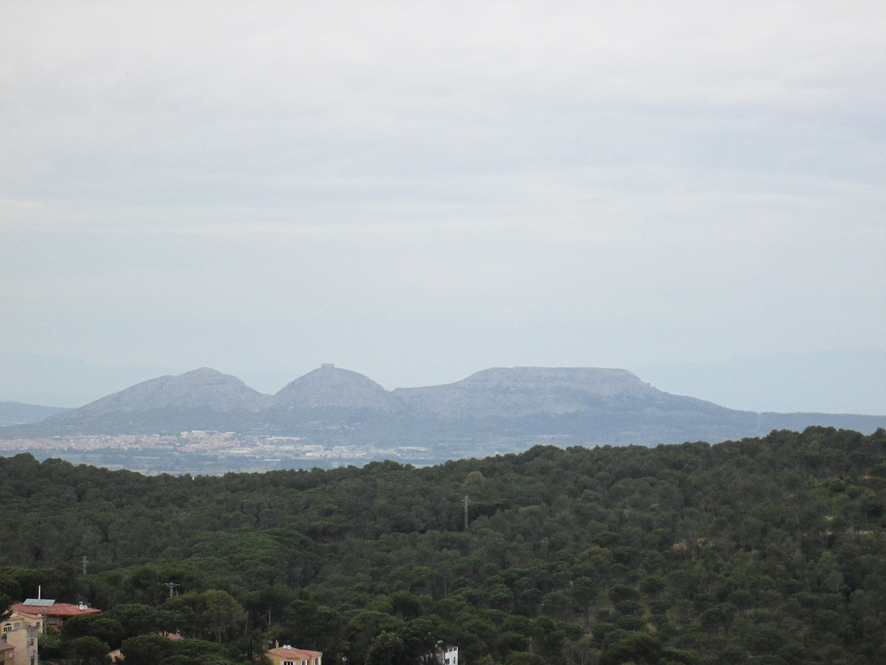

 Toroella is a special place as Dee and I walked to the castle – the nipple on the sleeping lady’s bosom. We phoned and waved to her sister lounging in the campsite far below. Quite a day!
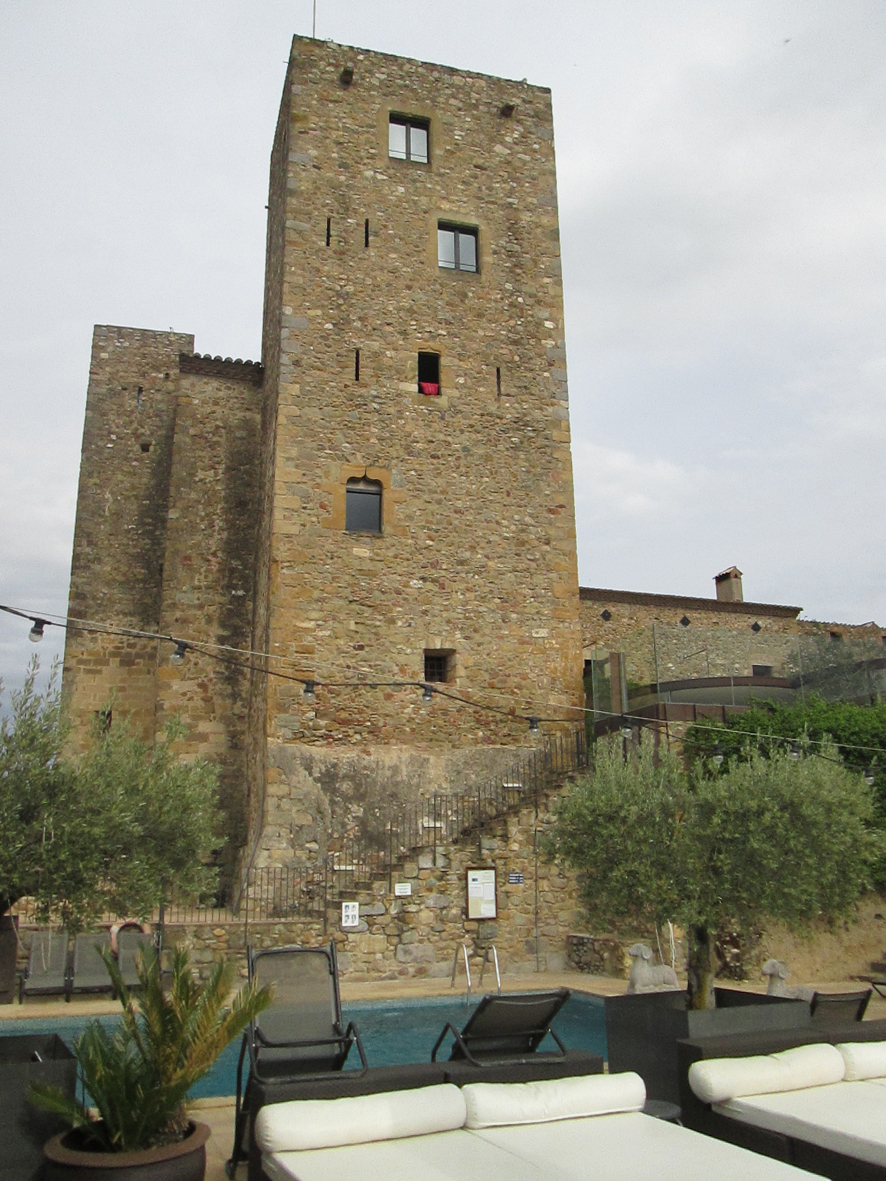 That’s my room with my swimming trunks drying in the window. What do towers have? Lifts? No. Steps? Yes lots of steps – good for the fitness regime I tell myself as I pant to not quite the top. The view is magnificent. Worth it? If I survive two days without heart failure – yes. In fact we came to look at it many years ago when it was still under reconstruction by a Dutch couple who have done a great job in converting it to a boutique hotel.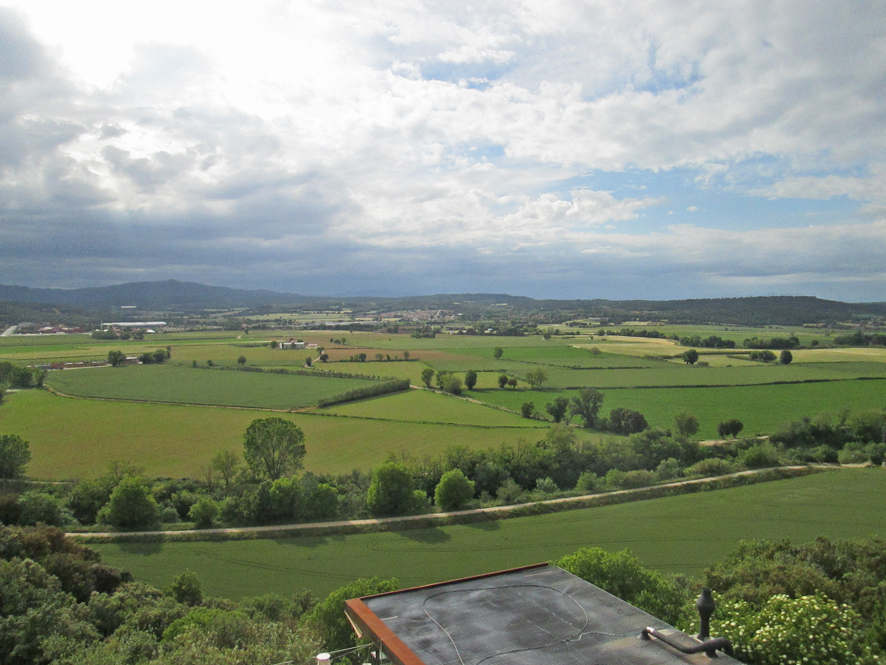
 mikeandmurakami.com