Music, mystery, movement and more

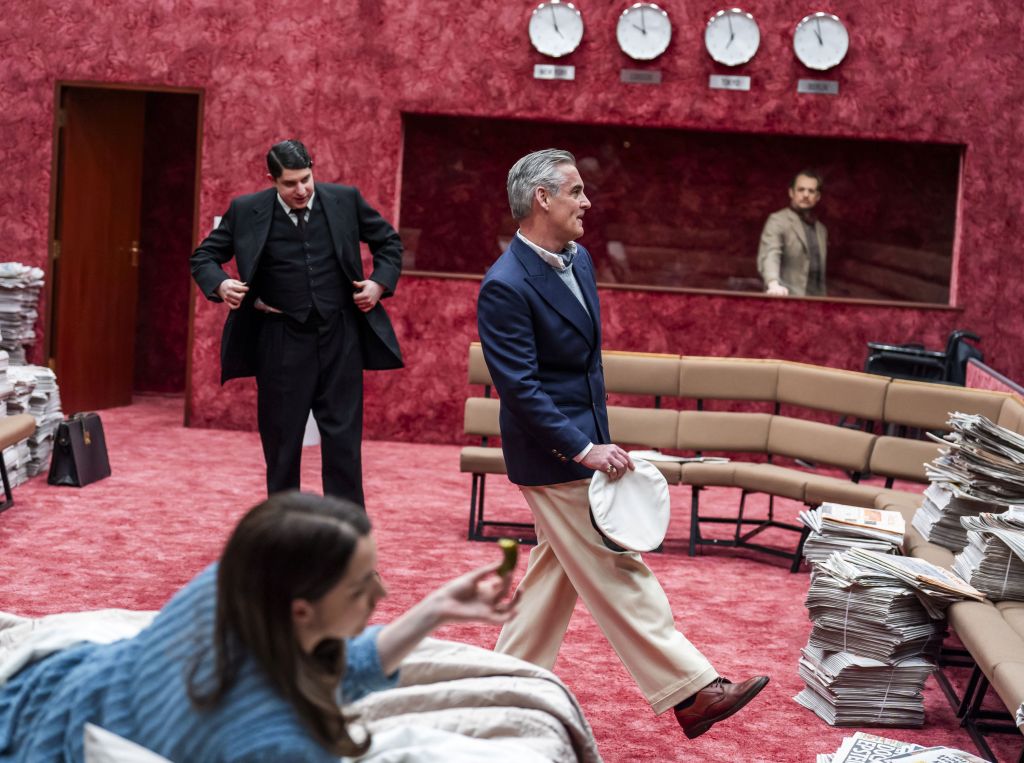
I had the privilege a couple of weeks ago of seeing an hour of the technical rehearsal of The Unbelievers at the Royal Court as part of Frances’s patrons’ deal. It was fascinating and set up a sense of great anticipation for the play itself. It did not disappoint. The central performance of Nicola Walker was quite stunning as a woman grieving the mysterious disappearance of her teenage son. Spoiler alert – he doesn’t appear but his absence hangs over the three intercalated time periods after his failure to return home.

The whole cast remains on stage throughout except for a couple of costume and role changes in a set that has a sparse domestic interior at the front with what looks like a police or doctors’ waiting room at the rear. Fear, anger, incomprehension, blame and violence swirl through the mother, her two ex- husbands, children and step-children. Some people, it seems, found the mingling of the day after, a year after and seven years after time periods confusing but I thought it added to the power of the writing, depicting clinically the way grieving does affect your sense of reality and time. It sounds bleak but had quite a few moments of hilarity. A serious examination of grief, guilt and sanity leavened by tender, moving and funny moments.

Next it was off to the downstairs theatre at Hampstead where new playwrights are given space to experiment. The Billionaire Inside Your Head by Will Lord was an examination of greed, ambition, entitlement and fantasy in an office setting. Echoes of Glengarry Glen Ross and other Mamet two-handlers spring to mind as a thruster and a slacker trade dreams and insults. The entitled slacker Darwin is the son of the company’s owner who as well as appearing in the drama, opens it with a chorus-like prologue as The Voice, that sets the scene for us all to examine our thoughts. The debt-collection nature of the company is perhaps a bit less exciting than Mamet’s realtor wheeler dealers but the tension between Darwin and the OCD Richie is well depicted. It was exciting, engaging and thought-provoking – just what Hampstead downstairs aims to be.

There was lots of the movement of my title in both the above but the prime expression of it this week came in Akram Khan’s Thikra: Night of Remembering at Sadler’s Wells where I had the pleasure of Rosa’s company. Devised in conjunction with the Saudi visual artist Manal AlDowayan, this is an intense hour of modern dance infused with classical Indian forms and a sound track that moves from a foreboding drone through ragas, Balkan chorale, drumming and hints of Purcell.

The twelve female dancers all have waist-length black hair that forms an important part of the performance. Would have been an interesting casting call: “Find me twelve women with equal-length black hair who can dance classical Bharatanatyam choreography”. Nine of the dancers were uniformly clad in olivey long dresses while the sacrificial victim was in white, the matriarch in red and her sister in black. AlDowayan’s involvement gave it a very graphic look that comes from her work in exploring cultures, heritage and change. The narrative didn’t really matter but was essentially about annual rebirth and renewal through sacrifice. Visually stunning, musically stimulating – an hour of total transportation into a world of magic and wonder. You can get a short glimpse of it here.

A select group of us returned to the Bridge Theatre for The Lady from the Sea. I haven’t been there for ages as it’s been wall-to-wall Guys and Dolls. I wrongly thought this was a version of Hedda Gabler but Ibsen actually wrote a play with this title so I need to brush up my Scandi classics knowledge. This was a Simon Stone adaptation, so after the Billie Piper Yerma, expectations were high for something off the wall. And we got it – the usual Ibsen anguished captive bride played bravely by Alicia Vikander resisting the cage into which her husband Andrew Lincoln, in great form, had placed her. The drama plays out on a thrust stage (the Bridge is so versatile as a space) which becomes soaked with rain in Act 2 and then turns into a swimming pool. Writing, acting, sound and lighting were all excellent but the award of the evening has to go to the set design and build – the vision of Lizzie Clachan. Another exceptional evening of entertainment.

After all this fun it was back to work – as a producer! A couple of times a year for the last few years, I’ve recorded an audiobook version of a reader for use in teaching English as a Foreign Language in Germany. I’ve now, it appears, done 11 of them – here are a few from Hueber Verlag in Frankfurt.

I have a small repertory company of actors who are brilliant at producing a range of characters in the course of the narrative – teenage protagonists, their parents, threatening outsiders, police and other officials. The stories are often a bit Famous Five but tackle issues like single parenthood, criminal behaviour, the environment and relationships. For this one, Joining the Circus,I invited Gyuri Sarossy, who I met at a Hampstead Theatre party a while back, to perform the script. It doesn’t sound the most likely name for an English language project but he is English born of a Hungarian father and English mother. The story involved a farming family setback by the father’s accident and a circus family devastated on finding their usual pitch was waterlogged and wouldn’t work. Gyuri was born in Bristol so we opted for a West Country accent for the farmers and an East Midlands for the circus people. It worked extremely well and I am constantly amazed at how these actors can switch characters seamlessly in a single sentence. After the recording Gyuri was off to Budapest to record his final scenes in a vampire movie. Another spoiler – he dies. A week later we hear that the client likes the results of the session. Great news – we’ll all get paid! A little.

It was then on to my main unpaid role as a trustee of the British Bilingual Poetry Collective. I was invited by the publisher of the collective’s anthology Home and Belonging, which resulted from a series of translation circles like the last blog’s reference to the Barbican, to chair a discussion panel at the Palewell Press Literary Festival. The day also included readings from a number of poets including Chika Jones and Nasrin Parvaz who feature in our anthology. It was fixed a long time ago and so I missed Watford’s best game of the season so far, a 3-0 demolition of Middlesbrough – such dedication to the cause, such a fair weather fan!

However the occasion was very interesting with my panellists translating from Arabic with Dr Amba Jawi and Catherine Temba Davidson as collaborators, Barbara Mitchell who translates from Spanish and Caroline Stockford who does Turkish and Welsh and finds striking and unexpected parallels. We ranged over the process of translation and the difficulties of rendering essence and spirit rather than words, the degrees of faithfulness and liberties translators are allowed and the reactions of the original authors.

In all the cases featured here there were difficulties since all the authors were in prison on political charges. Palewell Press specialises in human rights publications so this was only to be expected. The overriding message was that all art forms have to continue to expose and challenge human right abuses whever they occur.

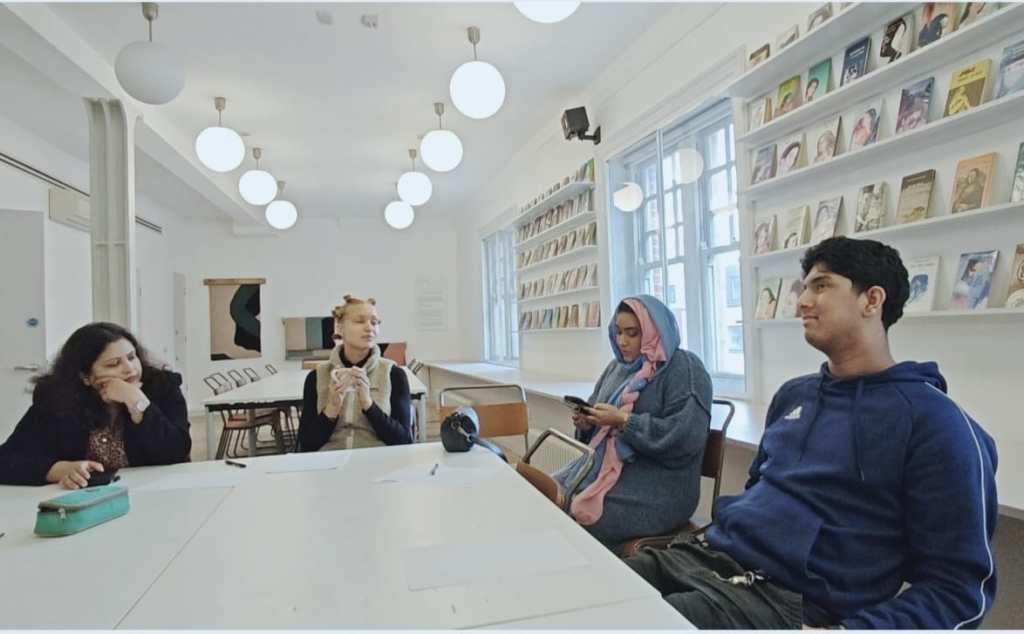
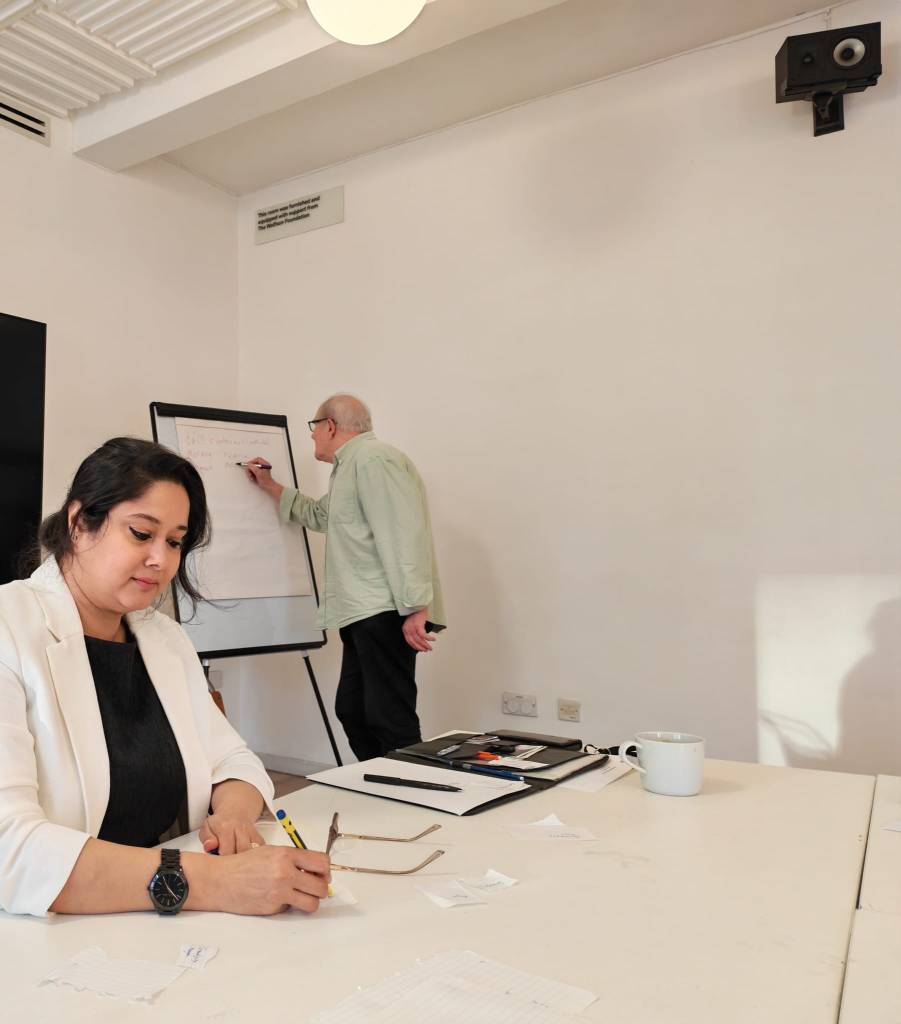
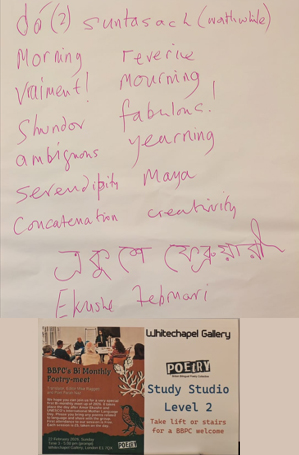
Next day, to make it a full weekend of poetry, I co-hosted BBPC’s annual contribution to the Tower Hamlets Season of Bangla Drama. The season has a theme each year – we’ve done ‘love’ and ‘hope’ and this year it’s ‘kindness’. We decided to go all alliterative and call the session Kindness with Kazi using the poems and songs of the national poet of Bangladesh Kazi Nazrul Islam. Shamim Azad and I hosted the occasion which had performances by the brilliant singerJoyeta Chonchu of a couple of Nazrul songs , my colleague Milton and I recited one of his most famous poems “I Sing of Equality” followed by a discussion of his work and influence on people’s lives. After a short break we then broke up into pairs to talk about kindness given or received in our personal lives after which everybody wrote a short poem or piece of prose. There were some very moving contributions and very positive feedback that participants found it both enjoyable and valuable.

Monday saw me joining Frances at the Orange Tree Theatre for Hedda. Ibsen is all the rage these days it seems – well I guess he has been for a while. This is an adaptation by Tanika Gupta – well really more of a new play based on – Hedda Gabler, relocated to Chelsea in the post-war, post-partition of India period. Tanika’s take is based around the need to conceal the ethnicity of Hollywood’s Anglo- Indian stars, in particular Merle Oberon. The evening was pacy, directed by Hettie Macdonald, twisty and with a full range of emotion, fear, deception, devotion and angst.

From the dramatic opening with her lifelong maid, brilliantly portrayed by Rina Fatania, asking which face whitening she’d like today through to the realisation that she’d made a disastrous marriage believing her screen career to be over, Pearl Chanda was Merle Oberon.

A powerful performance with hints of her former influencer status dashed by the creeping reality of her current dull life. It touched a real nerve with me as I was currently reading Kiran Desai’s Booker nominated The Loneliness of Sonia and Sunny which brilliantly examines the whole question of identity, ethnicity and personal authenticity. I was fortunate to be able to speak to Tanika about our Kindness event and she said her father used to sing Nazrulgeeti (KNI songs) around the house all the time. That was before seeing the play so sadly I wasn’t able to tell her how much I enjoyed it.

Another part of the Season of Bangla Drama was a presentation of kindness stories collected by long-term Bangladesh resident Peter Musgrave who had taken part in our BBPC Kazi session so it seemed only right to go to his. An added attraction was that Gitabini, the singing group featuring my friend Rumy Haque was to perform. There were stories to bring hope of new flood resistant ways of building houses and farming being demonstrated by NGO staff to educate the Bengali populace, particularly in the most threatened areas. One of the countries most prone to disappearing into the Bay of Bengal if climate change continues unchecked – not sanguine about the current COP to prevent it – but good to see alternative approaches to mitigate the effects. Gitabini sang a Kazi Nazrul Islam song and Rumy recited her conservation-oriented poem about a banyan tree and I was able to chat with a number of old and new friends at the post-event Koffee and Kake.

Gitabini performing

I’m fortunate to call the young composer Dani Howard a friend and so when her saxophone concerto was finally to receive its UK premiere I just had to whizz off to Poole to the Lighthouse Arts Centre to hear it. I did some voluntary work a few years back for the London Chamber Orchestra which had originally commissioned the concerto but then got into financial difficulties and couldn’t complete the contract. So I’d waited nearly two years to hear it. Stockholm Philharmonic and the Bournemouth Symphony Orchestra came to the rescue and while I didn’t make the world premiere in Sweden, I wasn’t going to miss out on the first UK performance. The journey was horrendous. The train was 30 minutes late arriving at Waterloo because of earlier signalling problems, and quite a bit more than that departing. Then we couldn’t get into Southampton Station because of other trains blocking our platform. Finally they decided to skip some stops and head directly to Poole after Bournemouth. At least Delay Repay will kick in and I’ll get some dosh back. By the time I’d checked in to the hotel, checked out the location – my first time at The Lighthouse – and gone for a walk down to the Quay it was dark. I guess one benefit of this was the bright lights of the Poole Museum shone out. A quick beer and back to the hotel to prepare for the concert. Was all the hassle worth while? Oh yes.

The concert opened with a Wagner piece I’d never heard – the overture to his first opera, a comedy called Forbidden Love. A comedy from Wagner! It failed miserably and lasted for only two performances in 1836, but the overture was fun, very jolly and lively, opening with castanets of all things! But the main event came next. Dani had written the concerto specifically with the versatile Jess Gillam in mind. In three contrasting movements the music showcased Jess’s talent but also wove evocative call and response moments with different sections of the orchestra. Lush pastoral passages alternated with bold percussive swathes and the brass were strongly featured – Dani does like her brass – one of her first pieces I heard was her trombone concerto for Peter Moore at the Barbican in April 2022, another amazing performance. Dani says the concerto is a homage to Adolf Sax who invented the wonderful instrument which finds its place more frequently in jazz clubs than in the concert hall. I love the way Dani combines pure and simple sounds from nature with a clear understanding of the power of complex orchestration. She’s a master of the medium. The Times critic liked it too: The first movement bubbles and chatters, passing ideas between soloist and orchestra, while the finale is a dazzling moto perpetuo, dispatched with seeming ease by Gillam. Best of all was the central movement, an extended cadenza for Gillam, who made it seem as if we were hearing Sax’s innermost feelings

Jess Gillam is a master too and for her encore, chose a piece she’d played in BBC Young Musician of the Year in 2016 – Pedro Itteralde’s Pequeña Czarda – when the conductor was Mark Wigglesworth, now principal conductor of the Bournemouth Symphony Orchestra, whose home base is the Lighthouse. Most appropriate. After the interval we heard the orchestra in full flow with Berlioz’s Symphonie Fantastique. It will be interesting to compare this rendition with the Orchestra of the Age of Enlightenment’s approach in June next year on period instruments under Sir Simon Rattle.

What made the evening extra special was that Dani invited me to the pre-concert reception where I met her mother, Belinda, again – we had both been at the Barbican gig in 2022 – meet her sister Sam for ther first time and catch up with boyfriend Sion Jones who I’d met at the Colin Currie percussion concerto at the Wigmore Hall. Dani was of course the centre of attention with a former pupil effusing over her influence on his career and her former music teacher from Hong Kong, now working in Poole, bringing a class of her primary pupils to say hello. After the concert, Dani had some formal duties but after a while she and Sion were able to join Belinda, Sam and me in the pub where I’m afraid we stayed till they kicked us out. After all the music it was an evening of fascinating conversation eavesdropped and joined in with by locals Jeff and Jonny and covering coping with bereavement, mine and the Howards’ who lost a husband/father last year, music, the arts generally, contracts, 2027 paradigm shift and blogging among others which were continued outside the pub until we all decided to head for our rather tardy beds in three different hotels.

Another quiet week …

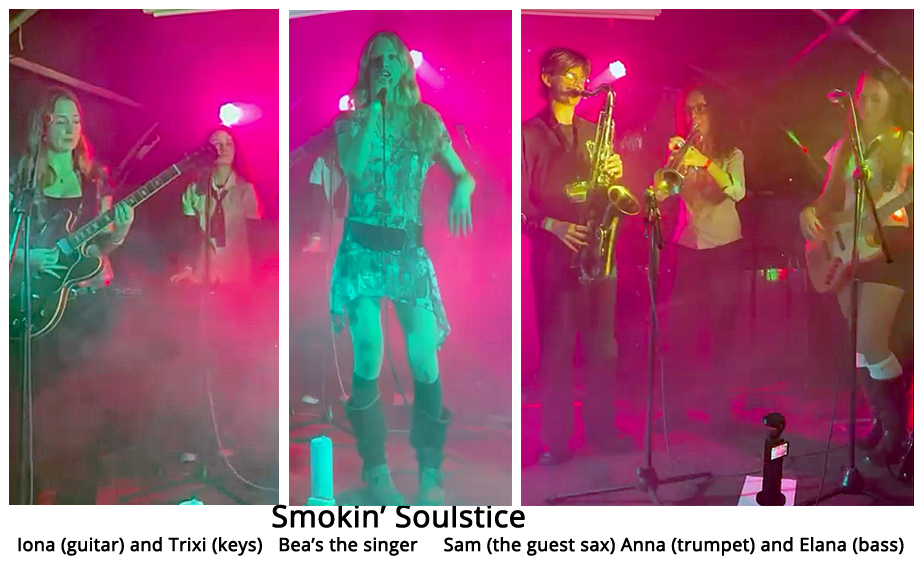
The week started with an interesting journey acrosss south London to see my granddaughter perform with the band Soulstice at BrockFest a music festival organised by Junior Open Mic which arranges monthly sessions for bands under the age of 18. This was a much bigger event in Brockwell Park in Herne Hill which I reached via a bus from home to Crystal Palace and then another to Brockwell Park. My daughter had equipped band and parents with branded merch. I had complained about being left out so today I was for the first time able to pull on my tee with SOULSTIC E GRANDAD appliqued on the back and keyboards on the chest as Daisy (Trixi in the band) plays the keys and flute. After some heavy metal and a plaintive female singer-songwriter it was time for Soulstice to perform their three-song set. The organisers had brought heir start time forward and there was a moment when they thought they may have to start with out their bass player. However she did make it on time – just – and they rocked the audience with a cover of Raye’s The Thrill is Gone and original compositions Still I Rise and Supersonic. As the applause rang out and they prepared to leave the stage the MC called them back for an encore and then a second one. A great start to the week and a proud grandad retired to the pub with some of the band and their parents to congratulate ourselves for the talent our genes had bestowed!

The next day it was me on the stage. I had been invited to read some poems at the Bangladesh Book Fair at the Brady Arts Centre in Tower Hamlets. I had a ten minute slot that I filled with a couple of poems inspired by my visits to Bangladesh back in 2009 and other more recent efforts which were politely received by the, fortunately, largely bilingual audience.

On Tuesday it was off to the Hampstead Theatre to see the transfer of Titus Andronicus from the Royal Shakespeare Company at Stratford. Having seen it there with Simon Russell Beale in the titular role it would be interesting to see how John Hodgkinson filled the space after SRB was sadly unwell and unable reprise his performance in London. Hodgkinson had apparently had only two weeks to learn the part and only one other public performance before we saw him. He was magnificent. His taller stature and natural authority gave the part a different feel. Despite the mutilations, murders and children-in-the-pie mayhem, you felt a degree of sympathy for Titus. The set had transferred to Hampstead slightly reducing the thrust which made it even more intimate than the Swan. Once again protective blankets were provided for front row guests against the blood spatter. The brilliance of Max Webster’s direction in using blackouts and audio to cover the goriest actions was still highly effective and the wardrobe choices for Romans and Goths worked really well. It was a stunning evening of theatre – again!

Then it’s off to the Kiln to see a play that Frances missed at the Galway Arts Festival last year but which has now happily got a run in Kilburn. The Reunion gathers a family on a remote island – maybe they used to holiday there when younger but I didn’t quite catch it – some coming from Dublin others from London – to commemorate the anniversary of their father’s death. After a cordial start, the cracks begin to show and develop into fissures and then chasms as sibling rivalry, jealousies, disapproval of lifestyle choices and parenting start to surface through the evening and into a nightmare of a night. There are a couple of great coups de theatre that I won’t reveal but alongside all the grief and misery there is a lot of humour, both verbal and physical.

And afterwards Fran had a chance to catch up with Paul Fahey the director of the Galway Arts Festival who remembered her photographer uncle Stan who used to photograph the festival for the local newspaper, about whom they chatted so it made for a great end to a fun evening.

I had missed Inter Alia at the National Theatre so was delighted that NT Live had recorded it and were showing it at the Greenwich Picturehouse on Thursday so I got three plays in three days albeit one of them on a screen.

The play is an amazing follow up to the sensational Jodie Comer spectacular Prima Facie and has an equally staggering performance from the central character Judge Jessica Parks played by Rosamund Pike. Unlike Jodie Comer, Rosamund is not alone on stage but still has the most incredible amount of stage business with props and costume changes as the awful story of a teenage rape unfolds through hints, evasions, suspicion and eventually confession. It’s a very moral exploration of social media’s effect on adolescents, understandings of consent and appropriate sexual behaviour – a theme explored in the eponymous Adolesensce on TV in 2025 and Micaela Coel’s I May Destroy You a couple of years ago. It’s a hot topic at present with toxic masculinity promoted seemingly unfettered by the big tech platform owners. The play calls for acting of a high order with both sides of dialogue in conversations, being an ever-present mother and a high-powered judge. Rosamund Pike delivers brilliantly with great support from her husband and son and a cast of children who pop in and out. It was most excellently filmed as NT Live shows usually are with enough wide shots including the audience to give a sense of being in the theatre but with the telling close ups of moments of joy and anguish that you don’t get when you are actually in the room. Shocking content, stunning performances, superb evening, applause in the cinema.

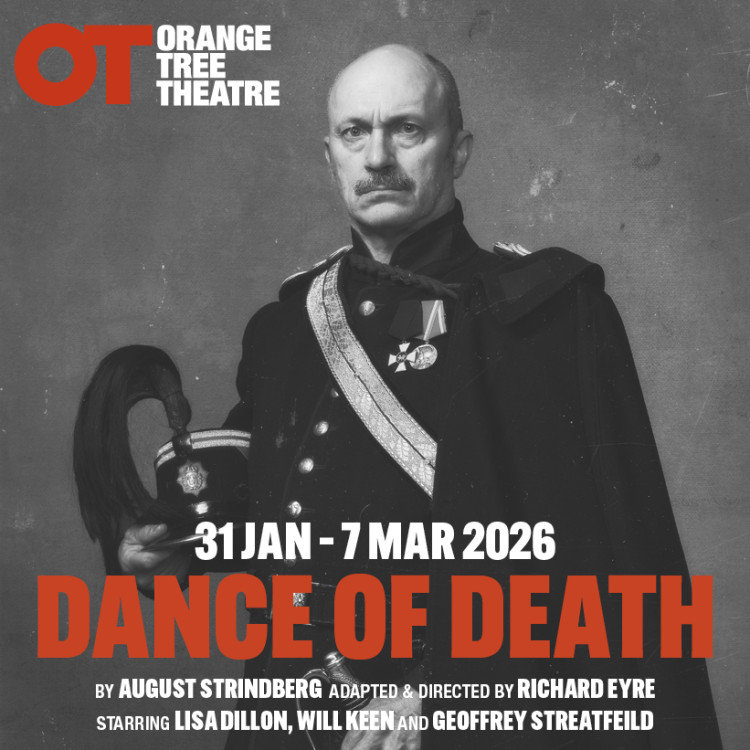
Having seen a part of the technical rehearsal for Creditors at the Orange Tree a couple of weeks ago it was now time to head off to Richmond to see the whole thing. Fortunately the journey time allowed me to watch the Red Roses complete their victory over France in the Womens’ Rugby World Cup and seal their place against Canada in next week’s final.

It’s been a week in which crucial issues have been aired in the theatre. War, power and empire building; family intrigue and betrayals; rape and social media and now Strindberg’s take on coercive control. The cast are outstanding in bringing a terrifying text of mysogyny and manipulation to us with compelling performances that deliver humour amid the horror and which draw gasps from the audience as Charles Dance’s Gustav ties Nicholas Farrell’s ailing artist Adolf in knots with a tissue of lies and innuendo. Missing for the first scene but the centre of the play is Geraldine James’s Tekla. She enters in scene two with comic flirting and her own level of manipluation of her husband Adolf to allow her to pursue other conquests in an ‘open marriage’. It all turns grim as Gustav’s poison pours out of Adolf in an attack on Tekla. Finally Tekla and Gustav play a scene in which many revelations occur. The adaptation by Howard Brenton and direction by Tom Littler make this a compelling evening in the theatre with actors at the peak of their powers. It appears that the three actors last worked together 20 years ago in the TV series The Jewel in the Crown. Their chemistry is intact.

And when I got home, there on the doormat was the latest edition of POL (Poetry Out Loud – Issue 7) in which I have a short story published. The magazine has a Bangladeshi slant and my story has a female British-Bengali protagonist in a tale of lost lovers reunited during a male lecturer’s trip to Yorkshire. You can get it from Amazon if you are interested.

Royal Albert Raggetts

When I met Jenna Raggett back in March at St George’s Hanover Square, we agreed to keep in touch. We did and so I set off with family and friends to the Royal Albert hall to see a BBC Prom given by the Irish Baroque Orchestra in which Jenna plays violin. So we had the delightful moment pre-concert in which Jenna could say “Michael Raggett meet Michael Raggett”. Her father is also a Michael and stayed and had a chat to me and two other Raggetts – Tom and Caroline – while Jenna went off to change and prepare. The Irish branch also have a cousin Michael who lives in Basingstoke! Also with us were my friend Jadwiga and her daughter Lucy and son-in-law Brian who were amused by this weird nominal encounter. We then went to our excellent seats and enjoyed a most magnificent performance of Handel’s Alexander’s Feast, a work I’d not heard before. We all enjoyed it thoroughly as did the critics (here’s just one of the reviews). In another coincidence the counter tenor Hugh Cutting was performing and we had seen him a Garsington back in June in Handel’s Rodelinda and singing with Tom’s choir Pegasus the next day at St John’s Smith Square . All the soloists were great as was the energetic conducting of Peter Whelan and of course the mellifluous playing of the violins!

Peter Whelan saluting the orchestra and soloists.
And then we got the Hallelujah Chorus as an encore.
Behind Closed Doors …

That outing marked the end of August but September has started with some further treats. Thanks to my friend Frances’ patronage of several theatre companies, I get invited to some behind the scenes events as well as the plays themselves. We had the privilege of going into the rehearsal room at the Young Vic for a Q&A with the cast of Joe Orton’s Entertaining Mr Sloane. It was a fascinating discussion of how the outrage it caused in 1963 was in danger of being repeated in our time too in the case of people who don’t conform to some British ‘norm’.

Also it was interesting to hear how the actors ahd prepared for their roles, including a visit by Tamzin Outhwaite to Sheila Hancock who had played Kath in one of the earliest productions. It was also a special moment to be able to look at the maquette for the set and see the marks and props laid out for rehearsals. We also had a chance to chat to the new artistic director of the Young Vic and director of the play Nadia Fall.

A couple of days later Fran invited me to a patrons’ event at the Orange Tree Theatre in Richmond. Again it was a huge privilege to be present at a technical rehearsal – the moment when all the elements – lighting, sound, wardrobe – some easing needed of tight waistcoat and attention to a cravat – script assistant, technical crew and of course the actors and director put it all together in the actual theatre space. Once again it was the Orange Tree’s artistic director Tom Littler who was directing the play – August Strindberg’s Creditors in a new translation by Howard Brenton, whose brilliant Churchill in Moscow we saw here earlier in the year.

The cast was very impressive Charles Dance and Nicholas Farrell were working through a lengthy scene with references to the third cast member Geraldine James who was in the theatre but not involved on stage during our visit. Watching silently from the balcony it was interesting to look at the processes of blocking the scene, adjusting lighting and sound levels and to note the great difference in approach between directing for the stage and for television. An afternoon of real insight. Can’t wait to see the full play.

And out in the open …

My friend and colleague in the British Bilingual Poetry Collective, Shamim Azad had been asked to curate a family day at the Serpentine Pavilion in Kensington Gardens. This was very special as this year’s pavilion, the 25th, is the work of Marina Tabassum a renowned Bangladeshi archictect. There were sessions of storytelling, poetry performance and traditional Bengali song and dance throughout the day from 10 until 3 in the afternoon.

Our poets included our executive director Eeshita Azad originally from Bangladesh, Sara Kärpänen originally from Finland, Chiko Jones originally from Nigeria and Pip McDonald still from Sunderland. They each recited poems to an enthralled audience – in all cases mixing their original language with English.

As well as our own group Shamim had invited an experienced and engaging storyteller Sally Pomme Clayton who opened the proceedings and Mukto Arts who played and danced after our poets with some fine traditional Bengali tunes and encouraged the audience to come and join them which they did with ages ranging from, I would guess six months in a baby sling, to seniors like me.

I’ve been to many of the annual temporary Serpentine Pavilions over the years with memorable ones from Zaha Hadid, Frank Gehry, Sou Fujimoto, Theaster Gates and Ai Wei Wei with Herzog and de Meuron. It was wonderful to see Marina Tabassum’s pavilion which she calls A Capsule in Time filled with these performances and also with seed planting, weaving, character creation and role play sessions going on concurrently. A really fun day out and I was just there to support our team not to perform which was a great relief.

Groupie Grandad

On Sunday I had the great privilege of attending the rehearsal for the Orchestra of the Age of Enlightenment’s Das Jahr concert at the Queen Elizabeth Hall. Friends were invited to take coffee and cake in the Artist’s Bar at 13:00. So it was with great excitement that I entered as instructed through the Artists’ Entrance – this feels special already. Familiar faces were around, coffee was fine but the promised cake did not materialise. One of the familiar faces was composer Electra Perivolaris who I’d met a couple of weeks before at the OAE Season Launch. We had a chat about the piece of her’s that was being rehearsed and played today and it was soon time to enter the hall for the rehearsal to begin. I knew one of the other composers Roxanna Panufnik who I remembered from a previous occasion gives up chocolate for Lent. When I reminded her of this: “Ah,” she said, “but I’m a Catholic and today’s Sunday so we don’t have to fast!” She then introduced me to the other two composers Errolyn Wallen, appointed Master of the King’s Music in August last year, and Freya Waley-Cohen. I sat behind the four as they discussed each other’s work, prepared comments for the conductor and orchestra members. Seeing a cheeky thumbs up between Electra and tympanist Adrian Bending when a suggestion came good was fun to see. Watching them enhance the playing of their compositions was (sorry) enlightening. I’ve given lots of notes to actors and seen performances change for the better but in this new context it was exciting – literally in one instance when a segment of Freya’s piece was played for a third time with different intensity and I got goosebumps. I’m now a total women composer groupie!

After the rehearsal concluded to everyone’s satisfaction, there was a break and then the composers joined Max Mandel (principal viola and artistic co-ordinator of the project) for a talk about Fanny Mendelssohn’s piano cycle and how it had inspired the four composers to write their own compositions. They also spoke of the challenges of writing for historically accurate period instruments.

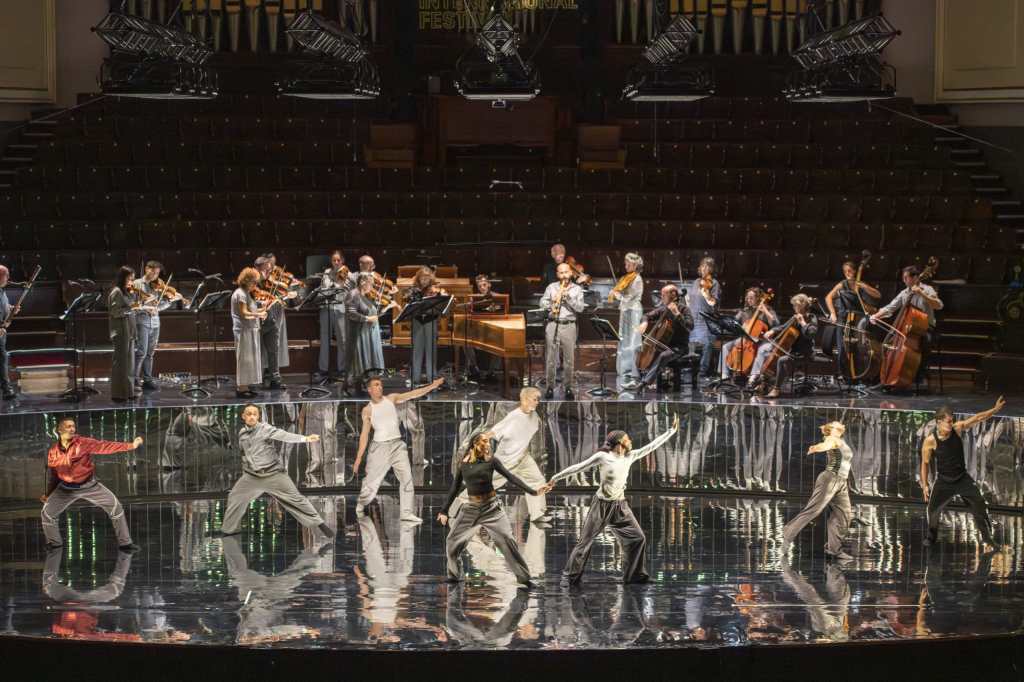
Then it was off to the bar and a chance to catch up with more OAE regulars and to be joined by Frances for the concert itself. This consisted of several of Fanny’s original months from the cycle played brilliantly by Olga Pashchenko on an 1831 Erard piano similar to an instrument Fanny would have used. We also heard the only full orchestral composition she completed – it was an era when it wasn’t seemly for women to write for orchestras – the Overture in C major. It’s a shame she didn’t do more. Conducted enthusiastically by Natalia Ponomarchuk, the overture moved from haunting horn figures through strings and wind sections with strong melodies and frequent lively arpeggios that showed a mastery of composing for an orchestra. The three pieces by Electra (March), Errolyn (April) – as it happens their own birth months too – and Freya (After June) followed. The subtleties and reflexions of Fanny’s work became more apparent on this second hearing and I hope they’ll get many more outings which all three fully deserve. The second half of the programme started with Olga playing the summer months and then four principals from the OAE played a romanze from Fanny’s String Quartet in E flat major which again showed what an underrated, supressed compser she was. The word is that she was a far superior pianist than her younger brother Felix but wasn’t allowed to perform. The finale was Roxanna Panufnik’s piece Postlude inspired by the thirteenth section which Fanny had added to the year. It had witty echoes of Fanny’s own work and a rhythmic pulse which drove it along. There were minimalist passages and areas that fully exploited the orchestra’s capabilities – I really enjoyed it. Natalia Ponomarchuk brought both enthusiasm and precision to the whole concert.

Olga Paschenko and Natalia Ponomarchuk take a bow with the Orchestra of the Age of Enlightenment.

After a feast of music old and new it was time on to theatre new and slightly older. Monday was The Habits at Hampstead Theatre downstairs. It’s a first play by award-winning director Max Bradfield. It is set in a boardgame café in Bromley – very close to home! The action unfolds through a (to me) baffling game of Dungeons and Dragons (my son and grandson both play) and through the moments out of D&D character we learn of the participants’ real lives encompassing ambition, grief, addiction, fecklessness and perhaps love. It’s brilliantly acted with switches in and out of role done most skilfully and there are lots of laughs and some fabulous dressing up for the finale.

Ruby Stokes as Jess with her dragon in The Habits at Hampstead.

Across town to the Orange Tree in Richmond on Tuesday to revel in April de Angelis’s Playhouse Creatures. Written in 1993 and set in the 1660s when theatres were just opening up again after the Cromwell interregnum had closed down all forms of pleasure. It’s a period I was familiar with having done lots of research for a series of blogs and a script I wrote for Clive Myrie to present at the OAE’s concert of Restoration Music in 2021 when theatres and concert halls here were just opening again after the Covid lockdowns. In London theatre in 1660 there was a real sensation – women were allowed to appear on stage and took to it with gusto if Ms de Angelis is to be believed.

Some of the girl power here could have benefitted poor Fanny Mendelssohn a couple of centuries later. Funny, informative about acting craft in the Restoration period and with insights into the struggle for fair pay, the roles of women in those times both on and off stage, the play gives us plenty to think about that resonate in these uncertain times for actors and musicians as theatres try to recover from the lockdowns. It’s bawdy and brash and gives you plenty of belly laughs with a few winces of agonised reality thrown in.

The cast led by Anna Chancellor as Mrs Betterton – wife of theatre owner Thomas – are all excellent bringing depth to the on and off-stage characters they portray: Katherine Kingsley as sweary men-baiting Mrs Marshall; Dona Croll as Doll Common the drudge with attitude; Nicole Sawyerr pained at being supplanted as the King’s mistress by the younger version in the form of Nell Gwyn played with increasing assurance by Zoe Brough (that’s the character not Zoe’s performance).

Wednesday evening saw me again as a music groupie but also a grandad. Grandson Jake was playing his cello in the Royal Holloway Symphony Orchestra in a programme that included Felix Mendelssohn’s Hebrides Overture, Holst’s Planets Suite and the Trombone Concerto by Dani Howard who I’ve been honoured to call a friend and whose music in the Casa Battló in Barcelona I wrote about a few years back. I also attended the London premiere of the Trombone Concerto at the Barbican so was interested to hear how it sounded here. I had picked up my son-in-law (daughter at work sadly) and driven into a full, low, thoroughly disconcerting, huge red setting sun through Surrey lanes towards the M25 which was relatively free-flowing and we arrived at the magnificent Royal Holloway in time to grab a sandwich in the well-appointed campus shop. I remembered making a promotional recruitment video for RHU back in the 80s when I did a whole slew of such videos for KIng’s College London, Guy’s and St Thomas’s Medical and Dental Schools, Imperial College, Felsted and Harrow Schools. The Royal Holloway shoot was special as we had access to a helicopter to fly over the campus for the money shots – and also for the estates director to see close up footage of any necessary roof repairs!

Who ever designed the auditorium clearly never expected 100 performers to be occupyingo the stage. People in the front row seats were in danger of injury during the longer slide extensions of the solo trombone. What was wonderful was to see so many young people being encouraged with whoops and whistles from their mates to entertain us with a programme of classical music. The players responded well. The Mendelssohn was a bit shaky to start but soon found its stride. Dani Howard’s trombone concerto was given an excellent reading under orchestral music director of the university Rebecca Miller with Amelia Lewis in fine command of the complex trombone parts.

Amelia Lewis, Rebecca Miller and about half the orchestra at Royal Holloway Windsor Auditorium.

After the interval the orchestra played Gustav Holst’s The Planets Suite and Chris and I – as well as being impressed by the massive forces deployed – reckoned that we very rarely heard all seven planets played together. The line-up included lesser-spotted bass versions of flute, oboe, clarinet and trombone and impressive percussion arrays. There was enthusiasm, energy and considerable musicality in the performance and it gladdens the heart to hear music of such quality from a youthful university orchestra at a time when university finances are so threatened.

After a debrief with Jake and some of the other players we managed to negotiate the insane Junction 13 from the A30 onto the M25 and the never-ending roadworks at Junction 10 and made it back home in reasonable time despite several overheads warning us of “Workforce in the Carriageway”. We saw few.

Carry On Culture

After my slightly odd Valentine’s weekend I plunged into a fortnight of amazing cultural activity. Keeping on keeping on will, I hope, hold dementia at bay. Another life motto has always been ‘Do it while you can’. I don’t usually write about this stuff but the blog is partly for me to reminisce with when I can get out anymore. So ignore if you just like my travels not my opinions.

So here’s how it all kept coming. Monday 17 February East is South at Hampstead Theatre courtesy of Frances’ patronage. Company, canapes, networking first class play not so much. It was a semi sci-fi thriller/Line of Duty style interrogation about data leaks from a world changing computer programme Logos. Written by Beau Willimon the creator of the US version of House of Cards, its subject matter was highly apposite with the march of AI. However it sometimes felt as if the script had been written by AI with strange diatribes, a virtually unused character and rather cliched and confusing flashbacks.

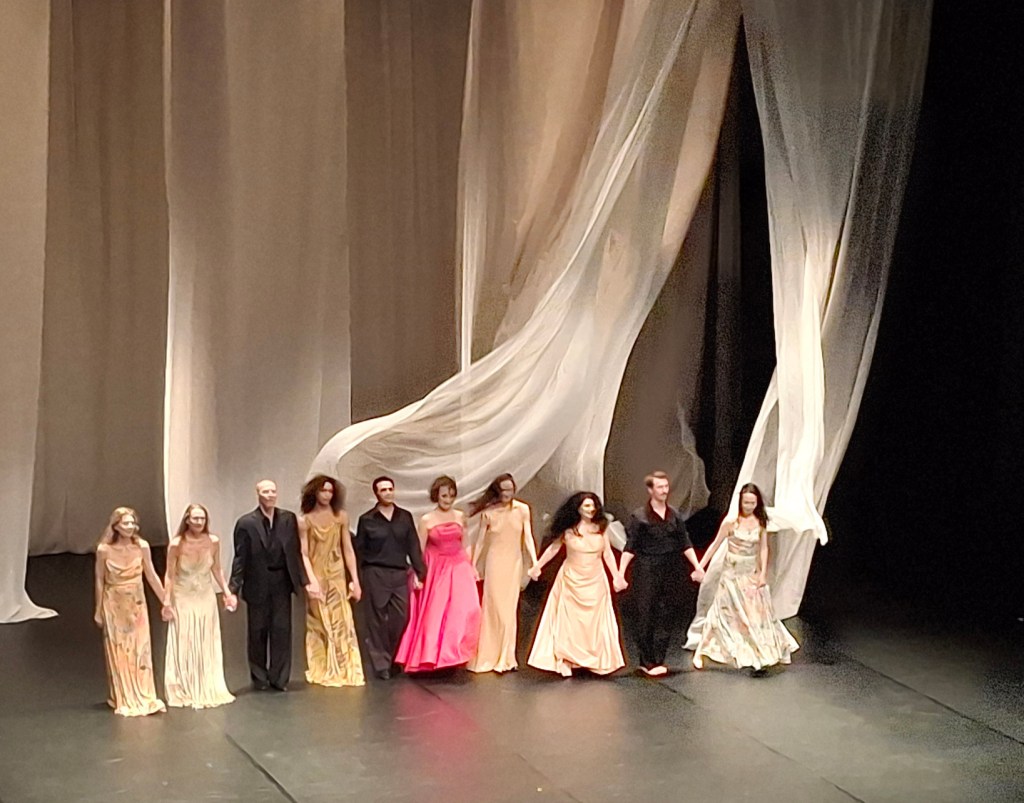
The next night made up for any disappointment. Following my previous exploration of Sadler’s Wells East Tuesday saw me heading for the Rosebery Avenue Sadler’s for Pina Bausch’s Vollmond. Need Es to lift your spirits? Well they were here aplenty! Entertaining, exquisite, energetic, enthralling. It was one of the last things Bausch choreographed and it a lot lighter in mood than some of her work.

We had dancers flirting, arguing, courting and conversing often soaked in torrential water flowing from the flies. I got talking in the interval to a couple of professional classical musicians – she harpist, he oboe – which was an interesting precursor to Wednesday. We all absolutely loved the performance and my only regret was that two friends who would have loved it couldn’t be with me.

Wednesday evening saw me accompanied by local resident Frances to the launch of the 2025-26 season of the Orchestra of the Age of Enlightenment of which I’ve been a long-time supporter and occasional contributor of blogs, scripts and articles. It was help in the wonderful brutalist hexagonal hall of their home Acland Burghley School in Tufnell Park. Alongside the exciting reveal of Fantastic Symphonies to be played between October and March at the Southbank Centre and on tour, we were treated to a recital by the mezzo-soprano Helen Charlston accompanied on the harpsichord by Satako Doi-Luck. Helen benefitted from the OAE’s rising stars scheme and now has a stellar recital career covering baroque, classical and contemporary repertoire. However she will find it hard to stop being asked about singing Dido’s Lament backwards in an OAE video. Satako is part of Ensemble Moliere that specialises in exploring the world of Baroque music. I’ve been to a couple of their concerts too. But the plans for celebrating OAE’s 40th anniversary are exciting with the return of early supporter Sir Simon Rattle who contributed a splendid video interview to the evening, alongside many other familiar figures in OAE history. Check out the programme here and let me know if you fancy joining me to hear this fantastic group of players and lovely people.

I stayed home on Thursday and on Friday joined my friend Opu Islam at the launch of an exciting heritage project in the Bengali community in the East End. It’s an initiative from the Season of Bangla Drama to which the British Bilingual Poetry Collective (of which I am a gtrustee) contributes each year. There were discussions with producers and poetry recitals as well. It’ll be interesting to see the outcome in the 2026 festival.

What a treat on Saturday with Celia Imrie and Tamsin Greig both on stage at the Donmar Warehouse in Backstroke! Two superb actors trading mother daughter love and insults in equal measure in a fascinating if slightly baggy play. It made me wonder if writers are always the best people to direct their own work. Still a hugely enjoyable evening.

I woke on Sunday at 10:15 after finally falling asleep at six after a horrendous night with acute toothache. This was too late for me to get to Watford to see our arch rivals Luton beaten 2-0 some revenge for our defeat in the reverse fixture. It was on the telly and the house was filled with shouting best left on the terraces.

I’d arranged to visit a friend Nuala O’Sullivan on Monday afternoon before going to join Frances at the Orange Tree in Richmond. Nuala was a BBC World Service colleague back in 2009 and then co-wrote on of my ELT series with me in 2014-15, She has subsequently founded and runs the highly successful Women Over Fifty Film Festival so it was great to talk film, literature and life with her. Walthamstow to Richmond is not the most straightforward journey but I’m glad I made it. Frances had been invited to a special staging of the play in the hope (successful) of luring her back as a patron. At a reception we had an opportunity to talk with Tom Littler the artistic director of the Orange and also the director of the play we were about to see. Both very impressive.

I’ve long been a fan of Howard Brenton from the controversy over The Romans in Britain back in 1980, through plays like Pravda at the National, The Arrest of Ai Wei Wei and Drawing the Line at Hampstead. This new work Churchill in Moscow in which two would-be world leaders slugged it out in negotiations could not be more timely. Dramatically it was frightening, funny and fascinating with wonderful supporting roles for the two interpreters who put their own palliative gloss on what Churchill and Stalin were saying to each other. In the compact space of the Orange Tree you really felt part of the action.

The rest of the week was calmer just on Thursday a pre-concert talk about and an electrifying performance of the Beethoven Violin Concerto with Vilde Frang and the Eroica Symphony in which Maxim  Emelyanychev conducted the OAE in a rousing performance with no residual hint of Napoleon.  

Then there was a trip to Watford as part of a consulting group helping plan the move of the Watford Museum from the old site in what was Benskin’s Brewery into the Town Hall later this year. Lots of interesting ideas with fellow supporters and friends. I also foolishly decided to have an occasional away-day trip to our game at Stoke on Saturday which proved beyond all doubt that we go for the people not the football – excruciatingly dull match – adjudged a bore draw by colleague Frances in her blog, but great beer and conversation.

And the next week was pretty similar …